
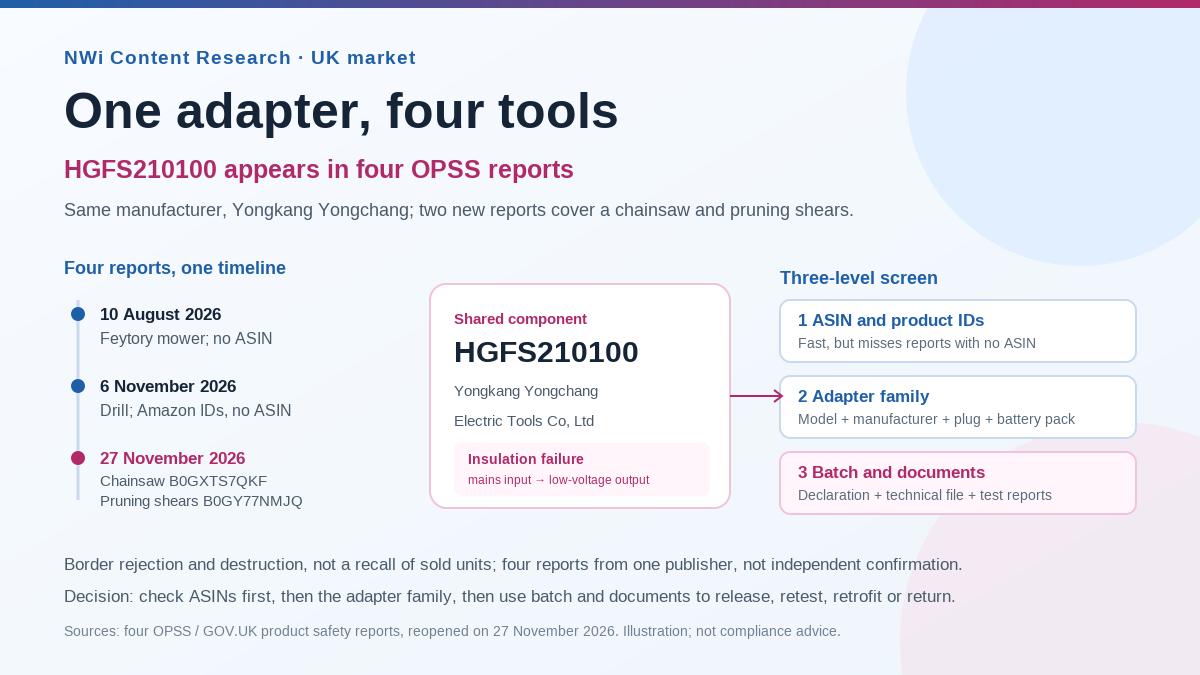
If you sell or import mains-powered tools in the UK that use the HGFS210100 adapter, the decision is not whether OPSS published another report. It is whether the next consignment should be checked only against the two new ASINs, or whether every SKU sharing the adapter should be quarantined, documented, retested or fitted with a different adapter. OPSS published two reports on 27 November 2026 that name the same manufacturer, the same adapter model and the same insulation failure; earlier reports on 6 November 2026 and 10 August 2026 add two more products to the same adapter family. The answer is not a blanket recall. It is a three-level screen: ASIN for known listings, adapter model and manufacturer for family exposure, then batch and conformity documents for the release decision.
What changed on 27 November: two reports, two ASINs, one adapter
OPSS published two product safety reports on 27 November 2026. One covers a cordless chainsaw; the other covers electric pruning shears. Both rate the risk as serious, both record the measure as import rejected at the border and destruction of the product, and both name adapter model HGFS210100. The chainsaw report is PSD 2610-0250 and lists SKU FG0004109327E and Amazon ASIN B0GXTS7QKF. The pruning shears report is PSD 2610-0253 and lists product identifier FG0004320962E and Amazon ASIN B0GY77NMJQ.
The hazard wording is nearly identical. The adapter did not meet the insulation requirements between its mains input and low-voltage output circuits. Insulation breakdown could transfer mains voltage to the output connector or connected equipment and cause electric shock. Both reports also say the declaration of conformity and technical documentation could not be linked back to the machinery, and that warnings, markings and instructions needed improvement. The chainsaw report cites the Supply of Machinery (Safety) Regulations 2008. The pruning shears report cites that regulation and the Electrical Equipment (Safety) Regulations 2016.
Two earlier reports complete the family. The cordless drill report 2610-0235, published on 6 November 2026, lists adapter HGFS210100, battery pack YC01 and two Amazon product identifiers, X001XXUPER and FBA15M1MHGNLU000034. It has no ASIN field. Its hazard includes insulation breakdown during electric strength testing and a plug that does not meet the dimensional requirements of BS 1363. The Feytory rechargeable grass mower report 2608-0052, published on 10 August 2026, also lists HGFS210100. It says the charger failed electrical strength testing, that a valid declaration of conformity and technical documentation were not supplied, and that the import was rejected and destroyed. The summary says the mower was sold via Amazon; the corrective action says the listing was removed by AliExpress.
| Report date | Product | PSD number | Identifiers | Adapter | Regulations cited | Measure |
|---|---|---|---|---|---|---|
| 10 August 2026 | Feytory rechargeable grass mower | 2608-0052 | Brand Feytory; no ASIN | HGFS210100 | Supply of Machinery (Safety) Regulations 2008; Electrical Equipment (Safety) Regulations 2016 | Border rejection and destruction; AliExpress removed the listing |
| 6 November 2026 | Cordless drill | 2610-0235 | X001XXUPER; FBA15M1MHGNLU000034; no ASIN | HGFS210100 | Electrical Equipment (Safety) Regulations 2016; Plugs and Sockets etc. (Safety) Regulations 1994 | Border rejection and destruction |
| 27 November 2026 | Cordless chainsaw | 2610-0250 | SKU FG0004109327E; ASIN B0GXTS7QKF | HGFS210100 | Supply of Machinery (Safety) Regulations 2008 | Border rejection and destruction |
| 27 November 2026 | Electric pruning shears | 2610-0253 | Product identifier FG0004320962E; ASIN B0GY77NMJQ | HGFS210100 | Supply of Machinery (Safety) Regulations 2008; Electrical Equipment (Safety) Regulations 2016 | Border rejection and destruction |
The table supports a narrow finding: four OPSS reports name the same manufacturer, Yongkang Yongchang Electric Tools Co, Ltd, and the same adapter model, HGFS210100. It does not establish sales volume, shipment size, importer identity, defect rate, test standard or a recall of units already sold. The measure in all four reports is border rejection and destruction, not a recall.
One nearby report should not be merged into the family. The EmdTOOL cordless drill report 2603-0013, published on 11 March 2026, names the same manufacturer but a different charger model, TZ-C03AE. It lists ASIN B0DGG9JCLH and battery YC01, and its measures include border rejection, destruction and removal of the listing by Amazon. It is a reminder that one manufacturer can have several charger families.
Mechanism: how one adapter model carries risk across product lines
The adapter converts mains input to a low-voltage output. If the insulation between the two circuits breaks down, mains voltage can appear at the output connector and cause electric shock. The failure mode is not tied to whether the end product is a chainsaw, pruning shears, drill or mower. If those products share the same power-supply design and insulation structure, the risk can travel across product lines.
The second mechanism is the document chain. The reports do not only describe an electrical test failure; they also say the declaration of conformity and technical documentation could not be linked back to the specific machinery. For an importer, that means a sample can pass an electrical test and the consignment can still be stopped if the technical file does not match the model or batch. Electrical non-compliance and documentary non-compliance are separate problems; one test report does not solve both.
The third mechanism is the plug. The 6 November drill report separately says the plug does not meet the dimensional requirements of BS 1363 and cannot make a secure connection with the socket, which could lead to overheating and fire. That is a different failure mode from insulation breakdown, but it points to the same component family: the power adapter and plug.
Why an ASIN screen is not enough: an ASIN identifies a listing, not a component. The 6 November drill report has no ASIN, only Amazon product identifiers. The 10 August mower report identifies the product by brand and adapter model. The same adapter can appear in products sold under different brands and in different categories. Screening only the two new ASINs misses the no-ASIN report and any SKU that uses the same adapter but is not named in a report.
The counter-case belongs up front. The same model number does not prove that every unit is defective. A different production batch, adapter revision, supplier or traceable conformity file can change the conclusion. HGFS210100 is a trigger for verification, not a finding of non-compliance. All four reports come from one regulator, OPSS; they show a repeated component signal but do not establish a defect rate, sales volume or a recall of sold units. They are four different reports from one publisher, not four independent confirmations.
A three-level screen: ASIN, adapter family, batch and documents
The real decision is whether the next consignment should be checked only against the two new ASINs, or whether every SKU using HGFS210100 should be quarantined, documented, retested or fitted with a different adapter. A three-level screen keeps the decision proportionate: any level can stop a release until the evidence is complete.
Level one, ASIN and product identifiers. Match B0GXTS7QKF and B0GY77NMJQ first, then the older identifiers X001XXUPER, FBA15M1MHGNLU000034 and the Feytory brand. An ASIN quickly locates a known listing, but it is not a component identifier. If you stop at this level, you miss the 6 November drill report, which has no ASIN.
Level two, the adapter family. Put adapter model HGFS210100, manufacturer Yongkang Yongchang Electric Tools Co, Ltd, plug type, battery pack model YC01, product category and supplier name into one component table. Ask the factory or supplier for the bill of materials, adapter label photos, batch records and change history. Pay particular attention to private labels and different brand names: the same adapter can sit inside products sold under different brands, so the ASIN and brand change while the component model may not.
Level three, batch and documents. Match purchase orders, invoices, packing lists, batch or date codes, declarations of conformity, technical files, test reports and importer details item by item. GOV.UK guidance for the Electrical Equipment (Safety) Regulations 2016 states that importers must check that manufacturers have carried out the right conformity assessment procedures and must include the importer's name and address on the equipment, packaging or accompanying documents; manufacturers must keep technical documentation and the declaration of conformity and make them available to the market surveillance authority. If the file cannot be tied to the model and batch, hold the stock; do not release a whole consignment on one sample test report.
A practical order: if the ASIN matches and the adapter is the same, quarantine first; if the adapter matches but the ASIN does not, check the batch file and sample-test; if the adapter or manufacturer is different, record the basis and follow the normal compliance process; if the file cannot be linked, hold the stock; if the test fails, treat the batch as non-conforming and trace it. This order does not replace laboratory testing or legal advice, but it closes the two-ASIN blind spot.
Observation fields: the adapter label's model, manufacturer, plug type, batch or date code; battery pack model; ASIN, GTIN or product identifier; carton markings; the version of the declaration of conformity and technical file; test report number and test date; importer name and address; supplier change notices; customer returns and reviews that mention shock, heat, a loose plug or a burning smell; and the current status of the Amazon UK listing.
When to act: before the next shipment leaves; before relisting; when a new OPSS report matches any component field; when a customer complaint matches the reported hazard; or when the supplier cannot produce a traceable conformity file. Stop conditions: the specific batch is shown to use a different adapter model or manufacturer, with a traceable declaration of conformity and test evidence; the supplier accepts a return or replacement at a cost below the risk of continuing to sell; or the regulator takes a recall, delisting or other product-specific measure. Only then consider lifting the quarantine or ending the remediation.
The economics: test, retrofit or return
The three scenarios below are assumptions, not OPSS, NWi or seller measurements. They are in pounds sterling and exclude freight, VAT, destruction fees, penalties, lost sales, refunds and customer compensation. Replace the landed cost, contribution, batch and supplier terms with your own.
Scenario A: test only the two new ASINs and review their files
Assume the two new ASINs total 1,200 units at GBP 22 landed each, and testing plus file review costs GBP 650.
The consignment value is GBP 26,400; the break-even rejection probability is 650 divided by 26,400, or 2.46%; at a 10% rejection probability the expected loss is GBP 2,640 and the net benefit after the test fee is GBP 1,990.
If the same container also holds a no-ASIN SKU that uses the same adapter, assume 300 units at GBP 22 landed and a 10% rejection probability. Its expected loss is GBP 660, already more than the GBP 650 test budget. An ASIN-only check can save the test fee and still miss the one SKU that costs more.
Decision: If you confirm there are only two new ASINs and no other SKU uses the same adapter, ASIN-level testing can be a low-cost starting point; if no-ASIN or private-label SKUs exist, move to the component screen.
Scenario B: retrofit all 4,000 units
Assume 4,000 units in a UK warehouse, a GBP 4.10 adapter and GBP 0.35 relabel per unit, GBP 800 for batch retesting, and GBP 36,000 of contribution.
The adapter and relabel cost is 4.10 plus 0.35, or GBP 4.45 per unit; 4,000 units cost GBP 17,800, plus GBP 800 for retesting, for a total of GBP 18,600, or GBP 4.65 per unit; 18,600 divided by 36,000 is 51.7% of contribution.
If only 10% of the units are affected, the expected loss is 36,000 times 10%, or GBP 3,600; a full retrofit costs GBP 18,600, which is GBP 15,000 more than that expected loss. Batch quarantine and testing is cheaper when it costs less than that GBP 15,000 difference. A full retrofit makes more sense only if the probability that the whole consignment is rejected or unsellable is above 51.7%, or if the supplier cannot segregate batches.
Decision: Ask the supplier to segregate by batch and provide adapter change records first; if only some batches use the problem adapter, test or retrofit by batch; consider a full retrofit or return only if the supplier cannot segregate and the whole-consignment rejection probability is high.
Scenario C: release on a 30-unit sample
Assume 30 units are tested for electric strength and the true defect rate is 5%.
The probability that all 30 units pass is 0.95 to the power of 30, or about 21.5%; even at a 5% defect rate, there is about a 78.5% chance of at least one failure. With zero failures, the rough 95% upper bound is 3 divided by 30, or 10%, so a 10% defect rate is not excluded.
Decision: A zero-failure 30-unit sample cannot release the batch; it can only rank which batch to test first; release requires a larger sample, batch segregation evidence or supplier batch-test reports.
| Scenario | Key assumptions | Calculation | Result | Decision meaning |
|---|---|---|---|---|
| A: ASIN-level testing | 1,200 units at GBP 22; test cost GBP 650 | 650 ÷ 26,400 | Break-even 2.46%; at 10% rejection, net benefit GBP 1,990 | Only if no other SKU uses the same adapter |
| B: full retrofit | 4,000 units; adapter 4.10 + relabel 0.35; retest 800; contribution 36,000 | (4.10 + 0.35) × 4,000 + 800; 18,600 ÷ 36,000 | GBP 18,600; 51.7% of contribution; GBP 4.65 per unit | Only if whole-consignment rejection probability is above 51.7% or batches cannot be segregated |
| C: 30-unit sample | 30 units; assumed 5% defect rate | 0.95^30; 3 ÷ 30 | 21.5% chance of zero failures; about 10% upper bound | Cannot release alone; use only to rank batches |
Sensitivity: if the test fee doubles from GBP 650 to GBP 1,300, Scenario A's break-even rejection probability rises from 2.46% to 4.92%; if the landed cost falls from GBP 22 to GBP 20, the break-even rises from 2.46% to 2.71%; if the full retrofit falls from GBP 18,600 to GBP 12,000, Scenario B's share of contribution falls from 51.7% to 33.3%. These changes move the thresholds, not the order of the decision.
Scenario A's break-even rejection probability is 650 divided by 26,400, or 2.46%; Scenario B's retrofit cost of GBP 18,600 is 51.7% of the GBP 36,000 contribution. Read together, ASIN-level testing is a low-cost screen and a full retrofit is a high-cost backstop; the middle path is batch quarantine and testing.
Counter-cases and alternative explanations: when not to check everything
Counter-case one: a different adapter batch. The supplier can provide change records showing that a batch uses a different version or a different manufacturer's adapter, with a traceable declaration of conformity and test report. That batch can be removed from the HGFS210100 family, but the component model, batch and file linkage should still be recorded.
Counter-case two: the seller is not the importer. The UK importer obligation may sit with another entity; the seller should confirm the contract, invoice and customs party rather than assume all responsibility. This is not legal advice; take professional advice on the specific facts.
Counter-case three: the product is not on the UK market. The OPSS report concerns the UK market; the same adapter in another market may be handled by a different regulator, and the UK border measure should not be applied to every site.
Counter-case four: treating the 10 August mower report as an Amazon UK enforcement signal. The summary says the mower was sold via Amazon; the corrective action says the listing was removed by AliExpress. The channel field is inconsistent, so it cannot support an inference about Amazon UK listing status or enforcement.
Alternative explanation: a test failure may come from a specific batch, a specific adapter revision or transport damage, not necessarily a design defect across the whole model; a passing test may simply have missed a defect in the sample. The four reports do not give a defect rate, test standard or sampling method, so this article supports a component-family screen, not a blanket recall or a blanket all-clear.
Action list and stop conditions
Step one, freeze the scope: list every SKU purchased or imported in the past 12 months that uses the HGFS210100 adapter, including private labels, different brand names and products without an ASIN. Step two, build a component table: adapter model, manufacturer, plug type, battery pack model, batch, supplier, ASIN or GTIN, and carton markings. Step three, request files: declaration of conformity, technical file, test reports, change records and importer details. Step four, quarantine: put matching stock on quality hold before labeling or shipping. Step five, test: sample or test by batch, with a test plan set by a qualified laboratory under the applicable regulations. Step six, decide: release, retrofit, return or destroy, batch by batch and evidence by evidence. Step seven, monitor: add new OPSS reports, customer complaints, returns and supplier change notices to a monthly review.
Screen known listings by ASIN first, then map family exposure by adapter model and manufacturer, then use batch and conformity documents to decide release, retest, retrofit or return. The point is not to check as much as possible; each level needs a clear evidence threshold and stop condition.
Review frequency: check weekly while goods are in transit or a new batch is arriving; check OPSS reports and supplier change notices monthly when there is no new batch. Escalate to a full quarantine when a new report matches the same adapter, a customer complaint matches the hazard, or the supplier cannot provide the file.
Stop conditions: the specific batch is shown to use a different adapter model or manufacturer, with a traceable declaration of conformity and test evidence; the supplier accepts a return or replacement at a cost below the risk of continuing to sell; the regulator takes a recall, delisting or other product-specific measure; or testing and file review show that the batch meets the applicable requirements. Only one of these conditions lifts the quarantine; do not release on a passing sample or a supplier's assurance alone.
Limitations and unknowns
This article has no sales volume, shipment size, importer identity, defect rate, test standard or recall data, and it did not verify the current Amazon UK listing status. All four reports come from one regulator, OPSS; they are different reports from one publisher, not independent third-party confirmation; they prove the products, models, hazards and measures in the reports, not a market-wide defect rate.
The 10 August mower report has an inconsistent channel field: the summary says sold via Amazon, while the corrective action says the listing was removed by AliExpress. That limits any channel inference; this article uses it only as an earlier record in the same adapter family, not as an Amazon UK enforcement sample. The 11 March EmdTOOL report uses a different charger, TZ-C03AE, and is not part of the HGFS210100 family; it is used only to show that different models should not be merged.
The landed cost, test fee, adapter price, relabeling cost, contribution, rejection probability and defect rate in the scenarios are assumptions; take actual values from purchase contracts, supplier quotes, laboratory quotes and your own sales data. This article is not legal, compliance, tax or investment advice; consult a qualified professional on importer obligations, product liability and test standards.
Product boundary: NWi CrossborderGo provides global overview, category analysis, brand and store analysis, product research and custom market analysis, which can help map affected ASINs, brands, stores and live sites. Available sites, history and fields depend on account authorization and the contract. It does not read OPSS notices and does not provide compliance certification, defect rates or recall status.
Method and disclosure
The article turns four OPSS reports from single-product news into a component-family screen and uses reproducible testing, retrofit and sampling scenarios to show when to check the whole family and when to work batch by batch.
Data basis: this research reopened and read the GOV.UK pages on 27 November 2026 for four OPSS product safety reports: the cordless chainsaw report 2610-0250 and the pruning shears report 2610-0253, both published on 27 November 2026; the cordless drill report 2610-0235, published on 6 November 2026; and the Feytory grass mower report 2608-0052, published on 10 August 2026. It also read the GOV.UK guidance for the Electrical Equipment (Safety) Regulations 2016 in Great Britain and the Supply of Machinery (Safety) Regulations 2008 in Great Britain to check importer, manufacturer, technical-file and declaration-of-conformity obligations. Report dates, PSD numbers, ASINs, product identifiers, adapter model, hazard wording, legal references and measures come from those pages. The 11 March 2026 EmdTOOL report 2603-0013 is used only to show that a different charger model, TZ-C03AE, should not be merged into the HGFS210100 family. Calculation basis: Scenario A consignment value = 1,200 × GBP 22 = GBP 26,400; break-even rejection probability = 650 ÷ 26,400 = 2.46%; net benefit at a 10% rejection probability = 0.10 × 26,400 − 650 = GBP 1,990. Scenario B retrofit cost = (4.10 + 0.35) × 4,000 + 800 = GBP 18,600; cost per unit = 18,600 ÷ 4,000 = GBP 4.65; share of contribution = 18,600 ÷ 36,000 = 51.7%. Scenario C probability of zero failures = 0.95^30 = 21.5%; the approximate 95% upper bound after zero failures is 3 ÷ 30 = 10%. Every landed cost, test fee, adapter price, relabeling cost, contribution, rejection probability and defect rate is a labeled assumption, not an OPSS, NWi or seller measurement. Product basis: NWi CrossborderGo provides global overview, category analysis, brand and store analysis, product research and custom market analysis; available sites, history and fields depend on account authorization and the contract. It does not read OPSS notices or provide compliance certification, defect rates or recall status.
This article was prepared with automated research assistance from the public sources listed at the end and has not been manually reviewed; it does not invent customer data, expert review, sales lift, ranking results or platform endorsement. It is not legal, compliance, tax or investment advice; consult a qualified professional on importer obligations, product liability, test standards and recall status.
If you need to map affected ASINs, brands, stores and live sites before deciding the quarantine scope, see the global overview, category analysis, brand and store analysis, and product research modules in [NWi CrossborderGo](/product/); available sites, history and fields depend on account authorization and the contract, and it does not read OPSS notices or provide compliance certification. To assess your own sites and data scope, [book a demo](/demo/). Teams that need to connect marketplace data to internal SKU or compliance records can review [MCP data access](/mcp/); client compatibility, fields and permissions are confirmed during onboarding.
Teams that need to turn public regulatory reports, marketplace data and internal SKU records into a research brief can review the expert research workflow in the [NWi Cross-border Agent](/page/agent.html). Its consumer and review insights cover selected brands, its product-innovation advisor focuses on beauty, and outputs still need human review; it does not replace compliance certification.
Sources: the pages below were reopened and checked on 27 November 2026.
- OPSS / GOV.UK, 'Product safety report: Cordless Chainsaw and AC/DC Adaptor (2610-0250)', 27 November 2026: gov.uk/product-safety-...
- OPSS / GOV.UK, 'Product safety report: Electric Pruning Shears and AC/DC Adaptor (2610-0253)', 27 November 2026: gov.uk/product-safety-...
- OPSS / GOV.UK, 'Product safety report: Yongkang Yongchang Electric Tools Co Ltd Cordless Drill sold via Amazon (2610-0235)', 6 November 2026: gov.uk/product-safety-...
- OPSS / GOV.UK, 'Product safety report: Feytory Rechargeable Grass Mower sold via Amazon (2608-0052)', 10 August 2026: gov.uk/product-safety-...
- OPSS / GOV.UK, 'Product safety report: EmdTOOL Cordless Drill sold via Amazon (2603-0013)', 11 March 2026: gov.uk/product-safety-...
- OPSS / GOV.UK, 'Electrical Equipment (Safety) Regulations 2016: Great Britain', last updated 27 October 2026: gov.uk/government/publ...
- OPSS / GOV.UK, 'Supply of Machinery (Safety) Regulations 2008: Great Britain', last updated 24 March 2025: gov.uk/government/publ...