
If you sell in the UK, the question after 25 November 2026 is not whether the CMA will come for you. It is which seller-controlled urgency claim to fix first before Black Friday this weekend and Cyber Monday on 30 November: a repeated 24-hour countdown discount, or a pre-ticked paid add-on, and what evidence proves the fix is right. The answer turns on two tests: whether your offer is still available at the same or a lower price the next day, and whether your add-on actually obtained the consumer's express consent. This article uses the raw numbers in the CMA's two final infringement notices to build a 31-day price-path audit and three labelled scenarios. It does not treat the two penalties as a seller tariff, and it does not count platform-controlled labels as the seller's own copy.
1. What was published on 25 November: two FINs, two penalties and one refund order
The UK Competition and Markets Authority (CMA) gave both Final Infringement Notices (FINs) on 12 October 2026, and the non-confidential versions were published on 25 November 2026. Wayfair's penalty was GBP 8,000,000 before the 40% settlement discount and GBP 4,800,000 after it; Appliances Direct's penalty was GBP 2,000,000 before the settlement discount and GBP 1,200,000 after it. Both are payable by 11 December 2026. The discount reflects admissions, an expedited procedure and an agreement not to appeal; it is not a standard discount a seller can expect.
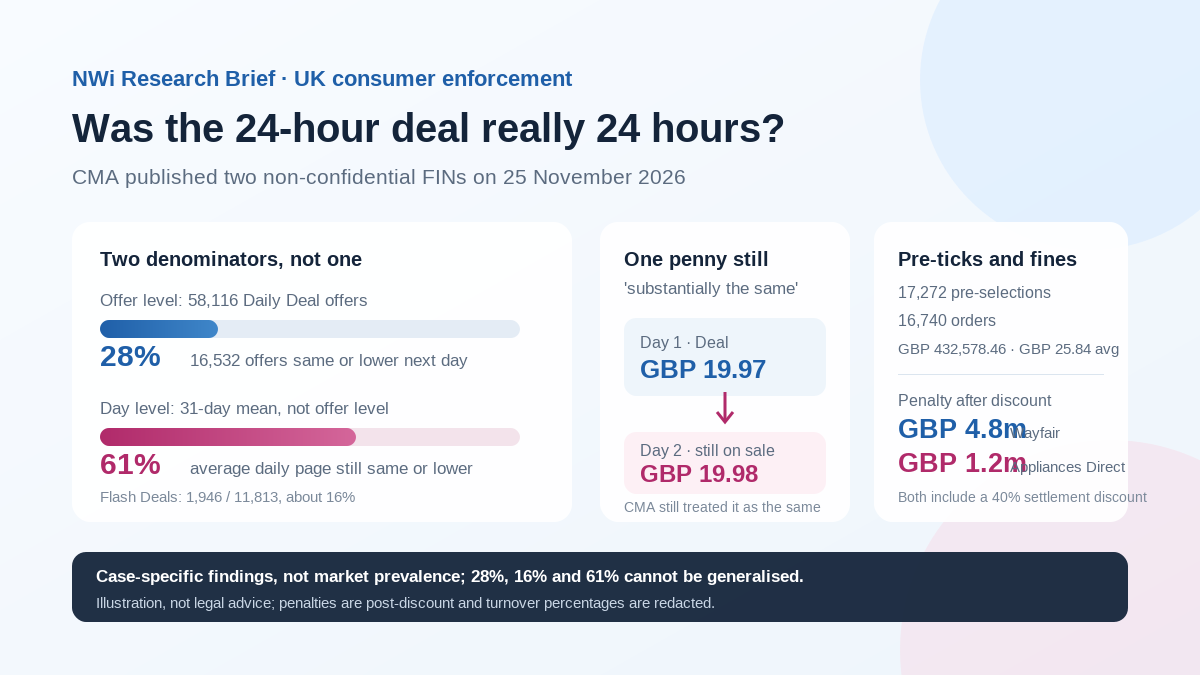
Wayfair's relevant period was 6 April 2025 to 15 June 2026. The CMA examined two 24-hour promotions, Daily Deals/Deals of the Day and Flash Deals. Daily Deal countdowns ran from 00:01 to 23:59; Flash Deal countdowns ran in hours, minutes and seconds, with homepage banners reading '24-HOUR FLASH DEALS' and 'Ends Midnight'. In the sample from 17 July to 17 August 2025, 16,532 of 58,116 product-level Daily Deal offers, or 28%, were available at the same or a lower price the next day; the mean daily share was 61%. In the dataset covering 1 June to 31 October 2025, 1,946 of 11,813 Flash Deal occurrences, or about 16%, were available at the same or a lower price the next day.
Appliances Direct's relevant period was 6 April 2025 to 17 November 2025. The CMA found that when a consumer added a relevant product to the basket, two paid services, 'Remove & Recycle Your Old Appliance' and 'Installation on Delivery', were pre-selected and added automatically; the consumer had to click 'X' or reduce the quantity to zero to remove them. The two services covered 17,272 instances across 16,740 orders, worth GBP 432,578.46 including VAT, or about GBP 25.84 per order. The CMA ordered refunds of around GBP 432,000 to affected consumers. The pre-selection stopped on 19 November 2025, after the CMA's case-opening letter.
The same business also used time-limited discount codes: HURRY25, HURRYSAVE10, HURRY20 and QUICK10, with discounts from GBP 10 to GBP 25 and timers of 2 to 12 hours. On 1 August 2025, a GBP 20 HURRY20 pop-up appeared on 1,583 product pages; 118 more followed on 15 August. For 813 products, the code and base price were identical for all 31 days of August; for 69 products, they were identical for 17 days. The codes could still be redeemed after the countdown ended. These figures come from the CMA's analysis of data supplied by Appliances Direct, not from this article's own testing.
In its 14 October 2026 press release, the CMA said the three businesses were fined GBP 6m in total; over the previous 18 months it had imposed more than GBP 12m in fines and secured nearly GBP 2.4m in refunds under its new powers. The third business, Gold's Gym, is a gym franchise, not an e-commerce seller, so the GBP 6m should not be read as an e-commerce enforcement total. The context shows enforcement intensity, not where the next case will land or which sellers it will target.
2. The legal test: why a false '24 hours' is unfair in all circumstances
The CMA tests a false time limit under DMCCA section 225(1) and Schedule 20 paragraph 7, and tests pre-ticked add-ons under regulation 40 of the 2013 Consumer Contracts Regulations; the two legal routes require different fixes. Schedule 20 lists commercial practices considered unfair in all circumstances. Paragraph 7 covers falsely stating that a product will only be available for a limited time, or only on particular terms for a limited time, in order to elicit an immediate decision and deprive consumers of sufficient opportunity or time to make an informed choice. Once the statement is false, the CMA does not need to prove that a particular consumer was actually misled.
Both cases meet the three elements of a 'relevant infringement' in DMCCA section 148: harm to the collective interests of consumers, the UK connection condition and the specified prohibition condition. Wayfair and Appliances Direct both carry on business in the UK and sell to UK consumers, so section 149 is satisfied; section 150 links the conduct to an enactment listed in Schedule 16. Wayfair is linked to section 225(1) and Schedule 20 paragraph 7; Appliances Direct's pre-tick issue is linked to regulation 40 of the Consumer Contracts Regulations 2013.
The pre-tick issue is a separate legal route. Regulation 40(1) says that, before the consumer is bound, the trader must obtain the consumer's express consent to any payment in addition to the remuneration for the main obligation. Regulation 40(2) says there is no express consent if consent is inferred from the consumer not changing a default option, such as a pre-ticked box. The CMA relied on that provision in the Appliances Direct case; it did not force pre-ticking into the false-time-limit provision. The distinction matters: countdowns and pre-ticked add-ons are different tests, and one remediation plan cannot answer both.
There is also an easily missed boundary. Paragraph 3.4 of the Wayfair FIN says the direction does not prevent an offer from being repeated at a future time, provided a reasonable period has elapsed after the stated time limit. The problem is not running promotions every day; it is saying an offer ends tonight when the same price is still available tomorrow. The FIN does not say how long a reasonable period is, and this article cannot fill that gap for the CMA.
The penalty is not a price list either. The FIN says the starting point for a substantive infringement can be up to 30% of UK turnover, but the statutory cap is GBP 300,000 or, if higher, 10% of worldwide turnover. Both cases were also reduced sharply on proportionality grounds before the settlement discount: Wayfair's Step 3 penalty was cut by about 90% to GBP 8,000,000, and Appliances Direct's combined Step 3 penalty of GBP 87,110,240 was cut by about 97.7% to GBP 2,000,000. Wayfair's Step 3 amount and turnover are redacted; Appliances Direct's Step 3 amount was about 26.83% of worldwide turnover. The 40% is a settlement discount, not a standard price for breaking the law. A seller cannot use GBP 4.8m or GBP 1.2m to infer its own penalty.
3. How the CMA measured it: 28% of offers is not 61% of the daily page
The two figures are often mixed up. The 28% divides 16,532 offers available at the same or a lower price the next day by 58,116 product-level Daily Deal offers. It answers: of all the daily offers, how many did not actually rise in price the next day? The 61% is calculated differently: for each day, the CMA took the share of that day's Daily Deal products available at the same or a lower price the next day, then took an unweighted mean across 31 days. It answers: on an average day, how much of the deal page was still at the same price the next day?
Both can be true because the same product can appear on the deal page on consecutive days. A SKU that appears every day contributes 31 observations to the offer-level denominator and also appears once in each day's share. If a small group of SKUs repeats, they enter both denominators and can push up both figures. For a seller, the offer-level rate is useful for estimating audit workload; the day-level rate is useful for estimating how much of today's page would fail a next-day check. Using only one number either understates the page exposure or overstates the number of SKUs that need changing.
'The same price' also includes 'substantially the same'. The FIN gives two examples: a product at GBP 19.97 on a Daily Deal was GBP 19.98 the next day; another at GBP 65.42 was GBP 65.44. A one-penny or two-penny increase was still treated as substantially the same. The FIN does not publish a safe threshold for how much a price must rise; this article will not invent one. What is clear is that a one-penny increase cannot prove that a time limit was genuine.
After the investigation opened, the CMA reviewed another 101 products in March and May 2026. On 19-20 March, 18 were lower and 14 were the same the next day; on 6-7 May, 15 were lower and 17 were the same. Both reviews found 32 of 101 products that did not genuinely rise in price the next day. The repeat review shows that the CMA does not rely only on historical samples; it repeats the same next-day test during an investigation. Wayfair received a 10% uplift for continuing after the case opened; Appliances Direct stopped after the case-opening letter but was still fined and ordered to refund. For a seller, 'wait for the noise to pass' is not a strategy.
4. Which UK sellers are exposed: seller copy, platform labels and pre-ticked boxes
The real decision is which seller-controlled fix comes first before Black Friday and Cyber Monday on 30 November: repeated 24-hour countdown discounts or pre-ticked paid add-ons, and what evidence proves the fix is right. The DMCCA's 'trader' includes a business selling to consumers in the UK; a cross-border seller on Amazon UK, eBay UK or TikTok Shop UK is in scope in principle when the end consumer is in the UK. But both cases were against retailers, Wayfair and Appliances Direct, not marketplace sellers; the public material does not show a CMA campaign against Amazon sellers. This article supports running the same test on your own catalogue; it does not support the claim that the CMA will investigate you next.
The seller-controlled layer is what the seller writes and configures: listing titles, bullets, A+ content and brand-store pages using 'today only', 'ends midnight', 'flash sale' or 'limited time'; coupon end times; seller-owned landing pages, subscription flows or checkouts; and, most importantly, the price path. Platform-controlled labels and timers, such as Amazon's limited-time deal badge, a deal page countdown or a platform checkout default, cannot be changed by the seller and should not be presented as if they can. The right action is to screenshot them, identify the controller and wait for the platform to change them.
Pre-tick risk depends on who controls checkout. Amazon's checkout defaults are platform-controlled, and a seller generally cannot pre-select its own paid service in a consumer's basket. But if a seller uses its own checkout, a brand-store subscription flow or a self-configured bundle or add-on that treats a default as consent, regulation 40 can apply directly. This article does not say Amazon checkout has pre-ticked add-ons, and it does not treat a platform-controlled deal badge as the seller's false statement.
Three groups are most exposed. First, sellers with many SKUs, daily deals and a single countdown template. Second, high-ticket categories such as furniture, appliances and beauty, where paid add-ons are common. Third, sellers that put 'limited time' into images, A+ content or a brand store but cannot produce a 31-day price record. Conversely, a wholesale-only seller that does not sell to UK consumers is outside the core consumer definition, though that does not excuse it from platform rules or contractual obligations.
5. The arithmetic: a 31-day price audit, pre-tick refund exposure and a pre-Cyber-Monday order
The three scenarios below are hypothetical, not CMA, NWi or seller measurements. The currency is pounds sterling; they count only the items listed and exclude VAT, platform commission, advertising, returns, exchange rates, legal fees and demand effects. Every rate, order count, price point, contribution rate and hour estimate is a labelled assumption.
Scenario A: 100 SKUs over 31 days, two denominators
Assume 100 SKUs on a 24-hour deal page every day for 31 days, or 3,100 SKU-days; 28% and 61% are illustrative planning rates from the CMA sample, not the seller's own data.
At 28% there are 868 suspected offers; at 61% an average of 61 SKUs a day remain at the same or a lower price; the full audit takes 6,200 minutes, the top 20 1,240 minutes and the top 10 620 minutes.
If the top 20 SKUs cover about 60% of suspected offers, fix those 20 first; complete at least the top 10 before Black Friday, move the rest to the first week of December, and do not schedule the full catalogue.
The 3,100 SKU-days produce 868 suspected offers at 28%, and 61 SKUs a day at 61%; the two figures use different denominators and cannot replace each other. At two minutes per SKU-day, the full audit is 6,200 minutes, or 103.3 hours; the top 20 is 1,240 minutes, or 20.7 hours; the top 10 is 620 minutes, or 10.3 hours. Two people working 5.2 hours each can finish the top 10 within one working day; the top 20 takes about 1.3 working days at eight hours each. The hour estimate excludes data export, operations sign-off, asset changes and a second review.
Scenario B: 500 orders a month with a GBP 25 pre-ticked add-on
Assume 500 orders a month include a pre-ticked GBP 25 add-on, close to Appliances Direct's GBP 25.84 average; assume a 50% contribution margin and refunds at the full amount.
Current monthly revenue is GBP 12,500 and contribution GBP 6,250; with explicit opt-in and 40% still choosing, contribution falls to GBP 2,500, a GBP 3,750 loss; full refund exposure is GBP 12,500 a month, 3.3 times the contribution loss.
If the seller controls the checkout default, remove the pre-tick first; keeping it is better on contribution only when refund or penalty exposure is below GBP 3,750 a month.
The arithmetic: current monthly revenue = 500 x GBP 25 = GBP 12,500; monthly contribution = GBP 12,500 x 50% = GBP 6,250; after explicit opt-in, assume 40% still choose, or 200 orders, so monthly contribution = 200 x GBP 25 x 50% = GBP 2,500; contribution loss = GBP 6,250 - GBP 2,500 = GBP 3,750. Dividing GBP 3,750 by GBP 12,500 gives 30%: once refund or penalty exposure exceeds GBP 3,750 a month, explicit opt-in is better than keeping the pre-tick. In the full-refund scenario the exposure is GBP 12,500, well above GBP 3,750. The Appliances Direct case supports using the full overcharge rather than a complaint rate: the CMA ordered refunds of around GBP 432,000 against total charges of GBP 432,578.46, not only refunds to customers who complained.
Scenario C: an 8-hour checkout fix or a 10-SKU audit before Black Friday
Assume the pre-tick fix takes 8 hours and the top-10 price-path audit takes 10.3 hours, or 18.3 hours in total; two people work 8 hours each.
18.3 person-hours is about 1.1 working days; with one person it takes about 2.3 working days, missing Cyber Monday on 30 November but finishing in the first week of December.
Because the pre-tick exposure is quantifiable and the fix is shorter, do the 8-hour checkout fix first, then audit the top 10 SKUs; sellers who do not control checkout should put all 18.3 hours into the price audit.
This order is not legal advice; it is a triage based on three questions: is the exposure quantifiable, is the fix controllable, and can it be finished before the deadline? The pre-tick refund exposure can be calculated directly. The conversion effect of removing a countdown has no public data, so it has to be ranked by the certainty of the price path. When both cannot be finished, do the one that directly removes a full-refund exposure first.
| Scenario | Key assumptions | Result | Decision |
|---|---|---|---|
| A Price path | 100 SKUs x 31 days = 3,100 SKU-days; 28%/61% are illustrative rates | 868 suspected offers; 61 SKUs a day; full audit 103.3 hours, top 20 20.7 hours | Fix the top 20; finish the top 10 before Black Friday |
| B Pre-tick | 500 orders/month; GBP 25 add-on; 50% contribution; 40% opt-in | Contribution GBP 6,250 to GBP 2,500; loss GBP 3,750; refund exposure GBP 12,500/month | If checkout is controlled, fix the pre-tick first |
| C Order | 8-hour checkout fix + 10.3-hour top-10 audit | 18.3 person-hours, about 1.1 working days for two people; 2.3 days for one | Fix the pre-tick, then audit the top 10 |
6. Counter-cases: when not to change
If the price genuinely rises the next day, or the product is no longer available at the same or a lower price, the 'ends tonight' statement may be true. Paragraph 3.4 of the FIN also allows the same offer to be repeated in the future after a reasonable period. The CMA's 28% finding at Wayfair does not make every deal in every catalogue false.
Counter-case two: platform-controlled labels. Amazon's limited-time deal badge, deal-page countdown and checkout defaults are controlled by the platform; the seller cannot change them and should not be blamed for them. The right action is to document who controls the element, keep a screenshot and, if needed, ask the platform; do not claim a platform label as your own remediation.
Counter-case three: the seller's own rate may be far below 28%. The 28% is Wayfair's offer-level rate in a specific sample, and the 16% is the Flash Deal rate in a specific dataset; neither is a market prevalence nor an Amazon seller average. A seller should calculate its own 31-day rate before changing anything; changing without data can remove promotions that are genuinely effective.
Counter-case four: pre-tick may not apply. Amazon checkout is platform-controlled; a B2B-only seller that does not sell to UK consumers is outside the core scope of the Consumer Contracts Regulations. If consumers genuinely choose an add-on, keep it; the problem is default consent, not charging for a service.
Counter-case five: the penalties cannot be reverse-engineered. GBP 4.8m and GBP 1.2m are post-discount figures, and both cases were also reduced on proportionality grounds by about 90% and about 97.7% before the discount; Wayfair's turnover percentage is redacted. Using these figures to calculate 'my fine' produces a conclusion without a basis.
7. Action list and observation fields
Export 31 days of price paths, rank by repeat days multiplied by GMV, audit at least the top 10 SKUs before Black Friday, and fix seller-controlled pre-ticked checkout first. Start with each SKU's daily price, discount code, countdown start and end, coupon end time, strike-through price, bundle price and add-on default state. If 31 days are not available, start with 14, but 14 days will miss a weekly repeat pattern.
Second, calculate the next-day price. Compare each SKU's next-day price with its deal price and mark it as the same, one or two pence higher, lower or higher. For SKUs marked the same or substantially the same, count repeat days and rank by repeat days multiplied by GMV. Do not mark a one-penny increase as a real increase; the FIN's GBP 19.97 to GBP 19.98 example is the counter-case.
Third, audit the top 20, or at least the top 10 before Black Friday. Check whether the countdown copy, coupon end time and any 'limited time' wording in images or A+ content match the price path. Change what the seller controls and record who controls what it does not. Keep before-and-after screenshots with timestamps.
Fourth, audit pre-ticks. List every paid add-on and its default state. If the seller controls checkout, switch to explicit opt-in and keep consent records. If the platform controls it, record the platform interface and version; do not pretend it has been changed.
Fifth, build an evidence file: the 31-day price table, deal-page screenshots, coupon redemption records, consent records, refund and complaint records, and a note on platform control. The Wayfair FIN requires a quarterly review of time-limited offers and a standing board agenda item; a seller does not need to copy the board process, but quarterly review plus a record is a usable minimum.
Observation fields: next-day price, same or substantially-the-same flag, repeat days, countdown length, discount code, deal price, GMV, contribution, add-on default state, explicit opt-in rate, refund and complaint counts, and the party controlling the element. Triggers: a new CMA case or guidance; a platform change to a deal badge or timer; the seller's own repeat rate crossing a preset threshold; a refund or complaint. Stop conditions: the price genuinely rises the next day; the same offer repeats only after a reasonable period; the consumer explicitly opts in; the element is platform-controlled and documented; or a legal adviser confirms the practice is out of scope. When any condition is met, remove that SKU or service from the remediation list.
8. Limits and unknowns
Both cases are the CMA's findings against specific businesses, not market prevalence; 28%, 16% and 61% cannot be generalised to all UK marketplace sellers. This article read only the two FINs, the two case pages and the CMA press release and new consumer protection regime page; every source is the CMA, with no independent second source.
The public version redacts Wayfair's turnover and starting-point percentage, and the FIN does not define how long a 'reasonable period' is; this article cannot fill those gaps. The Appliances Direct public version discloses a combined Step 3 penalty of GBP 87,110,240 (about 26.83% of worldwide turnover) and a final GBP 1.2m, but the starting percentages, proportionality adjustment and settlement discount cannot be transplanted to another seller; the FIN also gives no threshold for how much a price must rise to be a genuine increase.
This article has no seller-level Amazon UK data, no evidence of a CMA campaign against marketplace sellers, and no measure of the conversion effect of removing a countdown. The pre-tick section applies only where the seller controls checkout or the default; Amazon checkout is platform-controlled, and this article does not say Amazon checkout has pre-ticked add-ons.
This is not legal, compliance, tax or investment advice; consult a UK lawyer or compliance professional on the DMCCA, the CCRs, consumer contracts, refunds and penalties. The article was published on 27 November 2026, with Black Friday already here; its audit is a triage, not a full compliance programme.
9. Method and disclosure
Data basis: on 27 November 2026 this research reopened and read the UK Competition and Markets Authority's two non-confidential Final Infringement Notice PDFs (Wayfair and Appliances Direct, both dated 12 October 2026 and published in non-confidential form on 25 November 2026), the two GOV.UK case pages (last updated 25 November 2026), the CMA press release of 14 October 2026, 'CMA fines firms GBP 6 million for misleading sales tactics', and the CMA release of 7 April 2025, 'CMA to boost consumer and business confidence as new consumer protection regime comes into force'. The penalties, refunds, relevant periods, samples, offer counts, order counts, discount codes, timer lengths, pre-ticked services and legal provisions come from those pages. The 28% is 16,532 of 58,116 product-level Daily Deal offers available at the same or a lower price the next day; the 61% is the unweighted mean of the 31 daily shares; the 16% is 1,946 of 11,813 Flash Deal occurrences. Calculation basis: Scenario A's 3,100 SKU-days = 100 x 31; 868 = 3,100 x 0.28; 61 = 100 x 0.61; full audit 6,200 minutes = 3,100 x 2; top 20 1,240 minutes = 20 x 31 x 2; top 10 620 minutes = 10 x 31 x 2. Scenario B's monthly revenue GBP 12,500 = 500 x GBP 25; monthly contribution GBP 6,250 = GBP 12,500 x 50%; after explicit opt-in GBP 2,500 = 200 x GBP 25 x 50%; contribution loss GBP 3,750 = GBP 6,250 - GBP 2,500; 3,750 / 12,500 = 30%. Scenario C's 18.3 hours = 8 + 10.3; 1.1 working days = 18.3 / 2 / 8; 2.3 working days = 18.3 / 8. Every order count, price point, contribution rate, hour estimate, refund rate and percentage is a labelled assumption, not a CMA, NWi or seller measurement. Product basis: NWi CrossborderGo provides global overview, industry analysis, brand and store analysis, product research and custom market analysis; available sites, history and fields depend on account authorization and the contract. It does not read a seller's checkout defaults and does not provide legal compliance findings, penalty forecasts or refund calculations.
This article was prepared with automated research assistance from the public sources listed at the end and has not been manually reviewed; it does not invent customer data, expert review, sales lift, ranking results or platform endorsement. It is not legal, compliance, tax or investment advice; consult a UK lawyer or compliance professional on the DMCCA, the Consumer Contracts Regulations, pre-ticked consent, refunds and penalties.
The original contribution is to separate the 28% offer-level rate from the 61% day-level rate and rank by repeat days multiplied by GMV, so sellers fix the SKUs most likely to fail the next-day test first.
If you need to map UK SKUs, categories, brands and price bands before deciding which deals deserve a next-day price audit, see NWi CrossborderGo for global overview, industry, brand and store, and product research; available sites, history and fields depend on account authorization and the contract. To see the platform against your own sites and data scope, request a demo. If your team wants public regulatory material, platform prices and an internal SKU ledger in one research workflow, see the NWi Cross-border Agent; its output still needs human review and does not replace UK legal or compliance advice. The 26 November Temu EU commitments article covers the platform layer; this article covers the UK enforcement test, so the two can be read together: Temu EU consumer commitments.
Sources: every page below was reopened and checked on 27 November 2026.
- 1. Competition and Markets Authority, 'Wayfair: consumer protection enforcement case', published 18 November 2025 and last updated 25 November 2026; FIN date, GBP 4.8m penalty, 40% settlement discount and non-confidential publication date: read the source
- 2. Competition and Markets Authority, 'Final Infringement Notice: Wayfair Stores Limited (Case 51629)', 12 October 2026, non-confidential version 25 November 2026; 28%/61%/16% samples, GBP 19.97 to GBP 19.98 and GBP 65.42 to GBP 65.44, GBP 8m/GBP 4.8m, payment by 11 December and quarterly review: read the source
- 3. Competition and Markets Authority, 'Appliances Direct: consumer protection enforcement case', published 18 November 2025 and last updated 25 November 2026; GBP 1.2m penalty, around GBP 432,000 in refunds and the 6 April to 17 November 2025 opt-in period: read the source
- 4. Competition and Markets Authority, 'Final Infringement Notice: Buy It Direct Ltd (Appliances Direct)', 12 October 2026, non-confidential version 25 November 2026; 17,272 pre-selected instances, 16,740 orders, GBP 432,578.46, GBP 25.84 average, HURRY/QUICK codes, 2-12 hour timers and 813 products repeated for 31 days: read the source
- 5. Competition and Markets Authority, 'CMA fines firms GBP 6 million for misleading sales tactics', 14 October 2026; three businesses, GBP 6m total, more than GBP 12m in fines and nearly GBP 2.4m in refunds over 18 months, and identifies Gold's Gym as a gym franchise: read the source
- 6. Competition and Markets Authority, 'CMA to boost consumer and business confidence as new consumer protection regime comes into force', 7 April 2025; DMCCA consumer protection provisions in force (the FINs date commencement to 6 April 2025), direct fines and redress, and drip pricing and fake reviews as priorities: read the source