
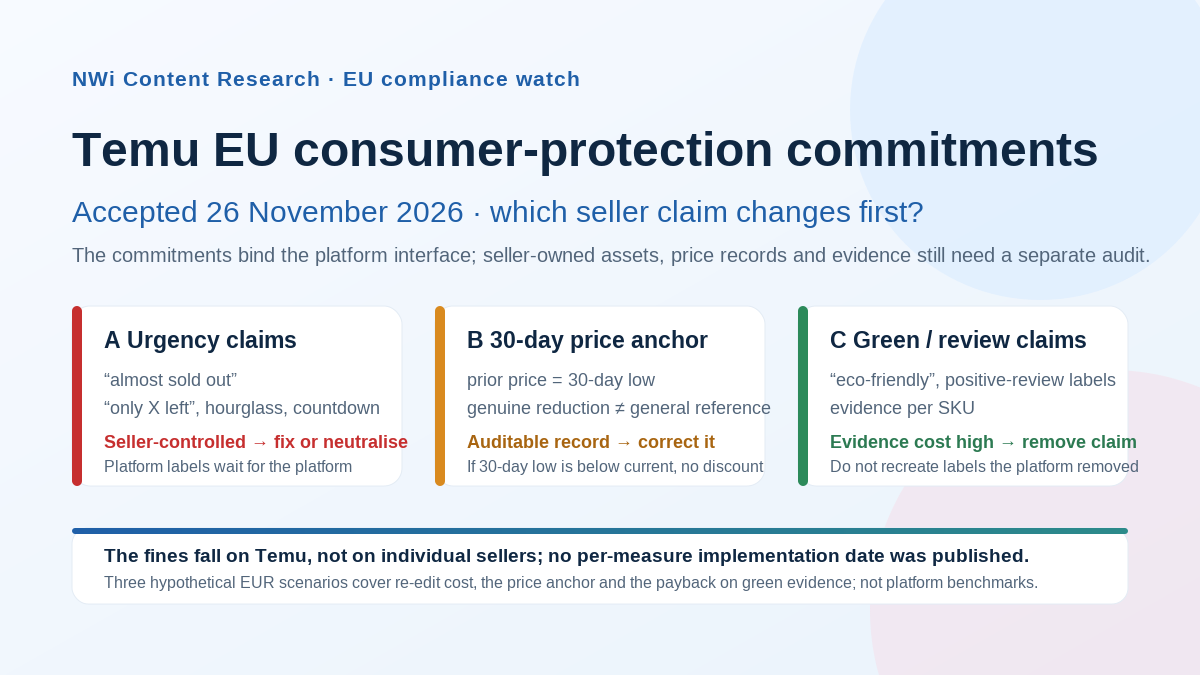
If you sell on Temu's EU/EEA marketplace, the question after 26 November 2026 is not whether Temu will be fined. It is which of your own listing images, videos, titles and discount histories need to change first, and which can wait for the platform's redesign. The European Commission and the Consumer Protection Cooperation (CPC) Network accepted Temu's commitments that day: Temu committed to remove “almost sold out”, “only X left”, hourglass icons and countdown timers, to calculate the “prior price” as the lowest price in the 30 days before the reduction, and to address review labels, forced gamification, green claims, checkout and seller information. The commitments bind Temu's platform interface, and the fines fall on Temu, not on individual sellers. But seller-owned creatives that repeat the same urgency, discount, review or green claims can still be examined under EU unfair-commercial-practices rules. This article separates seller-controlled from platform-controlled changes and uses three hypothetical EUR scenarios to show what to fix first and when to stop.
The unit of action is not the shop and not every asset, but the claim × placement × SKU. The same “only X left” can sit in a platform-generated label, where the seller waits for Temu to remove it, or in the seller's own video subtitle or main image, where the seller must change it. Mixing the two leads to two errors: assuming the platform commitments will clean up the seller's own assets, or assuming the seller can do nothing until the platform redesign.
1. The decision: separate seller-controlled from platform-controlled claims
The real question is not whether Temu made a commitment. Four variables decide the action: first, whether the claim is controlled by the seller, such as a listing image, video, title or coupon copy, or generated by the platform, such as a label, badge or countdown; second, how much GMV and contribution it represents; third, whether the 30-day price record is auditable; fourth, whether a green, review or stock claim has evidence. Different combinations lead to different actions: a seller-controlled red asset with high GMV should change first, a platform-controlled label should wait for the platform, and an unsubstantiated green or review claim should be removed rather than defended.
That is why both “pull everything” and “wait for the platform” can be wrong. Pulling everything also deletes ordinary product assets that are not the problem, wasting the re-edit budget; waiting misses the seller-controlled images, videos, titles and price records. The right order is to screen the seller-controlled layer first, then rank by GMV share, price-record completeness and evidence cost.
2. The event and mechanism: what the CPC commitments change
On 26 November 2026 the European Commission and the CPC Network announced that they had accepted Temu's commitments. The CPC action was led by the competent authorities of Belgium, Germany and Ireland, coordinated by the Commission; the press release calls it the broadest CPC action so far by the number of grievances investigated. The commitments cover company information and customer support, withdrawal/returns/refunds, review authenticity, price information, pressure selling, forced gamification, environmental claims, checkout and seller information.
Six groups matter most to sellers. First, price: Temu committed to calculate the “prior price” as the lowest price in the 30 days preceding the reduction and display it next to the reduced price; genuine reductions must be distinguished from a comparison with a general reference price; the RRP must be labelled clearly and must not appear together with the prior price, and no strikethrough or percentage discount may be shown when the RRP is displayed. Second, pressure selling: Temu committed to remove “almost sold out”, “only X left”, hourglass icons and countdown timers from its main page and product listing pages across the EU/EEA; a neutral “X left” message is allowed, but it must refer to the exact quantity of the selected product (for example, T-shirt, white, XS) and must not use capitals or exclamation marks to create urgency.
Third, reviews: Temu committed to a multidimensional fake-review detector, a reporting tool, transparency on review ranking and star-rating calculation, and to remove promotional labels such as “[XX]% of the item's reviews are positive”, “Recently, [XX] people gave this a 5-star review”, “Order within [HH:MM:SS] for fast dispatch”, “Most repurchased”, “High repeat customers provider” and “Low item return rate provider”. Fourth, environmental claims: Temu committed to an accurate description of its environmental donation programme, including the cost structure of the donation price and tree-survival data.
Fifth, checkout and returns: Temu committed to a clear “Order and Pay” confirmation button across all EU/EEA website versions, refunds within 14 days of a withdrawal request, and a standard EU withdrawal form in all official EU/EEA languages. Sixth, seller information: Temu committed to add a “trader information” link and a “Sold by Trader” label on the product detail page, and to list the seller's address, trade register, registration number, email address and telephone number on a dedicated page so consumers can identify the seller before purchase.
| Commitment area | What Temu committed to | Direct seller effect |
|---|---|---|
| Price | Prior price = lowest price in the preceding 30 days; genuine reductions distinguished from a general reference price; RRP not shown with prior price | Keep an accurate 30-day price record; do not advertise a discount when there is no genuine reduction |
| Pressure selling | Remove “almost sold out”, “only X left”, hourglasses and countdowns; neutral “X left” allowed for the exact selected SKU | Seller-owned images, videos and titles with the same claims must change; platform labels wait for the platform |
| Reviews | Fake-review detection, reporting tool, ranking transparency; removal of several promotional labels | Do not recreate removed labels in seller copy unless the claim is verifiable and permitted |
| Environment | Accurate description of the donation programme, cost structure and tree-survival data | Seller green claims need their own evidence; the platform commitment does not cover every seller claim |
| Checkout/returns | “Order and Pay”; refunds within 14 days; standard withdrawal form | Return and refund costs may rise; update profit assumptions |
| Seller information | “Sold by Trader” and trader-information page; address, registration number, email, phone | Verify and update the legal seller details |
The point of the table is not what Temu will change, but who will change it. Most platform commitments are implemented by Temu in the interface; the seller directly controls its own assets, price records, review copy, green evidence and legal details. Treating the commitments as a seller fine schedule is a misreading; assuming the seller has nothing to do misses the seller-controlled layer.
3. What is seller-controlled and what waits for the platform
Start with the seller-controlled layer. First, urgency claims in listing images, videos, titles, A+ content and coupon copy: “almost sold out”, “only X left”, “last chance”, “today only”. If the seller added them, the platform redesign will not remove them. Second, discount history: the prices, coupons, campaign prices and “original” or strikethrough prices the seller sets. If the 30-day low is below the current price, there is no genuine reduction; remove the discount claim instead of inventing a higher “original” price. Third, review-derived copy: “99% positive”, “XX five-star reviews recently”, “most repurchased”, “lowest return rate”. After the platform removes those labels, the seller should not recreate them in its own copy unless the claim is verifiable and permitted.
Fourth, green claims: “eco-friendly”, “sustainable”, “green” or specific reduction/recycling percentages. Temu's environmental donation-scheme commitment does not automatically make every seller green label compliant; the seller needs evidence per SKU or should remove the claim. Fifth, seller information: legal name, address, trade register, registration number, email and phone. Temu will add “Sold by Trader” and a trader-information page; inconsistent details can prevent consumers from identifying the seller and may trigger a platform review. Sixth, stock claims: if the seller writes “only X left” in its own asset, use the exact quantity for the selected SKU and neutral wording; do not use capitals, exclamation marks or a countdown to create urgency.
Now the platform-controlled layer: “almost sold out” on the main page and listing pages, hourglasses, countdown timers, the spin-the-wheel game, review-ranking interfaces, star-rating explanations, the checkout button, customer-support entry points, withdrawal/refund flows and minimum-order-value notices. Temu changes these; the seller does not need to rebuild assets and should not imitate a platform label before the platform does. The seller's job is to observe and record when the platform changes, what it changes to, whether old labels remain on its listings, and whether conversion and returns move.
In the middle is the shared layer: the prior-price display is implemented by the platform, but the price data comes from the seller; review labels are removed by the platform, but seller copy can repeat the same claim; the environmental donation programme is described by the platform, but the seller's own green claims still need evidence. Treating this as either “the platform handles everything” or “the seller is responsible for everything” is inaccurate.
Category differences change the priority order, not the seller-controlled versus platform-controlled test. Beauty and personal care are more likely to carry green, ingredient or “gentle/free-from” claims, where evidence is costly; household and low-price fast-moving goods are more likely to use “only X left” or “today only” urgency, where re-editing is cheap; fashion is more likely to have colour and size variants, where the exact selected-SKU stock is the most common inconsistency; electronics and durable goods are more likely to rely on review labels and seller information. This order is an audit assumption, not a platform rule; replace it with the seller’s own GMV, evidence cost and complaint data.
4. Evidence boundary: commitments, enforcement and timing
The primary evidence is the European Commission press release of 26 November 2026 and the November 2026 “Summary of TEMU's main commitments”. The press release states that the CPC Network accepted the commitments that day and that, if Temu fails to comply, national authorities may take enforcement measures, including fines of up to 4% or more of Temu's annual turnover in the Member States concerned. The fines fall on Temu, not on individual sellers; neither document sets a seller-level fine, delisting or store-closure penalty.
Neither document sets a separate implementation date for each measure. They say the commitments should apply across the EU and the EEA, and that national authorities will closely monitor compliance. The commitments summary is a summary, not the full legal text; implementation may vary by Member State. This article cannot claim that Temu has completed every change, that a label has disappeared everywhere, or that a seller will be fined 4%. Nor can it merge the Commission's DSA preliminary finding of 17 November 2026 into the CPC commitments: the DSA case concerns illegal or unsafe products and platform risk assessment, a separate track that does not replace this one.
We also checked Temu Seller Central's public page on 26 November 2026; it returned a login/interstitial page and did not expose a corresponding listing-policy notice. This article therefore does not claim that the seller centre has published an implementation date or seller instructions. That unknown affects timing: seller-controlled assets and price records can change now; platform-controlled labels and flows should wait for a platform notice or an actual interface change before the seller adjusts operating assumptions.
5. Counter-cases: five common misreadings
- Counter-case 1: treating the CPC commitments as a direct ban on sellers. The commitments bind Temu's platform interface and the fines fall on Temu; seller-owned assets remain subject to EU unfair-commercial-practices rules, but the commitments should not be rewritten as “sellers will be fined 4%”.
- Counter-case 2: assuming genuine discounts are banned. The commitment requires the prior price to be the 30-day low and distinguishes a genuine reduction from a general reference price; a real, documented reduction can still be shown. What is banned is presenting a general reference price as a reduction.
- Counter-case 3: assuming “X left” is unusable. The commitment removes pressure messages such as “only X left”; a neutral “X left” can still show the exact quantity of the selected SKU, but it must not use capitals, exclamation marks or a countdown to create urgency.
- Counter-case 4: assuming all green claims are banned. The commitment requires environmental claims to be accurate and substantiated; a supported green claim can remain, an unsupported one should be removed. Temu's donation-scheme commitment does not automatically make every seller green label compliant.
- Counter-case 5: assuming waiting for the platform is safest. The platform redesign will not automatically edit the seller's images, videos, titles, coupon copy or price records. Leaving those seller-controlled items until after the redesign can miss the next promotion window and expose them first in a platform review or consumer complaint.
6. Worked analysis: three hypothetical EUR scenarios
All figures below are assumptions, not Temu, European Commission, seller or NWi measurements. Common basis: all amounts are EUR; GMV is gross merchandise value before returns and before VAT; contribution is after product cost and platform fees, before fixed costs; refunds, returns, FX, tax, advertising and demand recovery are excluded. Re-edit and evidence costs are one-off; losses are monthly contribution losses.
Scenario A: 300 SKUs, with 120 listings carrying seller-owned urgency claims. Assumptions: the 120 listings represent 40% of EUR 200,000 monthly GMV, or EUR 80,000; if the claims are removed without neutral replacement, conversion is assumed to fall 8%; contribution margin is 15%; monthly contribution loss = EUR 80,000 × 8% × 15% = EUR 960; re-edit cost = 120 × EUR 6 = EUR 720. Result: the re-edit cost equals 0.75 month of the assumed loss; if the seller starts with the top 30 SKUs, assumed to represent 60% of affected GMV, re-edit cost = 30 × EUR 6 = EUR 180 and avoided monthly contribution loss = EUR 48,000 × 8% × 15% = EUR 576, a payback of about 0.31 month. Decision: re-edit the top 30 SKUs first; if measured conversion loss reaches 8%, extend to the other 90; if the measured loss is below the payback threshold, remove the claim and use neutral stock information instead of re-shooting.
Scenario B: 80 SKUs, with 20 listings showing a discount higher than the 30-day low. Assumptions: current price EUR 78; displayed original price EUR 120, a 35% discount; the 30-day low is EUR 100, so the committed prior price is EUR 100 and the discount becomes 22%. Monthly orders are 2,000; assuming orders follow SKU count, 20/80 = 25%, or 500 affected orders; assuming 10% of discount-sensitive orders churn, 50 orders are lost; contribution is EUR 8 per order; monthly contribution loss = EUR 400; at 20% churn, the loss is EUR 800. Result: correcting the price record is internal work with no external re-edit cost; under the 10% churn assumption the monthly loss is EUR 400, below a typical promotion's discount budget; under 20% churn it is EUR 800. Decision: correct all 20 SKUs; if measured order loss exceeds 20% for two consecutive months, adjust price or assortment, but do not keep the wrong prior price.
If the 30-day low is below the current price, the current price is not a reduction at all; remove the discount claim. The answer is not to lower the prior price further, but to stop advertising a discount. That boundary matters more than “showing a smaller discount”, because it decides whether a discount should be shown at all.
Scenario C: 50 SKUs, with 10 carrying “eco-friendly” or similar green claims. Assumptions: evidence costs EUR 120 per SKU, or EUR 1,200 for all 10; green claims drive 5% of EUR 150,000 monthly GMV, or EUR 7,500; contribution margin is 20%, or EUR 1,500 per month; payback = EUR 1,200 / EUR 1,500 = 0.8 month. Result: the full evidence programme pays back in about 0.8 month; if the seller starts with the top 2 SKUs, assumed to represent 40% of green-claim GMV, evidence cost = EUR 240, monthly contribution = EUR 3,000 × 20% = EUR 600, payback = 0.4 month. Decision: substantiate the top 2 SKUs first; remove the green claim from the other 8 until evidence exists; if a SKU's evidence cost exceeds its 12-month green-claim contribution, remove the claim instead of commissioning evidence.
| Scenario | Key assumptions | Recalculation | Decision |
|---|---|---|---|
| A Urgency claims | 120/300 listings; 40% of EUR 200k; 8% conversion loss; 15% contribution | EUR 960/month loss; EUR 720 re-edit; top 30 EUR 180 | Start with top 30, extend on measured loss |
| B Price anchor | 20/80 SKUs; 35% → 22%; 500 orders; 10% churn; EUR 8/order | EUR 400/month; EUR 800 at 20% churn | Correct all 20; adjust price only if >20% for two months |
| C Green claims | 10/50 SKUs; EUR 120/SKU; 5% of EUR 150k; 20% contribution | EUR 1,500/month; full payback 0.8 month; top 2 0.4 month | Top 2 first; remove the rest until evidence |
The common conclusion is not that removing claims always reduces conversion. It is that seller-controlled claims with evidence cost below the assumed loss should change first; platform-controlled items should wait for the platform; and claims whose evidence cost exceeds their contribution should be removed rather than defended. The 8%, 10%, 20% and 5% figures are assumptions; replace them with the seller's own holdout or before/after test, not with a Temu benchmark.
7. Action plan: a six-step audit ranked by GMV
Start with a claim inventory, not a full re-shoot. The inventory should include SKU, platform site, asset file, placement, claim text, whether it is seller-controlled, 30-day GMV and contribution, 30-day price record, evidence status and whether it is live. Then follow six steps:
- 1. Export the top 200 SKUs by 30-day GMV, contribution, orders, returns and ad spend; mark the top 20%.
- 2. Tag each claim as seller-controlled (image, video, title, A+ content, coupon copy) or platform-controlled (platform label, badge, countdown, review ranking, checkout, customer support).
- 3. Red: seller-controlled “almost sold out”, “only X left”, hourglass, countdown or false urgency; remove now or replace with neutral, accurate stock information.
- 4. Amber: discounts and prior price; rebuild the 30-day price record per SKU; keep genuine reductions, remove the discount claim when the 30-day low is below the current price, and never show RRP together with the prior price.
- 5. Blue: reviews, green claims and seller information; do not recreate review-derived labels, substantiate or remove each green claim, and reconcile the legal seller details with the trade register.
- 6. Watch the platform rollout: record platform notices, label changes, checkout/return flows and the seller-information page; after 30 days, review conversion, returns, refunds, complaints and contribution.
| Timing | Action | Observation fields |
|---|---|---|
| Now–30 November 2026 | Complete the top-200 SKU inventory; remove or neutralise red assets; rebuild the 20 discount records; verify seller details | Asset version, listing status, 30-day price, seller-detail completeness |
| After a platform notice | Update platform-controlled items per Temu Seller Central or the actual interface; do not imitate platform labels | Notice date, label removal, checkout/return flow |
| 1–31 December 2026 | Observe conversion, returns, refunds and complaints; replace assumptions with a holdout | Orders, conversion, return rate, refund rate, contribution, complaints |
| After 30 days | Review; expand or shrink the re-edit scope | Measured loss, re-edit cost, evidence cost, contribution change |
Stop conditions: if the platform publishes a different implementation date or wording, follow the platform; if a claim is legally required or a mandatory platform field, keep it and change the wording; if a discount is genuine and documented, keep it; if a green claim cannot be substantiated within budget, remove it; if correcting the prior price produces more than 20% order loss for two consecutive months, adjust price or assortment but do not keep the wrong anchor; if a platform-controlled label is still live, do not recreate it in seller assets and wait for the platform.
8. Limitations and uncertainty
This article has no Temu seller back office, seller-centre policy notice, platform review record, EU Member State enforcement data or legal opinion. The commitments summary is not the full legal text, and implementation may vary by Member State. Temu Seller Central's public page returned a login/interstitial page on 26 November 2026 and did not expose a corresponding listing-policy notice; this article therefore does not claim that the seller centre has published an implementation date.
The commitments do not set a separate implementation date for each measure and do not publish take-up, conversion effects, seller penalties or enforcement counts. The fines fall on Temu, not on individual sellers. The DSA case (preliminary finding of 17 November 2026) is a separate track; this article uses it only as a boundary, not as evidence for the CPC commitments.
The GMV, contribution margin, conversion loss, order churn, evidence cost and green-claim GMV share in the scenarios are assumptions, not Temu, European Commission, seller or NWi measurements; refunds, returns, FX, tax, advertising and demand recovery are excluded. The variables most likely to change the conclusion are the seller-controlled share of GMV, the completeness of the 30-day price record, the actual platform rollout timing, consumer response to neutral stock information, the cost of green evidence, and changes in returns/refunds. Recalculate with those data; do not apply the EUR figures directly.
9. Method and disclosure
Data basis: the date the CPC accepted the commitments, the scope, the fine range and the “broadest action” statement come from European Commission press release IP/26/2594 of 26 November 2026; the specific wording on prior price, pressure selling, review labels, environmental claims, checkout/returns and seller information comes from the European Commission's November 2026 “Summary of TEMU's main commitments”; the Swedish Consumer Agency's press release of 26 November 2026 independently corroborates the acceptance and the 4%-or-more fine range. Calculation basis: monthly contribution loss = affected GMV × assumed conversion loss × contribution margin; re-edit cost = number of assets × cost per asset; payback = one-off cost ÷ monthly contribution; discount = 1 − current price ÷ prior price. The GMV, contribution margin, conversion loss, order churn, evidence cost and green-claim share in the scenarios are explicitly labelled assumptions, not Temu, European Commission, seller or NWi measurements; refunds, returns, FX, tax, advertising and demand recovery are excluded. NWi CrossborderGo covers Temu's US, EU and LATAM sites/regions with monthly sales, units, ASP, price-band and lifecycle metrics; coverage.json notes that Temu has no independent GMV disclosure; fields and historical coverage depend on the contract. NWi Operations can handle listing and image-translation work but does not provide legal advice, compliance certification or platform appeal representation.
This article was prepared with automated research assistance from the public sources listed at the end and has not been human-reviewed; it does not invent customer data, expert review, enforcement results, platform penalties, sales uplifts or ranking outcomes. It is not EU legal advice, compliance certification or platform appeal advice; whether a specific claim complies should be decided by an EU lawyer with the actual assets.
10. Sources
- 1. European Commission, “Temu commits to complying with EU consumer protection rules following action by national authorities”, 26 November 2026 (primary: CPC acceptance, commitment scope, fine range, broadest action): read the release, accessed 26 November 2026.
- 2. European Commission, “Summary of TEMU's main commitments”, November 2026 (primary: specific wording on prior price, pressure selling, review labels, environmental claims, checkout/returns and seller information): read the summary, accessed 26 November 2026.
- 3. Konsumentverket, “Konsumentskyddsmyndigheter ser till att Temu följer EU:s konsumentskyddsregler”, 26 November 2026 (independent corroboration: acceptance and 4%-or-more fine range): read the release, accessed 26 November 2026.
- 4. European Commission, “Commission preliminarily finds Temu in breach of the Digital Services Act”, 17 November 2026 (background only: distinguishes the DSA illegal/unsafe-products track; not evidence for the CPC commitments): read the release, accessed 26 November 2026.
- Note: all sources are official European Commission or Swedish Consumer Agency material; no competitor data provider's text, estimates, charts, screenshots, methods or API/MCP output was used.
11. Original contribution
The contribution is not another “Temu is under EU investigation” news brief. It separates the commitments into seller-controlled, platform-controlled and shared layers and gives a GMV-ranked audit order. The official summary does not tell a seller which layer to fix first; this article answers that with four variables: control, GMV share, 30-day price record and evidence cost.
The second contribution is a single reproducible frame for urgency claims, the 30-day price anchor and green claims: Scenario A shows why the top 30 SKUs come first; Scenario B shows why correcting the prior price is internal work that should not wait for an assumed churn rate; Scenario C shows why a claim whose evidence cost exceeds its contribution should be removed rather than defended. The third contribution separates the CPC consumer-protection track from the DSA illegal/unsafe-products track, so sellers do not reduce both to “Temu was fined, so every label is illegal”.
To put Temu's EU market, price bands and lifecycle into one research process, see NWi CrossborderGo; to move listing and image-translation work into daily operations, see NWi Operations; for expert or custom research, see the Cross-border AI Agent; for a quote or demo, contact us.