
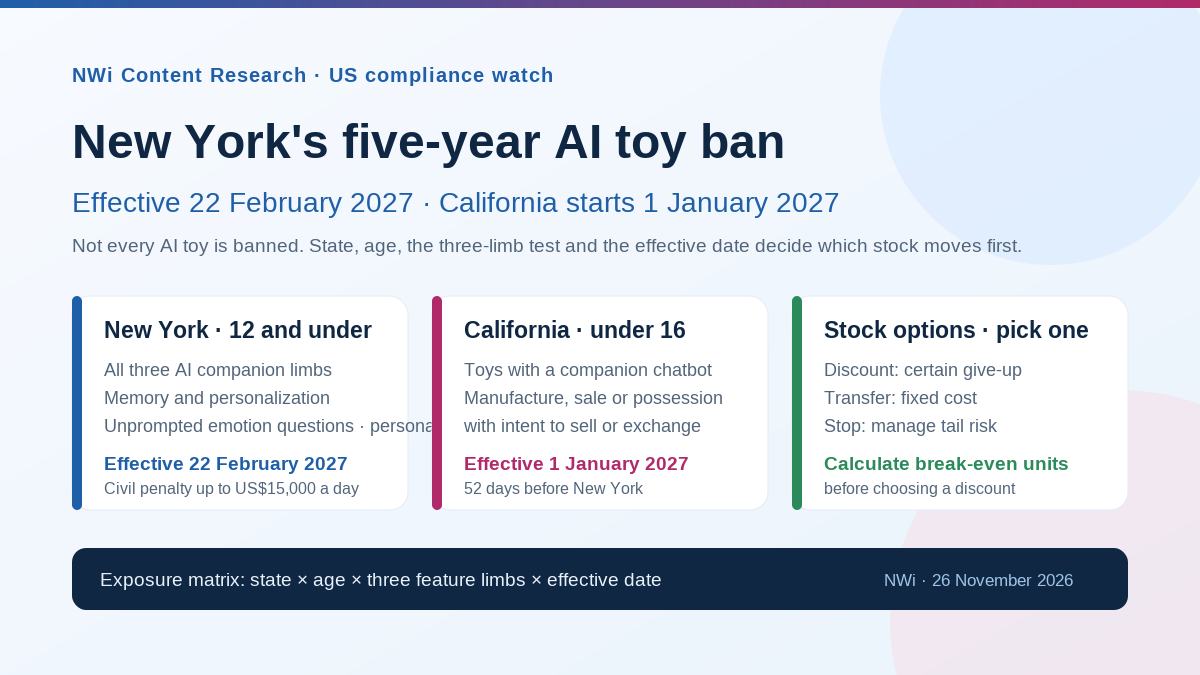
For a cross-border seller listing AI plush toys, talking dolls or child robots on Amazon US, New York's signing on 24 November 2026 does not ask whether AI toys will be banned. It asks which SKUs cannot be sold in New York or California, from which date, and whether existing FBA stock should be handled before the effective date. New York defines a chatbot toy as an AI companion embedded in or integrated with a children's toy, and its three-limb test is conjunctive. California's toy ban starts earlier, on 1 January 2027, and uses an under-16 definition. The two states differ in age, date and the wording that reaches inventory, so 'the US banned AI toys' is the wrong summary.
1. The decision: separate the state, the age and the inventory
The real question is not whether AI toys will be banned, but which SKUs cannot be sold in New York or California from which date, and whether existing FBA stock should be handled before the effective date.
The unit of decision is not the store but the SKU × state × age positioning × feature set. The same listing can be highly exposed in both states if it is positioned for ages 3 and up, retains conversation memory, asks unprompted emotion questions and sustains personal dialogue. If it only gives fixed scripted answers, keeps no memory and never asks an emotion question, New York's three-limb test is likely not met, but California still turns on its companion chatbot definition. Treating 'AI toys' as one block leads to two errors: stopping every SKU and losing sales that remain lawful, or watching only New York and missing California's earlier date and wider age definition.
The statutes also separate selling from holding inventory. New York prohibits manufacturing, exchanging, holding for sale, distributing or selling. California, according to Latham & Watkins' summary, prohibits manufacturing, selling, or possessing with intent to sell or exchange. Both may reach warehouse stock, but the wording differs, and New York's 'in this state', the treatment of FBA stock as 'holding for sale', and the scope of the penalty clause have no case law or enforcement guidance. Inventory is the practical problem here because Q4 stock has already been ordered; waiting until 2027 is usually too late.
2. The event: two statutes, two age thresholds, two effective dates
New York's governor signed S.9408A/A.11144B on 24 November 2026 (CHAP.416), adding Article 48 (§§1800–1802) to the General Business Law. The act defines a chatbot toy as an AI companion embedded in or integrated with a children's toy. 'AI companion' takes the definition in §1700(4): a system using artificial intelligence, generative AI and/or emotion-recognition algorithms designed to simulate a sustained human or human-like relationship by (i) retaining information on prior interactions or user preferences to personalize the interaction and facilitate ongoing engagement; (ii) asking unprompted or unsolicited emotion-based questions beyond a direct response; and (iii) sustaining an ongoing dialogue about matters personal to the user. The three limbs are joined by 'and', so the test is conjunctive. Customer service, efficiency, research or technical assistance, and internal business systems are excluded.
'Children's toy' takes the definition in 15 U.S.C. §2057c(g): a consumer product designed or intended by the manufacturer for a child 12 years of age or younger for use when the child plays. The prohibition covers manufacturing, exchanging, holding for sale, distributing or selling. The Attorney General may seek an injunction and civil penalties of up to US$15,000 per day for each violation against an 'operator', without proof that anyone was injured. The act takes effect on the 90th day after signing, 22 February 2027, and expires five years after that, on 22 February 2032.
California's SB 867 passed in the 2026 session. It prohibits manufacturing, selling, or possessing with intent to sell or exchange a toy that includes a companion chatbot; it takes effect on 1 January 2027 and is repealed on 1 January 2031. California defines a toy as a physical product designed, marketed, or manufactured for play by children under 16. Latham & Watkins also note that the companion chatbot definition uses the same definition as SB 1119. The text of that definition was not readable in this round, so this article does not compare how broad the two states' relationship tests are; it compares only the age, dates and prohibited acts that could be verified.
One sequencing point is easy to miss: California starts 52 days before New York. Between 1 January and 22 February 2027, California is already in force while New York is not. For a seller active in both states, the first post-Q4 gate is California, not New York.
| Item | New York | California |
|---|---|---|
| Statute and signing | S.9408A/A.11144B, signed 24 November 2026 | SB 867, passed in the 2026 session |
| Effective and repeal | 22 February 2027 / 22 February 2032 | 1 January 2027 / 1 January 2031 |
| Toy age | 12 and under (15 U.S.C. §2057c(g)) | Under 16 (Latham & Watkins summary) |
| AI test | All three AI companion limbs | Companion chatbot, definition follows SB 1119; text not read |
| Prohibited acts | Manufacture, exchange, hold for sale, distribute, sell | Manufacture, sell, possess with intent to sell or exchange (secondary summary) |
| Enforcement and penalty | Attorney General action against an operator, up to US$15,000 a day | Penalty clause not read this round |
3. Applying the three limbs to a product
New York's test is conjunctive: retained memory and personalization, unprompted emotion-based questions, and sustained dialogue about personal matters; a scripted question-and-answer toy that meets only one limb does not automatically fall inside the ban. The first question is whether the product retains prior interactions or user preferences and uses them to personalize later conversation. The second is whether it asks unprompted or unsolicited emotion-based questions beyond a direct answer. The third is whether it sustains dialogue about matters personal to the user.
A fixed-script robot that only answers 'what is the weather' or 'tell me a story', keeps no memory, never asks an emotion question and never discusses the child's personal life is unlikely to meet all three limbs. A plush that remembers the child's name, the school and friends from the last conversation, and asks 'are you unhappy today' is much easier to bring within the definition. Product documentation, app screens, voice logs, marketing assets and customer-service scripts can all become evidence of design intent; the age label on the box is not the only test.
The other boundary is 'children's toy'. New York uses 12 and under; California uses under 16. Both look at the manufacturer's design or intent, not at how a consumer happens to use the product. A product labeled '16+' but sold with cartoon characters, child-sized proportions and child-scene marketing can still be treated as a children's toy; a genuine adult collectible with clear marketing and channel evidence may fall outside. That judgment needs legal advice; operations should not self-certify it.
4. Evidence boundary: what is statute, what is interpretation, what is unknown
The statutory text is readable, but whether 'in this state' reaches an out-of-state seller, whether FBA stock in a New York warehouse counts as 'holding for sale', and whether a retailer that only resells finished toys is an 'operator' for the penalty clause have no case law or enforcement guidance.
This article can cite directly the New York bill text, the §1700(4) definition, the 15 U.S.C. §2057c(g) toy definition, California SB 867's effective and repeal dates and under-16 scope, and The Toy Association's confirmation of the 22 February 2027 date. It cannot cite directly the Governor's press release (the direct fetch returned HTTP 403 or a Cloudflare challenge, so its quotations are not treated as independent evidence), the California leginfo bill text (HTTP 403, so the California details rely on Latham & Watkins' secondary analysis), or any marketplace delisting rule or enforcement case.
Open questions include whether New York's 'in this state' reaches an out-of-state seller selling to a New York consumer; whether FBA stock in a New York warehouse is 'holding for sale'; whether a retailer that only resells finished goods, without operating the AI companion, is an 'operator' for the penalty clause; the exact California companion chatbot definition; how the two attorneys general and the marketplaces will prioritize enforcement; and whether platforms will act before the effective dates. The article records these as items to verify rather than resolving them for the reader.
The numerical boundary is just as important. This article has no seller's state-level orders, FBA inventory distribution, return rate, advertising cost or legal quote. Every price, landed cost, unit count, sell-through rate, discount and transfer fee in the scenarios is a labeled assumption used to demonstrate the calculation; none is an industry benchmark or NWi measurement. NWi's Amazon data is site-level monthly market, brand and product data and does not provide state-level order detail; the state shares must come from the seller's own order data.
5. Three scenarios: same technology, different states and ages
All three scenarios use the same unit economics: first calculate the stock still in a restricted state on the effective date, then compare the contribution lost by discounting to clear it, the fixed cost of transferring it, and the landed cost of doing nothing. Every number is an assumption.
Scenario A: an AI plush toy for ages 3 and up, 300 units in a New York warehouse, 55% Q4 sell-through (illustrative assumptions) Assumptions: US$49 price, US$18 landed cost, 300 units in a New York warehouse, 55% Q4 sell-through, New York and California together at 20% of US sales, US$0.90 removal per unit, US$0.60 inter-warehouse transfer per unit, a 25% discount, and no advertising, returns, storage or tax. Result: 135 units remain in the New York warehouse on the effective date, with US$2,430 of landed cost; clearing them at a 25% discount yields US$2,531.25 of contribution and gives up US$1,653.75; transferring them and selling at full price elsewhere yields US$3,982.50 net of US$202.50 of transfer cost; the transfer needs at least 89 units sold, about 66%, to beat the discount. Decision: stop replenishing the New York warehouse first; transfer if other states can absorb at least 89 units before the effective date; discount to clear below 89 units; stop US replenishment for the SKU if neither route works.
Scenario B: a scripted question-and-answer robot for ages 8 to 12, 200 units in a California warehouse, 50% Q4 sell-through (illustrative assumptions) Assumptions: US$89 price, US$32 landed cost, 200 units in a California warehouse, 50% Q4 sell-through, fixed scripted answers only, no retained memory, no unprompted emotion questions, no sustained personal dialogue, and New York and California together at 5% of US sales. Result: the New York three-limb test is likely not met, but California's under-16 toy definition may still apply; 100 units remain in the California warehouse on the effective date, with US$3,200 of landed cost; transferring those 100 units costs US$150 and yields US$5,550 net if they sell at full price elsewhere. Decision: do not treat the failed New York test as safety in both states; obtain a legal read on California's companion chatbot definition before deciding whether to transfer the 100 units before 1 January 2027.
Scenario C: a technology toy for ages 13 to 15, 300 units in a California warehouse, 60% Q4 sell-through (illustrative assumptions) Assumptions: US$69 price, US$24 landed cost, 300 units in a California warehouse, 60% Q4 sell-through, age positioning of 13 to 15, New York and California together at 10% of US sales, a 20% discount, US$1.50 transfer per unit, and no advertising, returns, storage or tax. Result: New York's children's toy definition covers ages 12 and under, so this product sits outside New York; California covers under 16, so it remains inside California; 120 units remain in the California warehouse on the effective date, with US$2,880 of landed cost; a 20% discount yields US$3,744 of contribution, while transferring and selling at full price yields US$5,220 net, and the transfer needs at least 88 units, about 73%, to beat the discount. Decision: treat California as the binding state rather than treating '13+' as a two-state exemption; handle the 120 California units first, then review whether the New York marketing really targets only ages 13 and up.
6. Reproducible thresholds: discount, transfer or stop
The handling threshold can be calculated from unit economics: compare the contribution forgone by discounting to clear stock, the fixed cost of transferring inventory, and the landed cost of restricted stock if nothing is done. Write it as: restricted inventory = units in the restricted state × share still unsold on the effective date; landed cost at risk = restricted inventory × landed cost per unit; discount contribution = (discounted price − landed cost) × restricted inventory; transfer net contribution = (full price − landed cost) × units that can be transferred and sold elsewhere − fixed transfer cost. The break-even point is the unit count at which transfer net contribution equals discount contribution.
Using Scenario A: discount contribution is US$2,531.25; fixed transfer cost is US$202.50; full-price contribution per unit is US$31; break-even units = (2,531.25 + 202.50) ÷ 31 = 88.2, rounded up to 89 units, or 65.9% of 135. If other states can absorb at least 89 units at full price before the effective date, transfer beats discount; below 89, discounting to clear is more reliable. The transfer's net contribution of US$3,982.50 equals full-price contribution of US$4,185 minus US$202.50 of transfer cost.
Using Scenario C: discount contribution is US$3,744; fixed transfer cost is US$180; full-price contribution per unit is US$45; break-even units = (3,744 + 180) ÷ 45 = 87.2, rounded up to 88 units, or 73.3% of 120. The same formula applies to any SKU once the price, landed cost, unit count and sell-through rate are replaced with the seller's own data.
The formula also explains why a blanket 50% clearance is usually wrong: the discount give-up is certain, the transfer cost is fixed, and full-price selling depends on demand and timing in other states. Calculate the break-even unit count before choosing a discount depth, rather than starting from a 'clearance discount'. The penalty should not enter expected cost: US$15,000 a day is a ceiling, not a per-order cost, and multiplying it by a self-invented probability creates false precision. Treat it as tail risk and reduce the trigger probability by stopping replenishment, isolating stock and obtaining legal advice.
7. Observation fields and action list
This week, export state-level sales shares for New York and California and the states where FBA inventory sits, rank SKUs by the three-limb test, age positioning and inventory depth, then handle California exposure before 1 January 2027 and New York exposure before 22 February 2027. Export four fields: first, the share of orders shipped to New York and California over the past 12 months, by shipping state rather than billing state; second, FBA inventory by fulfillment-center state and the next eight weeks of replenishment; third, each SKU's age positioning, packaging, listing title, A+ content and creator assets; fourth, feature evidence, including whether the product retains memory, asks unprompted emotion questions, sustains personal dialogue, and whether the app or voice logs can prove it.
Then rank by feature test × age scope × restricted-state share × inventory depth. SKUs that meet the test, sit inside the age scope, carry a high restricted-state share and hold deep inventory go first. SKUs that fail the test or sit clearly outside the age scope go to legal review rather than immediate clearance. For the top group, stop replenishment to restricted states this week, freeze new inbound to New York and California warehouses, and evaluate transfer or discount clearance.
Timeline: finish the California exposure by 31 December 2026, because California takes effect on 1 January 2027; finish the New York exposure by 22 February 2027. Marketplaces may act before the law, so leave time for platform review and delisting; do not treat the effective date as the only deadline.
Stop conditions: if legal advice confirms the product fails New York's three-limb test and California's definition does not cover it either, stop transferring and discounting and resume normal replenishment; if a marketplace publishes a clear ban notice or starts delisting, stop waiting and follow the platform; if full-price sales in other states fall below the break-even unit count, stop transferring and switch to discount clearance; if the discounted contribution falls below landed cost, stop selling and consider removal or destruction.
If you need Amazon US category, brand, price-band and SKU data in one table, NWi CrossborderGo provides site-level monthly market data. It does not provide state-level order detail, so state shares still have to come from your own order data. The available fields, history and contract scope are described on the product page, and you can discuss them through the demo request.
8. Counter-cases and alternative explanations
The counter-case is a product for ages 13 to 15: it sits outside New York's 12-and-under definition but inside California's under-16 toy definition, so one line about a 'New York ban' cannot cover both states. Seven more counter-cases need separate treatment.
First, not every 'AI toy' meets New York's three limbs. A product that only gives scripted answers, keeps no memory and never asks an emotion question may fall outside. Second, before 22 February 2027 the New York ban is not in force, so Q4 holiday sales are not directly restricted; but marketplaces can act earlier, and 'not in force' is not 'the platform will not move'. Third, whether FBA stock counts as 'holding for sale' is untested; do not assume it does or does not. Fourth, whether a retailer that only resells finished goods is an 'operator' is unclear; do not assume every seller is a penalty target, and do not assume only the AI developer can be pursued. Fifth, California's 'possession with intent to sell' wording may reach inventory more directly than New York's 'hold for sale', but that is a secondary summary and must be checked against the statute with counsel. Sixth, removing or disabling the chatbot may change the classification, but it needs legal advice and verifiable product documentation; do not self-certify compliance. Seventh, platform delisting can precede the law: Amazon has said it will restrict AI-enabled toys in prohibited jurisdictions, but no public rule, list or timeline was read, so a media paraphrase is not the full platform policy.
9. Limitations and unknown quantities
This article has no seller back end, state-level orders, FBA inventory distribution, legal opinion or platform enforcement record; every unit count, price, landed cost and discount is a labeled assumption, not NWi measurement or a legal conclusion. It also has no enforcement guidance from either attorney general, no settlement or penalty case, no full marketplace policy, no test report and no state-level sales data. The California bill text and the New York Governor's release could not be read directly because of access blocks, so the article uses secondary legal analysis and an industry notice, and labels them.
Whether the two states' AI companion and companion chatbot definitions are identical, how marketplaces will detect and geofence products, and where the jurisdiction of an out-of-state seller ends are all unresolved in public sources. This article does not forecast sales, ranking, conversion or penalty probability. The scenario numbers only demonstrate thresholds; they are not industry benchmarks. Readers should recalculate with their own orders, inventory and costs, and obtain legal advice before stopping sales, clearing stock or re-engineering a product.
10. Original contribution
The contribution is an exposure matrix of state, age, the three feature limbs and effective date, plus reproducible thresholds for discounting, transferring or stopping replenishment, rather than another headline summary. The matrix explains why a product for ages 13 to 15 is outside New York but inside California, and why California may become the binding constraint earlier.
The second contribution is putting discount, transfer and stop into one unit-economics formula and producing break-even counts such as 65.9% and 73.3%, instead of an arbitrary discount. The third is keeping the penalty out of expected cost: it is tail risk, managed by stopping replenishment, isolating stock and obtaining legal advice, not by multiplying a self-invented probability.
11. Sources
- 1. New York State Assembly, S09408A bill page (signed CHAP.416, 24 November 2026): original, accessed 26 November 2026.
- 2. New York General Business Law §1700 (unofficial consolidation, current): original, accessed 26 November 2026.
- 3. Cornell Legal Information Institute, 15 U.S.C. §2057c: original, accessed 26 November 2026.
- 4. The Toy Association, “New York Governor Signs AI Chatbot Toy Bill into Law” (24 November 2026): original, accessed 26 November 2026.
- 5. TechCrunch, “Want to buy your kid an AI toy this Christmas? Not in New York” (25 November 2026): original, accessed 26 November 2026.
- 6. Latham & Watkins, “Newest slate of AI laws keeps California at the forefront of US regulation” (5 October 2026): original, accessed 26 November 2026.
12. Method and disclosure
Sources and definitions: the New York signing date, article structure, three-limb definition, prohibited acts, enforcement clause, and effective and expiry dates come from the full text of the New York State Assembly S.9408A bill page (signed 24 November 2026, CHAP.416); the AI companion definition comes from General Business Law §1700(4) (New York Public Law unofficial consolidation, because nysenate.gov returned HTTP 403); the children's toy definition comes from 15 U.S.C. §2057c(g) (Cornell LII); the 22 February 2027 effective date is also confirmed by The Toy Association's 24 November 2026 notice. California SB 867's 1 January 2027 effective date, 1 January 2031 repeal, under-16 toy definition and 'possession with intent to sell' wording come from Latham & Watkins' 5 October 2026 secondary legal analysis; the California leginfo bill page returned HTTP 403 and was not read directly. Amazon's statement that it will take steps to restrict AI-enabled toys in prohibited jurisdictions comes from TechCrunch's 25 November 2026 report and is a company statement, not a published policy. Calculations: restricted inventory = units in restricted states × share unsold on the effective date; landed cost at risk = restricted inventory × landed cost per unit; discount contribution = (discounted price − landed cost) × restricted inventory; transfer net contribution = (full price − landed cost) × units that can be transferred and sold elsewhere − fixed transfer cost; break-even units = (discount contribution + fixed transfer cost) ÷ full-price contribution per unit. Every price, landed cost, unit count, sell-through rate, state share, discount and transfer fee is a labeled assumption, not a marketplace rule, seller measurement or NWi data. NWi's Amazon data is site-level monthly market, brand and product data and does not provide state-level order detail.
This article was prepared with automated research assistance from the public sources listed at the end. It was not reviewed by a human expert. It does not invent customer data, expert review, sales or ranking results, or marketplace endorsement. Nothing here is legal, tax, marketplace-operations or investment advice.