
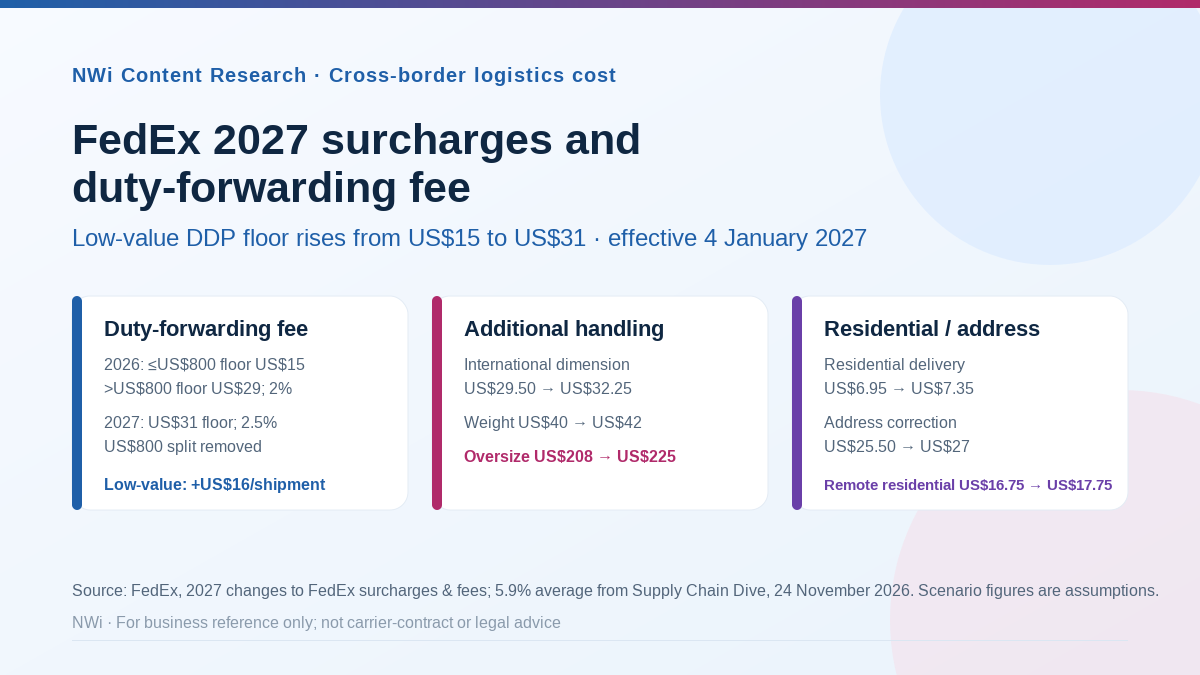
For cross-border sellers shipping from China or a US warehouse to US customers, using FedEx international parcel or US domestic services and mostly selling DDP, the FedEx surcharge schedule effective 4 January 2027 poses a narrower question than 'rates rise 5.9% on average': which low-value DDP parcels will pay US$16 more per shipment for duty and tax forwarding, which oversize, residential and address-correction shipments will stack additional fees, and whether that fixed fee already exceeds contribution per order. FedEx's official 2027 schedule changes the duty-forwarding fee from 'at least US$15 when customs value is US$800 or less, at least US$29 when above US$800, at a 2% rate' to 'a US$31 minimum and a 2.5% rate, with the US$800 split removed'. Supply Chain Dive reported on 24 November 2026 that FedEx and UPS will raise base shipping rates by 5.9% on average, and flagged lighter parcels, additional handling and remote ZIP changes. This article separates the three layers, recalculates the per-parcel and monthly impact in three illustrative scenarios, and lists the fields, actions and stop conditions for moving to DAP, consolidating parcels, changing packaging, repricing or switching carriers. The 5.9% is an average, not a per-parcel increase.
1. The conclusion first: three cost layers, not a 5.9% increase on every parcel
The question is not how much FedEx is raising rates on average, but how much more each DDP parcel will pay for duty and tax forwarding from 4 January 2027, and whether that fixed fee already exceeds the contribution per order. Supply Chain Dive reported on 24 November 2026 that FedEx and UPS will raise base shipping rates by 5.9% on average, with FedEx effective 4 January 2027 and UPS effective 21 December 2026; it also reported that lighter parcels face higher average increases and that FedEx will move more than 2,500 ZIP codes from an US$8.80 extended area surcharge to an US$17.75 remote area surcharge. The 5.9% is an average, not a per-parcel increase, and the report itself says accessorials can push the effective impact above that average.
FedEx's official PDF provides a different layer: the line-item 2027 surcharge and fee schedule. It lists the duty-forwarding fee, international additional handling, oversize, residential delivery, address correction, declared value and US delivery-area surcharges separately, with an effective date of 4 January 2027 unless otherwise noted. For a seller, base rates, per-parcel accessorials and the duty-forwarding fee are three different cost layers and cannot be covered by one percentage.
| Fee item | 2026 | 2027 | Change |
|---|---|---|---|
| Duty and tax forwarding fee (international package/express freight; Canada-to-US international ground) | Customs value ≤ US$800: max(15, 2% × D); above US$800: max(29, 2% × D) | max(31, 2.5% × D), US$800 split removed | Low-value floor +US$16; higher-value floor +US$2; rate +0.5 percentage point |
| International additional handling (dimension/packaging) | US$29.50 per shipment | US$32.25 per shipment | +US$2.75 |
| International additional handling (weight) | US$40 per shipment | US$42 per shipment | +US$2 |
| International oversize | US$208 per shipment | US$225 per shipment | +US$17 |
| Residential delivery (US domestic and US import-rated international) | US$6.95 per shipment | US$7.35 per shipment | +US$0.40 |
| Address correction | US$25.50 per correction | US$27 per correction | +US$1.50 |
| US remote commercial/residential delivery area surcharge | US$16.75 per shipment | US$17.75 per shipment | +US$1 |
In the table, D = duty + tax + MPF. The 2026 duty-forwarding fee is tiered by customs value; the 2027 fee removes that split. International additional handling and oversize are charged per package; residential delivery and address correction are charged per shipment or per correction. The next section breaks the duty-forwarding formula apart.
2. How the duty-forwarding fee works: a fixed floor plus 2.5%
The duty-forwarding fee is a hybrid of a fixed floor and a percentage of duty, tax and MPF: in 2026 the floor was US$15 for low-value entries and US$29 for higher-value entries at 2%, while 2027 sets a single US$31 floor and a 2.5% rate. The fee is what the carrier charges for advancing duty, tax and MPF on the consignee's behalf. In 2026 the rule was max(15, 2% × D) when customs value was US$800 or less, and max(29, 2% × D) when above US$800. In 2027 the rule is max(31, 2.5% × D), with no US$800 split. Low-value entries are therefore driven by the floor, while high-duty entries are driven by the percentage.
Solve the 2027 formula for the crossover: 2.5% × D = US$31 when D = US$1,240. A shipment with D at or below US$1,240 pays US$31; a shipment with D above US$1,240 pays 2.5% × D. The 2026 crossovers were US$750 (15 ÷ 2%) and US$1,450 (29 ÷ 2%). That is why the same 'duty-forwarding reform' feels like a US$16 increase per shipment to a low-value DDP seller, but a rate change from 2% to 2.5% and only a few dollars to a high-duty seller.
The DDP/DAP choice determines who bears the fee. Under DDP the seller is responsible for duty, tax and clearance, and usually bears the forwarding fee; under DAP the consignee bears it, so the US$31 floor does not directly enter the seller's cost, but the buyer may refuse the parcel, return it or leave negative feedback. The scenarios below use DDP and discuss DAP separately in the counter-cases.
3. Which sellers are hit first
The first group is low-value DDP parcels: customs value and D are low, so the 2026 fee sits at the US$15 floor and the 2027 fee jumps to US$31, a US$16 increase per shipment. For a seller shipping 2,000 parcels a month, that is US$32,000 a month; if contribution is US$30 per order, US$16 is already more than half of it.
The second group is high-duty, high-value parcels: once D exceeds US$1,240, the fee moves from 2% to 2.5%, and the per-shipment delta depends on D. For high-contribution B2B or high-value orders the absolute increase may be only a few dollars, but the rate itself rises by 25%.
The third group is parcels whose dimensions, weight or packaging sit near an additional-handling threshold: international additional handling for dimension and packaging rises from US$29.50 to US$32.25, weight from US$40 to US$42, and international oversize from US$208 to US$225. A smaller box may avoid both additional handling and oversize, but it may also increase damage or require more filler, so the net effect has to be recalculated.
The fourth group is sellers with a high residential share, poor address data or a high remote-ZIP share: residential delivery rises from US$6.95 to US$7.35, address correction from US$25.50 to US$27, and the US remote commercial/residential delivery area surcharge from US$16.75 to US$17.75. Supply Chain Dive reports that more than 2,500 ZIP codes will move from an US$8.80 extended area surcharge to a US$17.75 remote area surcharge in 2027. The detailed ZIP list was not read for this article; sellers should match their own order addresses against the carrier's list.
4. Three worked scenarios
Write the fee per shipment as max(31, 2.5% × (duty + tax + MPF)), subtract the 2026 fee of max(15 or 29, 2% × the same base), and multiply the per-parcel delta by monthly parcel volume to get the monthly impact. All three scenarios use the same formula: calculate the 2026 and 2027 fee per shipment, the per-shipment delta and the monthly delta, then divide by contribution per order. Every parcel count, customs value, D, contribution and trigger rate is an assumption, not a FedEx quote or a seller invoice; additional handling and oversize are charged per package, and the scenarios assume one package per shipment, so multiply by the package count for multi-piece shipments.
Scenario A: low-value DDP parcels, 2,000 shipments a month, US$120 customs value and US$12 of duty, tax and MPF (illustrative assumptions) Assumptions: 2,000 shipments a month, US$120 customs value per shipment, US$12 of duty, tax and MPF, US$30 contribution per order, all cleared through FedEx with FedEx advancing duty and tax, no contract discount, and no base freight or other accessorials. Result: the 2026 fee is max(15, 2% × 12) = US$15; the 2027 fee is max(31, 2.5% × 12) = US$31; the increase is US$16 per shipment (+106.7%), or US$32,000 a month; US$16 equals 53.3% of the US$30 contribution. Decision: first confirm that these 2,000 shipments really use FedEx to advance duty and tax; if they do, move low-value DDP to DAP or consolidate parcels before repricing, because US$16 is already more than half of the contribution per order.
Scenario B: high-duty, high-value parcels, 200 shipments a month, US$5,000 customs value and US$1,500 of duty, tax and MPF (illustrative assumptions) Assumptions: 200 shipments a month, US$5,000 customs value per shipment, US$1,500 of duty, tax and MPF, US$400 contribution per order, all cleared through FedEx with FedEx advancing duty and tax, no contract discount, and no base freight or other accessorials. Result: the 2026 fee is max(29, 2% × 1,500) = US$30; the 2027 fee is max(31, 2.5% × 1,500) = US$37.50; the increase is US$7.50 per shipment (+25%), or US$1,500 a month; US$7.50 equals 1.9% of the US$400 contribution. Decision: do not switch to DAP or change carriers for this high-value traffic because of the duty-forwarding fee; absorb it and monitor, and focus on base rates and other accessorials rather than the US$7.50.
Scenario C: international parcels with additional handling, oversize, residential delivery and address corrections, 1,000 shipments a month (illustrative assumptions) Assumptions: 1,000 shipments a month, 20% trigger international additional handling (dimension) at US$2.75 more per shipment, 5% are oversize at US$17 more per shipment, 10% need address correction at US$1.50 more per correction, 30% are residential at US$0.40 more per shipment, and contribution is US$12 per order. Result: additional handling 200 × 2.75 = US$550; oversize 50 × 17 = US$850; address correction 100 × 1.50 = US$150; residential 300 × 0.40 = US$120; total US$1,670 a month, or US$1.67 per shipment, equal to 13.9% of the US$12 contribution. Decision: fix packaging dimensions, validate addresses and residential flags first, then reprice the SKUs still affected; do not use a blanket 5.9% to cover these per-shipment accessorials.
Put the three scenarios together: the low-value DDP case has the largest per-shipment delta (US$16), the high-duty high-value case has a smaller per-shipment delta (US$7.50), and the accessorial-heavy case has a middle per-shipment delta (US$1.67) but affects a broad set of orders. The decision order is therefore not 'who is raised the most' but 'what share of contribution the per-shipment delta represents' and 'whether a term change, parcel consolidation or packaging change can remove it'.
| Scenario | Monthly shipments | Delta per shipment | Monthly delta | Share of contribution |
|---|---|---|---|---|
| A Low-value DDP | 2,000 | US$16.00 | US$32,000 | 53.3% |
| B High-duty high-value | 200 | US$7.50 | US$1,500 | 1.9% |
| C Accessorial-heavy | 1,000 | US$1.67 | US$1,670 | 13.9% |
The US$1,670 in Scenario C is a portfolio-level monthly delta, not a US$1.67 charge on every parcel; additional handling, oversize, address correction and residential delivery are calculated on their own trigger shares and cannot be treated as a single flat accessorial.
5. Counter-cases and alternative explanations
The counter-case is a DAP seller: the consignee bears the duty-forwarding fee, so the US$31 floor does not directly enter the seller's cost, but the buyer may refuse the parcel, return it or leave negative feedback, so DAP is not cost-free. Counter-case 1 (continued): if the buyer refuses or returns the parcel, the seller still bears return freight, refunds and customer-service cost.
Counter-case 2: contract discounts and negotiations may cover or reduce some accessorials; this article uses FedEx's published list prices, not the seller's actual contract. Without an invoice, do not assume every shipment is charged the US$31 list fee.
Counter-case 3: a seller using its own broker, a 3PL or its own importer of record may not use FedEx's duty-advance service at all; in that case the clearance fee does not apply, and the relevant comparison is broker fees, the cost of funding duty and tax, and compliance responsibility.
Counter-case 4: consolidating parcels reduces the number of per-shipment charges, but the consolidated parcel may become heavier or larger enough to trigger additional handling or oversize, or to change the billable weight; the net saving is 'reduced shipments × fee per shipment' minus 'new accessorials'.
Counter-case 5: switching carriers may lower the label price, but migration, API integration, coverage, transit time, claims and customer-service training all cost money; comparing label prices alone overstates the saving.
Counter-case 6: for high-value, low-duty shipments the absolute change in the clearance fee is small; for low-value, low-duty shipments the fixed floor changes the most. Neither '5.9% on average' nor 'US$16 per shipment' can be applied to every SKU.
Counter-case 7: 5.9% is an average base-rate increase, not a per-parcel increase; light parcels may be above 5.9%, heavy parcels below it, and accessorials and contract discounts change the final invoice. The reproducible part of this article uses only the line-item deltas in FedEx's official schedule and does not apply 5.9% to every shipment.
6. What to pull and what to do
Pull the January 2027 carrier invoice, split it by DDP versus DAP, weight band, dimensions, residential or remote delivery and address corrections, then decide whether to reprice, consolidate parcels, switch to DAP or change carriers; do not apply a blanket 5.9% increase before the invoice is read. Pull the following fields: the duty and tax forwarding fee per shipment; customs value, duty, tax and MPF; DDP or DAP; service type (international priority, economy or ground); weight, dimensions and packaging; residential or commercial; remote ZIP; address-correction count; declared value; contribution per order; monthly shipments; and contract discount.
Then rank by 'per-shipment delta ÷ contribution per order'. Absorb and monitor SKUs below 2%; test repricing, parcel consolidation or packaging changes for SKUs between 2% and 10%; for SKUs above 10%, prioritise DAP, a carrier switch or contract renegotiation. The 2% and 10% thresholds are assumptions in this article, not FedEx rules or industry standards.
Timeline: build the invoice baseline in December 2026, then test the model against the first new invoice after 4 January 2027. Do not wait until the end of January, because the January invoice will mix old and new rates.
Stop conditions: if the measured per-shipment delta is below the modelled threshold, stop repricing; if moving to DAP leads to refusals, returns or negative feedback that cost more than the saving, stop the DAP move; if the total cost of a carrier switch (including migration and customer service) is not lower, stop the switch; if a packaging change increases damage, stop the packaging change.
If you need to put price bands, ASP and SKU contribution for Amazon, TikTok Shop, Shopee, Lazada, Temu and Walmart into one table, NWi CrossborderGo provides site-level monthly market, brand, store and product data; it does not provide FedEx quotes, duty-forwarding invoices or parcel-level freight, and carrier costs still depend on your contract and invoices. Available platforms, sites, fields and history depend on the contract; see the product page or request a demo.
7. Evidence boundary and limitations
The FedEx 2027 surcharge schedule is readable, but it is a published list price: it does not contain a seller's contract discount, actual invoice, DDP/DAP mix, parcel dimensions or remote-ZIP share, and the 5.9% average comes from trade press, not the FedEx schedule.
The article can directly cite the line-item prices and effective date in the FedEx PDF, and the 5.9% average, effective dates and 2,500-ZIP reclassification reported by Supply Chain Dive on 24 November 2026. It cannot directly cite the FedEx rate-changes HTML page (WAF block), the UPS official rate page (Access Denied), the full remote-ZIP list, or a seller's actual invoice and contract. The Sifted, LJM, AFS Logistics and TransImpact analysis cited in the trade report was not used for this article's calculations.
This article has no seller's FedEx contract, invoice, DDP/DAP mix, parcel dimensions, remote-ZIP list or actual clearance charge; every parcel count, customs value, duty rate and contribution is a labeled assumption, not a FedEx measurement or NWi data. It also does not predict FedEx enforcement, contract changes or seller conversion rates.
8. Original analytical contribution
The contribution is to split the 5.9% average into base rates, per-parcel accessorials for handling, residential, remote and address correction, and the duty-forwarding fee, then give a reproducible formula for the low-value DDP floor doubling, rather than repeat the rate-increase headline.
The second contribution is to solve the 'fixed floor plus percentage' structure for its crossover: in 2027 the fee is US$31 when D is at or below US$1,240, and 2.5% × D above US$1,240. That explains why low-value and high-duty shipments feel the change differently.
The third contribution is to put DDP/DAP, parcel consolidation, packaging changes and carrier switching into one decision framework: calculate the per-shipment delta as a share of contribution first, then decide which action can remove the fee, instead of applying a blanket price increase.
9. Sources
- 1. FedEx, '2027 changes to FedEx surcharges & fees' (PDF, 7 pages; effective 4 January 2027): original, accessed 26 November 2026.
- 2. Supply Chain Dive, Max Garland, 'FedEx, UPS' upcoming rate hikes: What shippers should know' (24 November 2026): original, accessed 26 November 2026.
10. Method and disclosure
Data: the effective date, duty-forwarding fee, additional handling, oversize, residential delivery, address correction, declared value and US delivery-area surcharge amounts for 2026 and 2027 come from FedEx's official '2027 changes to FedEx surcharges & fees' PDF (created 10 September 2026, seven pages; full text read on 26 November 2026 at 20:10; a repeat request at around 23:10 on the same day returned the WAF failover page, and the PDF and extracted text were kept as an internal snapshot). The 5.9% average base-rate figure and the statement that more than 2,500 ZIP codes move from an US$8.80 extended area surcharge to a US$17.75 remote area surcharge come from Supply Chain Dive's 24 November 2026 report by Max Garland; that report is not a FedEx rate schedule, and this article does not use it to derive the line-item fees. Calculation: the 2026 duty-forwarding fee is max(15, 2% × D) when customs value is US$800 or less, or max(29, 2% × D) when above US$800; the 2027 fee is max(31, 2.5% × D), where D = duty + tax + MPF; per-parcel delta = 2027 fee − 2026 fee; monthly delta = per-parcel delta × monthly shipments; share of contribution = per-parcel delta ÷ contribution per order. Every parcel count, customs value, D, contribution and trigger rate is a labeled assumption, not a FedEx quote, seller invoice or NWi measurement. NWi CrossborderGo provides market, brand, store and product data for platforms including Amazon, TikTok Shop, Shopee, Lazada, Temu and Walmart; it does not provide FedEx quotes, duty-forwarding invoices or parcel-level freight.
This article was prepared with automated research assistance from the public sources listed at the end. It was not reviewed by a human expert. It does not invent customer data, expert review, sales or ranking results, or carrier endorsement. Nothing here is legal, tax, carrier-contract or investment advice.