
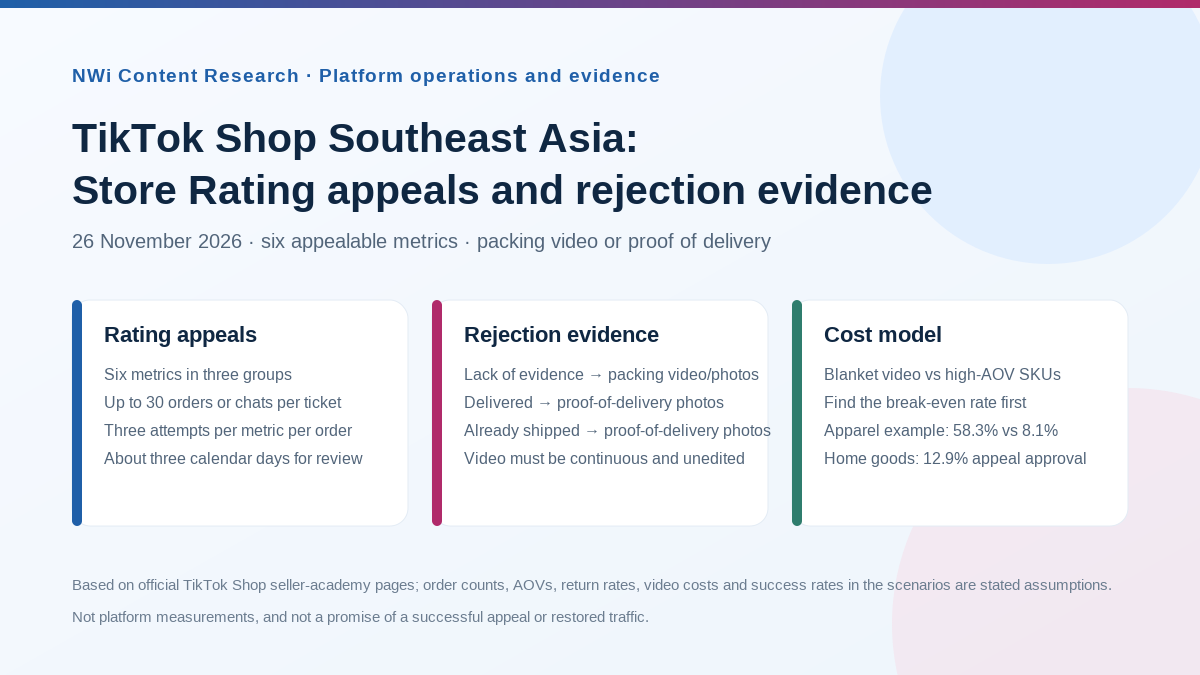
For sellers on TikTok Shop in Thailand, Indonesia and other Southeast Asian markets — with hundreds to thousands of orders a month and an AOV of roughly US$8–80, in apparel, home goods or low-priced accessories — the two changes announced on 26 November 2026 have to be read together. TikTok Shop has opened an appeal channel for six Store Rating metrics in Seller Center, rolling out to all sellers by December. When rejecting a buyer's aftersales request, choosing 'lack of evidence' now requires a packing video or photos, and choosing 'delivered to the address provided' or 'already shipped' requires proof-of-delivery photos. The real decision is whether to record a packing video for every order, only for high-value and high-risk SKUs, or accept more refunds to protect the rating — and which metrics deserve the three appeal attempts. This article uses two hypothetical scenarios to calculate the break-even, then sets out the fields to watch, the order of actions and the stop conditions before 12.12. The platform publishes no appeal success rate, metric weight or traffic effect, and none is invented here.
1. Two changes on 26 November: rating appeals and rejection evidence
Separate the two tracks. The first is the Store Rating appeal. TikTok Shop's 26 November 2026 policy update lists 'Appeal eligible Store Rating metrics in Seller Center'. The appealable metrics fall into three groups. Product Satisfaction: Negative Review Rate (NRR) and Seller-Fault Return/Refund Rate (SFRR). Fulfilment and Logistics: Fast Dispatch Rate (FDR) and Seller-Fault Cancellation Rate (SFCR). Customer Service: After-Sales Handling Time (AHT) and the 12-hour response rate.
The entry is Seller Center > Account Health > Store Rating. Sellers can use Appeal center in the top-right corner or Appeal order inside the Metric diagnosis tool. One ticket can contain up to 30 orders or chats. The same metric on the same order can be appealed up to three times; after three rejections the entry closes. TikTok generally reviews an appeal in about three calendar days, and an approved correction takes about one more calendar day.
The second track is rejection evidence. Rejecting an aftersales request with 'Lack of evidence' now requires a packing video or photos, and rejecting with 'The package has been successfully delivered to the shipping address that was provided' or 'Product has already been shipped, please wait for parcel to arrive' requires photos showing proof of delivery. The Thailand and Indonesia policy pages dated 26 November 2026 state this. This is evidence uploaded when rejecting a request, not evidence uploaded when appealing a platform decision; they are different tickets.
Scope matters. This article read the Thailand and Indonesia (TikTok Shop by Tokopedia) policy pages dated 26 November 2026 and the Singapore Returns And Refunds page updated on 24 November 2026, which carries the same rejection-evidence table. The pages do not say whether or when every other Southeast Asian market applies the change. Do not write that it took effect across all of Southeast Asia today.
2. Who is exposed first: three denominators, not one compliance slogan
The first group has a high seller-fault return/refund rate and a large share of rejections coded as 'lack of evidence'. Apparel, shoes and bags, and soft home goods often face size, colour and material-expectation gaps. If support agents routinely select 'lack of evidence' without a packing video, those rejections will lack evidence after 26 November.
The second group has a high average order value (AOV). Video cost is per order; the refund is per order value. The higher the AOV, the easier one successful rejection covers the cost of the evidence. Low-priced accessories are the opposite: recording, storing and retrieving a video can cost more than refunding the item.
The third group has logistics or platform faults attributed to the shop. Store Rating appeals cover non-seller-fault cases: malicious reviews, ratings given by mistake, false creator promotion, carrier delays and platform system errors. Late dispatch, wrong items and out-of-stock cancellations are not non-seller faults. An appeal does not change the facts, and repeated appeals consume the three attempts.
Watch two denominators. Store Rating is a ratio: the numerator is affected orders, the denominator is orders in the scoring window. An appeal corrects the metric; it does not recover cash already refunded. Refund approval and rating appeals are separate workflows, and one action does not solve both.
3. The cost model: calculate the evidence cost per recovered order
Write the problem so it can be recalculated. Let monthly orders be N, AOV be R, the seller-fault return/refund rate be r, the share of rejections coded 'lack of evidence' be s, the per-order video cost be c, and the share of evidence accepted by the platform be p. If every order gets a video, the monthly evidence cost is N × c; the monthly amount recovered is N × r × s × p × R; net benefit is N × r × s × p × R − N × c. The break-even acceptance rate is p* = c / (r × s × R).
The formula says: lower video cost, higher AOV, a higher seller-fault return rate and a higher 'lack of evidence' share make blanket recording more likely to pay; low AOV, a low return rate and a low 'lack of evidence' share make it likely to lose money. The two scenarios below plug in numbers; every number is a stated assumption, not platform or seller data. The article's increment is to turn 'record or not' from a compliance checklist into per-order evidence economics: use AOV, return rate, evidence cost and acceptance rate to find the break-even, then choose the SKU scope.
Scenario A: apparel seller, 1,500 orders a month, US$25 AOV (hypothetical)
Assumptions: 1,500 orders a month, US$25 AOV, a 4% seller-fault return/refund rate (60 orders a month), 60% of those rejected as 'lack of evidence' (36 orders a month), a US$0.35 per-order video cost, a 30% evidence acceptance rate, and no extra labour or storage cost.
Result: blanket video costs 1,500 × 0.35 = US$525 a month; recovered amount is 36 × 30% × 25 = US$270; net benefit is 270 − 525 = −US$255 a month. The break-even acceptance rate is 0.35 ÷ (4% × 60% × 25) = 58.3%, meaning 21 of the 36 rejections must succeed to break even. If video covers only the 20% of orders with a US$60 AOV that account for 60% of the 36 'lack of evidence' rejections: cost is 300 × 0.35 = US$105; recovered amount is 21.6 × 30% × 60 = US$388.80; net benefit is +US$283.80 a month, and the break-even acceptance rate falls to 8.1%.
Decision: under these assumptions, do not record every order. Start with high-AOV SKUs that have a high 'lack of evidence' share, run the test for two weeks, and use the actual acceptance rate to decide whether to expand.
Scenario B: home-goods seller, 800 orders a month, US$80 AOV (hypothetical)
Assumptions: 800 orders a month, US$80 AOV, a 1.5% seller-fault return/refund rate (12 orders a month), another 20 orders a month attributed to logistics or platform errors, video only for the top 20% of orders by value (160 orders), a US$0.35 per-order video cost, 10 hours of appeal labour a month at US$15 an hour, and a 50% approval rate on the 20 appeals.
Result: video costs 160 × 0.35 = US$56; appeal labour costs 10 × 15 = US$150; total US$206. Appeals recover 20 × 50% × 80 = US$800; if 4.8 of the high-value orders are 'lack of evidence' rejections and 30% succeed, another 1.44 × 80 = US$115.20 is recovered. Total recovery is US$915.20, a net benefit of +US$709.20 a month. The break-even appeal approval rate is 206 ÷ (20 × 80) = 12.9%.
Decision: appeal the 20 cases with complete logistics or platform evidence first, then record video for high-value SKUs. If the approval rate stays below 12.9% for two consecutive months, stop bulk appeals and fix dispatch and aftersales processes instead.
4. Fields to watch and the order of actions before 12.12
Watch at least six fields: the current value and affected-order count for each of the six Store Rating metrics; the seller-fault return/refund rate and the mix of rejection reasons, especially 'lack of evidence' and the two delivery reasons; AOV, unit contribution and refund value; the per-order video cost including recording, storage, retrieval and labour; appeal outcomes and review days; and the 12.12 order peak and warehouse packing rhythm.
- Step one: export the last 90 days of affected orders, classify them by the six metrics and rejection reason, and calculate rejections per 1,000 orders, AOV and the 'lack of evidence' share.
- Step two: build continuous packing video only for high-AOV, high-rejection SKUs. The frame must show the order or tracking number, the full quantity, the packing process and the label; the video must be continuous, clear and unedited.
- Step three: appeal logistics or platform errors. One ticket holds up to 30 orders; the same metric on the same order gets three attempts; evidence must match the order ID, buyer information and time.
- Step four: review weekly. Track appeal approval rate, rejection success rate, video cost and recovered amount; if two weeks show no positive net benefit, narrow the scope.
Write the stop conditions down: if recovered amount minus video cost and labour is negative for two consecutive weeks, stop blanket or expanded recording; if the appeal approval rate is below your break-even, stop bulk appeals for that metric and fix late dispatch, wrong items or stockouts first; if the video cannot continuously show the order number and the product, do not submit it and waste one of three attempts; if the refund is seller-caused, do not use an appeal to hide it — fix the process.
5. Counter-cases and boundaries: when not to record and not to appeal
Counter-case one: low AOV. For an accessory seller with a US$8 AOV and a 6% return rate, one refund is US$8, while recording, storing and retrieving a compliant video can cost more. Accepting the refund and improving the description may be cheaper than blanket recording.
Counter-case two: seller fault. Late dispatch, wrong items and out-of-stock cancellations are not non-seller faults. An appeal does not change the facts, and repeated appeals consume the three attempts.
Counter-case three: the feature is not fully rolled out. The Indonesia policy page says all sellers by 1 December 2026, while the how-to page says by December 2026; some sellers may not see the entry yet. Do not write that every seller can appeal today.
Counter-case four: two different systems. The Southeast Asia Store Rating appeal is not the US SPS appeal; do not apply US metric windows, reasons or evidence rules to Southeast Asia.
Counter-case five: platform approval is not external compliance. Passing a platform review does not stop customs, consumer-protection or civil claims, and video evidence must not be faked, edited or mismatched.
6. Method, sources and unknowns
Definitions: this article relies on TikTok Shop's official seller-academy pages. The Store Rating appeal mechanics come from 'How to Appeal Your Store Rating Metrics' (Indonesia/Tokopedia, page updated 26 November 2026, accessed 27 November 2026): six metrics in three groups — Product Satisfaction (NRR, SFRR), Fulfilment and Logistics (FDR, SFCR), Customer Service (AHT, 12-hour response rate); up to 30 orders or chats per ticket; up to three appeals per metric per order; about three calendar days for review and one more for a correction. The rejection-evidence change comes from the 'Latest Policy Updates' pages for Thailand and Indonesia/Tokopedia (both updated 26 November 2026, accessed 27 November 2026): 'lack of evidence' requires a packing video or photos, and the two delivery reasons require proof-of-delivery photos. The full-rollout date is '1 December 2026' on the Indonesia policy page and 'by December 2026' on the how-to page; the article keeps the discrepancy. The Singapore 'Returns And Refunds' page (updated 24 November 2026) is used to cross-check the same rejection-evidence table, not to infer other markets. Calculation: monthly evidence cost = orders × per-order video cost; monthly recovery = orders × seller-fault return/refund rate × 'lack of evidence' share × evidence acceptance rate × AOV; net benefit = recovery − evidence cost; break-even acceptance rate = per-order video cost ÷ (seller-fault return/refund rate × 'lack of evidence' share × AOV). All order counts, AOVs, return rates, video costs, labour costs and success rates are stated assumptions, not TikTok Shop or NWi measurements. The platform publishes no appeal success rate, metric weight or traffic effect, and none is added.
Product boundary: NWi CrossborderGo provides market, category, brand, store and product data for TikTok Shop and other platforms (monthly, by contract). It can rank SKUs by sales, units, AOV and price band to decide which SKUs justify video and appeal labour; it does not provide Store Rating, appeal outcomes, Seller Center data or aftersales evidence, and it cannot guarantee a successful appeal or restored traffic. See /platforms/tiktok-shop/, /product/ and /demo/.
Unknowns remain. The platform publishes no appeal success rate, no weight for the six metrics, no measured effect of a correction on traffic or campaign eligibility, no review time for rejection evidence, and no specific penalty for missing evidence. The AOV, return rate, video cost, labour cost and success rates in this article are assumptions; replace them with your own Seller Center export, settlement statements and ticket outcomes.
Sources: 1. TikTok Shop Academy (Indonesia/Tokopedia), Latest Policy Updates, updated 26 November 2026: read the original, accessed 27 November 2026; 2. TikTok Shop Academy (Thailand), Latest Policy Updates, updated 26 November 2026: read the original, accessed 27 November 2026; 3. TikTok Shop Academy (Indonesia/Tokopedia), How to Appeal Your Store Rating Metrics, updated 26 November 2026: read the original, accessed 27 November 2026; 4. TikTok Shop Academy (Singapore), Returns And Refunds, updated 24 November 2026: read the original, accessed 27 November 2026.
This article was prepared with automated research assistance from the public sources listed at the end and has not been reviewed by a human. It does not invent customer data, expert review, appeal success rates, traffic gains or platform endorsement. It is not legal, platform-operations or investment advice.