
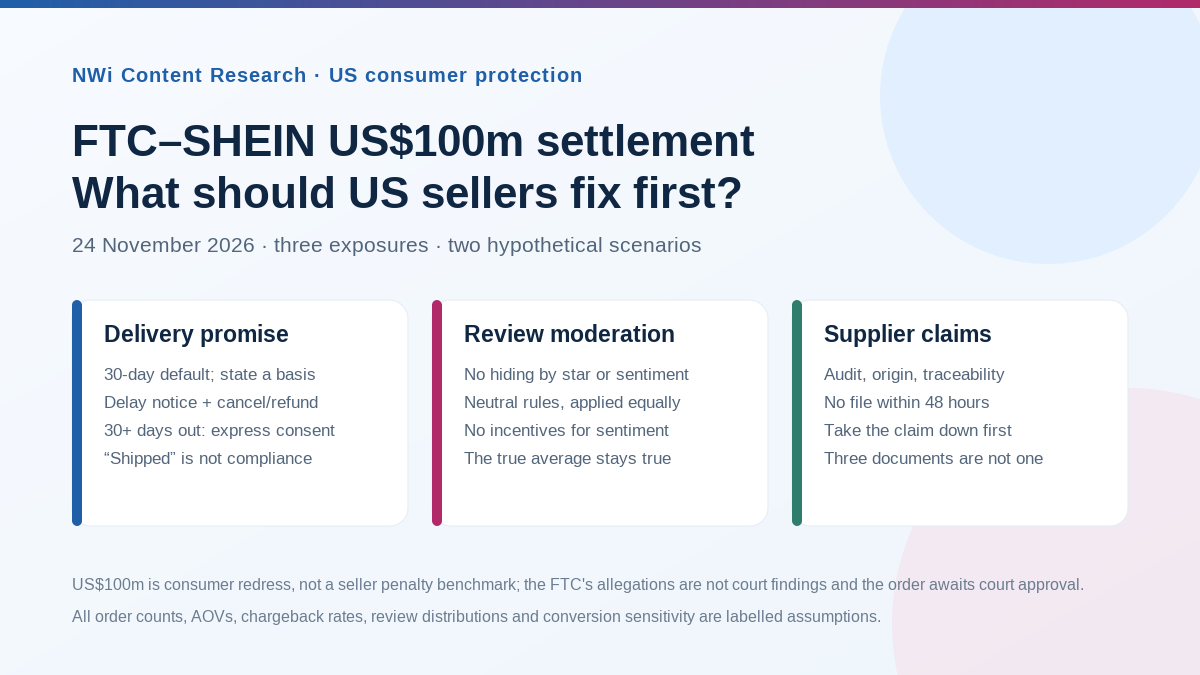
For cross-border sellers selling to US consumers — with delivery promises on the product page, displayed reviews, or claims such as 'audited suppliers' or 'US-grown cotton' — the useful lesson from the FTC's US$100 million consumer-redress settlement with SHEIN, announced on 24 November 2026, is not who was penalised. It is that the case puts three long-running exposures on one table: the delivery promise and delay notices, review moderation, and supplier-audit and country-of-origin claims. The decision is which to fix first, in what order, and when to stop. The answer is not 'full compliance'. It is to fix the claims and review rules that can be stopped immediately without waiting for data, then start the delivery-promise work that needs order data, because the shipping clock starts when a properly completed order is received. This article uses the US rule texts, SHEIN's HKEX announcement and two labelled scenarios to calculate the break-even on delay notices and the commercial cost of an honest review average. The FTC's allegations are not court findings, the proposed order is not in force, and the US$100 million is not a seller penalty benchmark.
1. The event: US$100 million is consumer redress, not a seller penalty benchmark
In its 24 November 2026 release, the FTC said SHEIN will pay US$100 million in consumer redress to settle allegations that it made purchase issues hard to resolve, failed to keep shipping promises, suppressed negative reviews, and made deceptive supply-chain and cotton-origin claims. The FTC says these practices violated Section 5 of the FTC Act, the Mail, Internet, or Telephone Order Merchandise Rule (16 CFR Part 435, MITOR) and the Rule on the Use of Consumer Reviews and Testimonials (16 CFR Part 465). The Commission voted 2-0 to file the complaint and proposed order in the US District Court for the Central District of California. A stipulated final order has the force of law only when the court approves and signs it.
SHEIN's HKEX announcement on 25 November 2026 confirms the agreement of 24 November, effective on court approval. SHEIN will pay US$100 million to the Treasurer of the United States within 30 days after the agreement takes effect. The announcement says the agreement is not an admission of the FTC's allegations and that SHEIN continues to disagree with aspects of the FTC's characterisation. It also says the agreement is not expected to have a material adverse effect and does not restrict the normal conduct of the core business. Keep the two statements separate: the FTC describes what it alleges and what it wants; SHEIN describes what it agreed to pay and whether it admits the allegations.
The nature of the US$100 million matters. It is consumer redress, not a penalty formula scaled to a seller, and it is not every seller's potential exposure. The FTC release gives no seller-level delay distribution, review-suppression rate, audit-failure rate or refund rate. Dividing US$100 million by your own order count, or scaling from SHEIN's volume to your own penalty, has no basis. What transfers is the legal test for each of the three practices and the order in which to fix them.
The FTC release describes enforcement allegations, and the proposed order takes effect only after court approval; the public record gives no seller-level delay distribution, review-suppression rate, audit-failure rate or penalty benchmark.
2. Three exposures, three clocks: why 'full compliance' can wait too long
The clocks differ, and that is the starting point for sequencing. Supplier-audit and origin claims run on a 'claim clock': a statement needs a reasonable basis when it is made; there is no transition period and no 'wait until the audit is done'. Review moderation runs on a 'rule clock': Part 465 took effect on 21 October 2024, so hiding reviews by star or negative sentiment and buying sentiment-specific reviews are already covered. Delivery promises run on an 'order clock': MITOR starts when a properly completed order is received, and every order is running; a quarterly review is too late.
The real decision is whether to fix the delivery promise and delay notices, the review moderation, or the supplier-audit and country-of-origin claims first; the order depends on verifiability, time-to-fix and recurring cost.
So the first week is not ordered by 'which penalty is largest'. It is ordered by 'which can be stopped immediately' and 'which needs data'. Remove or qualify every audit and origin claim that cannot be supported by a document within 48 hours. Replace star- or sentiment-based review hiding with neutral criteria applied equally to all reviews. For delivery, start exporting 90 days of orders, promised windows, carrier scans and actual delivery dates today, so the distribution is visible before deciding how much to automate and whether to change the promise.
If the late rate and chargebacks are already high, start the delivery data work on day zero; do not wait for the other two. But 'start the data work' does not mean 'buy a system first'. Align seven fields — order, promise, scan, delivery, cancellation, refund and chargeback — and run a manual sample before automating. Compliance is not optional; the sequencing is about where the first week of limited attention goes, not whether to comply.
The article's increment is to turn an enforcement headline into a three-exposure sequencing problem: use verifiability, time-to-fix and recurring cost to decide what to fix first, with break-even arithmetic for delay notices and review display.
3. Delivery promises: the 30-day default, delay notices and the automatic-cancellation trap
MITOR is not a '30-day delivery guarantee'. It is a rule about what you promised at the point of sale and whether you had a reasonable basis for it. 16 CFR 435.2(a)(1) requires a reasonable basis at the time of solicitation to ship within the time clearly and conspicuously stated, or, if no time is stated, within 30 days after receipt of a properly completed order (50 days where the buyer applies for credit). A reasonable basis is not a guess: 435.2(a)(4) says a seller's failure to have records or documentary proof of systems and procedures that assure shipment in the ordinary course creates a rebuttable presumption that it lacked a reasonable basis.
If the seller cannot ship within the applicable time, 435.2(b)(1) requires a clear and conspicuous offer, without prior demand and no later than the applicable time, of either consent to a delay or cancellation with a prompt refund. A refund is generally due within seven working days (one billing cycle in some credit-account cases). The trap is the revised date. If the new definite date is 30 days or less later than the applicable time, the buyer is deemed to consent unless they reject the delay before shipment and before the new date. If the new date is more than 30 days later, or the seller cannot give a definite date, the order is automatically deemed cancelled unless the seller ships within 30 days of the applicable time and receives no cancellation, or the buyer expressly consents within those 30 days.
That is why a generic 'your order is delayed, please wait' email is not enough. If the new date is more than 30 days out, the seller needs express consent, not deemed consent. If the seller wants to stay within 30 days, the notice should state the new definite date, the right to cancel and obtain a refund, and the default consequence of no response. A marketplace 'shipped' status is not on-time shipment under MITOR; the clock starts at receipt of a properly completed order, and customs or carrier delays explained only afterwards do not replace the seller's own notice, refund and records. If the seller is the merchant of record, the platform status does not answer the rule.
A notice is not done when it is sent. The seller needs records of when it was sent, the new date, the cancellation/refund option, the buyer's response and the refund date. 435.2(d) also creates a records presumption for delay notices and cancellations. Putting these fields into the order and customer-service systems is more useful than polishing the template.
MITOR starts the clock when a properly completed order is received: absent a clearly stated time, shipment is due within 30 days, and any stated time needs a reasonable basis; if the seller cannot ship on time, it must offer a delay consent or a cancellation and refund by the applicable time.
4. Review moderation: not 'publish every bad review', but 'same rule, no sentiment filter'
Part 465.7(b) prohibits a business from materially misrepresenting that the reviews displayed in a review section represent most or all submitted reviews when reviews are suppressed by rating or negative sentiment. It does not require publishing every review. It requires not implying that a sentiment-filtered set is the whole set. The rule lists criteria that can be applied equally to all reviews without regard to sentiment: trade secrets or confidential commercial or financial information; defamatory, harassing, abusive, obscene, vulgar or sexually explicit content; another person's personal information or likeness; discriminatory content; clearly false or misleading content; a reasonable belief that a review is fake; or content wholly unrelated to the product or service.
Three changes follow. First, check the default rules in the review widget or third-party plugin: 'hide below X stars', 'hide negative keywords', 'feature only positive reviews' are sentiment filters. Replace them with neutral criteria and keep the rule text and the reason for each removal. Second, stop offering gift cards, discounts, cashback or prizes for 'good' reviews; 465.4 prohibits buying reviews that express a particular sentiment, positive or negative. Third, invite reviews from all buyers under one rule, without screening the audience or signalling the star rating you want.
The risk is not 'too many bad reviews'. It is an inconsistent rule plus an implied 'these are all the reviews'. A workable check: take 20 hidden reviews at random and ask, for each, which neutral criterion it triggered, whether that criterion applies equally to all reviews, and whether publishing the rule would change what is displayed. If the answers are vague, restore the reviews and fix the product or service rather than tuning the filter.
5. Supplier audits and origin claims: if you cannot produce the file in 48 hours, take the claim down
The FTC's supply-chain allegations give two concrete examples. SHEIN marketed evoluSHEIN products as coming from suppliers with above-average ratings in social-compliance audits, but the FTC alleges SHEIN failed to provide a single audit that supported the claim. SHEIN represented some cotton as US-grown, but the FTC alleges that cotton was found to originate from China, and that some cotton could not be traced to any country of origin. These are allegations, not court findings. They still show the test: every 'audit', 'above average' or 'US cotton' statement needs a document that matches the supplier, product, period and specific conclusion.
Three kinds of document are not interchangeable. A social-compliance audit (child labour, forced labour and similar) is not product-safety compliance (US CPSC rules, EU EN71 standards and similar), and neither is an origin-traceability file (where the cotton came from, where it was processed, how it is proved). A supplier questionnaire, a one-page self-declaration or a certificate with no scope or expiry date does not support 'above-average audit rating' or 'US-grown'. An origin claim needs purchase records, processing or warehouse records, certificates of origin and shipping documents that form a chain. 'US-grown cotton' is an origin claim, not a marketing adjective.
The 48-hour rule: if you cannot produce the supporting file now, take the claim down or qualify it to what you can prove; do not wait for a new audit. Audits take weeks; the claim is on the page today. Prioritise by claim exposure times SKU sales: use market data to rank high-sales, high-exposure SKUs, but the documents themselves must come from the supply chain, not from market data.
6. The break-even on delay notices (hypothetical)
Scenario A: US apparel seller, 10,000 orders a month, 7-day delivery promise (hypothetical)
Assumptions: 10,000 orders a month, US$45 AOV, US$13.50 contribution per shipped order; 8% of orders exceed the 7-day window (800 a month); 150 chargebacks a month at US$60 each (US$45 order value plus an assumed US$15 fee); 25% of late orders contact support at US$6 per contact; proactive notices cover 800 orders at US$0.10 each; 20% of late orders cancel before shipment; chargebacks fall 60%; support contacts fall 50%.
Result: current monthly cost is 150 × 60 + 200 × 6 = US$10,200; after notices it is 60 × 60 + 100 × 6 + 160 × 13.50 + 800 × 0.10 = US$6,440, a saving of US$3,760. The break-even cancellation rate is (10,200 − 3,600 − 600 − 80) ÷ (800 × 13.50) = 54.8%; a reduction of about 38 chargebacks (from 1.5% to about 1.12%) covers the notice and cancellation cost.
Decision: automate the delay notice and the cancel/refund option, and run it for two months; if the cancellation rate exceeds 54.8% or chargeback cases fall by less than 25%, stop expanding it and change the promise window, carrier or warehousing instead of dropping the notice.
In Scenario A, proactive notices on 800 late orders cut the monthly cost from US$10,200 to US$6,440; the cancellation rate must exceed 54.8% to erase the benefit, while a 25% reduction in chargeback cases already covers the notice and cancellation cost.
The formulas: current monthly cost = chargeback cases × (AOV + chargeback fee) + late-order support contacts × cost per contact; notice-path cost = reduced chargeback cost + reduced support cost + cancellations × contribution per order + notices × cost per notice. Break-even cancellation rate = (current cost − notice-path fixed cost) ÷ (late orders × contribution per order); break-even chargeback reduction = (cancellation cost + notice cost) ÷ cost per chargeback. Every input is an assumption; replace it with your own order, chargeback and support data and the conclusion may reverse.
The notice is a legal requirement, not an option. The model is for deciding how much to automate, how to staff support and whether to change the promise window, not for deciding whether to send the notice. If the model says cancellations will exceed the break-even, the right move is to change the promise window, carrier or warehousing, not to stop notifying.
7. Putting hidden low-star reviews back: the average and the badge (hypothetical)
Scenario B: home-goods seller, 600 reviews, 4.6 displayed average, 100 low-star reviews hidden (hypothetical)
Assumptions: 500 displayed reviews at a 4.6 average; another 100 reviews hidden by star rating, of which 60 are one-star and 40 are two-star; a platform badge threshold of 4.2 stars; 20,000 sessions a month, 3% baseline conversion and US$13.50 contribution per order; each 0.1-star drop is assumed to reduce conversion by 1.5%.
Result: the true average is (500 × 4.6 + 60 × 1 + 40 × 2) ÷ 600 = 4.07 stars, 0.53 below the displayed 4.6; at 1.5% per 0.1 star, conversion falls by about 8.0%, and monthly contribution falls by 20,000 × 3% × 8.0% × 13.50 = US$648. At a 4.2-star badge threshold, 4.07 stars also puts the badge at risk; that loss is not included in the US$648.
Decision: stop hiding reviews by star or sentiment; move to neutral criteria applied equally to all reviews, accept the 4.07 average, and spend 90 days fixing the top three complaint reasons while inviting every buyer under one rule; if the average is still below 4.2 after 90 days and the channel requires it, delist or rebuild the SKU rather than restore suppression.
The formulas: true average = (displayed count × displayed average + hidden count × hidden average) ÷ total count; conversion effect = star gap ÷ 0.1 × assumed effect per 0.1 star; monthly contribution loss = monthly sessions × baseline conversion × conversion drop × contribution per order. The 1.5% is an assumption, not a platform-published elasticity; the 4.2-star badge threshold is also an assumption, and the real threshold depends on the channel.
The point is not that honesty always pays. It is that suppression converts a legal risk into a hidden commercial risk: the true average, conversion and badge eligibility do not disappear when the reviews are hidden; they show up somewhere else. Accept the true average first, then you know whether to fix sizing, material, colour, delivery or the description. If the true average is still below the channel threshold, the right move is to change the product, change the channel or delist, not to restore star-based suppression.
8. Counter-cases and boundaries: what makes it worse
A marketplace 'shipped' status is not on-time shipment under the rule; the clock starts at receipt of a properly completed order, and customs or carrier delays explained only afterwards do not replace the seller's own records.
Counter-case 1: treating 'publish every bad review' as compliance. Part 465 allows neutral hiding of abuse, privacy, clearly false or unrelated content; the problem is an inconsistent rule plus an implied 'all reviews'. Publishing everything does not make you compliant, and it may leave private or abusive content on the page.
Counter-case 2: an 'above-average audit rating' without the underlying audit is worse than saying nothing. The report must match the supplier, product, period and specific rating; an expired report, a report outside the scope, or a conclusion without a method does not support the claim. A social-compliance audit also does not prove product safety or cotton origin.
Counter-case 3: treating US$100 million as your own potential fine. It is platform-level consumer redress, not a seller penalty formula; the FTC's allegations are not court findings and the proposed order is not in force. A small seller cannot scale its exposure from SHEIN's volume, order count or customer-service staffing.
Counter-case 4: transplanting the EU Temu commitments to the US. EU consumer-protection commitments, platform remediation and the US FTC's MITOR/Part 465 have different legal bases, enforcers and timetables; cross-jurisdiction copying produces wrong conclusions.
Counter-case 5: treating 'nearly one million packages a day and five telephone agents as of September 2025' as a staffing benchmark. That figure in the FTC release is an allegation about SHEIN, not an industry benchmark or an NWi measurement. It shows the severity of a platform-level service gap; it does not tell you how many agents your store needs.
9. Fields to watch, action order and stop conditions
In the first week, do three things: remove or qualify every audit and origin claim that cannot be supported by a document within 48 hours; replace star- or sentiment-based review hiding with neutral criteria applied equally to all reviews; and export 90 days of promised-versus-actual delivery data.
Watch at least six sets of fields. First, the promise and its basis: the time shown on the product and checkout pages, the carrier and service level, and the document that supports the promise. Second, per-order carrier scans, actual delivery and days beyond the promise. Third, the delay-notice log: send time, new date, cancellation/refund option, buyer response and refund date. Fourth, chargebacks and complaints: reason code, order value, fee and outcome. Fifth, the review rule: which reviews are hidden, which neutral criterion was triggered, and the displayed versus true count and average. Sixth, the claims register: each audit/origin claim, its supplier, product, document, scope, expiry and file location.
| Exposure | Document you must be able to produce | First action | Stop condition |
|---|---|---|---|
| Delivery promise | Basis for the promised window, carrier scans, notice and refund records | Export 90 days of orders and calculate the late distribution; send the notice with a new date and the cancel/refund option by the applicable time | Cancellation rate above break-even, or chargeback-case reduction below 25%: stop expanding, change the promise/carrier/warehousing, but do not stop the legally required notice |
| Review moderation | Rule text, reasons for hiding, displayed and true counts and averages | Stop hiding by star or sentiment; move to neutral criteria and keep a log | True average below the channel threshold: fix the product/description or delist; do not restore sentiment filtering |
| Supplier/origin claim | Audit report, certificate of origin, purchase/processing/shipping records | Take down or qualify any claim that cannot be supported within 48 hours | Document scope does not cover the supplier/product/period: keep the claim down until a matching document exists |
- Days 0–2: build the claims register. List every audit, above-average, US-cotton or traceability statement on pages, listings, A+ content and creator scripts; match each to a document; take down or qualify anything you cannot support.
- Days 0–3: audit the review rule. Find settings such as hide below X stars, hide negative keywords or feature only positive reviews; replace them with neutral criteria applied equally to all reviews; stop incentivising reviews; keep the rule text and the hiding log.
- Days 0–7: export 90 days of orders. Include order ID, order time, promised window, ship time, carrier scan, actual delivery, cancellation, refund and chargeback; calculate the late rate, late-day distribution, chargeback rate, support-contact rate and cost per order.
- Days 7–30: run a notice sample. Pick one warehouse or carrier, send notices by the applicable time, and record cancellation rate, chargeback rate, support contacts and refund time; replace the assumptions in Scenario A with the actual results.
- Days 30–90: change the promise or the supply chain. If lateness concentrates in a carrier, warehouse or SKU, fix those first; if the true review average is below the channel threshold, fix the top three complaint reasons; audit only high-sales, high-exposure suppliers and keep the other claims down.
Write the stop conditions down: a claim without a document stops immediately, without waiting for an audit; a review rule that filters by star or sentiment stops immediately, and is not restored because the average falls; if the notice sample exceeds the break-even cancellation rate or misses a 25% reduction in chargeback cases, stop expanding and change the promise/carrier/warehousing, but do not stop the legally required notice; if the audit scope does not cover the supplier, product or period, keep the claim down; if the true average is below the channel threshold after 90 days of remediation, assess delisting or a channel change rather than buying back the average with suppression.
10. Method, sources and unknowns
Definitions: the event facts come from the FTC release 'SHEIN to Pay $100 Million Over Allegations of Deceptive and Unfair Practices' (24 November 2026, read in full on 27 November 2026). SHEIN's agreement, payment timing, effective-on-court-approval and no-admission language come from its HKEX announcement 'INSIDE INFORMATION — UPDATE ON THE U.S. FEDERAL TRADE COMMISSION INVESTIGATION' (SHEIN Global Holdings Limited, 25 November 2026, two-page PDF, read in full the same day). The shipping rules come from the current eCFR text of 16 CFR Part 435 (source 79 FR 55619, 17 September 2014; eCFR up to date as of 24 November 2026, read in full on 27 November 2026): the 30-day default, the reasonable-basis requirement for a stated time, the delay-notice and cancel/refund mechanics, the revised-date rules, the seven-working-day refund standard and the records presumption. The review rules come from the current eCFR text of 16 CFR Part 465 (source 89 FR 68077, 22 August 2024; effective 21 October 2024; eCFR up to date as of 24 November 2026, read in full the same day): 465.7(b) on suppression by rating or negative sentiment and the neutral-criteria exception, and 465.4 on sentiment-based review incentives. The FTC complaint and proposed-order PDFs returned 404 or an unsupported PDF type on direct fetch; this article does not cite either PDF and does not state details that appear only in them. The proposed order's effect is described from the FTC release. Calculation: Scenario A current monthly cost = chargeback cases × (AOV + chargeback fee) + late-order support contacts × cost per contact; notice-path cost = reduced chargeback cost + reduced support cost + cancellations × contribution per order + notices × cost per notice; break-even cancellation rate = (current cost − notice-path fixed cost) ÷ (late orders × contribution per order); break-even chargeback reduction = (cancellation cost + notice cost) ÷ cost per chargeback. Scenario B true average = (displayed count × displayed average + hidden count × hidden average) ÷ total count; conversion effect = star gap ÷ 0.1 × assumed effect per 0.1 star; monthly contribution loss = monthly sessions × baseline conversion × conversion drop × contribution per order. Every order count, AOV, contribution, chargeback rate, cancellation rate, support cost, review distribution, conversion sensitivity and badge threshold is a labelled assumption, not an FTC, SHEIN, platform or NWi measurement. NWi CrossborderGo provides market, category, brand, store and product data to rank SKUs by sales and price band; it does not provide order-level delivery, customer-service tickets, review-moderation logs, supplier audits, origin documents or settlement data, and product data does not replace compliance judgement.
This article has no reader order, delivery, review, supplier-audit or settlement data; every order count, AOV, cancellation rate, chargeback rate and review distribution is a labelled assumption, not an FTC, SHEIN or NWi measurement.
Product boundary: NWi CrossborderGo provides market, category, brand, store and product data across Amazon, TikTok Shop, Shopee, Lazada, Temu and Walmart (monthly, subject to contract authorisation), which can rank SKUs by sales and price band to decide which supplier claims or high-delay SKUs to review first. It does not provide order-level promised-versus-actual delivery, customer-service tickets, review-moderation logs, supplier audit reports, cotton-origin documents or settlement data, and it does not guarantee compliance or reduce a penalty. See [/product/](/product/), [/products/](/products/) and [/demo/](/demo/).
Unknowns: the FTC has not published a seller-level delay distribution, review-suppression rate, audit-failure rate, refund rate or penalty benchmark; the court approval timing, final terms and any follow-on enforcement are unresolved; and the materials read here do not say whether platforms will change review widgets, delivery measures or seller liability. This article has no reader order, delivery, review, supplier-audit or settlement data; every number is an assumption, and a real decision needs the reader's own order export, customer-service tickets, review back office and supplier files.
Sources: 1. FTC, “SHEIN to Pay $100 Million Over Allegations of Deceptive and Unfair Practices”, 24 November 2026: read the release, accessed 27 November 2026; 2. eCFR, “16 CFR Part 435 — Mail, Internet, or Telephone Order Merchandise”, up to date as of 24 November 2026: read the rule, accessed 27 November 2026; 3. eCFR, “16 CFR Part 465 — Rule on the Use of Consumer Reviews and Testimonials”, up to date as of 24 November 2026: read the rule, accessed 27 November 2026; 4. SHEIN Global Holdings Limited, “INSIDE INFORMATION — UPDATE ON THE U.S. FEDERAL TRADE COMMISSION INVESTIGATION”, 25 November 2026: read the announcement, accessed 27 November 2026.
This article was prepared with automated research assistance from the public sources listed at the end and has not been reviewed by a human. It does not invent customer data, expert review, ranking effects, penalty amounts or platform endorsement. It is not legal, compliance, tax, platform-operations or investment advice.