
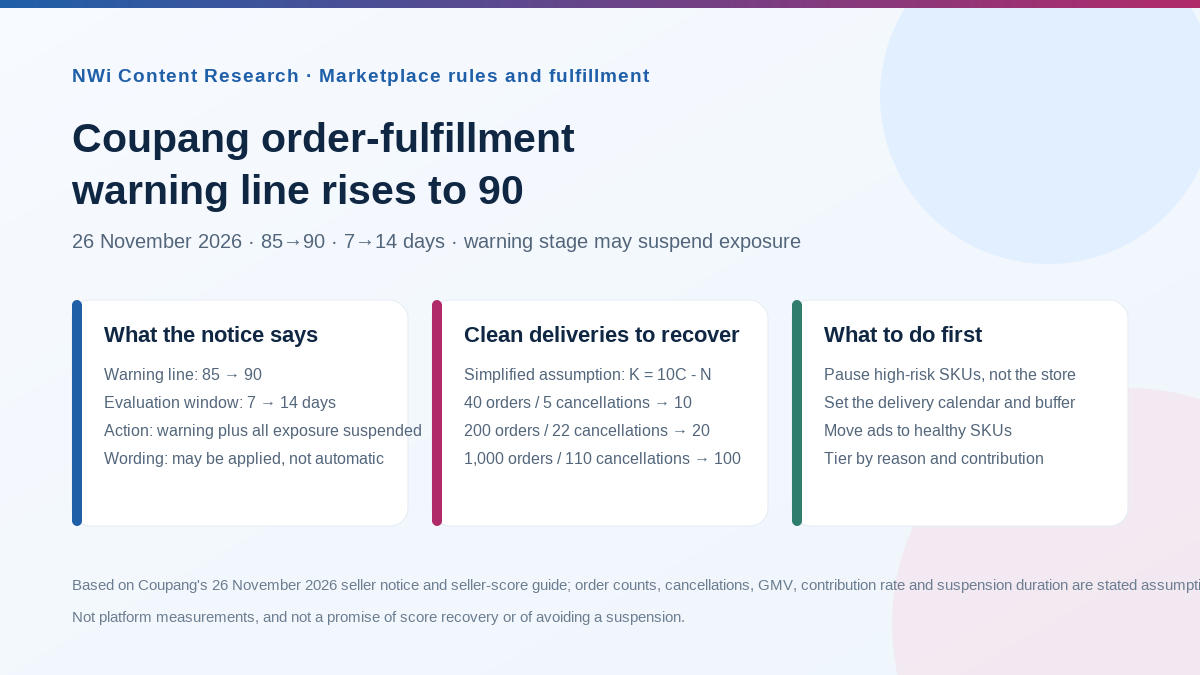
For a seller on Coupang’s Korean marketplace who has hovered around 89 points over the past 14 days and has peak-season stock and ad budget committed, the 26 November 2026 notice changes the question from “how do I protect 90 points” to “which SKUs do I pause, which delivery-calendar dates do I fix, and where do I move ad spend before a possible full exposure suspension.” Coupang’s seller notice raises the warning line from 85 to 90, lengthens the evaluation window from 7 to 14 days, and describes the warning-stage action as “warning and suspension of all product exposure.” The notice says the action may be applied, so it is not an automatic store shutdown. The current seller-score guide already lists a 14-day window and a below-90 warning band, and says exposure of all products on sale may be limited at the warning stage. This article uses three order-count tiers to calculate how many clean deliveries return an 89-point seller to 90, then compares the expected loss from a full suspension with pausing only high-risk SKUs. It does not treat 90 as a 10% cancellation rate, and it does not invent Coupang’s formula, seller data or restoration timeline.
1. The event: the 26 November notice turns “sales restriction” into “suspension of all product exposure”
Coupang Marketplace published the notice “판매자점수 ‘주문이행’ 평가 기준 강화 안내” (strengthening the order-fulfillment criteria in the seller score) on 26 November 2026 and states that it takes effect from that day. The notice puts three changes in one table: the warning line moves from “below 85” to “below 90”; the evaluation period moves from “the past 7 days” to “the past 14 days”; and the warning-stage action moves from “warning and sales restriction” to “warning and suspension of all product exposure.” The notice keeps the wording “적용될 수 있습니다” (may be applied) and cites Article 16 of the Customer Service Handling Standards.
In operating terms, for this metric alone: under a 7-day window, a seller with a few bad cancellation days could stay above 85 and avoid a warning; under a 14-day window at 90, two weeks of cancellations stay in the score. The old warning-stage consequence was a sales restriction; the notice now states it as a suspension of all product exposure. For a seller who has already committed stock and ads before the December peak, this is not a question of whether the score looks good. It is a question of whether to shrink proactively before a possible suspension.
| Item | Before, as stated in the notice | After, as stated in the notice |
|---|---|---|
| Warning line | Order fulfillment below 85 | Below 90 |
| Evaluation period | Past 7 days | Past 14 days |
| Warning-stage action | Warning and sales restriction | Warning and suspension of all product exposure |
| Where to check | WING > Seller Information > Seller Score | Same |
The table is the notice’s wording, not Coupang’s complete public rule. The current “판매자 점수 알아보기” guide already describes the order-fulfillment window as “the past 14 days, by cancellation completion time” and the warning band as “below 90”; it also says that at the warning stage, “exposure of all products on sale may be limited.” The guide has no publication date, so it supports the current wording but cannot prove when the 90-point line began. The notice describes the prior standard as 85/7, while the current guide shows 90/14; the public pages do not explain whether the notice reused an old template or the guide was updated early. Sellers should not treat 26 November as the first day the 90-point line existed, and should not ignore the notice’s clearer suspension wording because they have heard about a similar change before.
2. The mechanism: a 14-day window keeps one stockout in the score longer
The order fulfillment score is based on orders delivered without cancellation, and seller-fault cancellations enter the 14-day window when the cancellation is completed, so one bulk stockout stays in the score longer. The guide names “seller-fault cancellations” as the score-lowering event: out of stock, delayed shipment, operational error and other seller responsibility. When those cancellations are marked complete, the score falls. The guide does not publish the numerator and denominator details: how partial cancellations on multi-item orders are counted, whether buyer cancellations enter the denominator, whether reasons are weighted, or whether there is a minimum order count.
A 14-day window works in two directions. First, it dilutes single-day noise: five cancellations in one day are 1/7 of a 7-day window but 1/14 of a 14-day window, so one bad day does not move the score as sharply. Second, it keeps a bulk stockout longer: if 50 cancellations are completed on one day, they stay in the 14-day window for 14 days; if they are spread over 10 days, the tail of the last cancellation can push the effect to day 24. For peak-season sellers, the second direction matters more, because stockouts rarely arrive one at a time; a single SKU can sell through in an afternoon.
The guide also separates domestic and overseas shipping. Order fulfillment is a common metric; on-time shipment is a penalty item only for domestic shipping, and on-time delivery only for overseas shipping; a reply within 24 hours is not a penalty item but may affect exposure ranking. For cross-border sellers, the order-fulfillment score still applies, and on-time delivery is a separate metric to watch. “I shipped on time” is not the same as “my score will not fall.”
3. The evidence boundary: 90 is not a 10% cancellation rate, and the notice is not an automatic shutdown
The real question is not whether 90 is a high score, but how many seller-fault cancellations remain in the 14-day window, which SKUs are most likely to cancel again, and whether to pause SKUs, fix the delivery calendar, cut ads or wait for the score to recover. First, 90 is not a synonym for a 10% cancellation rate. The score is based on the share of orders delivered normally, but Coupang does not publish whether buyer cancellations enter the denominator, how multi-item orders are split, or how partial cancellations are weighted. Converting 90 directly into “at most 10% cancellations” is a simplifying assumption, not the platform formula. Every calculation in this article uses that assumption and labels it in each scenario.
Second, below 90 is a warning line, not an automatic full-store suspension. Coupang does not publish the formula, a minimum order count, the weighting of partial cancellations, the treatment of buyer cancellations, the appeal path or a restoration timeline; the notice says the action may be applied, not that a store is automatically suspended. The public pages do not say whether a suspension will be applied, how long it lasts, whether it covers all or some products, or what evidence is needed to restore exposure. Sellers should rely on the WING seller-score page, the warning email sent to the representative mailbox and the actual notice under Article 16 of the Customer Service Handling Standards. This article has no WING access and did not read Article 16, so it does not state that a score below 90 always suspends a store.
Third, the notice’s “prior standard 85/7” does not match the guide’s current “90/14.” The guide is undated and the notice does not explain the difference. Sellers should not infer which version applies to their account from either date; they should look at the score history in WING and the evaluation period stated in the warning email.
Fourth, the guide’s seller-score FAQ and exposure-restoration links require a seller login. This article did not log in, so it does not cite restoration conditions, appeal materials or review time. Any claim that a score “recovers in a few days” should not be treated as this article’s conclusion.
4. Counter-cases: who should not delist the whole store or stop all ads
The counter-case is a seller whose cancellations come mainly from buyer remorse or courier delays: delisting the whole store cannot fix the score and throws away orders that could still be fulfilled, along with ranking. Counter-case 1: cancellations come mainly from buyer remorse. The guide names seller-fault cancellations as the score-lowering event but does not publish how buyer cancellations are treated. If the reasons are a change of mind, a wrong address or a duplicate order, export them separately and confirm whether they actually enter the order-fulfillment score before delisting the store. Conversely, if the buyer cancels because the item is out of stock, the stockout is a seller-fault cause named in the notice; do not treat that cancellation as a safe “buyer cancellation.”
Counter-case 2: cancellations come mainly from the courier or platform logistics. The guide lists shipment delays and delivery delays as seller-responsibility situations, but courier scan delays, hub congestion and weather disruption are not always within the seller’s control. Delisting products cannot fix those cancellations; change the courier, the shipment lead time or the delivery calendar, and keep the scan records.
Counter-case 3: a seller with very few orders. In a 40-order window, one cancellation is 2.5 points; at 87.5, delisting the whole store can throw away orders that could still be fulfilled, and the score does not improve because the store is closed. A small seller should pause at the SKU level, not close the store.
Counter-case 4: a high-contribution SKU with enough stock. A full-store delisting interrupts the exposure, reviews and ad history of healthy SKUs; if cancellations are concentrated in two low-stock SKUs, pausing those two is enough.
Counter-case 5: stopping all ads. Ads do not cause cancellations, but they can push traffic to a SKU that is about to sell out. Move budget from high-risk SKUs to healthy SKUs instead of turning off the account.
Counter-case 6: one bulk stockout. In a 1,000-order window, 50 concentrated cancellations can pull 89 down to 84, but they are one SKU and one cause. If the batch will roll out of the 14-day window together, closing the whole store may cost more than waiting. Calculate the roll-out date before choosing the pause scope.
5. The arithmetic: how many clean deliveries return 89 to 90
Assumption first: simplify the score to S=(N-C)/N×100, where N is orders received in the window and C is seller-fault cancellations; multi-item orders, partial cancellations, buyer cancellations and weighting are excluded. This is not Coupang’s formula; it is a way to calculate how many clean deliveries are still needed.
Under the simplified order-share assumption, the number of clean deliveries needed to return from 89 to 90 equals 10 times seller-fault cancellations minus the orders in the window. Under this assumption, adding K clean deliveries with no new cancellations gives (N-C+K)/(N+K). To reach 90%, solve K=10C-N. Substituting C=(1-S)N gives K=(9-10S)N, with S as a decimal. The formula is used only when S is below 90%; the lower the score, the more clean deliveries are needed.
| Window orders N | Seller-fault cancellations C | Current score S | Approx. impact per cancellation | Clean deliveries K to 90.0 | Share of current window |
|---|---|---|---|---|---|
| 40 | 5 | 87.5 | 2.5 points | 10 | 25% |
| 200 | 22 | 89.0 | 0.5 points | 20 | 10% |
| 1,000 | 110 | 89.0 | 0.1 points | 100 | 10% |
K is the threshold that just returns the score to 90.0, not a safe target. Add 1–5 more deliveries or a larger buffer in practice, because the window may still contain open cancellations, refunds or delayed orders.
Now the bulk stockout: 1,000 orders, 110 cancellations, 89.0. If 50 more cancellations land in the same window, C becomes 160 and the score falls to 84.0; returning to 90.0 needs K=10×160-1,000=600 clean deliveries. The 50 cancellations do not just cost 5 points; they push the clean deliveries needed from 100 to 600. The non-linearity comes from the denominator growing: new cancellations and new clean deliveries both enter it.
The 14-day rolling window changes the result. The K above assumes N is fixed; in reality, old orders and old cancellations roll out and new orders roll in. If 50 cancellations are completed on one day, they roll out together after 14 days; if they are spread out, the tail is longer. Sellers should track the cancellation completion date, calculate the roll-out date first, and then decide how long to pause. The formula is a static snapshot, not a forecast of recovery time.
6. Scenarios: four sellers before peak season
All four scenarios are hypothetical examples. Order counts, cancellation reasons and scores are set for arithmetic, not measured by Coupang or NWi. Each gives assumptions, a result and a decision so you can replace them with your own data.
Scenario A: 200 orders, 22 seller-fault cancellations, current score 89.0 (hypothetical example) Assumptions: a 14-day window of 200 orders, all 22 cancellations are seller-fault, and buyer cancellations, partial cancellations and weighting are excluded; average order value, contribution rate and ad spend are separate. Result: 89.0, about 0.5 points per cancellation; the simplified formula needs 10×22-200=20 clean deliveries to return to 90.0, and 21–25 is a practical buffer. Decision: pause the two low-stock SKUs causing most cancellations, move ads to healthy SKUs and keep the rest live; 20 is the threshold, not the target.
Scenario B: 40 orders, 5 seller-fault cancellations, current score 87.5 (hypothetical example) Assumptions: a 14-day window of 40 orders and 5 seller-fault cancellations; if 2 are confirmed buyer remorse and Coupang excludes them, the seller-fault count is 3. Result: 87.5, about 2.5 points per cancellation; 10×5-40=10 clean deliveries are needed to return to 90.0, equal to 25% of the current window. Decision: pause the single SKU with the highest stockout risk and set the delivery calendar, not the whole store; if the 2 are buyer remorse, confirm the treatment with Coupang before keeping the pause.
Scenario C: 1,000 orders, 110 seller-fault cancellations, current score 89.0 (hypothetical example) Assumptions: a 14-day window of 1,000 orders and 110 seller-fault cancellations; 50 more stockout cancellations land in the same window, with buyer and partial cancellations excluded. Result: 89.0 needs 10×110-1,000=100 clean deliveries to return to 90.0; the 50 extra cancellations cut the score to 84.0 and require 10×160-1,000=600 clean deliveries to return to 90.0. Decision: ring-fence the 50 cancellations in a few SKUs, pause and replenish them, and keep healthy SKUs live; if the batch will roll out of the 14-day window, calculate the roll-out date before shutting the store.
Scenario D: 300 orders, 30 cancellations, exactly 90.0, of which 12 are buyer remorse (hypothetical example) Assumptions: a 14-day window of 300 orders and 30 cancellations; 12 are buyer remorse and 18 are seller-fault; Coupang does not publish whether buyer cancellations leave the denominator, so both treatments are tested. Result: if all 30 count, the score is exactly 90.0 and one more seller-fault cancellation cuts it to 89.67; if the 12 buyer cancellations are excluded, the seller-fault count is 18 and the score is about 93.75–94.0. Decision: export the reasons and confirm the 12 before acting; if they are buyer remorse, do not delist the store, fix only the SKUs and fulfillment behind the 18; if any are stockout cancellations, treat them as seller-fault.
The common point is not “pause everything.” It is to split cancellations by reason and SKU before choosing the pause scope. A and B have small windows, where one cancellation carries more weight, so pausing high-risk SKUs comes first. C has a large window, where one cancellation matters less but a bulk stockout has a long tail, so ring-fencing the SKU and replenishing comes first. D is exactly at 90.0 with no buffer, so confirm the buyer-cancellation treatment before deciding whether to pause.
7. The economics: full suspension versus pausing high-risk SKUs
This section compares two losses for a hypothetical Korea seller. Assume daily GMV of KRW 5,000,000 and a 15% contribution rate, or KRW 750,000 per day. A three-day full exposure suspension costs KRW 2,250,000; seven days costs KRW 5,250,000. Pausing high-risk SKUs that represent 10% of GMV for 14 days costs KRW 5,000,000×10%×15%×14=KRW 1,050,000.
| Option | Assumption | Loss |
|---|---|---|
| Full exposure suspension, 3 days | Daily GMV KRW 5,000,000; 15% contribution | KRW 2,250,000 |
| Full exposure suspension, 7 days | Same | KRW 5,250,000 |
| Pause high-risk SKUs at 10% of GMV, 14 days | Same | KRW 1,050,000 |
If the seller thinks a three-day full suspension has a 30% probability, the expected loss is 0.3×KRW 2,250,000=KRW 675,000, below the certain KRW 1,050,000 cost of the pause. In that case, “pause the highest-risk few SKUs and keep the rest live” is more reasonable. The break-even probability is KRW 1,050,000÷KRW 2,250,000≈46.7%: pausing 10% of GMV is worth it on expected value only if you judge the suspension probability to be above about 47%.
The model omits two things. First, pausing a SKU loses ranking, review accumulation and ad learning, which are not in the KRW 1,050,000; if the SKU is new or ads are ramping, the real cost is higher. Second, a full suspension also loses ad spend, customer lifetime value and post-peak recovery cost, which are not in the KRW 2,250,000; if the store depends on repeat purchase, the real cost is higher. Both point to the same action: do not choose between “pause everything” and “pause nothing”; tier SKUs by cancellation risk, contribution share and stock cover.
Probability, suspension duration, daily GMV, contribution rate and pause scope are all assumptions; Coupang has not published the trigger probability or duration of a suspension. The model compares orders of magnitude, not a forecast. The contribution is to separate the score line from the consequence wording, provide the clean-delivery formula for recovering from 89, and compare a full exposure suspension with pausing only high-risk SKUs using expected loss.
8. Action plan: 0–24 hours, 24–72 hours, 7–14 days
First export 14 days of cancellation reasons from WING and sort them by SKU, then pause or reduce SKUs whose stock cover is below replenishment lead time plus safety days, and finally move ads from high-risk SKUs to healthy SKUs. 0–24 hours: confirm the current score, evaluation period and warning status in WING > Seller Information > Seller Score, and save screenshots of the warning email, in-app notice and representative mailbox. Export 14 days of orders and cancellations with order ID, SKU, order time, cancellation completion time, cancellation reason, responsible party, shipment time and delivery completion time. For each SKU, calculate days of cover as sellable stock ÷ average daily sales, and flag SKUs whose cover is below replenishment lead time plus safety days. Example: 120 units, 15 units a day, a 5-day lead time and 3 safety days gives 8 days of cover, exactly at the 8-day threshold with no buffer, so reduce or pause. Pause high-risk SKUs or set their stock to zero immediately, keep healthy SKUs live, set holidays, warehouse closures and leave in WING > Seller Information > Delivery Calendar Management, and check multi-channel inventory sync delays to keep a safety buffer on Coupang.
24–72 hours: move ad budget from high-risk SKUs to healthy SKUs, not off the whole account. For orders already out of stock, contact buyers with the facts and a verifiable replenishment or cancellation option; do not use fake shipment or fake tracking to “protect the score.” If a warning email arrives, submit the improvement plan in the requested form and describe the cancellation reasons and the pause, replenishment and calendar actions already taken. Recheck the reasons: separate buyer remorse, wrong address, courier delay, platform cancellation and seller-fault cancellation; ask Coupang seller support where the attribution is unclear. If the score is between 89 and 90, use clean deliveries from healthy SKUs to push it back above 90; do not use fake orders, fake shipments or buyer-cancellation incentives to “fix” it.
7–14 days: record the score, cancellation count, cancellation completion dates and clean deliveries every day; use the formula to estimate the clean deliveries still needed, but treat the WING score as the authority. If the score keeps falling or a suspension notice arrives, stop expanding and fix stock and fulfillment first; do not relist every SKU. If the score recovers, keep high-risk SKUs paused until their stock cover is above the threshold; do not restore everything after one good day. If cancellations come mainly from a courier, change the courier or the shipment lead time; if they come from one warehouse, adjust the delivery calendar or split the warehouse. Keep the recovery records for a later appeal or improvement plan.
9. Observation fields, stop conditions and limitations
Track at least six groups. Score: order-fulfillment score, warning status, evaluation period and update time. Cancellations: order ID, SKU, cancellation completion time, reason, responsible party, whether the buyer initiated it and whether it was a stockout. Inventory: sellable stock, average daily sales, days of cover, replenishment lead time, in-transit stock and sync delay. Fulfillment: shipment due date, actual shipment, courier scan, delivery completion and delay days. Ads and contribution: SKU ad spend, GMV, contribution rate and the effect of a pause. Communication: warning email time, improvement-plan deadline, Coupang reply and restoration notice.
Write the stop conditions down. Stop expanding the pause when seller-fault cancellations are zero, or when the score is above 90 and stable. Do not delist the store when cancellations come mainly from buyer remorse or couriers and are confirmed not to count as seller-fault; fix fulfillment and the courier instead. Keep a SKU live and speed up replenishment when the contribution lost from pausing it exceeds the expected suspension loss and its stockout risk is manageable. When a warning email gives a deadline, follow the email and submit the improvement plan first. If a suspension has already happened, fix the SKUs and fulfillment behind the cancellations before restoring in batches; do not relist everything at once. If the data cannot separate the reasons, pause the smallest SKU set, keep the records and confirm with Coupang before expanding.
Limitations: Coupang has not published the score formula, a minimum order count, partial-cancellation weighting, buyer-cancellation treatment, the appeal path, suspension duration or a restoration timeline. The notice says the action may be applied, not that a store is automatically suspended. The guide is undated, and the notice’s “prior 85/7” does not match the guide’s current “90/14.” This article has no WING access and did not read Article 16 of the Customer Service Handling Standards. Every number is an assumption, not a seller measurement. This article is not legal, compliance, tax or platform-operations advice. This article does not have the reader’s WING score, cancellation reasons, inventory, ads or settlement data, and Coupang has not published its formula, suspension duration or restoration standard; every number is a stated assumption.
10. Method, sources and product boundary
Data: the event comes from Coupang Marketplace’s notice “판매자점수 ‘주문이행’ 평가 기준 강화 안내”, published and read in full on 26 November 2026 and accessed on 27 November 2026; the score definition, 14-day window, warning band and stage actions come from Coupang Marketplace’s “판매자 점수 알아보기” guide, read in full on the same day, with no publication date on the page; the Korean text was cross-checked against Cafe24 Marketplace’s 26 November 2026 reprint (board_no=15463), which is a reprint rather than an independent source. Calculations: the score is simplified as S=(N-C)/N×100; clean deliveries needed to recover are K=10C-N; the post-batch score uses the same N; the economics compare daily GMV × contribution rate × days and high-risk SKU GMV share × contribution rate × 14 days. All order counts, cancellation counts, average order values, GMV, contribution rates, suspension probabilities and durations are stated assumptions, not Coupang, seller or NWi measurements. Coupang has not published the score formula, a minimum order count, partial-cancellation weighting, buyer-cancellation treatment, the appeal path, suspension duration or a restoration timeline; this article has no WING access and did not read Article 16 of the Customer Service Handling Standards. NWi CrossborderGo provides Coupang Korea category, brand, store and product data monthly under activated modules and contract authorization, which can rank categories and SKUs by sales, price band and specifications; it does not provide order-level cancellations, seller scores, WING data, ad accounts or settlement data, and cannot guarantee score recovery or prevent a suspension.
Product boundary: NWi CrossborderGo’s Coupang module covers category, brand, store and product data for the Korean marketplace, updated monthly, with Korean attribute cleaning required. It can rank categories by sales, price band and specifications before market entry, or rank SKUs before peak season. It does not replace WING seller scores, order cancellations, ad accounts or settlement data, and it cannot predict a suspension. See [/product/](/product/), [/platforms/coupang/](/platforms/coupang/) and [/demo/](/demo/). When market data, fulfillment cost and ad budget need to sit in one table, [/products/zhiying/](/products/zhiying/) can support product selection and operating-cost modeling, but its market values are third-party estimates and should be checked against your own bills.
Sources: 1. Coupang Marketplace, “판매자점수 ‘주문이행’ 평가 기준 강화 안내”, 26 November 2026: read the notice, accessed 27 November 2026; 2. Coupang Marketplace, “판매자 점수 알아보기”, no publication date: read the guide, accessed 27 November 2026; 3. Cafe24 Marketplace reprint, “일반 판매자 점수 중 주문 이행 기준 강화 시행 안내”, 26 November 2026: read the reprint, accessed 27 November 2026.
This article was prepared with automated research assistance and is based on the public sources listed at the end. It was not reviewed by a human editor; it does not invent customer data, expert review, ranking results or platform endorsement. It is not legal, compliance, tax, platform-operations or investment advice.