
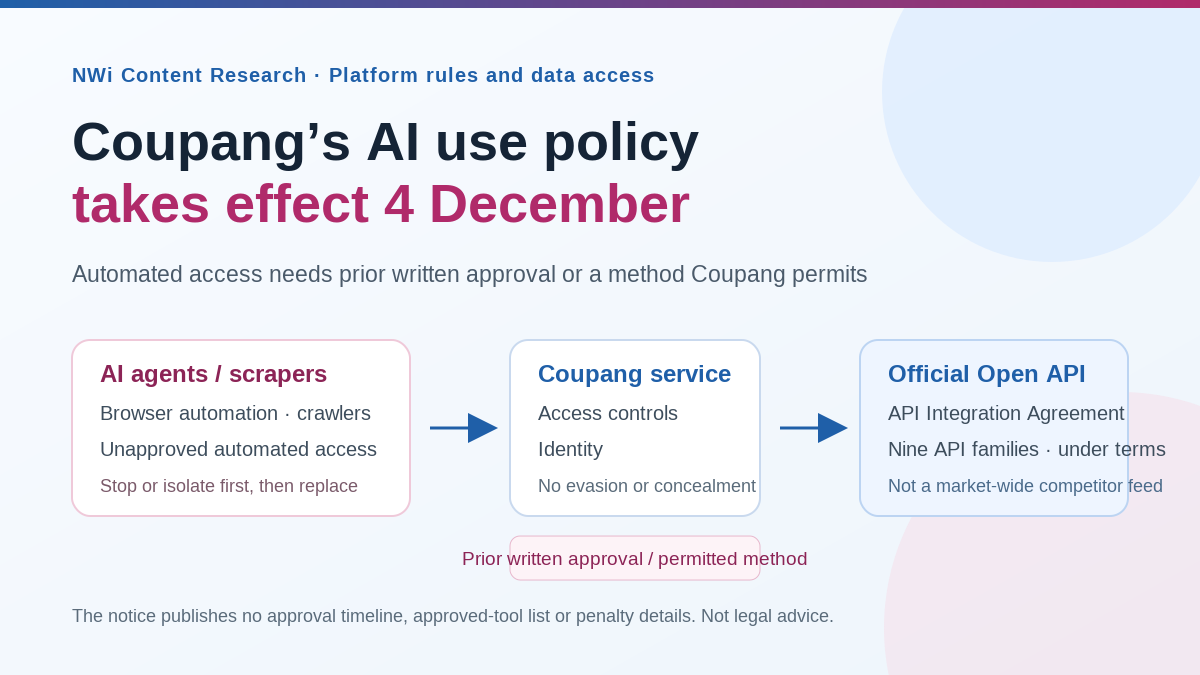
For a seller on Coupang Korea that uses a third-party AI tool or automation script to collect product, price, order or competitor data, the user notice dated 26 November 2026 changes the question from “is the tool good?” to “is this data path permitted after 4 December?” The notice revises Coupang’s AI Use Policy with effect from 4 December 2026 and adds a user-compliance section: without the company’s explicit prior written approval, or a method separately permitted by Coupang, users may not access or use Coupang services with AI technology or other automated means — autonomous programs (bots), robots, spiders, scrapers, crawlers, AI agents and similar tools — and may not evade access controls or conceal their identity. The notice also says Coupang may restrict AI or other automated means that inconvenience other users or interfere with its service. This article separates what the notice actually adds from a blanket ban on AI, reviews the separate agreement behind the official Open API, and compares switching to the API, seeking written approval, or narrowing the data scope in two costed scenarios. It does not invent approval timelines, penalties or platform endorsement.
What the notice actually adds: a user-compliance section, not a blanket AI ban
The Korean notice sets the old and new text side by side. The pre-revision policy contains a purpose statement and three explanatory bullets; the revision adds a bullet allowing Coupang to restrict AI or other automated means that inconvenience other users or interfere with service provision, and a new section “I. User compliance” containing the core restriction.
| Item | Before revision | After revision (effective 4 December 2026) |
|---|---|---|
| Policy structure | Purpose + 3 bullets | Purpose + 4 bullets + “I. User compliance” |
| Automated access | No separate AI/automation clause | No access to or use of the service with AI/automation without prior written approval or a method separately permitted by Coupang |
| Evasion and identity | No separate clause | Users may not evade access controls or conceal identity |
| Interference with others | No separate clause | Coupang may restrict AI/automation that inconveniences other users or interferes with the service |
The core restriction reads: without the company’s explicit prior written approval, or a method separately permitted by Coupang, users may not access or use Coupang services with AI technology or other automated means (autonomous programs (bots), robots, spiders, scrapers, crawlers, AI agents and similar tools), and users may not evade Coupang’s access controls or conceal their identity.
The notice adds a “User compliance” section that limits AI technology and other automated means and requires prior written approval or a method separately permitted by Coupang. The clause applies to “이용자” — members and non-members, not only sellers. The notice also says the announcement is currently available only in Korean and that English and Chinese versions will follow; this article relies on the Korean text and should be rechecked when the other versions appear. The notice refers to Article 3(8) of the seller terms: a user that does not object before the effective date is deemed to accept the revised policy.
The notice publishes no approval process, response time, approved-tool list, penalty method or enforcement data, and does not say whether the Open API covers market-wide competitor data. It does not define “AI technology”, and it does not say that existing tools are automatically approved or automatically banned. Those gaps cannot be filled with confident conclusions.
Who is actually exposed: classify by access method, not by the tool’s name
The real question is not whether Coupang will ban AI, but which data paths have no written approval or separately permitted method after 4 December, and which should be stopped, moved or submitted for approval first. The policy turns on the access method, not on whether a tool calls itself AI. A tool that automatically logs into Coupang, clicks through pages, or scrapes products, prices or reviews falls within “AI technology and other automated means”; a platform-native report or an official Open API integration is a different route. A vendor’s “official partner” claim is not Coupang’s prior written approval; the seller needs the document.
Five access types to review:
- Official Open API: a separate API Integration Agreement, with keys issued in WING and use within the agreement; check the fields, call scope and limits.
- Platform-native reports and WING: viewing or exporting inside the platform; the notice does not prohibit this, but “can export” is not permission to share or build a long-term database.
- Browser automation and extensions: automatic login, clicks, page turns and scraping; without written approval from Coupang, treat it as unapproved automated access.
- Scrapers and crawlers: direct collection of products, prices, reviews or competitor pages; this is the high-risk category named in the notice — stop or isolate it first.
- AI agents and autonomous programs: a model decides the next step and executes multi-step access; a “human in the loop” or “read-only” label does not avoid the approval requirement.
Three seller profiles need action first: a one-to-three-person team with a single third-party AI tool, where switching cost is the pain point; a multi-channel seller whose tool is supplied by an agency, where the missing approval document is the pain point; and an agency running one automation stack across several accounts, where account-level authorization and key separation are the pain point. The last two are most likely to mistake “the vendor says it is compliant” for “Coupang has approved it”.
The Open API is a separate route, not a compliance shortcut
Coupang’s API Integration Agreement (read in full on 27 November 2026) defines the relationship between the Seller Tool Provider and Coupang. Appendix 1 lists nine API families: logistics, category, product, shipment/refund, return, exchange, coupon/cashback, CS and settlement.
Article 3 prohibits copying, storing, processing or distributing API data, or providing it to a third party, without authorization; extracting data to build a database for purposes other than integrated operation and management; arbitrarily increasing API limits or using information from multiple users to raise call limits; providing API integration directly to a third party through the Seller Tool; disclosing API keys to a third party; and calling the API by bypassing Coupang’s system.
That means the Open API mainly covers order, logistics, customer-service and settlement operations; it is not an unlimited exit for market-wide competitor data. Appendix 1 does not list a market-research API. If the decision needs category-wide competitor sales, price bands or brand share, do not assume the Open API provides them, and do not assume an application will be approved. Article 11 also sets a one-year initial term, automatically extended for one-year periods unless either party gives one month’s written notice, so the term belongs in the switching cost.
One more boundary: the notice does not say whether an AI agent calling the official Open API counts as a “separately permitted method”. If a tool pulls data with an API key but an AI agent initiates the calls, compliance depends on the API Integration Agreement and Coupang’s interpretation. This article does not decide that for the platform; put the call pattern in the written request.
Evidence boundary: one notice text, with approval and penalties still unpublished
This article read the full text of Coupang’s 26 November 2026 notice through Cafe24 Marketplace’s reprint. Coupang’s own AI policy page returned HTTP 403 in this check, and its seller-terms page also returned 403. The reprint is not an independent source: it establishes the notice text, not a second confirmation. Coupang’s API Integration Agreement is a separate official document, but it describes API integration, not the AI-policy approval process.
The notice gives no approval timeline, approved-tool list, penalty ladder, enforcement cases or transition period, and it does not say whether existing tools will be cut off automatically after 4 December. The search-index text of the public AI policy page still shows the pre-revision version, which suggests the page may be updated on the effective date. This article does not turn “the notice exists” into “Coupang has started enforcing”, and does not turn “the Open API exists” into “all data can be obtained lawfully”.
Counter-cases: when not to stop a tool or switch to the API
Counter-case one: a seller that only uses Coupang’s native reports and its own order data for replenishment may not need a new tool. Confirm whether the current operation is a platform-native function; do not stop a normal report because the word “AI” appears.
Counter-case two: a seller already using the official Open API is not facing a blanket automation ban, but the API route is still governed by the API Integration Agreement. The task is to check the agreement’s fields and limits, not to buy a second tool.
Counter-case three: a vendor says “we are compliant” but provides no document. The notice requires Coupang’s prior written approval or a separately permitted method; a vendor’s own statement is not a platform document. Without the document, treat the path as unapproved.
Counter-case four: narrowing the data scope so far that it no longer supports the original product or pricing decision. Compliance is not the goal; if the remaining fields cannot answer the question, redefine the decision rather than buying a more expensive route.
Counter-case five: treating manual downloads as automatically safe. The notice does not mention manual exports, but silence is not approval; if the export is stored in a long-term database, shared with a third party or fed to an AI tool, confirm the permitted scope.
Counter-case six: treating the Open API as an unlimited data exit. The agreement explicitly prohibits copying, storing, distributing and bypassing limits; access through the API does not mean the data can be used for any purpose.
Worked example: monthly cost and payback in two scenarios
Fix the calculation first: monthly cost = tool fee + weekly hours × 52/12 × hourly cost; payback months = one-time integration cost ÷ monthly saving. Every number below is an assumption, not a Coupang, seller or NWi measurement.
Converting monthly cost at 52/12: 6 hours a week is 26 hours a month, and 2 hours a week is 8.67 hours a month; the first is KRW 780,000 of labour, the second KRW 260,000.
| Item | Scenario A: 1,500-SKU seller | Scenario B: agency with 8 accounts |
|---|---|---|
| Current monthly cost | KRW 350,000 + 6 h/week × 52/12 × KRW 30,000 = KRW 1,130,000 | KRW 800,000 + 10 h/week × 52/12 × KRW 30,000 = KRW 2,100,000 |
| Open API monthly cost | KRW 150,000 + 2 h/week × 52/12 × KRW 30,000 = KRW 410,000 | 8 × KRW 80,000 + 4 h/week × 52/12 × KRW 30,000 = KRW 1,160,000 |
| Monthly saving | KRW 720,000 | KRW 940,000 |
| One-time integration | KRW 4,000,000 | KRW 6,000,000 |
| Payback | 4,000 ÷ 720 = 5.6 months | 6,000 ÷ 940 = 6.4 months |
Scenario A: a 1,500-SKU seller keeps a third-party AI price tool (illustrative assumptions)
Assumptions: the tool costs KRW 350,000 a month; internal work is 6 hours a week at KRW 30,000 an hour; the Open API route needs KRW 4,000,000 of one-time integration, KRW 150,000 a month of infrastructure and 2 hours a week of internal work.
Result: the current route costs KRW 1,130,000 a month; the Open API route costs KRW 410,000 a month, a saving of KRW 720,000, and the KRW 4,000,000 integration cost pays back in about 5.6 months.
Decision: switch only if the Open API fields cover the data the price comparison needs; if coverage is incomplete, seek written approval or narrow the workflow to platform-native reports.
Scenario B: an agency runs 8 Coupang accounts on one automation stack (illustrative assumptions)
Assumptions: the shared tool costs KRW 800,000 a month; internal work is 10 hours a week at KRW 30,000 an hour; account-level API access needs KRW 6,000,000 of one-time integration, KRW 80,000 a month per account and 4 hours a week of internal work.
Result: the current route costs KRW 2,100,000 a month; account-level API access costs KRW 1,160,000 a month, a saving of KRW 940,000, and the KRW 6,000,000 integration cost pays back in about 6.4 months.
Decision: first confirm that every account can authorize separately and sign the API Integration Agreement; keys cannot be shared and multiple accounts cannot be pooled to raise call limits.
Action: use a data-path register before 4 December
In the first three days, list every tool that touches Coupang, the fields it reads, the frequency and the person who holds the credentials, then classify each path and deal with it before 4 December. The register should include the tool name, vendor entity, access method, fields, call frequency, storage location, contract end date and who can issue or revoke keys.
Within three to seven days, make one of three choices for each path: keep a platform-native function and confirm its scope; integrate through the official Open API under the agreement; or stop or isolate unapproved automation. Ask the vendor one question: show Coupang’s prior written approval or the method Coupang separately permits, with a document that matches the fields and access method you use. Without the document, do not record “the vendor says it is compliant” as compliance evidence.
Before 4 December, issue keys in WING and implement the Open API route where it fits; for data outside the API, submit a written request to Coupang describing the use case, fields, frequency, retention, access controls and any third-party sharing. The notice publishes no approval timeline, so plan on “no reply means no approval” rather than assuming the request will be granted.
Stop conditions: the vendor cannot produce written approval or a verifiable permitted method; the workflow requires evading access controls, sharing keys or pooling accounts to raise limits; the data is unrelated to a specific decision; or the compliance cost exceeds the decision value of the data. If any applies, stop collection first and discuss alternatives after.
Fields to watch: the date and scope of the approval document, the API-key owner, the fields read, call frequency, retention period, vendor subprocessors and the incident contact. Review monthly, and recheck immediately when the platform updates the policy or the vendor changes entity.
Limitations, method and product boundary
This article has no WING access and did not read Coupang’s original notice page; the full notice was read through Cafe24’s reprint, the public AI policy page returned 403, and the approval process and penalty details remain unknown. It has no seller’s real tool contract, call logs, field list or cost data; the monthly fees, hours, integration costs and savings in both scenarios are stated assumptions, not platform or NWi measurements. The notice is available only in Korean for now, with English and Chinese versions still to come, and the policy may change before the effective date. This article is not legal, compliance, tax or platform-operations advice.
Data: the event comes from Coupang’s notice “일반 이용자 고지사항, AI 이용 정책 개정 예정 안내” dated 26 November 2026, read in full on 27 November 2026 through Cafe24 Marketplace’s reprint (board_no=15462), which is a reprint rather than an independent source; Coupang’s official AI policy page and seller-terms page returned HTTP 403 in this check and could not be read directly. The Open API scope and limits come from Coupang Developer Center’s “API Integration Agreement”, read in full on 27 November 2026 and dated 23 June 2023 on the page; Appendix 1 lists nine API families: logistics, category, product, shipment/refund, return, exchange, coupon/cashback, CS and settlement. Calculations: monthly cost = tool fee + weekly hours × 52/12 × hourly cost; payback months = one-time integration cost ÷ monthly saving; all fees, hours, integration costs, savings and payback periods are stated assumptions, not Coupang, seller or NWi measurements. The notice publishes no approval process, response time, approved-tool list, penalty method, enforcement data or definition of “AI technology”; this article does not present it as a blanket AI ban, and does not present the Open API as an unlimited exit for market-wide competitor data. NWi CrossborderGo provides Coupang Korea category, brand, store and product data monthly under activated modules and contract authorization, which can rank categories by sales, price band and specifications; it does not provide WING, API call logs, order-level data, ad accounts or settlement data, and it does not mean Coupang has approved any tool or MCP connection.
Product boundary: NWi CrossborderGo’s Coupang module covers Korea category, brand, store and product data, updated monthly, with Korean attribute cleaning required. It can rank priority categories by sales, price band and specifications before entering Korea, or help decide which market data is worth keeping before changing a data path. It cannot replace WING order, ad or settlement data, and it cannot obtain Coupang’s written approval for a seller. See NWi CrossborderGo, Coupang data analysis and request a demo. To connect market data to a research workflow, see MCP data access; available platforms, fields and permissions are confirmed during onboarding, and an entry point is not proof that a connection is live.
The article’s increment is to turn “the AI ban” into a data-path register and use two reproducible monthly-cost scenarios to decide whether to move to the Open API, seek written approval or narrow the data scope first.
Sources: 1. Cafe24 Marketplace reprint of Coupang’s “일반 이용자 고지사항, AI 이용 정책 개정 예정 안내”, 26 November 2026: read the notice, accessed 27 November 2026; 2. Coupang Developer Center, “API Integration Agreement”, page dated 23 June 2023: read the agreement, accessed 27 November 2026; 3. Coupang, “AI 이용 정책”, direct read returned HTTP 403: open the page, accessed 27 November 2026.
This article was prepared with automated research assistance and is based on the public sources listed at the end. It was not reviewed by a human editor; it does not invent customer data, expert review, ranking results or platform endorsement. It is not legal, compliance, tax, platform-operations or investment advice.