
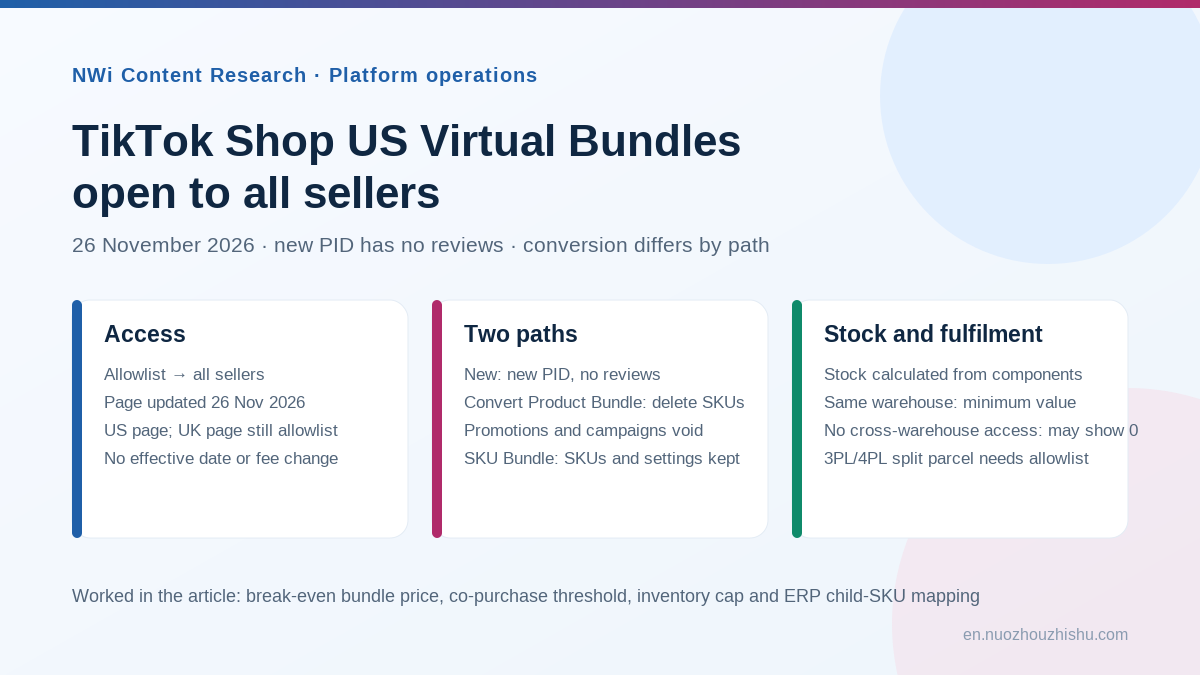
For US TikTok Shop sellers running multi-SKU catalogs, the page update on 26 November 2026 moved the question from “can I get access to bundles?” to “which build path, which SKUs first, and should anything change during the Black Friday to Cyber Monday window?” The US seller academy’s Virtual Bundles guide replaced its whitelist notice with an all-seller notice. The rules underneath did not become a simple “open”: a new bundle creates a brand-new PID and inherits no reviews or sales; converting an existing product keeps the PID, sales and reviews, but Product Bundle conversion deletes the original SKUs and voids subscriptions, promotions and campaign participation, while SKU Bundle conversion preserves them. Bundle inventory is calculated from component stock, 3PL/4PL split-package fulfillment still needs an extra allowlist, and the order API returns child-SKU mapping only in Get Order Detail. This article separates the scope and mechanism, then uses two assumed scenarios to recalculate bundle price, co-purchase share and the inventory cap, before setting the action order and stop conditions for the peak weekend. The real decision is which build path, which SKUs first, and whether to touch bundles during the Black Friday to Cyber Monday window.
1. What changed on 26 November is access, not price or fees
Keep the change inside the page that was read. The US Virtual Bundles guide’s 11 November 2026 version said “This feature is currently in the whitelist phase”. The 26 November 2026 version says “This feature is now available to all sellers. All sellers can access and use it through the entry point described in this article.” This is a version change on the same feature page; the page gives no formal effective date, eligibility conditions, fees, penalties or enforcement data, and says nothing about a change to bundle price, commission or fulfillment fees.
Scope also needs narrowing. This article read the US seller academy page. The UK Virtual Bundle page, updated 3 November 2026, still says “allowlist-only option, accessible only to select eligible merchants”. No equivalent page for other markets was confirmed in this round, so this is not a global rollout. For US sellers, the practical change is that the entry no longer needs an account-manager request; it does not mean the platform guarantees traffic, conversion or a higher AOV for bundles.
2. Mechanism: a bundle is a separate product, but its stock comes out of components
A Virtual Bundle combines several existing products into one product for sale without physical pre-packing. There are two structures: Product Bundle selects two products at the PID (product) level; SKU Bundle selects SKUs at the SKU ID level, within the same product or across products, and individual SKUs can be sold alongside bundle SKUs. A Virtual Bundle is a separate product with its own PID, while its inventory is calculated from component stock and changes when components change. It is not Linked Listings or Buy More, Save More: the first does not create a new PID, and the second is a promotion that also creates no PID.
The inventory rule is stricter than adding up totals. The guide’s example: in one warehouse A supports 10 bundles and B supports 4, so the smaller value, 4, applies. If A and B sit in different warehouses and the cross-warehouse allowlist is not enabled, the total may look sufficient for 4 bundles, but no single warehouse holds both, and available inventory shows 0. Bundle inventory updates automatically with component stock and cannot be edited by hand. FBT cross-warehouse fulfillment is generally available; split-package or cross-warehouse fulfillment through 3PL/4PL requires an additional allowlist request through the account manager. Oversized goods can ship in several parcels with separate tracking, also subject to the allowlist.
The order side adds a third constraint. TikTok Shop Partner Center states that a virtual bundle has to be created in Seller Center and cannot be created through the API; only Get Order Detail, not Get Order List, returns bundle information, adding a combined_listing_sku object to line_item that lists the child products or SKUs. For sellers using an ERP or third-party warehouse system, a bundle order may not decompose automatically like a normal order; getting one test order through end to end matters more than listing quickly.
3. Two build paths: new listing or conversion, with different consequences
The guide splits setup into two scenarios, and the consequences differ.
Scenario one, create a new bundle: this creates a brand-new PID and does not inherit reviews or sales from any product or SKU. It behaves as a new product for campaign enrollment, promotions and creator collaborations, with no additional restrictions. For a combination with no history, that is a clean start, but reviews also start from zero.
Scenario two, convert an existing standard product: the PID remains unchanged, sales and reviews are retained, and creator shoppable videos can be preserved. The effect lands on SKUs. Converting with Product Bundle deletes the SKUs on the existing listing and makes subscriptions, promotions and campaign participation invalid. Converting with SKU Bundle in Edit Product retains the existing SKUs and leaves subscriptions, promotions and campaign participation unaffected. The guide also says existing Virtual Bundles and certain pre-owned luxury products cannot be bundled.
| Path | PID and reviews | Original SKUs | Subscriptions, promotions, campaigns |
|---|---|---|---|
| New bundle | New PID, no reviews or sales | Not applicable | Treated as a standard product |
| Conversion: Product Bundle | PID, sales and reviews retained | Deleted | Invalid |
| Conversion: SKU Bundle | PID, sales and reviews retained | Retained | Retained |
That difference matters during the peak weekend. A conversion during a promotion can void live promotions and campaign participation under Product Bundle; SKU Bundle keeps the original SKUs and settings, which is much lower risk. The guide gives no conversion time, rollback path or effect on search ranking, and this article does not invent them.
4. Scenario A: a three-piece set, can the parcel saving cover the discount? (assumed example)
Scenario A: a three-piece beauty set with a US$44 component total (assumed example)
Assumptions: component retail prices of US$18, US$14 and US$12; landed cost at 45% of retail; US$5.20 per parcel and US$0.90 per pick; platform fee at 8% of selling price.
All three cases use three picks, with 8% as a placeholder platform fee to be replaced by the contract rate. If the three items are bought in three separate orders, fulfillment is 3 × 5.20 + 3 × 0.90 = US$18.30, the platform fee is 8% × 44 = US$3.52, and contribution is 44 − 19.80 − 18.30 − 3.52 = US$2.38.
If a bundle is priced at US$39 and shipped in one parcel, fulfillment is 5.20 + 3 × 0.90 = US$7.90, the fee is 8% × 39 = US$3.12, and contribution is 39 − 19.80 − 7.90 − 3.12 = US$8.18, or US$5.80 more than three separate orders.
If the same three items would have been bought together at the full US$44 in one order, fulfillment is still US$7.90, the fee is US$3.52, and contribution is 44 − 19.80 − 7.90 − 3.52 = US$12.78. The US$39 bundle is then US$4.60 worse.
Result: three separate orders contribute US$2.38; the US$39 bundle in one parcel contributes US$8.18; the full-price single basket contributes US$12.78. Putting the cases together gives a co-purchase threshold. Let s be the share of bundle buyers who would have bought all three at full price in one order; expected change = (1 − s) × 5.80 + s × (−4.60). Setting it to zero gives s = 55.8%. If more than about 55.8% of bundle buyers would have bought the three items in one order anyway, the US$39 bundle reduces contribution. Another calculable number is the break-even bundle price: P − 19.80 − 7.90 − 0.08P = 0, so P = US$30.11, 31.6% below US$44.
Decision: calculate the co-purchase share first; above 55.8%, do not use the US$39 bundle. Export your own 90-day co-purchase share and parcel count before deciding whether to build a bundle and at what price. The value comes mainly from merging parcels, not from the word “bundle”.
5. Scenario B: the real cap on a bundle when stock is shared (assumed example)
Scenario B: an apparel two-piece set with component A at US$29 and component B at US$31 (assumed example)
Assumptions: bundle price US$52 and landed cost at 50% of price; one parcel at US$5.20 plus two picks at US$1.80; platform fee at 8%; component A supply of 500 units against single-item demand of 400, and component B supply of 900 against single-item demand of 300.
Contribution first: bundle = 52 − 26 − 7.00 − 4.16 = US$14.84; component A = 29 − 13.05 − 6.10 − 2.32 = US$7.53; component B = 31 − 13.95 − 6.10 − 2.48 = US$8.47.
If A and B would both have sold on their own, their combined contribution is US$16.00, above the bundle’s US$14.84, so the bundle is US$1.16 worse per set. For the bundle not to lose money, 0.92P = 26 + 7 + 16, so P = US$53.26. If B is slow-moving or excess stock that would not have sold alone, the bundle’s US$14.84 against A alone at US$7.53 is US$7.31 better.
Result: the bundle contributes US$14.84 against US$16.00 for the two components sold separately; the break-even bundle price is US$53.26 and the inventory cap is 100 sets. The cap comes from component cover: with A supply of 500 and single-item demand of 400, only 100 A units remain for bundles; with B supply of 900 and single demand of 300, 600 B units remain. The smaller value caps bundles at 100 sets. Putting 300 sets on sale before A is replenished would take 200 units away from single-item A sales.
Decision: use the bundle on the component that would not have sold on its own; when both sell well, only a price above US$53.26 adds contribution. Track inventory by component rather than by bundle, and cap bundles at the minimum of component availability minus single-item demand.
6. Action order and stop conditions for the peak weekend
Between now and 30 November (Cyber Monday), the order below keeps the downside visible. Start by exporting the candidate components’ co-purchase share, live promotions and component stock, then decide whether to build a bundle.
- Step one, export three things for the candidate components today: the 90-day co-purchase share and average parcel count; live promotions, subscriptions and campaign participation; component stock and in-transit units. Without these three, do not build first.
- Step two, choose the path. For products with existing reviews and sales, convert with SKU Bundle in Edit Product to retain the original SKUs and promotions; use a new PID only for genuinely new combinations, and accept reviews starting from zero. Do not convert with Product Bundle during a promotion; if a conversion is unavoidable, wait until Cyber Monday ends.
- Step three, confirm fulfillment. FBT cross-warehouse is generally available; 3PL/4PL split-package or cross-warehouse needs an allowlist request through the account manager; run one bundle order end to end and check child-SKU mapping, warehouse allocation, each parcel’s tracking number and whether the ERP reads combined_listing_sku.
- Step four, set an observation window. Use 14 days or 100 bundle orders and record bundle contribution, component stock cover in days, co-purchase share, return rate and unit change for single-item SKUs; use your own back-office data, not the platform page’s AOV/GPM sentence.
Write the stop conditions down: if a Product Bundle conversion voids promotions or campaign participation and cannot be restored, stop further conversions immediately; when bundle contribution is below the combined contribution of the same components sold separately, check whether the second component would have sold on its own — if it would, stop or raise the price; if it would not, the Scenario B case still applies; if co-purchase share is above 55.8%, do not use the US$39 discount bundle under this article’s assumptions; if component stock cover falls below 14 days, stop scaling; after three consecutive bundle orders with ERP mapping errors, pause listing and fix the system first.
7. Evidence boundary, counter-cases and unknowns
The boundaries need to be explicit. First, the source is a platform feature page, not independent research; the page says “Across a range of categories, Virtual Bundles generally deliver higher AOV and GPM than comparable individual product listings”, but publishes no sample, definition, period or data, so this article treats it as a platform statement, not a measurement. Second, the page publishes no bundle conversion rate, return rate, ranking effect, fee difference or allowlist turnaround time. Third, scope is confirmed only for the US; the UK page still says allowlist-only, and other markets were not checked.
Counter-case one, the components are already frequently bought together: the bundle then simply discounts a full-price order. Scenario A puts the loss at US$4.60 per order. Counter-case two, both components are bestsellers: the bundle takes inventory that would have sold on its own, and Scenario B puts the loss at US$1.16 per set. Counter-case three, the ERP reads only Get Order List: child-SKU data is returned only in Get Order Detail, so the system may treat a bundle order as a normal order and pick or ship it wrongly.
The US page read in this round does not state whether bundle fulfillment fees are charged as the combined cost of components. The UK page describes combined component charging, but that cannot be applied to the US directly; the US page also does not say whether an FBT bundle switches to seller fulfillment when a component goes out of stock, while the UK page says it switches to FBM when all items are in stock at the seller warehouse. Whether “available to all sellers” will extend to other markets later is unknown. Confirm these in Seller Center or with the account manager; do not infer them from this article.
The contribution here is to turn bundles from “can we use it” into three calculable decisions: co-purchase share, component inventory cap and ERP mapping. The existing AOV/GPM sentence cannot answer whether this particular set is worth building; these three numbers can be calculated from a seller’s own back-office data.
8. Method, sources and product boundary
Data: the event comes from TikTok Shop US Academy’s “Virtual Bundles”, marked as updated on 26 November 2026 and read in full through the search-index channel on 27 November 2026; the 11 November 2026 version of the same page was used to compare the whitelist notice. The scope check comes from TikTok Shop UK Academy’s “Virtual Bundle”, marked as updated on 3 November 2026 and read the same day. The order and API constraint comes from TikTok Shop Partner Center’s “Virtual bundles are now available in order details”, marked as published on 4 April 2024 and read the same day. Direct HTTPS requests to seller-us.tiktok.com and seller-uk.tiktok.com timed out and partner.tiktokshop.com returned a JavaScript shell, so body text was read through the search-index full-text channel with verbatim excerpts retained. Calculations: contribution = selling price − landed cost − fulfillment cost − platform fee; bundle-versus-single comparisons use the same components and the same number of picks; the co-purchase threshold is the zero of the weighted difference between the two cases; the break-even bundle price sets contribution to zero. All prices, costs, fulfillment fees, platform rates and inventory quantities are stated assumptions, not TikTok Shop, seller or NWi measurements.
Product boundary: NWi CrossborderGo provides TikTok Shop US, major Southeast Asia sites and UK market, category, brand, store and product data (sales, units, average selling price, creator GMV and price bands, updated monthly under activated modules and contract terms). It can rank priority SKUs by sales, price band and product combination and indicate which components are worth bundling; it does not provide bundle-level conversion, component inventory, Seller Center access, order-level or fulfillment data, and it cannot verify whether a bundle lifts AOV or GPM. See NWi CrossborderGo, TikTok Shop data analysis and request a demo. To connect market data to a research workflow, see MCP data access.
Sources: 1. TikTok Shop US Academy, “Virtual Bundles”, updated 26 November 2026: read the source, accessed 27 November 2026; 2. TikTok Shop UK Academy, “Virtual Bundle”, updated 3 November 2026: read the source, accessed 27 November 2026; 3. TikTok Shop Partner Center, “Virtual bundles are now available in order details”, published 4 April 2024: read the source, accessed 27 November 2026.
This article was prepared with automated research assistance and is based on the public sources listed at the end. It was not reviewed by a human editor; it does not invent customer data, expert review, bundle performance, search ranking or platform endorsement. It is not legal, platform-operations or investment advice.