
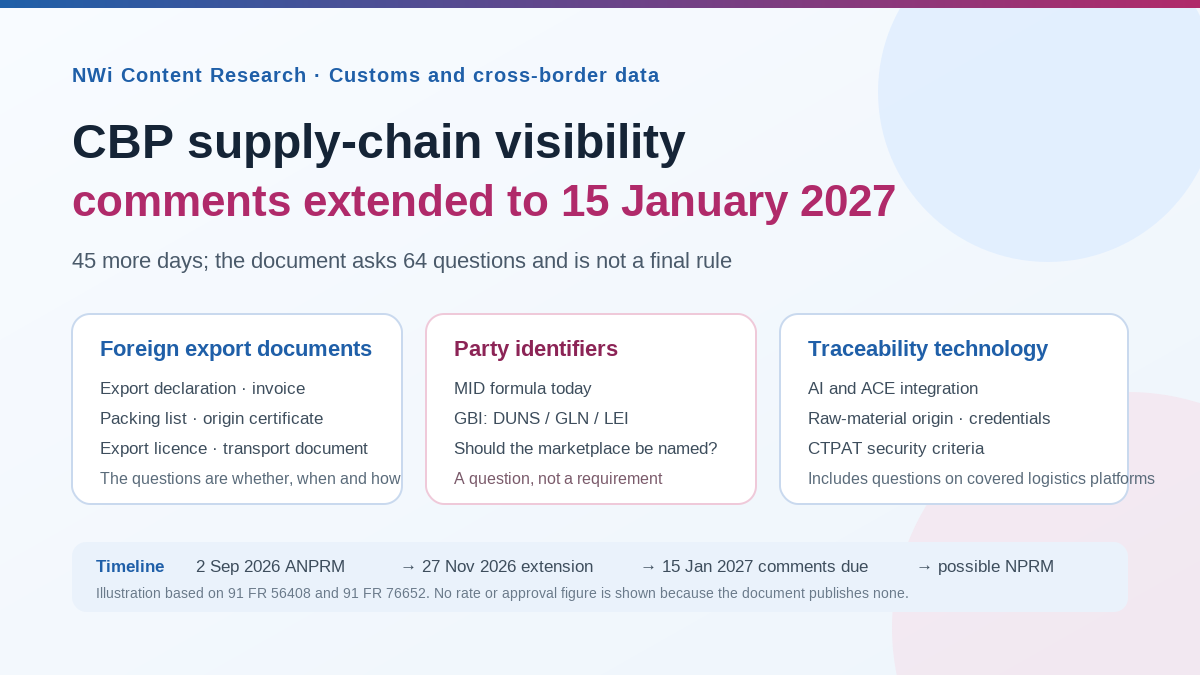
For a cross-border seller shipping goods to the United States, only one thing changed on 27 November 2026: CBP extended the comment period for its supply-chain visibility ANPRM from 1 December 2026 to 15 January 2027, adding 45 days. The document itself is still the request for comment published on 2 September 2026 (91 FR 56408), not a final rule, and it creates no new filing duty. The question is whether to use the 45 days for data-backed comments, for an inventory of export documents, party identifiers and record flows, or for both, and which fields are worth preparing now. This article separates the three proposed data layers, three import structures and two worked scenarios, then sets an action order and stop conditions for 15 January 2027. The real decision is whether to use the 45 days for data-backed comments, for an inventory of documents and party data, or for both, and which fields are worth preparing now.
1. The extension changes the deadline, not the rule
Pin the dates first. CBP published “Heightened Import Disclosures for Supply Chain Visibility” as an ANPRM on 2 September 2026 (91 FR 56408–56414, FR Doc. 2026-17926, Docket No. USCBP-2026-1058, RIN 1685-AA47), with comments originally due on 1 December 2026. The extension notice of 27 November 2026 (91 FR 76652, FR Doc. 2026-24149) moves the deadline to 15 January 2027, an additional 45 days. The notice gives the reason: importers, customs brokers, carriers and other interested parties, including small businesses, should have time to prepare thorough responses with the data and cost information CBP requested.
The document type matters too. The ACTION line of the extension reads “Advance notice of proposed rulemaking; extension of comment period”, not final rule. The ANPRM says the comments “will be used, potentially, to draft a Notice of Proposed Rulemaking”: they may inform a proposed rule, not a decision already taken. There is no field list, system specification, effective date, penalty or adoption rate, and no statement that a platform, product category or country will be prioritized. Treating this as a current compliance duty overstates today’s risk; treating it as remote from sellers misses the one window to put cost data into the rule design.
2. Three proposed data layers: documents, parties and traceability
Mechanically, CBP is not adding a filing yet; it is asking whether future entries should carry foreign export documents, party identifiers and traceability credentials together. The document groups its questions into three blocks (Q1–Q61) and adds Q62–Q64 on costs and benefits, 64 questions in total. The first block is foreign export documentation (Q1–Q23). CBP is considering requiring the importer of record to submit documents that the foreign exporter already filed with the foreign customs authority before export, and it lists six categories: export declarations (which may show declared value, classification and quantity), commercial invoices (the transaction value declared to the foreign customs authority), packing lists (contents, weight and packaging), certificates of origin, export licenses or permits for controlled, restricted or dual-use goods, and transport documents such as bills of lading and air waybills filed with the foreign export manifest.
The hard part is not whether the documents exist but how they would be filed, how long they would be kept and who would be responsible. Q2 asks whether they should be transmitted with the entry or entry summary or kept as a recordkeeping requirement; Q3 asks whether CBP should randomize requests; Q8 asks how long retention should last; Q12 asks how the importer can show that the document is the exact one filed abroad and has not been modified; Q16 asks how much lead time importers need to obtain documents from foreign suppliers; Q18 asks about cost. For a seller, these questions define a process and a retention burden, not a single form.
The second block is party identification (Q24–Q45). Today the importer of record provides the manufacturer or shipper identification code (MID) at entry summary under 19 CFR part 142 and CBP Form 7501; the MID is derived from the manufacturer or shipper name, address and country of origin on the commercial invoice. The ANPRM itself says the MID “provides limited identifying information”, does not always identify the party CBP cares about, is not always available early enough, and is “not always a consistent or unique number”. It therefore asks whether to keep the current MID formula or require actual identifying data such as the full company name and physical address or another business identifier with each shipment (Q28); whether the MID or another identifier should be filed at entry, entry summary or on the manifest (Q29); whether a GBI should supplement or replace the MID and where it should be collected (Q37, Q40); whether importers or brokers can obtain and disclose entity-level foreign tax and global business identifiers for the manufacturer, shipper and seller (Q41); and whether a single product-level identifier such as a model or style number, composition, grade or size would be more feasible (Q42).
Q33 is the most misread question in this block. It asks whether, in addition to the manufacturer, shipper and exporter, other parties or indicators should be declared to CBP; for example, if an online marketplace facilitated the sale of the imported goods to a party in the United States, should that marketplace be identified, and why. It is a question, not a conclusion that platforms will be required to identify themselves; the document gives no field, responsibility split or enforcement method for marketplace identification.
The third block is traceability technology and CTPAT (Q46–Q61). CBP asks what technology the private sector uses to see supply chains and production methods, how it verifies the data and protects business information (Q46); what role AI plays (Q48); how such tools integrate with ACE and Partner Government Agency data exchanges (Q49); what technology can verify raw-material origin and bridge the “visibility gap” (Q50); whether it scales for small and large firms (Q51); whether unique entity identifiers and tamper-proof credentials exist (Q53); and whether technology can certify origin (Q54). The CTPAT questions ask whether all CTPAT partners should be required to use enhanced supply-chain tracing technology (Q57); whether the minimum security criteria should add cybersecurity and data integrity, including a prohibition on “covered logistics platforms” identified as a security risk (Q60); and what administrative, operational and software-transition costs a restriction or prohibition would create (Q61). CBP’s CTPAT page still says “Participation in CTPAT is voluntary and there are no costs associated with joining the program”, so these are questions about changing a voluntary program’s conditions, not a current threshold.
| Data layer | Questions | Where it sits today | What the seller should confirm |
|---|---|---|---|
| Foreign export documents | Q1–Q23, especially Q2, Q3, Q8, Q16, Q18 | Filed by the supplier or exporter abroad; the importer may not hold it | Who holds each of the six document types, how many days it takes to obtain, and whether an unmodified copy is available |
| Party identifiers | Q28, Q29, Q33, Q37, Q41, Q42 | MID at entry summary; GBI in a voluntary test; no marketplace identifier requirement | Whether suppliers can provide a DUNS, GLN, LEI or Altana ID; who files what at entry, summary and manifest |
| Traceability technology | Q46–Q61, especially Q57, Q60, Q61 | AI and ACE integration; CTPAT voluntary program | Whether covered logistics platforms are used; whether CTPAT status affects customers or broker choice |
3. Three import structures: who may be asked, who only cooperates
The same rule question lands on different parties depending on the import structure. The three below are the most common for cross-border sellers; for any single shipment, the entry document and the contract still decide.
| Structure | Who may be asked | What the seller usually holds | What to confirm first |
|---|---|---|---|
| Seller is the US importer of record and uses a licensed broker | The importer of record; the broker files as agent | Commercial invoice, packing list, purchase contract, some origin data | Which fields the broker collects; who generates the MID; whether GBI handling costs extra; whether manifest data is also needed |
| Platform facilitates the sale and the platform or its logistics arm is importer of record | The platform or logistics entity; the seller cooperates under contract | Product, specification, origin and supplier data | Data-cooperation clauses; whether the platform already holds export documents; who would identify the marketplace if Q33 changes |
| 3PL or FBT fulfillment with the platform controlling part of transit | The platform or 3PL; the seller owns product and listing data | Product and inventory data; limited transit visibility | Which transit legs the platform controls; whether the seller can obtain transit data; where returns and after-sales data sit |
The difference between the first two structures decides Q33’s practical effect. If the platform is already the importer of record, marketplace identification is more likely to fall on the platform, with the seller supplying product and origin data. If the seller is the importer of record and only sells through a marketplace, a final Q33 requirement could ask the seller to explain which marketplace facilitated the sale. In neither case does the document allocate responsibility or say the seller must replace the platform’s filing. In the third structure the seller controls the least transit, yet Q34 asks whether CBP should require identification of the party to which the goods are ultimately “intended to be delivered”, who may not be the initial recipient or the consignee taking custody on arrival. For sellers using overseas warehouses, platform warehouses or drop-shipping, that final recipient may differ from the buyer named in the contract; draw the chain first.
4. Fields to watch: MID, GBI, entry, entry summary and manifest
Looking at one metric misses what the document actually asks. The fields below can already be found in entry records and contracts; where they cannot, that is the question for the broker or supplier.
| Field | Status today | Relevant questions | Why it matters now |
|---|---|---|---|
| MID | Provided at entry summary on Form 7501; derived from name, address and country of origin | Q28, Q29, Q30 | CBP calls it limited, not unique and sometimes too late; if full names, addresses or GBIs replace it, supplier master data must match |
| GBI | Voluntary test since 2022; permits DUNS, GLN, LEI and Altana ID | Q37, Q39, Q41 | Not every factory has one; acquisition and maintenance cost decides whether to build in-house or buy per entry |
| Entry, entry summary, manifest | Entry and summary are separate events; the carrier files the manifest | Q2, Q29, Q37, Q43 | The event where a field sits decides the split between broker, carrier and seller |
| Product-level identifier | Model, style number, composition, grade or size | Q42 | If CBP chooses a product identifier over an entity identifier, SKU master data matters more than the company registry |
| Origin and raw-material source | Certificates of origin, supplier declarations, some traceability files | Q46, Q50, Q54 | Technology ultimately needs origin evidence; a tool without evidence is only an interface |
| Retention period | Current recordkeeping rules; the ANPRM asks whether to extend | Q8 | Retention is a recurring cost, not a one-off |
The two entry events are easy to conflate. Entry is the filing that precedes release; entry summary is the later filing that consolidates and assesses duty, and the MID is currently provided there. Q29 asks whether the MID or another identifier should be filed at both entry and entry summary, or even on the manifest; Q37 asks whether GBIs should be collected at entry, summary or both. For a seller, the same supplier identifier may have to be filed at different times by different parties. Q43 asks whether entry should be filed earlier, which would change both data accuracy and supplier responsiveness. Asking the broker “where is the MID generated for this shipment, and who reviews it” is more useful than buying a system first.
5. Scenario A: build a GBI registry or pay a per-entry broker fee (illustrative)
Scenario A: build a GBI registry or pay a per-entry broker fee (illustrative)
Assumptions: 1,200 entries a month and 40 suppliers; obtaining and verifying each supplier’s GBI takes 45 minutes at a $40 hourly cost; quarterly revalidation takes 15 minutes; the broker charges $1.20 per entry for GBI data handling.
Start with the in-house option. First-time acquisition and verification for 40 suppliers: 40 × 45 ÷ 60 × $40 = $1,200. Quarterly review: 40 × 15 ÷ 60 × 4 × $40 = $1,600 a year. Year-one fixed cost is $2,800. The broker option at 1,200 entries a month × 12 × $1.20 = $17,280 a year. The difference is $14,480 in favour of the in-house registry in year one.
Result: year-one fixed cost = 40 × 0.75 × 40 + 40 × 0.25 × 4 × 40 = $1,200 + $1,600 = $2,800; the broker option costs 1,200 × 12 × $1.20 = $17,280 a year; the break-even volume is $2,800 ÷ $1.20 = 2,334 entries a year, about 195 a month.
Put on the same basis, the in-house registry costs $2,800 in year one and beats the $1.20-per-entry fee once annual volume exceeds 2,334 entries.
Decision: build the registry when monthly volume is above 195 entries and suppliers stay at or below 40; below that, use the broker’s per-entry service and rerun the math if annual supplier churn exceeds 25%.
Run the sensitivity too. At 120 suppliers rather than 40, year-one fixed cost becomes 120 × 0.75 × 40 + 120 × 0.25 × 4 × 40 = $3,600 + $4,800 = $8,400, and break-even rises to 7,000 entries a year, about 583 a month; 1,200 entries a month still clears it, but 400 does not. If the broker charges only $0.40 per entry, break-even becomes 7,000 entries a year; at $2.00 it falls to 1,400. The conclusion is most sensitive to the per-entry fee and the supplier count, not to the minutes assumption.
6. Scenario B: pre-build an export-document packet or respond ad hoc (illustrative)
Scenario B: pre-build an export-document packet or respond ad hoc (illustrative)
Assumptions: 2,400 entries a month; CBP requests export documents for 3% of entries; an ad hoc response takes 25 minutes at a $36 hourly cost; a pre-built packet costs $9,000 once and cuts response time to 10 minutes.
Start with ad hoc response. At 25 minutes and $36 an hour, one response costs $15. The expected monthly cost is 2,400 × 3% × $15 = $1,080, or $12,960 a year. The packet costs $9,000 once and $6 per response; at a 3% request rate, year one is $9,000 + 2,400 × 3% × $6 × 12 = $9,000 + $5,184 = $14,184, which is $1,224 more than ad hoc.
Result: the ad hoc expected cost is 2,400 × 3% × $15 = $1,080 a month; the packet costs $9,000 + 2,400 × 3% × $6 × 12 = $14,184 in year one, above the $12,960 ad hoc cost; at an 8% request rate the packet costs $22,824 against $34,560 ad hoc; the break-even request rate is $9,000 ÷ (2,400 × 12 × $9) = 3.47%.
Decision: pre-build the packet when the expected request rate is above 3.5% or requests already occurred in the past 90 days; below that, keep records and respond ad hoc, and stop the build if no request arrives in 90 days and the rate stays under 1%.
The key assumption is the request rate. The document only asks whether CBP should randomize requests (Q3) and publishes no rate; 3% and 8% are assumptions, not CBP data. At 1%, ad hoc costs $4,320 a year and the packet $10,728, a wider gap; at 15%, ad hoc costs $64,800 and the packet $34,920, so the packet wins. A seller can replace the assumption with the number of document requests it actually received in the past 12 months and reuse the same formula.
7. Counter-cases, evidence boundary and unknowns
Counter-case one: when the platform is the importer of record, the seller may not be the party asked to file, but contractual data-cooperation duties still reach the seller. Counter-case two: if the broker already collects MIDs and export documents, an in-house GBI registry may duplicate the service; ask what the current contract covers before spending the $2,800. Counter-case three: small factories may lack a DUNS, GLN or LEI, and obtaining one can take longer than the 45 minutes assumed in Scenario A; if only 10 of 40 suppliers have an identifier, the fixed cost changes but the marginal time rises. Counter-case four: random sampling means most entries will never be requested; at a 1% rate the packet does not pay back in year one. Counter-case five: the rule may stop at the ANPRM; CBP says comments may inform an NPRM and makes no commitment to issue one, so heavy spending on an unfinalized rule can become a sunk cost. Counter-case six: Q33 may push identification to the platform rather than the seller, leaving a seller-built marketplace field unused. Counter-case seven: CTPAT is voluntary and free to join today, but Q60 and Q61 ask about cybersecurity, data integrity and restrictions on covered logistics platforms; those costs may fall on CTPAT partners that use such platforms, not on every seller.
The evidence boundary is that this is a 64-question request for comment with no field list, system specification, compliance date or penalty, and comments may only inform a proposed rule. The three CBP documents (the ANPRM, the extension and the CTPAT page) corroborate the policy text but are not independent third-party evidence of economic impact; they publish no seller sample, request rate, document-acquisition cost or adoption probability.
This article has no seller entry records, entry summaries or supplier documents, and cannot know whether CBP will adopt any of the 64 questions. It is not legal advice; whether and what to comment, and which commercial data to disclose, depends on contracts, confidentiality and counsel. The foreign IOR final rule (91 FR 69977, published 6 November 2026, effective 5 January 2027) and this ANPRM are separate CBP actions: the first is final and takes effect on 5 January 2027, the second is still at the comment stage. Do not merge their dates or duties.
The contribution is to turn “should we prepare” into three testable tests: the document-holder matrix, the GBI registry break-even volume and the expected cost of random document requests. Most policy summaries stop at “the comment period was extended”; these three tests let a seller replace the assumptions with its own entry volume and supplier count and put a budget behind the answer.
8. What to do before 15 January 2027, and when to stop
Before 15 January 2027, export 90 days of entry records, mark who holds each document type, and then decide whether to comment. The sequence is as follows.
- Step one, by 5 December: export 90 days of entry and entry summary records and classify them by structure — seller as importer of record, platform as importer of record, or 3PL/FBT fulfillment. Without this split, the cost calculation mixes different duties.
- Step two, by 12 December: build a document-holder table for the six foreign export document types. For each, record whether the supplier, exporter, forwarder, broker or platform holds it, how many days it takes to obtain, and whether an English version exists. This is the lead-time question behind Q16.
- Step three, by 19 December: measure three numbers — minutes to obtain documents per entry, the broker’s per-entry surcharge, and the number of document requests received in the past 12 months. Replace the assumptions in Scenarios A and B and calculate your own break-even.
- Step four, by 5 January 2027: confirm the broker’s CTPAT status and the IOR chain. The IOR rule takes effect that day; it is a separate action from the ANPRM, but both involve CTPAT. If you are changing brokers, ask about the cost questions in Q57, Q60 and Q61 at the same time.
- Step five, by 15 January 2027: comment only if you have real data and can disclose the share that is public. Focus on Q2, Q3, Q8, Q16, Q18, Q29, Q37, Q41, Q42 and Q33. A scope-only comment is acceptable without data, but do not present assumptions as measurements.
Write the stop conditions in advance: if the platform is the importer of record and the contract already covers data cooperation, do not build a duplicate GBI registry; if no document request arrived in the past 90 days and the estimated request rate is under 1%, do not pre-build the packet; if supplier count or churn pushes the break-even above monthly volume, use the broker’s per-entry service; if a comment would require disclosing confidential commercial data that cannot be redacted, do not file it or file scope only; if the rule reaches an NPRM with fields that differ from these assumptions, stop using this budget and recalculate from the new text.
9. Method, sources and product boundary
Data: the extension comes from the US Federal Register notice “Heightened Import Disclosures for Supply Chain Visibility; Extension of Comment Period” (91 FR 76652, FR Doc. 2026-24149, Docket No. USCBP-2026-1058), read through the Federal Register API metadata and the downloaded GPO full text on 27 November 2026. The original request for comment comes from “Heightened Import Disclosures for Supply Chain Visibility” (91 FR 56408–56414, FR Doc. 2026-17926), downloaded the same day to check all 64 questions, the MID/GBI language and the Q33 text. The statement that CTPAT is voluntary and free to join comes from CBP’s CTPAT page, read directly on 27 November 2026. The foreign IOR final rule (91 FR 69977, published 6 November 2026, effective 5 January 2027) was checked through the Federal Register API only for its date and citation; its body was not re-read this round. Calculations: in Scenario A, year-one fixed cost = suppliers × first verification minutes ÷ 60 × hourly cost + suppliers × quarterly review minutes ÷ 60 × 4 × hourly cost; break-even volume = year-one fixed cost ÷ broker fee per entry. In Scenario B, ad hoc expected cost = monthly entries × request rate × minutes per response ÷ 60 × hourly cost; packet year one = one-off cost + monthly entries × request rate × minutes after the packet ÷ 60 × hourly cost × 12; break-even request rate = one-off cost ÷ (monthly entries × 12 × minutes saved per response). All volumes, supplier counts, minutes, hourly costs, per-entry fees, request rates and one-off costs are stated assumptions, not CBP, seller or NWi measurements.
Product boundary: NWi CrossborderGo provides market, category, brand, store and product data for Amazon, Shopee, Lazada, TikTok Shop, Temu, Coupang and other platforms. Public market data is updated monthly (the prior month between the 10th and 15th), and coverage is described as 18 platforms, 61 sites and 31 countries and regions, with the exact platform, site, history and field matrix confirmed in the contract. It can show which categories, price bands and products depend most on the US market and therefore help prioritize the inventory; it does not provide entry, entry summary, MID, GBI, HTS classification, export documents or CBP system data, and cannot determine whether a seller will be sampled. Related pages: Cross-border data analysis, NWi CrossborderGo, MCP data access and request a demo.
Sources: 1. U.S. Customs and Border Protection, “Heightened Import Disclosures for Supply Chain Visibility; Extension of Comment Period”, 27 November 2026, 91 FR 76652, FR Doc. 2026-24149: read the notice, accessed 27 November 2026; 2. U.S. Customs and Border Protection, “Heightened Import Disclosures for Supply Chain Visibility”, 2 September 2026, 91 FR 56408, FR Doc. 2026-17926: read the ANPRM, accessed 27 November 2026; 3. U.S. Customs and Border Protection, “Customs Trade Partnership Against Terrorism (CTPAT)”: read the program page, accessed 27 November 2026; 4. U.S. Customs and Border Protection, “Heightened Requirements for Foreign Importers of Record”, 6 November 2026, 91 FR 69977: read the rule, accessed 27 November 2026 (used only for the effective date and cross-link).
This article was prepared with automated research assistance and is based on the public sources listed at the end. It was not reviewed by a human editor; it does not invent customer data, expert review, a CBP sampling rate, odds that the rule will be adopted or platform endorsement. It is not legal, compliance, customs or investment advice.