
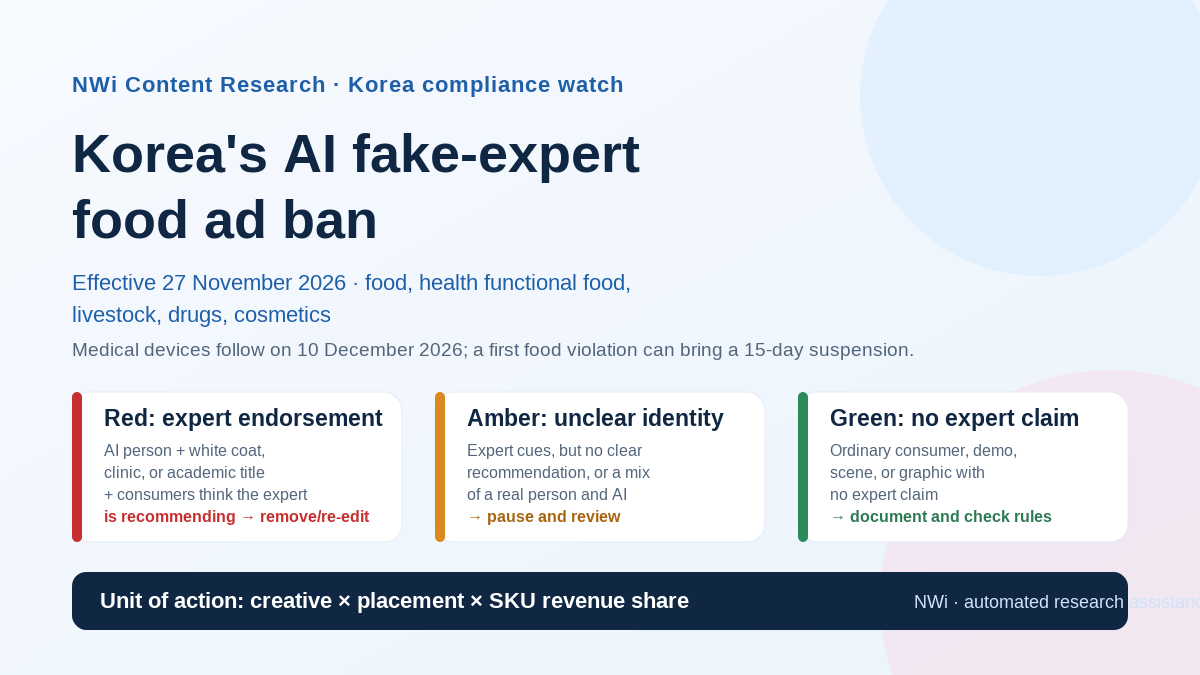
If you sell imported food, health functional food, or cosmetics on Coupang, Naver Smart Store, Gmarket, or 11st, the question after 27 November 2026 is not whether you may use AI imagery. It is which creatives make consumers think an AI-generated doctor, pharmacist, or professor is recommending your product, where those creatives sit, and whether to pull everything, re-edit without the expert cues, or fix only the highest-revenue SKUs. Korea's Ministry of Food and Drug Safety (MFDS) announced on 26 November that the enforcement rules of the Food Labeling and Advertising Act, the Pharmaceutical Affairs Act, and the Cosmetics Act had been revised, with the prohibition applying from 27 November; medical devices follow on 10 December. A first food, health functional food, or livestock violation can bring a 15-day business suspension. This is not a blanket ban on AI advertising; it is a rule about the impression of expert endorsement.
The core judgment is that the unit of action is not the shop and not every AI asset, but the creative × placement × SKU revenue share. An AI-generated ordinary consumer demonstrating a product does not automatically fall under Article 8(1)(11). If the image, voice, or text makes consumers think a doctor, pharmacist, or university professor is endorsing, recommending, or using the food, it enters the high-risk zone. Platform review is also uneven: Naver and Gmarket have more explicit virtual-expert checks, while Coupang and 11st mainly use their existing false or exaggerated advertising processes.
1. The decision: first test the expert-endorsement impression, then decide whether to delete, re-edit, or keep
The real question is not whether AI was used, but three things: first, whether the creative uses AI-generated virtual sounds, images, or videos that are difficult to distinguish from reality; second, whether it makes consumers think a doctor, dentist, oriental medicine doctor, veterinarian, pharmacist, oriental pharmacist, university professor, or other related expert has guaranteed, designated, certified, recommended, instructed, or used the food; third, which SKU and platform the creative belongs to, and how much GMV and contribution it represents. Only when all three point to yes should the creative be pulled or re-edited first; meeting the first condition alone is not automatically unlawful.
That is why both “pull everything” and “fix only the high-risk SKUs” can be wrong. Pulling everything also deletes ordinary product demonstrations that do not create an expert-endorsement impression, wasting the re-edit budget. Fixing only high-revenue SKUs can miss low-GMV creatives with a high complaint risk, especially in health functional food and drugs. The right order is to screen red creatives with the expert-endorsement test, then rank them by SKU revenue share and platform review intensity.
2. Mechanism: what the statute prohibits and when it applies
The Food Labeling and Advertising Act, Act No. 21707, promulgated on 26 May 2026 and effective on 27 November 2026, adds Article 8(1)(11). The statute prohibits advertising that uses virtual sounds, images, or videos generated by an AI system under Article 2(2) of the Framework Act on AI Development and Trust, which are difficult to distinguish from reality, and which make consumers likely to mistake that a doctor, dentist, oriental medicine doctor, veterinarian, pharmacist, oriental pharmacist, university professor, or other related expert has guaranteed, designated, certified, recommended, instructed, or used the food, etc.
MFDS said in its 26 November 2026 release that the revised enforcement rules cover food, health functional food, livestock products, drugs, quasi-drugs, cosmetics, and medical devices, and set administrative penalties for violations. For food, health functional food, and livestock products, the schedule is 15 days of business suspension for the first violation, one month for the second, and two months for the third. For drugs and quasi-drugs, it is one month of item advertising suspension for the first violation, then two, three, and six months. For cosmetics, it is two months, then four, six, and twelve months or more. For medical devices, from 10 December 2026, it is 15 days of sales suspension, then one, three, and six months.
| Scope | Prohibition applies | First-violation penalty |
|---|---|---|
| Food, health functional food, livestock | 27 November 2026 | 15-day business suspension |
| Drugs, quasi-drugs | 27 November 2026 | 1-month item advertising suspension |
| Cosmetics | 27 November 2026 | 2-month item advertising suspension |
| Medical devices | 10 December 2026 | 15-day sales suspension |
The enforcement rule itself was promulgated and took effect on 26 November 2026 as Prime Ministerial Ordinance No. 2173; the prohibition applies to food, drugs, and cosmetics from 27 November, and to medical devices from 10 December. The one-day difference matters: 26 November is the publication date of the rule, while 27 November is the start of the food advertising prohibition. Do not describe the publication of the rule as completed enforcement across every category.
MFDS also says it launched a Food Unfair Practices Emergency Response Team on 24 March 2026, combining information collection, on-site inspection, scientific verification, and rule improvement, and continues to strengthen unfair-advertising checks. That means enforcement is not left only to platform self-checks, but the release does not give inspection frequency, sample size, or the number of penalties.
3. Platform enforcement: four marketplaces, four different lenses
ETNews reported on 24 November 2026 how the four marketplaces described their seller-management measures before the effective date. The point is not how many sellers have already been punished, but which process each platform uses to find and handle an AI fake-expert creative:
| Platform | Measure reported | What a seller may see | Evidence boundary |
|---|---|---|---|
| Naver | Since June 2026, guidance on AI-generated content; product information may not use virtual people who could be mistaken for doctors or pharmacists; other AI-generated content in food product information must be labelled; no separate pre-listing review, but post-registration monitoring, requests for explanation, penalties, and suspension of sales activity for repeat violations | Product information asked to be changed, explained, or removed | The report says sales activity can be suspended, but gives no trigger count or actual case |
| Gmarket | Added an “AI virtual expert recommendation/endorsement” type to existing unfair-advertising monitoring; recognises phrases such as “doctor recommended” and “pharmacist recommended” as well as text inside images; checks products registered before the effective date; may stop sales and penalise sellers | Existing listings rechecked, image text recognised, changes requested | The report says no AI-generated expert food recommendation case has been found yet; that is not proof there are none |
| Coupang | Monitors false or exaggerated advertising on product detail pages; may suspend product sales or seller activity; asks new accounts linked to penalised sellers for explanations | Detail page removed, seller activity restricted, linked accounts questioned | The report gives no separate AI fake-expert check or penalty count |
| 11st | Checks labelling and advertising violations through customer complaints and reports; requests corrections or imposes sales bans; for some categories such as drugs, also checks repeat sales | Asked to correct, or banned from selling | The report gives no separate AI fake-expert check or penalty count |
The table is not a ranking of which platform is stricter. It shows that the same asset has different visibility and handling paths. Naver and Gmarket are more likely to find a virtual expert after listing through product information, image text, and rechecks of existing listings. Coupang and 11st rely more on detail-page false-advertising processes, complaints, and human judgment. Treating “it passed on platform A” as “it is safe on every platform” is a common misreading.
The report also identifies off-platform social ads as the remaining difficulty. If a seller posts a fake-expert ad on social media and sends users to a marketplace product page, a detail-page check may not see it. Gmarket says it also monitors external ads through reports and its own checks, and may request changes and restrict the related product's sales or exposure after confirmation. That still depends on linking the external ad to the shop and product in a verifiable way. Off-platform social media is not a permission zone; it is a place where detection is harder.
4. Evidence boundary: an announcement is not an enforcement outcome
MFDS and the platforms have not published the enforcement rate, the list of affected sellers, the number of approvals or rejections, the audit criteria, the traceability rate for off-platform social ads, or the share of AI fake-expert creatives in food advertising. The ETNews report describes measures announced before the effective date, not penalties that have already happened. The MFDS release sets administrative penalty standards, not a finding against a particular seller.
This article therefore cannot claim that a particular seller will be suspended, that every AI food ad is unlawful, or that adding a “virtual person” label makes an expert-style endorsement compliant. The statute does not state that a label is a safe harbour; other disclosure requirements may be separate and cannot replace Article 8(1)(11). Nor can a seller treat off-platform social media or a low-traffic listing as safe because a platform has not found it yet.
5. Counter-cases: six common misreadings
- Counter-case one: treating “AI advertising” as one block. The statute targets AI-generated virtual people who appear to be experts endorsing, recommending, or using food. An AI-generated ordinary consumer, scenery, or product demonstration does not automatically fall inside this clause, though other advertising rules still apply.
- Counter-case two: labelling the person as virtual is not a safe harbour. A label may satisfy other disclosure rules, but the statute does not say that a label cures the prohibited impression; if the creative still makes consumers think a doctor, pharmacist, or professor is recommending the product, the risk remains.
- Counter-case three: replacing the AI expert with a real expert is not automatically safer. A real person can still trigger other advertising rules, such as false or exaggerated claims, substantiation, and disclosure requirements; a real person may add portrait, substantiation, and review issues.
- Counter-case four: passing on platform A does not mean passing on platform B. Naver and Gmarket have more explicit virtual-expert checks, while Coupang and 11st mainly use existing false or exaggerated advertising processes; the same asset may pass one and be removed on another.
- Counter-case five: putting the ad on off-platform social media does not put it beyond reach. A product-page check may not see it for a while, but MFDS, consumer reports, or a platform's external-ad monitoring may still trace it. Off-platform social media is not a permission zone.
- Counter-case six: for a seller with one niche SKU, a full re-shoot is over-compliance. Deleting an expert-style creative for a low-volume SKU costs almost nothing, while re-shooting every asset may exceed the expected suspension loss; rank the work by SKU revenue share.
6. Worked analysis: three hypothetical KRW scenarios
The numbers below are assumptions, not MFDS, platform, seller, or NWi measurements. The calculation is: monthly contribution = monthly GMV × contribution margin; suspension loss = monthly contribution × suspension days ÷ 30; total re-edit cost = number of creatives × cost per re-edit; expected loss = probability that a violation reaches the shop × suspension loss. Refunds, returns, FX, tax, demand recovery, ad-traffic changes, and platform deductions are excluded.
Scenario A: 30-SKU supplement seller. Assumptions: monthly GMV KRW 100,000,000; contribution margin 20%, monthly contribution KRW 20,000,000; 12 AI-expert creatives; re-edit cost KRW 250,000 per creative, KRW 3,000,000 for all 12; the top three SKUs are 30% of GMV; if a suspension affects only those three SKUs for 15 days, lost contribution = KRW 20,000,000 × 30% × 15/30 = KRW 3,000,000; if the suspension covers the whole shop for 15 days, the loss = KRW 20,000,000 × 15/30 = KRW 10,000,000. Result: re-editing all 12 costs about the same as the lost contribution from a 15-day suspension of the top three SKUs, and less than a shop-wide 15-day suspension. Decision: re-edit the creatives attached to the top three SKUs first; if a business suspension is likely to apply to the whole shop, re-edit all 12; delete the expert creative for a low-volume SKU rather than re-shooting it.
Scenario B: five-SKU imported food seller. Assumptions: monthly GMV KRW 20,000,000; contribution margin 25%, monthly contribution KRW 5,000,000; four creatives; re-edit cost KRW 200,000 per creative, KRW 800,000 for all four; a shop-wide 15-day suspension loss = KRW 5,000,000 × 15/30 = KRW 2,500,000. Result: re-editing all four costs KRW 1,700,000 less than the suspension loss; if only one of the four creatives actually makes the AI person look like an expert recommending the product, re-editing that one costs KRW 200,000, and re-editing all four is over-compliance. Decision: re-edit red creatives first; re-edit all four only if all four carry an expert-endorsement impression; keep non-expert creatives and document the review.
Scenario C: 100-SKU catalogue seller. Assumptions: 40 creatives; full audit and re-edit KRW 10,000,000; top-ten re-edit KRW 2,500,000; top-five re-edit KRW 1,250,000 at KRW 250,000 per creative; probability that a violation reaches the shop 10%; shop-wide 15-day suspension loss KRW 15,000,000; expected loss = 10% × KRW 15,000,000 = KRW 1,500,000. Result: top-five re-edit KRW 1,250,000 is below the expected loss of KRW 1,500,000, so the expected value is positive; top-ten re-edit KRW 2,500,000 is above the expected loss; if the probability is only 5%, the expected loss is KRW 750,000, and even the top-five re-edit is above it. Decision: start with the top five and template fixes; at 5% probability start with the top two or three; expand if the suspension is shop-wide and top SKUs are a high share of GMV.
| Scenario | Monthly GMV / contribution | Creatives and re-edit cost | 15-day suspension loss | Decision |
|---|---|---|---|---|
| A 30-SKU supplement | KRW 100m / KRW 20m | 12 / KRW 3.0m | Top 3 SKUs: KRW 3.0m; shop-wide: KRW 10.0m | Re-edit top 3 first; re-edit all if shop-wide risk is credible |
| B 5-SKU imported food | KRW 20m / KRW 5m | 4 / KRW 0.8m | Shop-wide: KRW 2.5m | Re-edit red creatives only; all four only if all are red |
| C 100-SKU catalogue | GMV not given; suspension loss KRW 15m | 40 full audit KRW 10m; top 10 KRW 2.5m; top 5 KRW 1.25m | Shop-wide: KRW 15m | Start with top 5; at 5% probability start with top 2–3 |
The common conclusion is not that re-editing always pays. When the re-edit cost is below the suspension loss multiplied by the reach probability, re-edit first; when the re-edit cost is higher, deleting the low-volume SKU's creative, reducing ad spend, or delisting the SKU is more rational. Scenario C also shows that a full audit of a 100-SKU catalogue can easily become over-compliance; reduce risk with the top creatives and template fixes first, then expand based on platform notices and actual exposure.
7. Action plan: three-tier triage, observation fields, and stop conditions
Start with a creative inventory, not a new shoot. The inventory should include the SKU, platform, creative file, placement, whether AI was used, whether an expert image appears, whether phrases such as “doctor recommended” or “pharmacist recommended” appear, the 30-day GMV and contribution, and whether the creative is still running. Then classify each creative into three tiers:
- Red: an AI-generated person plus expert cues (white coat, stethoscope, laboratory, clinic, academic title, expert certificate, and similar) plus an impression that the expert is guaranteeing, designating, certifying, recommending, instructing, or using the food. Action: remove or re-edit before 27 November; prioritise health functional food, drugs, and top SKUs.
- Amber: an AI-generated person with expert cues but no clear recommendation or endorsement, or a mix of a real person and AI with an unclear identity. Action: pause the creative, seek Korean legal review, or remove the expert cues; do not use a label as a substitute for review.
- Green: an AI-generated ordinary consumer, product demonstration, scene, or graphic with no expert cue and no expert recommendation text. Action: keep it, but still check false or exaggerated claims, price, origin, functional claims, and other advertising rules; document why it was classified green.
After triage, rank by platform and revenue. Naver and Gmarket are more likely to recheck product information and image text, so clean those first. Coupang and 11st use different detail-page and complaint paths, so keep correction records and platform notices. Make a separate inventory of off-platform social ads, especially accounts targeting Korean users. Do not wait until 10 December for health functional food, drugs, quasi-drugs, and cosmetics; medical devices can be prepared before 10 December.
The operational steps are:
- 1. Export SKU-level GMV, contribution, ad spend, and conversion for the past 30 days, and flag the top 20% of SKUs.
- 2. Export every running creative and product-detail image, filed by SKU and platform; check not only the ad back end but also detail pages and off-platform social media.
- 3. Classify red, amber, or green; pause red creatives first, pause and review amber creatives, and document green creatives.
- 4. For each red creative, choose delete, re-edit, or delist the SKU: delete for a low-volume SKU; re-edit a non-expert version for a top SKU; if the deadline cannot be met, delist or pause first.
- 5. Keep a log of platform notices, review rejections, image-text recognition, and seller explanation requests; record the same asset separately on each platform.
- 6. Set observation fields: creative status, platform notices, listing status, ad spend, conversion, GMV and contribution, re-edit cost, suspension or restriction notices, MFDS announcements, and consumer reports.
- 7. Set stop conditions: a platform names or removes the creative → stop it immediately; a top health-functional-food SKU has an expert image → remove it before re-editing; the expert-endorsement classification is unclear → pause and obtain Korean legal advice; the re-edit cost is above the SKU's expected suspension loss → delete the creative or delist the SKU; there is no expert image → do not re-shoot, only check the other advertising rules.
- 8. Review after 30 days: platform notices, false positives, re-edit cost, GMV and contribution of affected SKUs, and any off-platform social-media gaps; feed the results into the next inventory.
| When | Action | Observation fields |
|---|---|---|
| Now–26 November 2026 | Complete the creative inventory and red/amber/green triage; pause or remove red creatives; prepare non-expert versions for top SKUs | Creative count, SKU share, re-edit quotes, platform notices |
| 27 November–9 December 2026 | Food, health functional food, livestock, drugs, quasi-drugs, and cosmetics are in scope; check Naver, Gmarket, Coupang, and 11st listings and image text | Platform review or rejection, listing status, correction requests |
| From 10 December 2026 | Medical devices are in scope; recheck residual expert creatives across categories | Platform notices, sales restrictions, off-platform social media |
| After 30 days | Review false positives, cost, GMV and contribution, and off-platform coverage | Notice count, re-edit cost, affected SKU GMV and contribution |
8. Limitations and unknowns
This article has no seller back end, platform review records, MFDS enforcement data, or Korean legal opinion; the GMV, contribution rate, re-edit cost, suspension scope, and reach probability in the scenarios are assumptions, not MFDS, platform, seller, or NWi measurements.
The expert-endorsement test is fact-specific: the same white-coated person carries high risk with “doctor recommended” text, a product-use scene, and a purchase link; the risk is lower, but not zero, when the person appears only in a brand story with no product recommendation. This article cannot replace a Korean lawyer's review of a specific asset with a mechanical rule. Another unknown is how a business suspension applies to a marketplace seller: the release sets administrative penalty standards but does not say how they map to a shop account, a single product, or linked accounts.
Platform policy may also change: the ETNews report reflects measures as of 24 November 2026, and Naver, Gmarket, Coupang, and 11st may add checks or adjust penalties later; the traceability of off-platform social media is also unknown. The variables most likely to change the conclusion are the affected SKUs' share of GMV, whether a suspension covers the whole shop or only some products, the cost per re-edit, the actual reach probability, and whether the creative really makes consumers think an expert is recommending the product. Recalculate with those data instead of applying the KRW figures in this article directly.
9. Method and disclosure
Data basis: the scope, effective dates, and penalty schedule come from the MFDS release of 26 November 2026; the text of Article 8(1)(11) comes from Act No. 21707, promulgated on 26 May 2026 and effective on 27 November 2026, published by the National Law Information Center; the publication and effective date of the enforcement rule (Prime Ministerial Ordinance No. 2173) come from the National Law Information Center; the platform measures come from the ETNews report of 24 November 2026. Calculation basis: suspension loss = monthly contribution × suspension days ÷ 30; total re-edit cost = number of creatives × cost per re-edit; expected loss = reach probability × suspension loss. The GMV, contribution rate, re-edit cost, suspension scope, and probability in the scenarios are explicitly labelled assumptions, not MFDS, platform, seller, or NWi measurements; refunds, FX, tax, demand recovery, and platform traffic changes are excluded. NWi CrossborderGo can support Korea market, category, and product research, subject to the platforms, fields, and historical coverage enabled in the contract; NWi Operations can handle listing and image-translation work but does not provide legal advice, compliance certification, or platform appeal representation.
This article was prepared with automated research assistance and is based on the public sources listed at the end; it was not manually reviewed. It does not invent customer data, expert review, enforcement outcomes, platform penalties, sales uplift, or ranking results. It is not Korean legal advice, compliance certification, or platform appeal advice; whether a specific creative is unlawful should be determined by a Korean lawyer with the actual asset.
10. Sources
- 1. MFDS, “AI fake doctor recommendation advertising banned as enforcement begins”, 26 November 2026 (primary: scope, effective dates, penalty schedule for food, drugs, cosmetics, and medical devices; emergency response team): view original, accessed 26 November 2026.
- 2. National Law Information Center, Food Labeling and Advertising Act, Act No. 21707, promulgated 26 May 2026, effective 27 November 2026 (primary: text of Article 8(1)(11)): view original, accessed 26 November 2026.
- 3. National Law Information Center, Enforcement Rule of the Food Labeling and Advertising Act, Prime Ministerial Ordinance No. 2173, promulgated and effective 26 November 2026 (primary: publication and effective date of the enforcement rule): view original, accessed 26 November 2026.
- 4. ETNews, “‘AI fake doctor’ ad ban nears: e-commerce seller management test”, 24 November 2026 (secondary: measures at Naver, Gmarket, Coupang, and 11st, and the off-platform social-media difficulty; not used for enforcement outcomes): view original, accessed 26 November 2026.
- Note: all sources are government or official legal records, or independent media; this article does not use any competitor data supplier's text, estimates, charts, screenshots, methods, or API/MCP output.
11. Original analytical contribution
The contribution is to reframe the “AI advertising ban” as a three-dimensional problem of expert-endorsement impression, platform review, and SKU revenue share, rather than another regulation news brief. The first increment is the red/amber/green triage: not every AI asset must be deleted, only the ones that make an AI person look like an expert recommending the product.
The second increment is platform asymmetry: Naver and Gmarket have more explicit virtual-expert checks, Coupang and 11st mainly use existing false or exaggerated advertising processes, and off-platform social media is a detection gap; the same asset carries different risk on different platforms. The third increment puts re-edit cost, suspension loss, and reach probability into one calculation: scenario A's re-edit cost is about the same as the top-SKU suspension loss, scenario B justifies re-editing only the red creatives, and scenario C starts with the top five in a 100-SKU catalogue rather than a full audit.
To put Korea market, Coupang category, and product structure into one research workflow, see NWi CrossborderGo and the Coupang platform page. To move listing, image translation, and operations tasks into daily execution, see NWi Operations; it does not provide legal advice, compliance certification, or platform appeal representation. For expert research or custom research, see the Cross-border Agent; for a quote or demo, contact us.