
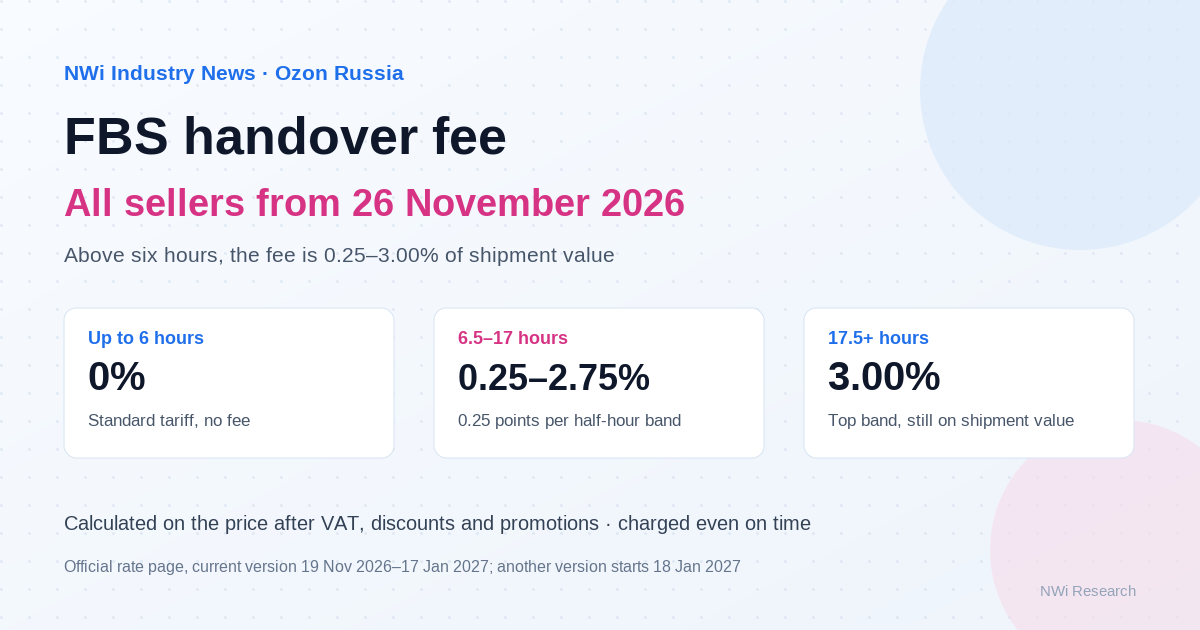
If you run FBS on Ozon Russia, the question after 26 November 2026 is not simply whether the platform raised a price. It is how long each SKU's cut-off-to-handover window should be: six hours, eight hours or longer. Ozon began removing the recommended handover slot for some sellers on 19 November and replaced it with a fee based on the handover time the seller sets. The seller news of 23 November confirms that the new order applies to all sellers from 26 November. Above six hours, the fee is 0.25–3% of the shipment value, and it is charged even when the seller hands over on time. This article separates the handover-duration fee, the error-index penalty for late handover and the warehouse/3PL cost, then uses three hypothetical scenarios to show when to shorten the window, when to accept the fee, and when to reprice or delist.
Ozon's seller news “FBS: отменим рек. слот с 26.11” (23 November 2026) states that the new order started for some sellers on 19 November and applies to all sellers on 26 November. If the handover time exceeds six hours, Ozon charges a handover-duration fee of 0.25–3% of the value of all goods in the shipment; up to six hours, the standard tariff applies. The official rate page gives the ladder: 0.25% at 6.5–7 hours, then 0.25 percentage points for every additional half-hour band, reaching 3.00% at 17.5 hours or more. The fee is calculated on the seller's price including applicable VAT and all discounts and promotions; additional point discounts are excluded.
The seller news and the rate page are the primary basis for this analysis. The contract-change page also records the handover-duration fee from 19 November 2026. This article does not describe the change as a blanket tax on all sales, and it does not treat six hours as the only correct setting.
1. The decision: not “did the price rise” but “how long should each SKU promise”
The real decision is how long the promised handover window should be for each SKU, and whether that promise is worth its cost in fees, late penalties and warehouse labour. Within one store, fast-moving goods, made-to-order items, bulky goods and low-contribution SKUs can have different answers. A fast mover may use six to eight hours to keep the fee low; a made-to-order item may prefer to pay 0.5–1.5% rather than risk a late penalty; a low-contribution SKU may lose its reason to exist at a 3% fee.
Three costs have to be compared together. First, the handover-duration fee, which rises with the window the seller sets and is charged on the product price. Second, the late-handover penalty, which depends on the error-index band over the past 14 days and appears only when a short window cannot be met. Third, the incremental warehouse/3PL cost: overtime, extra staff, an earlier cut-off, a different pickup point or expedited transport. Comparing only the first cost leads to “shorter is always better”; comparing only the second leads to “longer is always safer”; comparing all three gives the usable range for each SKU.
2. Mechanism: six hours is a price line
Handover time is not the actual packing time. It is the difference between two times the seller sets in the logistics settings: the order cut-off and the handover time. The official FBS guide uses this example: accept orders until 14:00 and hand them over by 20:00 the same day, and the handover time is six hours, with no fee. If the cut-off moves to 13:00, the handover time is seven hours, and the fee applies even if the seller hands over on time at 20:00. The fee is calculated on the value of all goods in the shipment, not as a flat per-order charge, and it is charged even when the handover is on time.
The fee ladder is below (official rate page, current version, 19 November 2026 to 17 January 2027):
| Handover time | Fee rate |
|---|---|
| 0–6 hours | 0% |
| 6.5–7 hours | 0.25% |
| 7.5–8 hours | 0.50% |
| 8.5–9 hours | 0.75% |
| 9.5–10 hours | 1.00% |
| 10.5–11 hours | 1.25% |
| 11.5–12 hours | 1.50% |
| 12.5–13 hours | 1.75% |
| 13.5–14 hours | 2.00% |
| 14.5–15 hours | 2.25% |
| 15.5–16 hours | 2.50% |
| 16.5–17 hours | 2.75% |
| 17.5 hours or more | 3.00% |
The rule turns the promised window into a priced parameter: a longer window costs more per shipment, while a shorter window raises the chance of a late handover. Lateness is not the handover-duration fee; it is a separate error-index penalty. Ozon calculates the error index as the share of late handovers and seller-caused cancellations over the past 14 days, excluding today. The bands are: 0–2%, no penalty; 2.1–5%, 1% for late handover and 2% for cancellation; 5.1–10%, 2% and 4%; 10.1–20%, 4% and 8%; above 20%, 8% and 8%. Late handovers are capped at RUB 2,000 and cancellations at RUB 4,000. Ozon sends a notice after the violation, charges three days later, and allows an appeal within 14 days. The handover-duration fee itself can be appealed within seven days of the notice.
| Error index (past 14 days) | Late-handover penalty | Cancellation penalty |
|---|---|---|
| 0–2% | 0 | 0 |
| 2.1–5% | 1% | 2% |
| 5.1–10% | 2% | 4% |
| 10.1–20% | 4% | 8% |
| Above 20% | 8% | 8% |
The rate page heading calls the charge a “сбор” (fee), while its text sometimes uses “штраф” (penalty). This article treats it as a fee for choosing a longer promised window, separate from the late-handover penalty. That distinction is why an on-time handover can still be charged.
3. Evidence boundary: the official rule is clear; seller distribution and conversion effects are not public
The official Ozon pages reviewed for this article do not publish how many sellers were brought into the new order on 26 November, the distribution of seller handover times, the effect of a six-hour promise on conversion, the total fee collected or the appeal success rate. This article therefore cannot claim that six hours always earns more or that a longer window always loses sales, and it cannot treat the rate table as an actual seller bill.
The rate table does not list a 6–6.5 hour row; this article does not infer that band, and sellers should use the actual settlement line. A second boundary is the time version. The rate page also has a tab “С 18 января 2027 г.” that explicitly says all days are counted in handover time, even days the seller marked as non-working. The current tab (19 November 2026 to 17 January 2027) does not say that, and the FBS guide says a weekend order can be handed over on a working day without a late penalty. The two statements are not contradictory—one is about the fee clock and the other about lateness—but a long-term plan that assumes weekends are free must be recalculated for 18 January 2027.
This article can verify the rules, dates and rates on the official seller news, rate page, FBS guide and contract-change page. It cannot verify a seller's actual settings, real fee bills, 3PL quotes or the platform's enforcement details. The order volumes, average order values, contribution rates, warehouse costs and lost orders in the scenarios are assumptions, not Ozon, seller or NWi measurements.
4. Counter-cases: five common misreadings
- Counter-case one: setting the cut-off at six hours is not automatically cheaper. If the warehouse cannot meet it, the late penalty can be 1–8%, subject to a RUB 2,000/4,000 cap, and it enters the error index; that can exceed the 0.25–1.5% handover-duration fee.
- Counter-case two: setting 17.5 hours and paying 3% is not “doing nothing”. If the SKU has a low contribution rate, 3% can consume a fifth of contribution; if the order is high-value and low-volume, the absolute 3% can exceed the cost of warehouse overtime.
- Counter-case three: the fee is calculated on the price including VAT and all discounts and promotions, not on contribution. The deeper the discount, the larger the share of contribution taken by 3%.
- Counter-case four: the weekend rule is time-limited. The current guide allows a weekend order to be handed over on a working day without a late penalty, but the rate page's version from 18 January 2027 explicitly counts all days in handover time. Treating “weekends are not counted” as a permanent rule would be wrong.
- Counter-case five: 26 November is the all-seller effective date, not a fresh start for every seller. Some sellers have been on the new order since 19 November; if the back end still shows the old recommended slot, check whether the setting has switched before assuming the fee has not started.
5. Worked analysis: three hypothetical scenarios
The numbers below are assumptions, not Ozon or seller measurements. The fee base is assumed to equal the order value P, including VAT and all discounts and promotions; contribution is the per-order amount left after product cost, marketplace commission, logistics and fulfilment. Refunds, returns, FX and tax are excluded.
Scenario A: mid-ticket, high-volume. Assumptions: fee base RUB 2,000; 1,000 orders per month; contribution RUB 300 per order; fee rates 0.50% at 8 hours, 1.50% at 12 hours and 3.00% at 17.5 hours; refunds, FX and tax excluded. Result: at 8 hours, RUB 10 per order, RUB 10,000 per month, 3.3% of the RUB 300,000 monthly contribution; at 12 hours, RUB 30 per order, RUB 30,000 per month, 10.0%; at 17.5 hours, RUB 60 per order, RUB 60,000 per month, 20.0%. Decision: set the shortest interval the warehouse can reliably meet—start with eight hours rather than forcing six to save the fee; if eight is also infeasible, compare overtime/3PL cost with the 12-hour fee.
Scenario B: low-ticket, very high-volume. Assumptions: fee base RUB 500; 5,000 orders per month; contribution RUB 80 per order; fee rates 0.50% at 8 hours, 1.50% at 12 hours and 3.00% at 17.5 hours. Result: at 8 hours, RUB 2.50 per order, RUB 12,500 per month, 3.1% of the RUB 400,000 monthly contribution; at 12 hours, RUB 7.50 per order, RUB 37,500 per month, 9.4%; at 17.5 hours, RUB 15 per order, RUB 75,000 per month, 18.75%. Decision: the per-order fee looks small, but the monthly total and contribution share are material; monitor the aggregate, not the unit fee.
Scenario C: high-ticket, low-volume. Assumptions: fee base RUB 8,000; 200 orders per month; contribution RUB 1,200 per order; 17.5-hour fee 3.00%; shortening to six hours costs an assumed RUB 50,000 per month in warehouse/3PL cost and loses five orders per month. Result: at 17.5 hours, RUB 240 per order, RUB 48,000 per month, 20.0% of the RUB 240,000 monthly contribution; shortening costs RUB 50,000 plus RUB 6,000 of lost contribution, or RUB 56,000, which is more than RUB 48,000. If the incremental cost is only RUB 20,000, the total is RUB 26,000, below RUB 48,000. Decision: compare the fee saved with incremental warehouse/3PL cost plus lost contribution; do not shorten just because 3% looks high.
Late penalties can be compared separately. Assume a seller is already in the 10.1–20% band, so a late handover is charged at 4%; on a RUB 2,000 fee base, that is RUB 80. The eight-hour fee is RUB 10 per order. If one in 50 orders is late, the expected penalty is about RUB 1.60 per order, below RUB 10; if one in five is late, the expected penalty is about RUB 16 per order, above RUB 10. The comparison shows that shortening the window depends on the late frequency and the index band, not on the fee rate alone.
| Scenario | Fee base / monthly orders | 8-hour fee | 12-hour fee | 17.5-hour fee | Contribution |
|---|---|---|---|---|---|
| A mid-ticket | RUB 2,000 / 1,000 | RUB 10,000 (3.3%) | RUB 30,000 (10.0%) | RUB 60,000 (20.0%) | RUB 300/order |
| B low-ticket | RUB 500 / 5,000 | RUB 12,500 (3.1%) | RUB 37,500 (9.4%) | RUB 75,000 (18.75%) | RUB 80/order |
| C high-ticket | RUB 8,000 / 200 | — | — | RUB 48,000 (20.0%) | RUB 1,200/order |
6. Action plan: set the window by SKU, review the fee weekly
Start by checking the current FBS method's cut-off time, handover time and working-day settings, then export the past 14 days of late/cancellation data and the current error index, and build a fee-versus-contribution table by SKU. The eight steps are:
- 1. In the seller back end, open the FBS method settings at the “Пункт отгрузки” step and record the cut-off time, handover time, pickup point/courier/sort centre and marked working days.
- 2. Calculate the current h as handover time minus cut-off time; if it crosses midnight, use the actual hours. Do not assume that “same day” means six hours.
- 3. Export the past 14 days of late handovers, cancellations, order volume and the current error index; identify which band a new late handover would push you into.
- 4. Build a SKU table with fee base P, contribution per order, current h, fee rate, monthly orders, monthly fee, fee/contribution, late frequency and the incremental warehouse/3PL cost of reaching the target h.
- 5. For each SKU, choose the shortest h you can reliably meet. Shorten if fee saved > incremental cost + lost contribution + expected penalty; otherwise keep the longer h and budget the fee.
- 6. Reconcile the handover-duration fee and the late penalty separately: fee line, settings screenshot, handover timestamp, notices and appeals. If h is six hours or less and the fee still appears, appeal within seven days with the settings evidence.
- 7. Stop conditions: if shortening h would push the error index above 2.1%, fix capacity first; if the 3PL cut-off cannot support the target h, change the 3PL or accept the fee; if the fee exceeds contribution for two consecutive cycles, reprice, delist or renegotiate; if the 18 January 2027 version starts counting non-working days, recalculate before that date.
- 8. Monitor the settings h, actual handover time versus deadline, late/cancellation counts, error index, fee line, appeal status, SKU contribution and 3PL cut-off time.
| Time point | What to watch | Trigger | Action |
|---|---|---|---|
| Now–31 December 2026 | Current h, fee line, error index, SKU contribution | h > 6 or fee/contribution > 10% | Reset h by SKU; budget the fee; correct and appeal errors |
| 1–17 January 2027 | 18 January version notice, weekend/holiday settings | New version confirms non-working days are counted | Recalculate h and fee; adjust shifts/3PL |
| From 18 January 2027 | Whether all days are counted; fee changes | Fee rises or h is recalculated | Update the SKU table; reprice or delist if needed |
7. Limitations and uncertainties
This article has no seller back end, real fee bill, 3PL quote or appeal outcome. The order volumes, average order values, contribution rates and warehouse costs in the scenarios are assumptions, not Ozon, seller or NWi measurements.
The rate table does not list a 6–6.5 hour row, and this article does not infer it. The current version applies only to 17 January 2027; whether it continues after that, and how non-working days are treated, depends on the platform's next version. The official pages reviewed for this article also do not publish the distribution of seller handover times, the conversion effect of a six-hour promise or the actual profit impact of the fee.
The unknowns most likely to change the conclusion are: whether your warehouse and 3PL can reliably meet the target h; how high your SKU contribution rate is; which error-index band a late handover would push you into; and whether the 18 January 2027 version changes weekend and holiday counting. Recalculate with your own settings, bills and 14-day late data; do not copy the ruble figures in this article.
8. Method and disclosure
Data basis: the six-hour threshold, the 0.25–3.00% ladder, the rule that the fee is calculated on the price including VAT and all discounts and promotions, and the rule that it is charged even on an on-time handover are taken from Ozon Seller's news “FBS: отменим рек. слот с 26.11” (23 November 2026) and the Ozon Seller Education rate page “Расходы на другие услуги и штрафы” (current version 19 November 2026 to 17 January 2027, accessed 26 November 2026). The handover-time definition, the 14:00/20:00 example and the weekend handover note are taken from the Ozon FBS guide “Отгрузка отправлений на FBS” (16 November 2026). The error-index bands, the 1%/2%/4%/8% and 2%/4%/8%/8% rates, the RUB 2,000/4,000 caps, the three-day charge and the 14-day appeal are taken from the same rate page. The contract-change page confirms that the fee was introduced from 19 November 2026. Calculation basis: monthly fee = monthly orders × fee base × fee rate; fee/contribution = monthly fee ÷ (monthly orders × contribution per order); total cost of shortening to the target h = incremental warehouse/3PL cost + lost orders × contribution per order. The RUB 2,000/500/8,000 fee bases, the 1,000/5,000/200 order counts, the RUB 300/80/1,200 contributions, the RUB 50,000/20,000 incremental costs and the five lost orders are explicitly labelled assumptions, not Ozon, seller or NWi measurements; refunds, returns, FX, tax and penalty interest are excluded. NWi CrossborderGo covers Ozon Russia sales, units, ASP and brand share, updated monthly and available by contract; the product data does not include seller-backend handover settings, fee bills, 3PL quotes or real-time settlement, and the calculations here do not depend on NWi product data.
This article was prepared with the assistance of an automated research workflow from the public sources listed at the end. It was not manually reviewed. It does not invent customer data, expert review, platform fee waivers, refunds, sales uplift, ranking results or platform endorsement. Nothing here is tax, legal, account-appeal or managed-operations advice.
9. Sources
- 1. Ozon Seller, “FBS: отменим рек. слот с 26.11”, 23 November 2026 (primary: all-seller effective date of 26 November, 0.25–3% above six hours, standard tariff up to six hours, charged even on time): read the original, accessed 26 November 2026.
- 2. Ozon Seller Education, “Расходы на другие услуги и штрафы”, current version 19 November 2026–17 January 2027 (primary: fee ladder, fee base, seven-day appeal, error-index bands and caps): read the original, accessed 26 November 2026.
- 3. Ozon Seller Education, “Отгрузка отправлений на FBS”, 16 November 2026 (primary: handover-time definition, 14:00/20:00 example, weekend handover note): read the original, accessed 26 November 2026.
- 4. Ozon Seller Education, “Все версии договора для продавцов товаров”, published 6 October 2026 and effective 19 November 2026 (primary: contractual basis for the FBS handover-duration fee): read the original, accessed 26 November 2026.
- Note: all four are official Ozon pages. Direct requests did not return the body; the pages were read in a browser session after the page verification, and the current and 18 January 2027 tabs of the rate page were checked separately. No competitor data-provider text, estimate, chart, screenshot, method or API/MCP output was used.
10. Original contribution
This article's contribution is to treat the handover-duration fee as a price for the promised window, not as another “platform raised prices” news brief. The decision unit is the SKU, not the store.
The second contribution is to put the fee, the late penalty and the warehouse/3PL cost into one calculation: in Scenario A, the eight-hour band takes 3.3% of contribution while the 17.5-hour band takes 20.0%; Scenario C shows that when the incremental cost of shortening exceeds the fee saved, paying 3% is cheaper. The third contribution is the time-version boundary: the current rule runs to 17 January 2027, and from 18 January 2027 the rate page explicitly counts all days in handover time, so the old habit of not shipping at weekends cannot be extrapolated.
If you want to put Ozon Russia price bands, brand/product structure and the handover-duration fee into one research process, see NWi CrossborderGo for platform, market and product research; for day-to-day product selection, listing and operations, see NWi Operations; for expert research on a specific category, see the Cross-border Agent; to connect platform data to your own analysis, see MCP data access; for a quote or demo, contact us.