
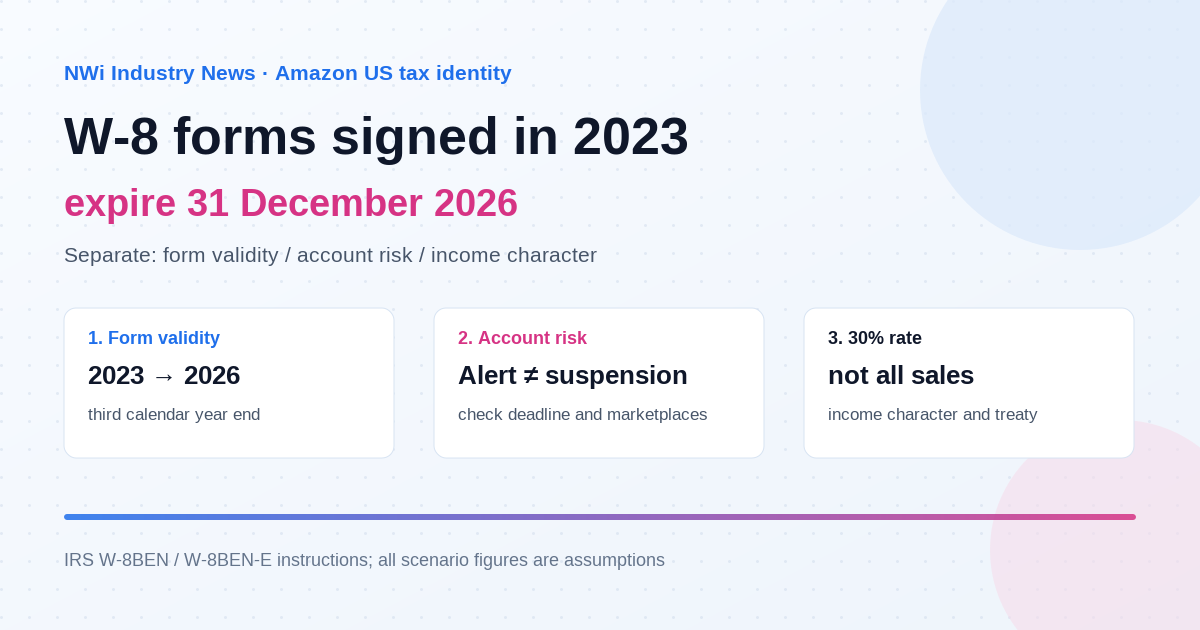
If you sell on Amazon US through a non-US entity and have just seen a tax-compliance alert asking for updated US taxpayer identity information, do not read it as “the platform will tax all sales at 30%”. The real decision has three parts: whether your W-8 form actually expires at the end of 2026, whether the reported 30 December platform deadline affects every marketplace you use, and what kind of US-source income the 30% rate actually reaches. This article separates the three questions, offers an audit ordered by signature year and change events, and works through three hypothetical scenarios that compare refiling cost with the cash-flow difference.
At 05:05 Beijing time on 26 November 2026, cross-border media outlet AMZ123 reported that since late November many Amazon US seller backends had shown a red tax-compliance alert asking sellers to update US taxpayer identity information by 30 December; sellers that submitted W-8BEN or W-8BEN-E in 2023 were in this expiry window; the platform set the deadline at 30 December to leave one day for system validation; failure to update could lead to suspension of selling privileges, and without valid proof of non-US tax residence, US-source income could face withholding of up to 30%; the alert also said the update would affect account status across multiple marketplaces and that the registered name must match the business licence exactly.
That brief is an independent media account of a seller-backend alert, not the text of the Amazon notice. This article labels the deadline, the multi-marketplace effect and the name-match requirement as reported. What can be checked independently is the IRS rule on W-8 validity.
1. The decision: form, account and income are three different questions
Form validity is a tax-document question; suspension risk is a platform-compliance question; the 30% rate is a question about income character and treaty eligibility. One cannot substitute for another. Refiling every form because a red alert appeared can waste administrative cost; changing only one marketplace can miss other stores that share the same tax identity; treating 30% as a blanket tax on all sales can overstate the cash-flow risk and lead to a wrong pricing or price-increase decision.
The practical order is: first, confirm whether the form is a W-8BEN or a W-8BEN-E, which year it was signed, and whether address, ownership or treaty eligibility has changed since signing; second, confirm the deadline, the affected marketplaces and the account status shown in the backend; third, decide whether the 30% rate applies to a particular type of US-source income and whether the treaty claim still holds.
| Question | Fields to check | Common misreading | Do first |
|---|---|---|---|
| Does the form expire? | Form type (W-8BEN/W-8BEN-E), signature year, change events | Refile every form because of a “mass expiry” headline | Filter by signature year and change events; handle only 2023 forms without an earlier invalidation event |
| Is the account at risk? | Reported deadline, affected marketplaces, account status | Treat the alert as a suspension notice | Check the deadline and all marketplaces; keep screenshots and receipts |
| Does 30% apply? | Income type, source, treaty eligibility | Treat 30% as a tax on all GMV | Confirm income character, then run a 30% stress case; do not decide treaty eligibility yourself |
2. Mechanism: the three-year W-8 validity rule and change events
The IRS Instructions for Form W-8BEN state that a W-8BEN generally remains in effect from the date it is signed through the last day of the third succeeding calendar year, unless a change in circumstances makes any information on the form incorrect; the example is a form signed on 30 September 2015 remaining valid through 31 December 2018. The W-8BEN-E instructions also state that the form generally remains valid from the signature date through the last day of the third succeeding calendar year. Under that rule, a form signed in 2023 expires on 31 December 2026.
This is not a blanket rule for every form. The IRS instructions also note that under certain conditions a W-8BEN-E can remain in effect indefinitely until a change of circumstances occurs; the W-8BEN instructions contain a similar chapter 4 exception. The right action is therefore not “refile every form” but “find the forms signed in 2023 that have no earlier invalidation event”.
Change events include a change of address, a change of ownership or entity type, or a change in treaty residence. The IRS instructions require the seller to notify the withholding agent within 30 days and provide a new form if a change in circumstances makes the information incorrect; a move to a US address, or outside the country whose treaty is being claimed, can also be a change. The signature year is only the first filter; the second is the change-event log.
3. Evidence boundary: an alert is not a suspension notice, and 30% is not a tax on all sales
The AMZ123 report is an independent media account of a seller-backend alert; the Amazon notice itself was not directly read in this environment, so the 30 December deadline, the multi-marketplace effect and the name-match requirement are labelled as reported. That matters: an alert is an account-level reminder, not a suspension that has already taken effect; deadlines and statuses can differ by marketplace and account, so one backend screenshot is not a universal timetable for every seller.
The 30% boundary also needs to be stated precisely. The IRS Instructions for Form W-8BEN-E limit chapter 3 withholding to US-source FDAP income, including interest, dividends, rents, royalties, premiums, annuities and compensation for services; the instructions also state that most gains from the sale of property are not FDAP. The 30% rate is therefore not a blanket tax on store GMV; for any platform payment, its character, source and treaty eligibility matter. This article does not determine the tax character of Amazon marketplace payments and is not tax advice.
A treaty is the third boundary. IRS Publication 515 says most types of US-source income are subject to a 30% rate, but a lower rate or exemption may apply if the foreign person's country of residence has a tax treaty with the United States; the benefit is generally collected through chapter 3 withholding. Filing a W-8 is the documentary step that establishes status and claims a benefit; it does not automatically grant treaty benefits. The entity type, the treaty article and conditions such as limitation on benefits still have to be satisfied.
4. Counter-cases: five common misreadings
- Counter-case 1: a form signed in 2024 or 2025 with no change of address, ownership or treaty eligibility is still valid and should not be refiled just because this alert appeared.
- Counter-case 2: a change of address, ownership or treaty eligibility after signing can invalidate a form earlier; looking only at the signature year misses those forms.
- Counter-case 3: refiling does not automatically secure a treaty benefit; if the entity does not qualify, entering 0% will not make the payer accept it.
- Counter-case 4: a backend alert is not a suspension and does not prove that every marketplace has the same deadline; treating it as a suspension can trigger an overreaction or a misplaced appeal.
- Counter-case 5: 30% is not a tax on all sales; most gains from the sale of property are not FDAP, and different income character produces a different withholding result.
5. Worked analysis: three hypothetical scenarios
Every figure below is a clearly labelled assumption, not a measurement from any seller, Amazon or NWi; penalties, interest, other income, exchange rates and refunds are excluded.
Scenario A: a 2023-signed entity claiming treaty benefits. Assumptions: a non-US entity signed W-8BEN in 2023; 2027 US-source income is USD 100,000; the assumed treaty rate is 0%; no refiling before 31 December 2026; refiling costs 8 hours × USD 50 = USD 400; penalties, interest and other income are excluded. Result: the form expires on 31 December 2026. If the payer cannot associate a valid form, 30% withholding is USD 30,000, versus USD 0 under the assumed treaty rate, a USD 30,000 difference; the USD 400 refiling cost is 1.33% of that difference. Decision: refile before 30 December and keep the receipt; if treaty eligibility is uncertain, run a 30% cash-flow stress case and confirm with a tax adviser rather than assuming 0%.
Scenario B: a 2024-signed form with no change. Assumptions: another entity signed W-8BEN-E in 2024; address, ownership and treaty eligibility are unchanged; the form remains valid through 31 December 2027; this alert only asks for 2023 forms; refiling would also cost USD 400. Result: under the three-year rule, no 2026 refiling is required; an extra filing would not extend validity and would add USD 400 of administrative cost plus name-mismatch risk. Decision: do not refile because of this alert; keep a change-event log and notify the payer within 30 days if address, ownership or treaty eligibility changes.
Scenario C: three marketplaces sharing one tax identity. Assumptions: one entity sells on three Amazon marketplaces; the US form signed in 2023 expires; the other two marketplaces use the same tax identity; audit and refiling take 2 hours × USD 50 = USD 100 per marketplace, or USD 300 in total; a one-month suspension of one marketplace would cost an assumed USD 20,000 in monthly contribution. Result: the USD 300 refiling cost is 1.5% of one month's USD 20,000 contribution; a one-month suspension would cost far more, but whether a suspension occurs and how long it lasts is not publicly guaranteed. Decision: start with the US marketplace, then check whether the other marketplaces reference the same identity; do not change only one marketplace, and do not treat submission as automatic approval.
6. Action plan: audit by signature year and change events
Export the forms signed in 2023, match the registered name to the business licence, confirm treaty eligibility, then submit before 30 December and keep the receipt. The sequence has eight steps:
- 1. Export or screenshot the current form from the seller-backend account-information/tax-information page; record the form type, signature year, signature date, registered name, country and treaty claim.
- 2. Put only 2023-signed forms with no earlier invalidation event on the must-refile list; check the validity of 2024/2025 forms first and do not refile them in bulk.
- 3. Match the registered name exactly to the business licence; a name mismatch is a common rejection reason, so fix it before submitting.
- 4. Confirm treaty eligibility: entity type, treaty article and limitation on benefits; if uncertain, run a 30% stress case instead of entering 0%.
- 5. Submit before 30 December to leave time for system validation; keep the submission receipt, screenshot and timestamp.
- 6. Multi-marketplace: check whether other marketplaces reference the same tax identity; if the alert says multiple marketplaces are affected, check each one rather than changing only the US store.
- 7. After submission, check the tax-information page and account health; if a suspension warning appears, keep the evidence and follow the platform process rather than assuming submission is automatically approved.
- 8. Set stop conditions: 2024/2025 form with no change — stop refiling; treaty eligibility unclear — stop claiming the benefit; name mismatch — stop and correct it first; platform deadline conflicts with the IRS rule — handle the platform deadline first and record the difference.
| Timing | What to check | Trigger | Action |
|---|---|---|---|
| Now–30 December 2026 | Form type, signature year, change events, registered name, treaty claim | Signed in 2023; or a change of address/ownership/treaty eligibility after signing | Put on the refiling list; correct the name first; submit and keep the receipt |
| 30–31 December 2026 | Backend tax-information status, account health, affected marketplaces | Alert persists; or a suspension warning appears | Follow the platform process to supplement or appeal; do not resubmit the same incorrect form |
| From 2027 | Whether the treaty benefit is accepted, withholding amount, Form 1042-S | Withholding differs from expectation | Check the payer's documents and treaty eligibility; consult a tax adviser if needed |
7. Limitations and uncertainty
The Amazon backend notice was not directly read, the scope of the 30 December multi-marketplace requirement and the suspension test are not public, and this article is not tax, legal or account-appeal advice.
This article has no seller-backend data, actual W-8 forms, withholding statements or account-status data. The 30% discussion is a general rule; it does not determine the tax character of Amazon marketplace payments. Treaty eligibility is a factual question that depends on the entity, country of residence, treaty article and limitation on benefits. The income, cost, contribution and suspension-loss figures in the scenarios are assumptions, not platform averages or NWi measurements.
The unknowns most likely to change the conclusion are: whether your form falls within the “may remain valid indefinitely” exception; whether a change event occurred after signing; how the payer characterises the income and the treaty documentation; and whether multiple marketplaces really share one tax identity. Once you have your own form, backend alert and withholding statement, recompute the refiling cost and cash-flow difference instead of applying the USD figures in this article.
8. Method and disclosure
Data basis: the three-year validity rule, the change-event notification, the scope of US-source FDAP income and the statement that most gains from the sale of property are not FDAP come from the IRS Instructions for Form W-8BEN and Form W-8BEN-E (revised October 2021; accessed 26 November 2026); the 30% rate, treaty relief and the general chapter 3 withholding rule come from IRS Publication 515 (2026) and 26 U.S.C. § 1441; the 30 December backend deadline, the 2023-form expiry window, possible suspension of selling privileges, withholding of up to 30%, the multi-marketplace effect and the name-match requirement come from the AMZ123 brief of 26 November 2026, 05:05 Beijing time, an independent media account of a seller-backend alert; the Amazon notice itself was not directly read. Calculation basis: 30% withholding = US-source income × 30%; treaty difference = withholding at 30% − withholding at the treaty rate; refiling cost as a share of the difference = refiling cost ÷ difference; multi-marketplace refiling cost = number of marketplaces × audit hours per marketplace × hourly cost. The USD 100,000, USD 400, USD 300 and USD 20,000 figures and all time/rate assumptions in the scenarios are clearly labelled assumptions, not Amazon, seller or NWi measurements; penalties, interest, other income, exchange rates and refunds are excluded. NWi CrossborderGo provides market, category, brand/store/product and price-band research for Amazon and other platforms, with available marketplaces, history and fields by account or contract; the product data does not include seller-backend tax information, W-8 forms, withholding statements or tax advice, and the calculations do not rely on NWi product data.
This article was prepared with automated research assistance and analysed from the public sources listed at the end; it was not manually reviewed. It does not invent customer data, expert review, tax-compliance certification, withholding results, sales lift, ranking results or platform endorsement. It is not tax, legal, account-appeal or investment advice.
9. Sources
- 1. IRS, Instructions for Form W-8BEN (revised October 2021; primary source: three-year validity, change-event notification, US-source FDAP scope and the statement that most gains from the sale of property are not FDAP): read the original, accessed 26 November 2026.
- 2. IRS, Instructions for Form W-8BEN-E (revised October 2021; primary source: the entity form's three-year validity, change events, FDAP scope and the general 30% withholding rule): read the original, accessed 26 November 2026.
- 3. IRS, Publication 515 (2026), Withholding of Tax on Nonresident Aliens and Foreign Entities (primary source: the 30% rate, treaty relief and the general chapter 3 withholding rule): read the original, accessed 26 November 2026.
- 4. Legal Information Institute, Cornell Law School, 26 U.S.C. § 1441 (primary source: the statutory 30% withholding rate): read the original, accessed 26 November 2026.
- 5. AMZ123, 'Amazon US W-8 tax forms reach a mass expiry; sellers must update by 30 December', 26 November 2026, 05:05 Beijing time (independent media account of a seller-backend alert: the 30 December deadline, the 2023-form expiry window, possible suspension of selling privileges, withholding of up to 30%, the multi-marketplace effect and the name-match requirement; not the Amazon notice itself): read the original, accessed 26 November 2026.
- Note: the first four are primary IRS/US Code materials; the AMZ123 item is an independent media account used only for the reported timing, deadline, multi-marketplace and name-match details, not as a substitute for the Amazon notice. No competitor data supplier's text, estimates, charts, screenshots, methods, APIs or MCP outputs were used.
10. Original contribution
This article separates form validity, account-suspension risk and the 30% withholding rule, and gives an audit ordered by signature year and change events instead of saying that every seller must refile.
The second contribution puts refiling cost and the cash-flow difference side by side: in Scenario A, USD 400 against USD 30,000; in Scenario C, USD 300 against a USD 20,000 monthly contribution. That is closer to the seller's actual decision than “refile immediately” or “wait for a suspension”. The third contribution is the set of stop conditions: not every form needs to be refiled, and not every 30% rate applies to your income.
To put US revenue structure, category and price band into one research process, see the Amazon data analysis platform and how NWi CrossborderGo supports platform, market and product research; for day-to-day selection, listing and operations tasks, see NWi Operations; for expert research on a specific category, see the Cross-border Agent; to connect platform data to your own analysis workflow, see MCP data access; for a quote or demo, contact us.