
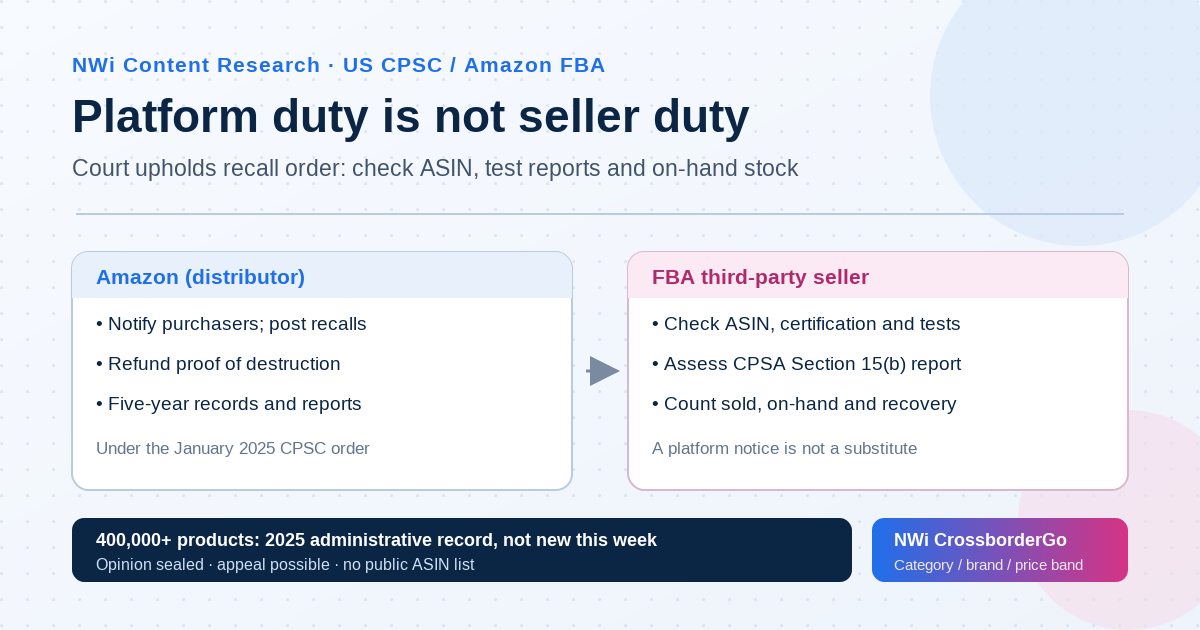
If you sell carbon monoxide detectors, hair dryers, children's sleepwear or other consumer products subject to CPSC rules on Amazon US through FBA, the court order of 24 November 2026 does not automatically make you a target of this recall case. It does, however, force a question: Amazon's duties as a distributor to notify, refund and keep records do not mean your own product-safety reporting duty as a manufacturer, distributor or retailer is complete. The real question is not whether Amazon will be penalized; it is whether your ASIN falls within the three product types covered by the January 2025 order, whether you hold test reports that cover the current product version, and whether known defect or injury information has already triggered your CPSA Section 15(b) reporting duty. Confirm scope by ASIN first, then check certification and test reports, units on hand and supplier recourse, and only then decide whether to pause replenishment, change supplier or keep monitoring.
1. The decision: Amazon’s recall duty is not your product-safety duty
On 24 November 2026, the US District Court for the District of Maryland (Case 8:25-cv-00853-LKG) issued an order denying Amazon's motion for summary judgment, granting the CPSC's cross-motion, entering judgment for the CPSC, and dismissing Amazon's challenge to the Commission's January 2025 Decision and Order. The CPSC announced the result on 25 November in Release 27-110. The order also directs the parties to file a joint status report by 8 December 2026 proposing redactions to the court's memorandum opinion; the opinion itself remains sealed.
The case is not about a newly discovered batch of defects. The core question is whether Amazon is a 'distributor' under the Consumer Product Safety Act (CPSA) when it distributes products through FBA. In a Decision and Order issued on 29 July 2024 and announced on 30 July, the Commission unanimously found that Amazon distributed the subject products through FBA and therefore bore legal responsibility for their recall; the order of 17 January 2025 then set out notification, refund, record-keeping and reporting duties. The order of 24 November 2026 upholds that administrative order and dismisses Amazon's challenge.
The easiest mistake for a seller is to conclude that 'Amazon handles the recall, so I do not have to.' The court confirmed Amazon's distributor responsibility; it did not transfer every FBA third-party seller's product-safety duty to Amazon. A seller that meets the CPSA role of manufacturer, distributor or retailer may still have a reporting duty when it obtains defect, noncompliance or unreasonable-risk information. Refunds for sold units, removal or disposal of on-hand inventory, supplier recovery and contractual liability do not disappear either.
The decision sequence should therefore be: first confirm whether the ASIN is one of the three product types covered by the January 2025 order (faulty carbon monoxide detectors, hair dryers without electrocution protection, and children's sleepwear that failed federal flammability standards); then check whether test reports and certification cover the current product version; finally estimate exposure from sold units, units on hand, unit contribution and supplier recourse. Only after those three steps can a seller decide whether to stop selling and assess a report, or keep selling with tighter monitoring.
2. What the court confirmed: distributor liability and the January 2025 order
The CPSC order of 17 January 2025 requires Amazon to: post recall releases on Amazon.com on the day the CPSC publishes them; notify original purchasers by email and show the recalls on each purchaser's 'Your Orders' page; provide one round of notice to FBA participants that sold the subject products; issue a full refund of the purchase price to any consumer who submits proof of destruction or disposal; keep the recall releases on Amazon.com's 'Recalls and Product Safety Alerts' page for at least five years; and submit monthly progress reports while keeping compliance records for five years. The order took effect on 26 January 2025.
The court order of 24 November 2026 is two pages long. It does not set out the court's full reasoning; it records the denial of Amazon's summary-judgment motion, the grant of the CPSC's cross-motion, judgment for the CPSC, dismissal of the complaint, and the 8 December deadline for redaction proposals. The memorandum opinion and joint appendix remain sealed, so the public can see the result and the CPSC release, not the complete legal reasoning. Amazon told The Verge it is reviewing its options and has not said whether it will appeal.
The '400,000-plus' figure comes from the January 2025 administrative proceeding. It is the number of products covered by that order, not a new count of defects discovered in the week of November 2026, and not a public ASIN list. The court order does not list specific ASINs, sellers or each seller's inventory; it confirms Amazon's distributor responsibility for those products. Treating '400,000' as 'every FBA product must stop selling' overreacts; treating it as 'nothing to do with me' misses the seller's own reporting duty.
3. The mechanism: an FBA seller’s own CPSA Section 15(b) reporting duty
CPSA Section 15(b) (15 U.S.C. § 2064(b)) provides that every manufacturer, distributor or retailer that obtains information reasonably supporting one of the following conclusions must immediately inform the CPSC: the product fails to comply with an applicable consumer product safety rule or a voluntary standard relied on by the Commission; the product contains a defect that could create a substantial product hazard; or the product creates an unreasonable risk of serious injury or death. The exception is where the subject firm has actual knowledge that the CPSC has already been adequately informed.
16 CFR Part 1115 explains the duty: §1115.10(a) requires immediate notice to the CPSC Office of Compliance; §1115.10(e) allows a distributor or retailer that is neither the manufacturer nor the importer to satisfy the initial reporting requirement by notifying the manufacturer (or importer) and sending a copy to the CPSC. In other words, a seller cannot treat 'I told my supplier' as automatic completion, and cannot treat 'Amazon will notify' as its own report. Keep a record of who told whom, what, and when.
Amazon bears notification, refund and record-keeping duties as a distributor; but an FBA third-party seller that meets the role of manufacturer, distributor or retailer still has to report defect, noncompliance or unreasonable-risk information it obtains to the CPSC. Amazon's one round of notice to FBA participants is the platform's action under the January 2025 order; it may inform some sellers and may mean the CPSC has received certain information, but it is not a substitute for the seller's own Section 15(b) duty. If a seller already has reportable information from complaints, returns, testing, a platform notice or a CPSC contact, it should assess its own reporting position by role instead of waiting for another platform email.
Beyond reporting, sellers should note that federal law prohibits selling products subject to a Commission-ordered recall or a voluntary recall undertaken in consultation with the CPSC; sold products may require notice, refund or disposal; on-hand products may require removal, disposal or return; and relevant records should be kept. State law, product liability, contractual recovery, insurance and marketplace terms are separate tracks. This article does not cover them, but the CPSA duty does not make them disappear.
4. Which sellers should act now: the three product types and adjacent categories
The first ring is the three product types named in the January 2025 order: faulty carbon monoxide detectors, hair dryers without electrocution protection, and children's sleepwear that failed federal flammability standards. The second ring is adjacent risk categories: other small appliances, children's products, products containing batteries, and consumer products subject to CPSC safety rules or voluntary standards. The second ring is not the legal scope of this case; it is a screening priority, because test reports, complaints and recall history in these categories deserve a closer look first.
A seller of ordinary goods unrelated to these three types, with no defect or injury information, should not stop every listing because of this news. A more proportionate step is to check supplier contracts, recall insurance and the platform-notification process, and add the CPSC recall pages to a quarterly review. Conversely, a seller of the three types or adjacent categories with missing or outdated test reports, a factory change or injury complaints should act before the next replenishment order rather than waiting for a platform notice.
5. What to observe: an ASIN audit table
| Field | What to check | Source | Trigger |
|---|---|---|---|
| ASIN and product type | Whether it is one of the three types, or an adjacent risk category such as small appliances, children’s products or battery products | Own listings, CPSC recall pages | In scope → audit |
| Certification and test reports | Whether CPC, GCC, flammability, electrical-safety and battery tests cover the current design, factory and version | Supplier, third-party lab | Missing/expired → freeze replenishment |
| Complaints and incidents | Return reasons, negative reviews, injury reports, CPSC or platform contacts | Own customer service, platform, CPSC | Injury/defect → assess Section 15(b) |
| On hand and in transit | FBA sellable, inbound, AWD/GWD and overseas-warehouse units | Inventory reports | Calculate gross exposure |
| Price and contribution | Average selling price, unit contribution, return and disposal cost | Own finance | Convert to net exposure |
| Supplier recourse | Contract, recall insurance, replacement/refund/indemnity terms | Procurement, legal, insurance | Decide recovery and cash flow |
| Platform notices | Seller Central, email, Recalls and Product Safety Alerts page | Amazon | Received → follow instructions and keep records |
6. Scenario A: 1,000 sold and 1,200 on hand
Scenario A (labeled example): a small appliance with 1,000 units sold and 1,200 units on hand
Assumptions: average selling price $29.99; 1,000 units sold; 1,200 units on hand; tax, shipping, returns, disposal and supplier recovery are ignored; unit contribution is not included.
Calculation: gross refund value = 1,000 × $29.99 = $29,990; gross on-hand inventory value = 1,200 × $29.99 = $35,988; total gross exposure = $65,978.
Decision: if the ASIN may be one of the three types or its test reports are missing, freeze replenishment and verify certification first; after converting gross exposure by unit contribution, decide whether to stop selling, change supplier or request platform removal.
7. Scenario B: 10,000 sold and 3,000 on hand
Scenario B (labeled example): a higher-priced safety product with 10,000 units sold and 3,000 units on hand
Assumptions: average selling price $79.99; 10,000 units sold; 3,000 units on hand; tax, shipping, returns, disposal and supplier recovery are ignored; unit contribution is not included.
Calculation: gross refund value = 10,000 × $79.99 = $799,900; gross on-hand inventory value = 3,000 × $79.99 = $239,970; total gross exposure = $1,039,870.
Decision: at this scale, test reports, supplier recovery and a recall-response plan matter more than the headline number; escalate to legal, finance and supply chain before the next purchase order and Q1 stocking.
Putting the two scenarios together: Scenario A: 1,000 × $29.99 = $29,990; 1,200 × $29.99 = $35,988; total gross exposure $65,978. Scenario B: 10,000 × $79.99 = $799,900; 3,000 × $79.99 = $239,970; total gross exposure $1,039,870. Both figures are gross exposure, not net loss; actual net loss must subtract recoverable amounts, reusable inventory, insurance proceeds and tax effects.
8. Counter-cases: six easy misreadings
- 'Amazon was found to be a distributor, so all seller liability has moved to Amazon': the court confirmed Amazon's distributor responsibility; it did not waive an FBA seller's manufacturer, distributor or retailer duties. On-hand stock, refunds, recovery and contractual liability may still sit with the seller.
- 'I did not receive an Amazon notice, so there is nothing to do': the January 2025 order requires one round of notice to FBA participants that sold the subject products. One round does not guarantee every party is reached, and the seller's own knowledge may still trigger Section 15(b).
- 'A test report means the product is safe': the report must cover the current design, factory and version; meeting a standard does not remove the duty to report once defect or injury information is obtained.
- 'The 400,000 units are a new recall this week': the figure comes from the January 2025 administrative record and is the product count covered by the order, not a new November 2026 discovery.
- 'The court has ruled, so Amazon must comply immediately and cannot appeal': judgment has been entered, but Amazon says it is reviewing its options, the opinion remains sealed, and the scope of any appeal or later enforcement is uncertain.
- 'Every FBA product must stop selling': the order concerns specific products. Without evidence that your ASIN is in scope, a blanket stop would cause unnecessary loss.
If a product has test reports that cover the current design, factory and version, is outside the three product types covered by the January 2025 order, and has no known defect or injury information, the seller should not stop selling every FBA product because of the '400,000' headline.
9. Action list and stop conditions
Confirm by ASIN whether the product is in the three product types or an adjacent risk category, then check test reports and units on hand; if certification is missing or injury/defect information appears, pause replenishment and assess the Section 15(b) report instead of waiting for Amazon’s one round of notice.
- Today: export active and on-hand ASINs and split them into three groups: the three product types, adjacent categories, and everything else. Check the CPSC recall pages and Amazon's 'Recalls and Product Safety Alerts' page. Freeze replenishment for SKUs with missing or unclear certification.
- Within 7 days: collect CPC (children’s products), GCC (non-children’s consumer products), flammability, electrical-safety and battery test reports, and confirm they cover the current factory, model and version. Assess delisting or stopping SKUs that cannot be confirmed; contact suppliers about recall, replacement, refund and indemnity terms.
- Within 30 days: build a recall-exposure table with sold, FBA sellable, inbound, AWD/GWD and overseas-warehouse units; rank by unit contribution and recoverable share; confirm notification, claim and record-retention steps with legal, insurance and finance.
- Ongoing: add CPSC recalls, platform notices, return reasons, negative reviews and injury complaints to a monthly review. Any signal of a known defect or injury should trigger a fresh Section 15(b) assessment.
- Stop conditions: if test reports are complete and cover the current version, the product is outside the three types and there is no known defect or injury information, quarterly review is enough. If a CPSC or platform notice arrives, an injury or defect is found, or a supplier admits a problem, stop selling, preserve records and move immediately to a reporting assessment.
- Do not: treat FBA removal or disposal as completion of a recall; delete a listing without addressing sold products; or publicly claim 'compliant' before verification.
10. Limitations and unknowns
- What this article can verify is the CPSC release, the January 2025 order, the July 2024 decision, the two-page court order, CPSA Section 15(b) and 16 CFR Part 1115; it has no public ASIN list, seller list, actual recall completion rate, refund amount, penalty amount or seller-level inventory and cost data.
- The court's memorandum opinion remains sealed, Amazon may appeal, and 400,000 is the product count from the 2025 administrative record, not a new defect count discovered this week; there is no public ASIN list and no seller-level inventory, sales, refund or penalty data.
- Whether CPSA Section 15(b) applies depends on the seller's role, whether the product is subject to CPSC jurisdiction, whether the information supports the conclusion, and whether the CPSC has already been adequately informed; this article is not legal advice.
- State law, product liability, contractual recovery, insurance, marketplace terms and customs/tax issues are outside this article; recall or disclosure requirements may differ by state.
- The scenarios exclude currency, tax, shipping, disposal, storage, markdown loss and insurance proceeds; gross exposure is not net loss.
- NWi CrossborderGo provides market, category, brand and price-band data; it does not provide CPSC recall lists, test reports, seller inventory, recall execution or legal advice, and the calculations do not rely on NWi product data.
11. Original analytical contribution
The original contribution is to split 'Amazon was found to be a distributor' into two lines, platform duties and seller duties, and to provide a recall-exposure table ordered by ASIN, test reports, units on hand and unit contribution, instead of repeating the '400,000' headline.
Most coverage stops at 'the court ruled for the CPSC' and '400,000 units.' This article separates the event into three executable lines: platform duties (Amazon's notification, refunds and records), seller duties (Section 15(b) reporting, stop-sale and records), and commercial exposure (sold refunds + on-hand inventory + recovery). The three run on different clocks: platform duties follow the order, seller duties follow information, and commercial exposure rolls by SKU and inventory.
For a data team, the useful work is not to decide the legal outcome but to put ASIN, category, brand, price band, on-hand and in-transit units on one table, screen out SKUs that are clearly outside scope, and hand the high-value, weakly certified, complaint-heavy SKUs to compliance and legal. NWi CrossborderGo can show Amazon US market, category, brand and price-band data to narrow the audit; it cannot replace a CPSC recall list, a test report or legal advice.
If the next step is to narrow the ASIN and market scope, see the NWi CrossborderGo product page for Amazon category, brand and price-band analysis, the Amazon platform page for category data definitions, or use the demo request. The product does not provide CPSC recall lists, test reports, seller inventory, recall execution or legal advice.
12. Sources
- 1. CPSC Release 27-110, Federal Court Rules in Favor of CPSC in Landmark E-Commerce Product Safety Case (U.S. Consumer Product Safety Commission; 25 November 2026; accessed 26 November 2026): Read the release
- 2. CPSC Release 25-098, CPSC Issues Final Order to Amazon.com Outlining Remediation Plans for Hazardous Products (U.S. Consumer Product Safety Commission; 17 January 2025; accessed 26 November 2026): Read the release
- 3. Order, Amazon.com, Inc. v. Consumer Product Safety Commission, Case 8:25-cv-00853-LKG (United States District Court for the District of Maryland; order dated 24 November 2026, filed 25 November 2026; accessed 26 November 2026): Read the order
- 4. CPSC Release 24-323, CPSC Finds Amazon Responsible Under Federal Safety Law for Hazardous Products Sold by Third-Party Sellers on Amazon.com (U.S. Consumer Product Safety Commission; 30 July 2024; accessed 26 November 2026): Read the release
- 5. 15 U.S.C. § 2064, Substantial product hazards (Legal Information Institute, Cornell Law School; current version; accessed 26 November 2026): Read the statute
- 6. 16 CFR Part 1115, Substantial Product Hazard Reports (Electronic Code of Federal Regulations; current as of 24 November 2026; accessed 26 November 2026): Read the regulation
- 7. The Verge, Amazon loses its latest attempt to get out of handling more recall notices (The Verge; 25 November 2026; accessed 26 November 2026): Read the report
13. Method and disclosure
Data basis: the case number, parties, denial/grant/dismissal and the 8 December 2026 redaction-report date come from the 24 November 2026 order (Document 54), US District Court for the District of Maryland; the CPSC Release 27-110 of 25 November 2026, the 30 July 2024 release finding Amazon a distributor, the 17 January 2025 final order with its 26 January 2025 effective date and the notification/refund/five-year records/five-year monthly reports come from official CPSC releases; the reporting parties, trigger conditions and the 'CPSC already adequately informed' exception in CPSA Section 15(b) come from 15 U.S.C. § 2064(b); the immediate-notice requirement and the procedure allowing a distributor or retailer to notify the manufacturer and copy the CPSC come from 16 CFR Part 1115 (eCFR); Amazon's public statement that it is reviewing its options and the list of January 2025 remedies come from The Verge's independent report, checked against the CPSC text. Calculation basis: gross refund value = units sold × average selling price; gross on-hand inventory value = units on hand × average selling price; total gross exposure = gross refund value + gross on-hand inventory value. The 1,000/1,200 units, 10,000/3,000 units and $29.99/$79.99 prices in the scenarios are clearly labeled assumptions, not seller, CPSC, Amazon or NWi measurements; tax, shipping, returns, disposal, storage, markdown loss, insurance proceeds and supplier recovery are excluded. NWi CrossborderGo provides market, category, brand and price-band data, with available marketplaces, sites, history and fields by account or contract; the product data does not include CPSC recall lists, test reports, seller inventory, recall execution or legal advice, and the calculations do not rely on NWi product data.
This article was prepared with automated research assistance and analyzed from the public sources listed at the end; it was not manually reviewed. It does not invent customer data, expert review, compliance certification, sales lift, ranking results or platform endorsement. It is not legal, tax, customs, procurement or investment advice.