
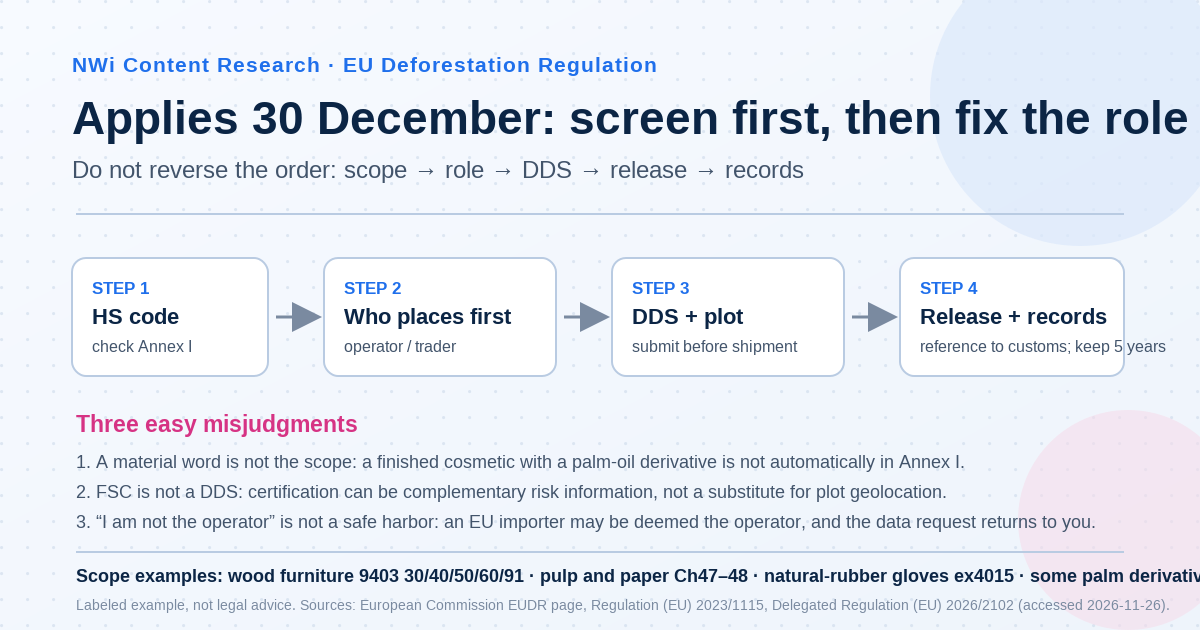
If you sell wood furniture, paper packaging or natural-rubber gloves into the EU, the question is no longer whether you hold a certificate. The real question is not whether the SKU has an FSC certificate, but whether its HS code falls inside Annex I, who first places the product on the EU market, and whether a DDS with plot geolocation can be obtained before shipment. The order cannot be reversed: screen the scope, fix the operator/trader role, then collect supplier data. Reverse it and you may spend the budget on SKUs that are not in scope at all. From 26 November 2026, 34 days remain before the 30 December 2026 application date.
1. The decision: screen the SKU, fix the role, then build the DDS
The EU Deforestation Regulation (EUDR) is not a certificate question. It is a scope-and-responsibility question. It applies only to the relevant products listed in Annex I; the same product can carry different duties when its HS code or the person placing it on the market changes.
Step one is scope. The Regulation covers seven commodities, cattle, cocoa, coffee, oil palm, rubber, soya and wood, and certain products made from them. The full list is in Annex I, not in everyday words such as “wood products”, “paper packaging” or “rubber gloves”. The September 2026 Delegated Act changed the list again: bamboo and rattan were excluded, leather was deleted, and some palm-oil derivatives and soluble coffee were added but deferred to 30 December 2027. Screening against the old list will leave out-of-scope products in the exercise and miss newly added ones.
Step two is the role. An operator is the person who first places a relevant product on the EU market or exports it from the EU; a trader is any other person in the supply chain who makes the product available on the market. When a third-country seller places a product on the EU market, the first EU-established person who makes it available may be deemed the operator. Non-SME traders are treated as non-SME operators; SME traders must collect supplier and customer information and DDS reference numbers and keep them for five years. The role decides who files the DDS, who keeps the records and who carries the contractual responsibility.
Step three is the DDS. An operator must complete due diligence and submit a DDS before placing the product on the market or exporting it; Article 4(2) prohibits placement without a prior DDS. The DDS includes the HS code, quantity, country of production, plot geolocation, any existing DDS reference and a confirmation statement, and records must be kept for at least five years. Reverse the order, ask suppliers for “a certificate” first, and you may end up with an FSC document that cannot fill the DDS fields.
2. The calendar: 30 December 2026, 30 June 2027 and 30 December 2027
The European Commission EUDR page gives the current application dates: large and medium-sized operators and traders from 30 December 2026; micro and small enterprises (SMEs) from 30 June 2027; and newly added products under the Delegated Act from 30 December 2027. Micro and small wood operators already covered by the EU Timber Regulation remain in scope on 30 December 2026. The EUDR replaces the EUTR, with transitional provisions for certain timber products.
The three dates imply three preparation rhythms. Large and medium-sized companies must now be able to answer “which SKUs are in scope and who files the DDS”; micro and small companies can schedule data collection for 2027, but “micro” is not a self-declaration: it is an accounting category under Directive 2013/34/EU. Newly added products (some palm-oil derivatives, soluble coffee and frozen cattle tongues) are deferred to 30 December 2027, but suppliers and customs brokers may ask for the data earlier, so do not wait until the last month.
From 26 November 2026, 34 days remain before 30 December 2026: four days left in November and 30 days in December. For a SKU that needs plot geolocation, those 34 days are not “another month”; they are the number of follow-up rounds you can still run.
3. The mechanism: operators, traders and the first placing on the EU market
Article 2 of the Regulation defines the two roles that decide who files the DDS. Article 7 adds that where a person established outside the EU places relevant products on the market, the first natural or legal person established in the EU who makes them available is deemed the operator. An operator is the person who first places a relevant product on the EU market or exports it from the EU; a trader is any other person in the supply chain who makes the product available on the market.
This means “I am not an EU company” is not “I have no duty”. The first placing can differ across a buy-and-sell EU importer, a marketplace, an own EU entity and an EU warehouse. A Chinese seller may be a trader, or may become an operator through an EU subsidiary; the EU importer may be the operator, or only a trader. Do not guess: draw a role map from contracts, invoices, customs records and platform terms.
The operator’s core duties are to exercise due diligence before placing on the market or exporting (Article 8), submit a DDS (Article 4(2)), and keep the DDS and due-diligence records for five years (Articles 4(3), 9(1) and 12(5)). Non-SME traders are treated as non-SME operators and are subject to Articles 3, 4 and 6, Articles 8 to 13, Article 16(8) to (11) and Article 18. SME traders must hold the Article 5(3) information (supplier and customer names, addresses, contact details and DDS reference numbers), keep it for five years and inform the competent authority when they learn of a risk.
A DDS is not a certificate. It is the operator’s declaration assuming responsibility for compliance. It contains the operator’s name, address and EORI number where applicable, the HS code, product description, quantity, country of production, coordinates of all plots (establishments for cattle), any existing DDS reference, a confirmation statement and a signature. Wood products also need the common and full scientific species name; plots above four hectares need polygons (other than cattle). By making the DDS available to the competent authority, the operator assumes responsibility for Article 3 compliance; using an authorised representative or referring to an upstream DDS does not transfer that responsibility.
Customs also looks at the DDS. The Regulation requires the DDS reference number to be made available to customs before release for free circulation or export, and customs checks the status through the electronic interface. For a seller, “submit the DDS after arrival” is not a workable plan; the DDS and reference must be in place at the latest before release, and in practice before shipment so that a missing document does not surface at the port.
4. The SKU map: what the September 2026 Delegated Act changed
Commission Delegated Regulation (EU) 2026/2102 was published in the Official Journal on 17 September 2026, entered into force on 18 September 2026 and amended Annex I. It did more than add a few materials: it deleted entries, clarified definitions and added products, with most additions deferred to 30 December 2027. The table groups the entries most relevant to cross-border sellers.
| Product group | Annex I status | Key condition | Action |
|---|---|---|---|
| Wood furniture (9403 30/40/50/60/91; wood seats ex 9401) | In scope | Wood must be deforestation-free and legally produced; the DDS needs the species name and plot geolocation; bamboo and rattan are excluded | Confirm the HS code, then collect plot data |
| Pulp and paper (Ch 47/48) | In scope, except bamboo-based and recovered waste | Packing material used to carry or protect another product is excluded; paper packaging placed on the market as a product on its own can still be in scope | Separate shipment packaging from standalone packaging SKUs |
| Natural-rubber gloves (ex 4015) | In scope | Only Hevea brasiliensis natural rubber; synthetic rubber is out; used and second-hand goods are excluded | Confirm the raw material and whether the goods are second-hand |
| Leather (4101/4104/4107) | Deleted from Annex I | Deleted by the September 2026 Delegated Act; other cattle products are separate | Do not keep asking for leather DDS under the old list |
| Palm-oil derivatives (glycerol, fatty acids, soap, etc.) | Partly in scope; some added | Most new entries apply from 30 December 2027; medicinal-product exemption; finished cosmetics under 3304 are not automatically in scope | Confirm the specific HS code and use |
| Coffee (0901; soluble coffee 2101 11 00) | In scope; soluble coffee added | Soluble coffee applies from 30 December 2027 | Update the old list |
| Soya (1201 90 00) | In scope | Soya beans for sowing are excluded | Confirm the HS code |
The easiest mistake is packaging. Recital 16 of the Delegated Act states that packing materials and containers used to support, protect or carry another product are outside the EUDR; reusable packaging presented with a product is also outside from the moment it is used for that purpose. But packaging placed on the market as a product on its own (for example, gift boxes or paper bags sold separately) can still be in scope. A carton you buy to pack your own furniture is normally not your EUDR obligation because it is packing used to carry another product; the carton manufacturer that places the carton on the market as a product on its own may still have its own duty. Do not read this as “paper packaging never matters”, and do not confuse it with packaging EPR.
The second easy mistake is “cosmetics containing palm-oil derivatives are in scope”. Annex I lists product HS codes; a finished cosmetic (HS 3304) is not on the list. The listed glycerol, fatty acids, soap and other palm-oil derivatives are the relevant products. A cosmetics brand using those inputs does not turn the whole finished cosmetic into an Annex I product merely because of the ingredient; the brand may still be asked for a DDS reference by an upstream supplier or customer, especially if it places the listed derivative on the market as a product itself. Confirm which HS code you are actually placing on the market before talking about a DDS.
The third easy mistake is “all wood products need a DDS”. The Delegated Act excludes bamboo, rattan, reeds, rushes, osier, raffia, straw and lime bark from the wood scope; but wood furniture (9403 30/40/50/60/91) and specific wood seats (ex 9401) remain in scope. Natural-rubber gloves (ex 4015) remain in scope, but only for Hevea brasiliensis natural rubber; synthetic rubber is out, and used and second-hand goods are excluded. Leather (4101/4104/4107) has been deleted from Annex I. Do not treat “rubber”, “wood” or “leather” as the scope itself.
5. Scenario A: 1,000 wood-furniture SKUs, three suppliers, and three held containers
Scenario A (labeled example): 1,000 wood-furniture SKUs, three suppliers per SKU, 20 minutes per supplier to collect plot geolocation and legal-production evidence, €30/hour labor cost; one held container carries 500 units at €20 contribution per unit.
Assume all 1,000 SKUs are already confirmed to be in Annex I, suppliers are in different countries, 20 minutes is enough only to collect and check plot geolocation, harvest date range and legal-production documents, excluding follow-up, translation and legal fees; €30/hour is an internal blended labor cost; the 500 units per held container and €20 contribution per unit are assumptions and exclude demurrage, storage and markdown losses.
Calculation: 1,000 × 3 × 20 ÷ 60 = 1,000 hours; 1,000 × €30 = €30,000; the contribution at risk in three held containers is 3 × 500 × €20 = €30,000. On these assumptions, the collection cost equals the contribution of three held containers; at 8 hours per person-day, 1,000 hours is about 125 person-days.
Decision: screen out SKUs whose HS codes are not in Annex I first, then rank by high container value and weak supplier evidence; do not spread the effort evenly across 1,000 SKUs. If a high-value SKU's supplier cannot provide plot data before the deadline, delay one container rather than ship on an incomplete DDS.
The point of this scenario is not the €30,000 figure; it is the order. If half of the 1,000 SKUs are not in Annex I, collecting data for all of them first is waste. Screen the scope, group suppliers by whether they can provide coordinates before the deadline, and only then discuss follow-up and shipment holds.
6. Scenario B: a paper-packaging supplier with FSC but no plot geolocation
Scenario B (labeled example): one paper-packaging SKU; the supplier holds FSC chain-of-custody certification but has no plot geolocation or harvest date range; the seller must choose between collecting the data, switching material or stopping the SKU.
Assume the paper packaging is sold to EU customers as a product on its own, not used to carry another product; the FSC certificate covers the pulp source but does not contain the plot geolocation required by Annex II; collecting the data requires the supplier to trace back to the pulp mill and takes weeks; switching material may move the product out of EUDR scope but triggers packaging performance, printing and EPR cost changes; stopping the SKU loses sales and customer relationships.
Result: FSC certification alone does not satisfy the DDS requirement. Article 10(2)(c) treats certification or third-party verified schemes only as complementary risk-assessment information, provided the Article 9 information requirements are met; without plot geolocation, the DDS is still incomplete. Collecting data, switching material and stopping the SKU each carry a cost, and FSC must not be presented as proof of compliance.
Decision: give the supplier a clear deadline to provide plot geolocation, harvest date range and pulp source; if it cannot, compare the gross-margin loss of switching to a non-wood material with the loss of stopping the SKU, and document the basis; never insert an FSC certificate number into the DDS in place of plot geolocation.
The point of this scenario is that FSC is not a DDS. A certificate can document the chain of custody, but it cannot replace the plot geolocation, harvest date range and country-of-production information required by Annex II. Inserting an FSC certificate number into the DDS does not make the DDS complete.
7. Counter-cases: seven easy misjudgments
- “All wood products need a DDS”: bamboo, rattan, reeds and similar materials are excluded; but wood furniture and specific wood seats remain in scope. Do not generalize.
- “All paper packaging needs a DDS”: packing material used to carry another product is excluded; paper packaging sold as a product on its own can still be in scope, and packaging EPR is a separate regime.
- “FSC means compliance”: FSC is not a DDS; Article 10(2)(c) treats certification only as complementary risk information, and the Article 9 information requirements still apply.
- “I am not the operator, so I am done”: Article 7 may deem the first EU-established person the operator; non-SME traders are treated as non-SME operators; contracts and customers will still push the data request back to you.
- “Micro and small enterprises have until 2027, so 2026 is irrelevant”: micro and small wood operators already covered by the EUTR remain in scope on 30 December 2026; “micro” and “small” are accounting definitions, not self-declarations.
- “Cosmetics with palm-oil derivatives are all in scope”: finished cosmetics under HS 3304 are not in Annex I; the listed derivatives are, so check the HS code of what you actually place on the market.
- “Used or second-hand goods can be labeled freely”: some used and second-hand goods are excluded, but the status needs evidence; labeling new goods as used is circumvention, not compliance.
8. Action list and stop conditions
Screen out SKUs whose HS codes are not in Annex I first, rank the rest by container value and weak supplier evidence, and only then decide whether to collect data, change supplier, stop the SKU or shift the declaration to an EU importer.
- Scope: check the HS code against Annex I as amended by the September 2026 Delegated Act, and record the screening date and list version; do not use the 2023 list.
- Role: draw a map of who first places the product on the EU market, covering an EU importer, a marketplace, an own EU entity and an EU warehouse; use contracts and customs records to confirm who files the DDS.
- Data: for in-scope SKUs, collect the supplier name, country of production, all plot coordinates (at least six decimal places; polygons above four hectares), harvest date range, wood species scientific name, quantity and any existing DDS reference.
- File: submit the DDS before shipment and give the reference to the customs broker or importer; keep the DDS, risk assessment and mitigation records for at least five years.
- Exclude: record the basis for excluding an SKU (bamboo/rattan, shipment packaging, used goods, medicinal exemption, etc.); do not rely on a verbal judgment, and recheck when the list changes.
Stop conditions are not “never do it”; they put uncertainty and commercial loss on the same table:
- The supplier cannot provide plot coordinates or an upstream DDS reference by the agreed deadline: pause replenishment of that SKU, or shift the declaration to an EU importer and renegotiate contractual responsibility.
- The HS code cannot be confirmed: complete customs classification first; do not guess. A wrong code can bring an out-of-scope product into the DDS or leave an in-scope product out.
- The contribution at risk in a held container is higher than the cost of collecting data: prioritize collection and supplier switching; if not, stop the low-value, weakest-evidence SKUs first.
- An upstream DDS is incomplete or fabricated: stop using it, document the evidence and change supplier; do not push responsibility to the customs broker, because the operator remains responsible for compliance.
If the next step is to narrow the SKU and market scope, NWi CrossborderGo can provide market, category, brand and price-band data to help prioritize which SKUs and price bands to screen for DDS readiness; it does not provide EUDR certification, DDS filing, plot-geolocation verification or legal advice. See the capability boundary on the product page or talk to us through the demo request.
9. Limitations and unknowns
- What this article can verify is the European Commission page, the text of the Regulation and the September 2026 Delegated Act; it has no seller-level SKU, supplier, DDS, plot geolocation, held-container or actual penalty data.
- The Amazon DDS notice reported by cross-border media around 25 November 2026 was not verified against an original Amazon page in this round; this article does not treat that report as Amazon policy evidence, and its dates and duties rely on the EU official sources.
- Member State enforcement frequency, fine levels, inspection duration and the operational details of the DDS system are outside the public sources reviewed here, so this article does not give those numbers.
- “Large”, “medium”, “micro” and “small” are accounting categories under Directive 2013/34/EU; this article does not classify the reader’s company and does not provide legal advice.
- The Delegated Act defers some newly added products to 30 December 2027; this article does not assume that every new entry applies immediately.
- Annex I HS codes require product-specific customs classification; this article cannot cover every SKU or classify on the reader’s behalf.
- The EUTR transition, FLEGT licences, CITES, packaging EPR, the PPWR and Member State competent-authority practice are not fully analyzed here; they can change the conclusion for a single SKU.
- The €30/hour, 20 minutes, 500 units per container and €20 per unit in the scenarios are assumptions; exchange rates, demurrage, storage, markdown losses and legal fees are excluded.
10. Original analytical contribution
The original contribution is to replace the material-word screen with an HS-code-plus-role sequence, and to put the packaging carve-out, the finished-cosmetics misconception and the data-collection break-even on one decision map.
A second increment is to explain the September 2026 Delegated Act’s packaging carve-out and the finished-cosmetics misconception: many checklists list “paper packaging” or “cosmetics containing palm oil” as EUDR products, but the Regulation tests the HS code and the product actually placed on the market; whether packaging travels with another product and whether a cosmetic is placed on the market as a finished good change the answer.
A third increment is the reproducible break-even between data-collection cost and the contribution at risk in held containers: 1,000 hours and €30,000 against three containers and €30,000 turns “which SKU first” from intuition into arithmetic.
A fourth increment is the stop conditions, not just a compliance checklist: when a supplier cannot provide plot data, when the HS code cannot be confirmed, and when an upstream DDS is incomplete, the article gives an executable order for stopping, switching or shifting the declaration to an EU importer.
11. Sources
- 1. European Commission, EU Deforestation Regulation page (published 19 May 2026; updated 9 November 2026; accessed 26 November 2026): Read the source
- 2. Regulation (EU) 2023/1115 (Official Journal of the European Union / EUR-Lex; published 9 June 2023; in force 29 June 2023; accessed 26 November 2026): Read the source
- 3. Commission Delegated Regulation (EU) 2026/2102 (Official Journal of the European Union / EUR-Lex; published 17 September 2026; in force 18 September 2026; accessed 26 November 2026): Read the source
12. Methodology and disclosure
Data basis: the application dates (large and medium-sized operators and traders from 30 December 2026; micro and small enterprises from 30 June 2027; newly added products from 30 December 2027; and micro and small wood operators already covered by the EU Timber Regulation from 30 December 2026) come from the European Commission EUDR page; the definitions of operator and trader, the first placing on the EU market, the timing of the DDS, the five-year record, the treatment of non-SME traders as non-SME operators, the information duties of SME traders and the deemed operator for third-country sellers come from Articles 2, 4, 5, 7 and 9 of Regulation (EU) 2023/1115; the DDS contents (HS code, quantity, country of production, plot geolocation, existing DDS reference and confirmation statement) come from Annex II to that Regulation; the September 2026 amendments to Annex I (bamboo and rattan exclusion, pulp and paper scope, the packing-material carve-out, natural-rubber gloves retained but used and second-hand goods excluded, leather deleted, some palm-oil derivatives added with application deferred to 30 December 2027, and soluble coffee added with application deferred to 30 December 2027) come from the recitals and Annex to Commission Delegated Regulation (EU) 2026/2102; the rule that certification may be complementary risk-assessment information but cannot replace a DDS comes from Article 10(2)(c) of Regulation (EU) 2023/1115. Calculation basis: collection hours = SKUs × suppliers × minutes per supplier ÷ 60; collection cost = hours × hourly labor cost; container contribution = containers × units per container × contribution per unit; break-even containers = collection cost ÷ contribution per container. The SKU count, supplier count, 20 minutes, €30/hour, 500 units per container and €20 per unit in the scenarios are clearly labeled assumptions, not seller, EU or NWi measurements. NWi CrossborderGo provides market, category, brand and price-band data, with available marketplaces, sites, history and fields by account or contract; the product data does not include EUDR certification, DDS filing, plot-geolocation verification, supplier audits or legal advice, and the calculations do not rely on NWi product data.
This article was prepared with automated research assistance and analyzed from the public sources listed at the end; it was not manually reviewed. It does not invent customer data, expert review, compliance certification, sales lift, ranking results or EU/platform endorsement. It is not customs, legal, tax, procurement or investment advice.