
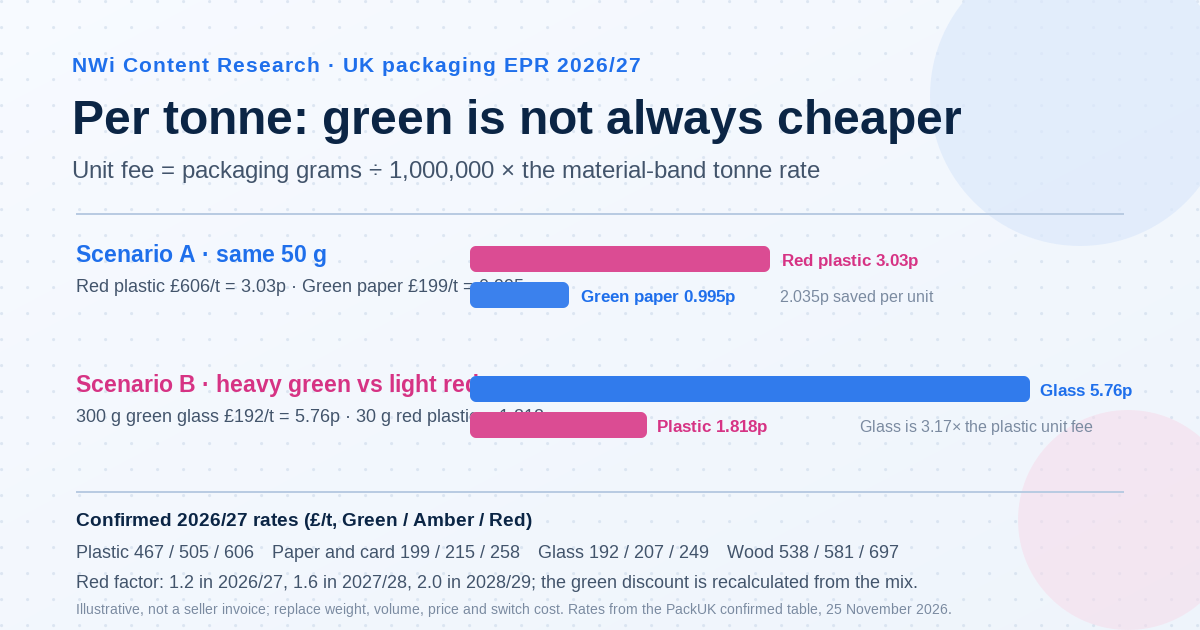
If you ship to UK consumers, the question after 25 November 2026 is not whether the UK has a packaging fee. It is three questions: whether you are the obligated large producer, how much of your packaging is household packaging, and how the unit weight of each SKU turns a per-tonne rate into a per-unit cost. PackUK has published confirmed per-tonne rates, not a flat per-item charge; divide the tonne rate by the weight and the answer can contradict the assumption that green always costs less.
1. The decision: pay, switch or pass through?
The UK packaging EPR cost chain has four gates: standing, producer size, packaging scope and material band. If any gate fails, the packaging-switch arithmetic downstream is irrelevant.
The first gate is UK establishment. The guidance treats a registered office, head office or principal place of business in the UK as established; if the head office is outside the UK, a branch, warehouse, PO box, returns address or any other UK postal address also counts. For a cross-border seller, a UK warehouse or returns address is not a logistics detail; it can change the obligation test.
The second gate is size. An obligated producer supplied or imported more than 25 tonnes of packaging in the UK in the previous year and had worldwide turnover of £1 million or more. A large producer is above 50 tonnes and more than £2 million. Large producers pay the household packaging disposal fee to PackUK; small producers register and report but do not pay that fee.
The third gate is packaging scope. The disposal fee applies to household packaging; secondary and tertiary packaging must be classed as non-household. Primary and shipment packaging reported as non-household needs evidence kept for at least seven years. A seller whose packaging is mostly B2B or bulky transit packaging can cross the tonnage threshold with little household packaging to pay on, which is not the same as a large bill simply because it passed 50 tonnes.
The fourth gate is material band and weight. Confirm the first three gates before modelling a switch; the order cannot be reversed.
2. The mechanism: per tonne, rated by recyclability
On 25 November 2026 PackUK published confirmed 2026/27 rates and, for the first time, charged household packaging through Green, Amber and Red bands under the Recyclability Assessment Methodology (RAM). Amber is the base rate; red is 1.2 times amber in 2026/27, green is amber less a discount, and the 2026/27 green discount is 7.5%.
| Material | Green £/t | Amber £/t | Red £/t | Majority RAM rating |
|---|---|---|---|---|
| Aluminium | £269 | £290 | £349 | Green |
| Fibre-based composite | £480 | £518 | £622 | Amber |
| Glass | £192 | £207 | £249 | Green |
| Paper and card | £199 | £215 | £258 | Green |
| Plastic | £467 | £505 | £606 | Red |
| Steel | £274 | £296 | £356 | Green |
| Wood | £538 | £581 | £697 | Red |
| Other | £214 | £232 | £278 | Red |
Several details are easy to misread. First, the rates are per tonne in pounds; a unit cost needs the gram weight. Second, the red factor is not fixed at 1.2: the PackUK modulation statement sets 1.2 for 2026/27, 1.6 for 2027/28 and 2.0 for 2028/29, and says later statements are expected to follow a similar approach. Third, the green discount is not fixed: it depends on the tonnage mix of red and green packaging placed on the market. More reported red raises the green discount; more reported green lowers it, so green fees can rise.
Fourth, the amber base is recalculated each year: local-authority efficient costs for managing household packaging waste, minus material sales revenue, plus a share of PackUK administration, public information and debt-provision costs, divided by the household packaging tonnage of that material category placed on the market in 2025. The 2026/27 £505 per tonne for plastic is therefore not a long-run constant.
Fifth, the confirmed fees exclude registration charges and the cost of packaging waste recycling notes (PRNs/PERNs); a large producer still has to acquire enough PRNs/PERNs and submit a certificate of compliance. Sixth, household packaging that has not been assessed under RAM, or lacks the detail needed for an assessment, is an automatic red, not a default amber.
Seventh, rigid and flexible plastic are reported separately but charged at the same rate in 2026/27; single-use PET, aluminium and steel drinks containers of 150 ml to 3 litres in a deposit return scheme (DRS) are excluded from the relevant material weights.
The rates apply to the 2026 to 2027 fee year and are calculated from packaging supplied in 2025. The confirmed-fees page does not restate the exact start and end dates of that fee year, so this article does not assert a date such as 1 April.
3. What six official documents can and cannot prove
This article checked six official documents, all re-opened on 26 November 2026: the PackUK news story of 25 November 2026, the confirmed-fees page updated the same day, the Defra and Environment Agency compliance guidance last updated on 19 August 2026, the RAM v1.1 overview, the PackUK modulation statement updated on 17 February 2026, and the household and non-household guidance.
They establish the rates, the band factors, the obligation thresholds, the household and non-household rules, the default band for unassessed packaging and the three-year red-factor schedule.
They cannot establish the actual tonnage of a seller, the material composition and RAM rating of a SKU, whether a seller has received a Notice of Liability, the amount on that notice or the invoice. They also cannot establish that a particular package is household packaging. The confirmed fees are rounded to £1 while individual notices of liability use a more precise value, so the per-unit figures here are decision approximations, not invoice amounts.
Nor do the documents give the 2027/28 or 2028/29 amber base, or future green discounts. The two-year projection below is a conditional calculation under an explicit fixed-amber assumption, not a PackUK forecast.
4. The arithmetic: grams ÷ 1,000,000 × the tonne rate
Converting a tonne rate into a unit fee takes one step: divide the unit packaging grams by 1,000,000 to get tonnes, then multiply by the tonne rate for the material band. Fifty grams is 0.00005 tonnes; 0.00005 × £606 = £0.0303, or 3.03p.
| Unit packaging weight | Plastic green £467/t | Plastic red £606/t | Paper green £199/t | Paper red £258/t | Glass green £192/t |
|---|---|---|---|---|---|
| 10 g | 0.467p | 0.606p | 0.199p | 0.258p | 0.192p |
| 30 g | 1.401p | 1.818p | 0.597p | 0.774p | 0.576p |
| 50 g | 2.335p | 3.030p | 0.995p | 1.290p | 0.960p |
| 100 g | 4.670p | 6.060p | 1.990p | 2.580p | 1.920p |
| 300 g | 14.010p | 18.180p | 5.970p | 7.740p | 5.760p |
The point of the table is not any single cell but the reversal of the assumption that green is cheaper. A 300 g green glass bottle costs 5.76p per unit, more than a 50 g red plastic mailer at 3.03p; at that weight, the green switch nearly doubles the unit fee.
The second variable is price. On a £10 SKU, 3.03p is 0.30% of the selling price; on a £50 SKU it is 0.06%. The same red plastic is a larger share of price on low-ticket, high-volume SKUs, which should be dealt with first.
The third variable is scope. The table covers the disposal fee only, not PRNs/PERNs, registration, assessment labour or any packaging purchase premium; if a switch raises damage or returns, those costs belong in the same comparison.
5. Three scenarios: light red plastic, heavy green glass and the three-year factors
All three scenarios are illustrative, not seller, PackUK or NWi measurements. Replace the weights, volumes, prices and switch costs with your own.
Scenario A: 1,000,000 units a year, a 50 g red plastic mailer versus a 50 g green paper mailer (illustrative)
Assume 1,000,000 units a year, a 50 g single-material mailer in both cases, plastic at the RAM red rate of £606/t and paper at the green rate of £199/t, with no printing, filling, testing, damage or returns cost.
Calculation: 50 g = 0.00005 t. Red plastic = 0.00005 × 606 = £0.0303 per unit, or £30,300 a year. Green paper = 0.00005 × 199 = £0.00995 per unit, or £9,950 a year. The difference is £20,350 a year, or 2.035p per unit.
The paper mailer pays £20,350 less disposal fee a year, or 2.035p less per unit; this is the 2026/27 disposal-fee difference only, excluding PRNs, registration and any packaging purchase premium.
Switch only if the purchase, testing, damage and returns costs of the paper mailer add up to less than 2.035p per unit in 2026/27; otherwise absorb or pass through and recalculate when the 2027/28 rate is published.
Scenario B: 500,000 units a year, a 300 g green glass bottle versus a 30 g red plastic pouch (illustrative)
Assume 500,000 units a year, a 300 g single-material glass bottle versus a 30 g single-material plastic pouch, glass at the green rate of £192/t and plastic at the red rate of £606/t, with no glass breakage, transport weight or deposit-return effect.
Calculation: glass = 0.0003 × 192 = £0.0576 per unit, or £28,800 a year. Plastic = 0.00003 × 606 = £0.01818 per unit, or £9,090 a year. The glass unit fee is 3.17 times the plastic fee, or £19,710 more a year.
The green glass unit fee of £0.0576 is higher than the red plastic fee of £0.01818; at these weights, switching to the green material costs more.
If the glass bottle has no irreplaceable product reason, do not trade a 30 g plastic pouch for a 300 g glass bottle for EPR reasons; cut weight or move to a light green material first, then compare total cost.
Scenario C: holding the 2026/27 amber rate fixed and applying the published factors to 2027/28 and 2028/29 (conditional)
Assume the plastic amber rate stays at the 2026/27 £505/t, the red factors are the published 1.2, 1.6 and 2.0, the paper green rate stays at £199/t, and annual volume stays at 1,000,000 units of 50 g; the annual amber reset and any change in the green discount are excluded.
Calculation: red rate = 505 × 1.2 = £606, 505 × 1.6 = £808, 505 × 2.0 = £1,010. A 50 g unit = 0.00005 × the rate, or £0.0303, £0.0404 and £0.0505; annual cost is £30,300, £40,400 and £50,500; against £9,950 for green paper, the gap is £20,350, £30,450 and £40,550.
On a fixed amber base, the annual gap between red plastic and green paper widens from £20,350 to £40,550; the amber base is reset each year, so this is not a PackUK forecast.
If the packaging switch contract runs three years, budget against £40,550 rather than £20,350; if it can only be fixed for one year, decide on the current £20,350 and recalculate when the new rate is published.
6. Counter-cases: not every seller should switch
Counter-case one: green does not mean cheaper per unit; because the fee is per tonne, a heavy green material can cost more than a light red one, and Scenario B shows a 3.17 times gap. Cutting weight first, then changing band, is often more effective than changing material outright.
Counter-case two: the green discount is a redistribution, not a permanent price cut. The modulation statement says modulation does not increase the total household disposal fee, only how it is allocated; more reported red raises the green discount, more reported green raises the green fee. The 7.5% is a 2026/27 snapshot, not a long-term commitment.
Counter-case three: you may owe nothing. Without UK establishment, or below 25 tonnes or £1 million turnover, you are not an obligated producer; at or above 25 tonnes and £1 million but not above both 50 tonnes and £2 million, you are a small producer that registers and reports but pays no disposal fee. Switching packaging first can be wasted spend.
Counter-case four: non-household packaging can sit outside the fee. Secondary and tertiary packaging must be classed as non-household; primary and shipment packaging can also be non-household if supplied directly to a business or public institution that is the final user, or if the product is designed only for business use and is not likely to be disposed of in a household or public bin. Keep the evidence for seven years, and correct a wrong classification.
Counter-case five: unassessed means red. Completing the RAM assessment may be cheaper than changing material; packaging without an assessment is charged at the top band, a gap that costs more than most material choices.
Counter-case six: the red factor rises, but the amber base also moves. Applying the 2028/29 factor of 2.0 to the 2026/27 £505 is a conditional calculation only; the invoice depends on the amber base and green discount for that year.
Counter-case seven: switching has hidden costs. A paper mailer may protect less and raise damage and returns; lightweighting can affect unboxing and repeat purchase. When those costs exceed the 2.035p saving, the switch does not pay.
7. Action list and stop conditions
Check standing and size first, then packaging scope, and only then material and weight.
- Check UK establishment: registered office, head office, branch, warehouse, PO box or returns address in the UK.
- Check tonnage and turnover: packaging supplied or imported in the UK in the previous year and worldwide annual turnover; confirm whether you are below the threshold, a small producer or a large producer.
- Split household and non-household: secondary and tertiary packaging are non-household; assess primary and shipment packaging item by item and keep the evidence for at least seven years.
- Complete the RAM ratings: confirm the material category and Green/Amber/Red band for every household component; reserve the red band where no assessment exists.
- Calculate the unit fee: grams divided by 1,000,000, multiplied by the tonne rate; rank by fee as a share of price and start with low-ticket, high-volume SKUs.
- Run the three-year conditional test: with a fixed amber base, apply 1.2, 1.6 and 2.0 to red; model green separately and do not assume the discount is constant.
- Compare the total switch cost: packaging purchase premium, testing, damage, returns, storage volume and customer experience, all converted to a unit cost and set against the fee saving.
- Reconcile the Notice of Liability when it arrives: check tonnage, material, band and amount; watch for the resubmission deadline PackUK introduced, but this article did not read a specific date and cannot fill one in for a seller.
Write the stop conditions down as well, so the switch does not run on momentum:
- No UK establishment, branch, warehouse, PO box or returns address: do not act as a UK producer yet.
- Packaging tonnage at or below 25 tonnes, or worldwide turnover below £1 million: no disposal fee.
- At or above 25 tonnes and £1 million but not above both 50 tonnes and £2 million: small producer, register and report, no disposal fee.
- Packaging is evidenced as non-household: no disposal fee on that packaging; keep the evidence.
- Total switch cost above the three-year fee saving: absorb or pass through first, do not switch.
- Damage or returns rise after the switch and the increase exceeds the saving: stop the switch.
To put UK category, price-band and competitor price data back into this test, use [NWi CrossborderGo](/product/) to review marketplace, site, category and monthly data; it does not provide packaging weight, material composition or RAM ratings, and the calculations above do not rely on product data. To confirm the data scope, use the [demo and inquiry form](/demo/) to set out the marketplaces, countries and fields.
8. Limitations and unknowns
- This article has no seller-level tonnage, material composition, RAM rating, price, damage rate or return rate; the scenario numbers are assumptions.
- The confirmed-fees page does not restate the start and end dates of the 2026/27 fee year; this article does not assume a specific effective date.
- The 2027/28 and 2028/29 amber bases and green discounts are not published; the three-year test is conditional.
- RAM ratings are self-reported by producers and checked by regulators; this article does not assign a band to a specific SKU.
- Household and non-household classification depends on evidence; this article cannot classify packaging for a seller.
- PRNs/PERNs, registration fees, assessment labour, VAT and exchange rates are excluded; total compliance cost is higher than the disposal fee here.
- Medical packaging, deposit-return interactions, devolved-administration differences and other packaging-law duties are outside scope.
9. What this analysis adds
The first addition is to turn the rate table into a per-unit decision: not red or green, but grams times band rate as a share of the selling price.
The second addition is the heavy-green counter-example: a 300 g green glass bottle against a 30 g red plastic pouch, at 3.17 times the unit fee; both are green or red labels, but a tenfold weight difference reverses the conclusion.
The third addition is to put the automatic red for unassessed packaging, the evidence threshold for non-household packaging and the three-year factors into one action list, so a seller checks standing and scope before choosing a material.
The fourth addition is to separate the obligation threshold from the fee base: the threshold is tested on packaging supplied or imported, while the disposal fee falls only on household packaging, and secondary and tertiary packaging must be non-household. That separation decides whether a seller should check tonnage first or packaging classification first.
10. Conclusion
In one sentence: confirm whether you are a UK large producer and how much household packaging you place on the market, then multiply grams by the tonne rate to get the unit fee; the answer is light and assessed, not a colour label.
11. Sources
- 1. Confirmed 2026/27 EPR for packaging fees now available (PackUK; 2026-11-25; accessed 26 November 2026): Open source
- 2. Extended producer responsibility for packaging: confirmed fees 2026 to 2027 (PackUK / Department for Environment, Food & Rural Affairs; updated 2026-11-25; accessed 26 November 2026): Open source
- 3. Check if you must comply with EPR for packaging (Defra / Environment Agency; published 2022-06-07; updated 2026-08-19; accessed 26 November 2026): Open source
- 4. Recyclability assessment methodology: how to assess your packaging waste (Defra / Environment Agency / Natural Resources Wales; published 2024-12-23; updated 2025-09-04; accessed 26 November 2026): Open source
- 5. PackUK extended producer responsibility for packaging: producer disposal fees modulation statement (PackUK; statement dated 2025-06-28; updated 2026-02-17; accessed 26 November 2026): Open source
- 6. Extended producer responsibility for packaging: how to assess household and non-household packaging (Defra / Environment Agency / Natural Resources Wales; published 2024-03-11; updated 2025-08-05; accessed 26 November 2026): Open source
12. Method and disclosure
Data basis: the confirmation of the 2026/27 packaging EPR waste disposal fees, the Green/Amber/Red bands linked to RAM, and the 25 November 2026 publication come from the PackUK news story; the per-tonne rates for the eight materials, the red rate at 1.2 times amber, and the amber method (local-authority efficient household packaging waste costs minus material sales revenue, divided by 2025 household packaging tonnage) come from the PackUK confirmed-fees page; the obligation test (established in the UK, more than 25 tonnes of packaging supplied or imported in the previous year, worldwide turnover of £1 million or more; large producer above 50 tonnes and £2 million; the disposal fee applies to household packaging) comes from the Defra and Environment Agency compliance guidance; the red, amber and green definitions, the automatic red for unassessed household packaging, and the exclusion of non-household packaging and deposit-return drinks containers from the recyclability assessment comes from the RAM v1.1 guidance; the red factors of 1.2 for 2026/27, 1.6 for 2027/28 and 2.0 for 2028/29, and the annual recalculation of the green discount from the red/green tonnage mix, come from the PackUK modulation statement; the rule that secondary and tertiary packaging must be classed as non-household and the seven-year evidence retention come from the household/non-household guidance. Calculation basis: unit disposal fee = unit packaging grams divided by 1,000,000, multiplied by the material-band tonne rate; annual fee = unit fee multiplied by annual volume; difference = higher-rate option minus lower-rate option. All weights, volumes, prices, switch costs and the fixed amber base in the scenarios are clearly labelled assumptions, not seller, PackUK or NWi measurements. NWi CrossborderGo provides market, category, brand and price-band data, with available marketplaces, sites, history and fields by account or contract; the product data does not include packaging weight, material composition or RAM ratings, and the calculations do not rely on NWi product data.
This article was prepared with automated research assistance and analysed from the public sources listed at the end; it was not manually reviewed. It does not invent customer data, expert review, fee relief, sales lift, ranking results or government/platform endorsement. It is not customs, tax, legal, packaging-design, platform-operations or investment advice.