
If you ship sub-£135 goods directly to UK customers, the question is not whether the UK will remove the duty relief — it is when you should move stock into the UK. The policy paper confirms the relief will go, but the start date, the fee amount, the data fields and the fiscal-representative rules are still to be set. Building stock now means paying duty early on units that could still be shipped duty-free; waiting until the last minute risks missing 3PL onboarding, product classification and system integration. The calculation below puts both costs on one sheet and derives an executable switch window.
1. The decision: not whether duty is coming, but when to switch
The UK government has confirmed that the £135 customs duty relief for low-value imports will be removed. The start date is appointed by Treasury regulations, by October 2028 at the latest, six months earlier than the previous plan. Duty is not the whole route decision: after the reform, both direct shipping and UK stock pay duty on the same goods, and the real differences are the per-consignment fee, fixed compliance cost, 3PL fulfilment, storage and inventory carrying.
The real question is not whether the UK will remove the relief, but when to put stock into the UK and which compliance steps you must pay for before that date.
There are three options: keep direct shipping and prepare ten-digit UKGT classification, origin data, item-level data and a fiscal representative; move stock into the UK now; or stage the move by signing flexible 3PL capacity and system integration now and moving goods after the fee and data rules are clear. The conclusion is stated up front: for most sellers, do the preparation now and delay the physical switch; the early-switch duty and fulfilment penalty is often larger than the post-reform annual advantage.
Why is “build UK stock now” not the default answer? Before the start date, direct shipping still enjoys the duty relief. If you move stock into the UK early, you pay duty on units that could still have been sold duty-free, and you pay 3PL inbound, storage and carrying first. The post-reform annual advantage only starts after the start date. Put both periods into one cash-flow table to find the switch date.
2. Mechanism: the duty relief goes, not the £135 threshold and not VAT
The reform removes the customs duty relief for consignments valued at £135 or less; £135 remains the low-value threshold, and the current point-of-sale VAT rule is not changed by this policy paper.
Current rules have two layers. First, customs duty: a consignment valued at £135 or less can claim the duty relief. Second, VAT: for a consignment valued at £135 or less, the seller or the online marketplace charges VAT at the point of sale; above £135, normal import VAT and customs rules apply. HMRC’s VAT guidance says the £135 limit applies to the total consignment, not each item, and that the marketplace is liable for VAT on sub-£135 marketplace sales.
The first change is that the duty relief is removed: low-value goods must be classified to the UK Global Tariff (UKGT) and pay duty. The consultation response says there will be no simplified tariff schedule; traders must classify goods under the full UKGT and apply the applicable rate. Standard UK import declarations use ten-digit commodity codes, while the final data specifications are still to be published. The second change is process and responsibility: the seller or marketplace is responsible for duty and pays quarterly; non-UK sellers must appoint a UK fiscal representative; item-level data is required; the government will introduce an additional fee, but the amount and basis are not set. The £39 private-to-private non-commercial relief remains; commercial sellers cannot use it.
Four common misreads need correcting. First, “the £135 threshold disappears” is wrong: the threshold remains; the relief goes. Second, “VAT will move to the border” is not established: the policy paper does not directly change VAT, the consultation response says the VAT collection model is still under review, and the current point-of-sale VAT rule for sub-£135 sales is not replaced by this document. Third, “duty is charged on the retail price” is wrong: duty is ad valorem on the customs value, and the final valuation basis will be set in secondary legislation; this article uses customs value as a replaceable assumption. Fourth, “all low-value goods are covered” is wrong: excise goods, import restrictions, trade defence, non-ad valorem tariffs, goods claiming a customs relief or special procedure, and goods above £135 remain on standard customs procedures; GB-to-Northern Ireland movements under the Windsor Framework and private parcels of £39 or less are outside this LVI switch.
The additional fee is the item most likely to be written as a fixed number but is actually the least certain. The consultation response says the government will introduce an LVI-related fee to reflect administrative cost, but the amount and whether it is charged per consignment, per item or per product type are still being designed; most respondents favoured a per-consignment charge, but that is not the final decision. This article therefore treats the fee as a replaceable assumption and gives a fee trigger, rather than presenting a pound figure as fact.
3. Evidence boundary: what the policy paper, consultation response and draft legislation prove
The policy paper, consultation response and draft legislation prove that the government has decided to remove the relief and has taken the legal powers, but they do not prove that the start date is 1 October 2028 or that the fee will be per consignment or that a fiscal representative will be available.
The policy paper (published 13 July 2026, updated 28 October 2026) confirms the removal of the £135 duty relief, new customs arrangements, data/payment/compliance requirements, a UK fiscal representative, and a start date appointed by Treasury regulations by October 2028 at the latest; the timetable was accelerated by six months from March 2029. It also gives OBR-certified Exchequer impacts: +£225 million in 2028-29, +£535 million in 2029-30, +£540 million and +£550 million in the following two years. These are government revenue estimates, not seller costs, and cannot be converted directly into a duty rate for a SKU.
The consultation response (13 July 2026) confirms the key design: no simplified tariff schedule, full UKGT classification; an additional fee will be introduced, but its amount and design are pending; sellers or marketplaces are responsible for duty and pay quarterly; non-UK sellers must appoint a UK fiscal representative; item-level data is required; the £39 private non-commercial relief remains; excise, import restrictions, trade defence, non-ad valorem tariffs, customs reliefs and special procedures are excluded.
The draft legislation (updated 28 October 2026) provides the legal skeleton: low-value goods are goods in a consignment whose value does not exceed £135 and which meet other conditions in regulations; a fiscal representative is jointly and severally liable with the principal for import duty and other specified debts; appointment and withdrawal must be disclosed to HMRC; regulations may require HMRC approval; the amendments commence on a day appointed by Treasury regulations, and different days may be appointed for different purposes; Section 5 of the UK Reliefs document on negligible-value consignments is abolished.
What is not settled: the exact start date; the fee amount and basis; the item-level data fields and technical specifications; whether the £135 value is customs value or the intrinsic sales value; whether and how VAT is integrated with duty; the supply and pricing of fiscal representatives; whether HMRC will require approval of representatives; and how responsibility is split between marketplaces and sellers in different sale models. All of these change the calculation, so this article gives a trigger and a recalculation method, not a conclusion that everyone must build stock on 1 October 2028.
4. The reproducible calculation: post-reform advantage and pre-reform penalty
Write the post-reform per-unit advantage of UK stock as fee plus annual compliance divided by volume minus extra fulfilment minus inventory carrying divided by volume, then divide that by the monthly pre-reform penalty from duty, fulfilment and storage to get the break-even number of months before the start date.
Definitions: P is the VAT-inclusive selling price, C is the customs value per unit, r is the UKGT duty rate, f is the fee per consignment, A is annual fixed compliance cost (fiscal representative, data system, reconciliation), N is annual volume, S_d is direct postage, F_p is UK 3PL pick-and-pack, S_u is UK last mile, and H is annual storage and inventory carrying cost. Assume one unit per order and the same customs value on both routes. After the reform: direct cost per unit = rC + f + A/N; UK stock cost per unit = rC + (F_p + S_u − S_d) + H/N; UK stock advantage per unit = f + A/N − (F_p + S_u − S_d) − H/N. Duty rC appears on both routes, so it is neutral in the post-reform route comparison; it affects the pre-reform early-switch penalty.
Before the reform, direct shipping still pays no duty, while UK stock already pays rC and carries extra fulfilment and storage. So the early-switch penalty per unit = rC + (F_p + S_u − S_d) + H/N; monthly penalty = penalty per unit × N/12; post-reform annual advantage = advantage per unit × N. Divide the annual advantage by “monthly penalty + annual advantage/12” to get the break-even number of months m* before the start date. If the minimum lead time L is greater than m*, the latest switch date you can achieve (T − L) is earlier than the break-even point (T − m*), so the first year will lose money; either shorten L (air freight, faster inbound, earlier classification and system integration) or treat the loss as a readiness insurance premium. If L is less than m*, switching at T − L captures the post-reform advantage. Combining both periods, the first-year effect of switching m months early = −penalty per unit × N × m/12 + advantage per unit × N × (12 − m)/12. For scenario A with m = 6: −£1.0467 × 18,000 × 0.5 + £0.60 × 18,000 × 0.5 = −£9,420 + £5,400 = −£4,020; for scenario B: −£3.8333 × 4,800 × 0.5 + £0.5917 × 4,800 × 0.5 = −£9,200 + £1,420 = −£7,780.
There is also a fee trigger: if the fee f is below “(F_p + S_u − S_d) + H/N − A/N”, direct shipping is cheaper after the reform and the UK stock advantage is negative. In both scenarios below the trigger is around £0.40 per consignment; this is not a government rate, but the break-even assumption for these cost structures. When the secondary legislation publishes the fee, compare it with your own trigger before deciding to move stock.
5. Two scenarios: £25 low order value and £120 mid order value
Both scenarios are illustrative, not seller, platform, HMRC or NWi measurements. Every price, customs value, duty rate, fee, compliance cost, fulfilment and storage figure can be replaced with your own.
Scenario A: £25 low order value, 18,000 units a year (illustrative)
Assume a £24.99 selling price including VAT, a £6.00 customs value, an 8% UKGT duty rate, a £1.00 fee per consignment, £3,000 annual fixed compliance cost, £3.60 direct postage, £1.60 UK 3PL pick-and-pack, £2.40 UK last mile, and £3,000 annual storage and carrying cost; one unit per order and even sales through the year.
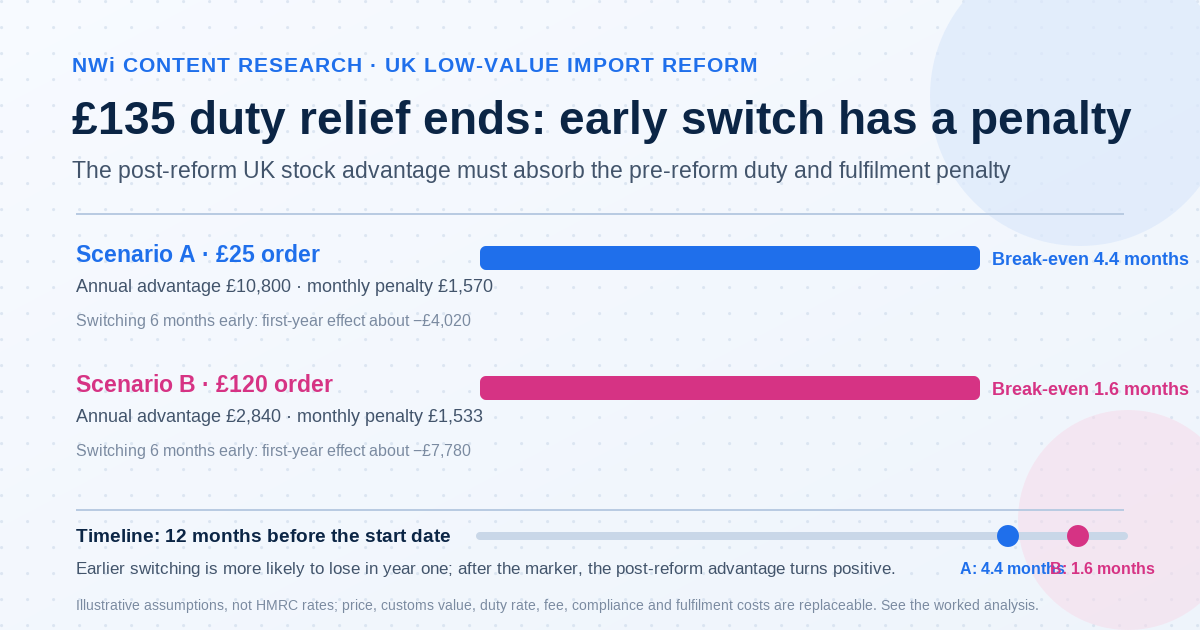
Calculation: duty per unit = £6.00 × 8% = £0.48; post-reform direct cost per unit = £0.48 + £1.00 + £3,000/18,000 = £1.6467; UK stock cost per unit = £0.48 + (£1.60 + £2.40 − £3.60) + £3,000/18,000 = £1.0467; advantage per unit = £0.60, annual advantage = £0.60 × 18,000 = £10,800. Pre-reform penalty per unit = £0.48 + £0.40 + £0.1667 = £1.0467; monthly penalty = £1.0467 × 1,500 = £1,570; break-even months = £10,800/(£1,570 + £900) = 4.37 months.
After the reform, UK stock costs £10,800 less than direct shipping a year; before the reform, each month of early switching adds £1,570 to the first-year cost; the break-even point is about 4.4 months before the start date.
If 3PL onboarding and first-mile shipping can be done in four months, switch about four months before the start date; if the minimum lead time is six months, switching six months early loses £4,020 in the first year, so use air freight or faster inbound to shorten the lead time, or treat the loss as a readiness insurance premium.
Scenario B: £120 mid order value, 4,800 units a year (illustrative)
Assume a £119.99 selling price including VAT, a £35.00 customs value, an 8% UKGT duty rate, a £1.00 fee per consignment, £3,000 annual fixed compliance cost, £4.20 direct postage, £1.80 UK 3PL pick-and-pack, £2.60 UK last mile, and £4,000 annual storage and carrying cost; one unit per order and even sales through the year.
Calculation: duty per unit = £35.00 × 8% = £2.80; post-reform direct cost per unit = £2.80 + £1.00 + £3,000/4,800 = £4.425; UK stock cost per unit = £2.80 + (£1.80 + £2.60 − £4.20) + £4,000/4,800 = £3.8333; advantage per unit = £0.5917, annual advantage = £0.5917 × 4,800 = £2,840. Pre-reform penalty per unit = £2.80 + £0.20 + £0.8333 = £3.8333; monthly penalty = £3.8333 × 400 = £1,533; break-even months = £2,840/(£1,533 + £236.7) = 1.60 months.
After the reform, UK stock costs only £2,840 less than direct shipping a year; before the reform, each month of early switching adds £1,533 to the first-year cost; the break-even point is about 1.6 months before the start date.
If the minimum lead time is more than two months, switching early loses money in the first year; keep this SKU on direct shipping until the last one or two months before the start date, or wait for the secondary legislation and the fee before deciding.
| Item | Scenario A (£25 order) | Scenario B (£120 order) |
|---|---|---|
| Selling price incl. VAT | £24.99 | £119.99 |
| Customs value per unit | £6.00 | £35.00 |
| Duty rate (assumption) | 8% | 8% |
| Duty per unit | £0.48 | £2.80 |
| Fee per consignment (assumption) | £1.00 | £1.00 |
| Annual fixed compliance (assumption) | £3,000 | £3,000 |
| Direct postage per order | £3.60 | £4.20 |
| UK 3PL + last mile per order | £4.00 | £4.40 |
| Annual storage and carrying (assumption) | £3,000 | £4,000 |
| Annual volume | 18,000 | 4,800 |
| Post-reform UK stock annual advantage | £10,800 | £2,840 |
| Pre-reform monthly penalty | £1,570 | £1,533 |
| Break-even months before start | 4.4 months | 1.6 months |
| First-year effect of switching 6 months early | −£4,020 | −£7,780 |
The table shows two things. First, the low order value case has a larger annual advantage because the per-consignment fee and fixed compliance are spread over more orders; but it also has a larger early-switch penalty because duty and extra fulfilment are paid before the start date. Second, the mid order value case has a smaller annual advantage and a break-even window of only about 1.6 months; if 3PL and first-mile shipping take six months, switching early loses £7,780 in the first year, far more than the £2,840 it saves after the reform. “Build now” is especially unattractive for scenario B.
6. Sensitivity: the fee and the duty rate change the conclusion
The additional fee is the biggest unknown. Moving f from £0.50 to £2.00 raises the annual advantage in scenario A from £1,800 to £28,800 and the break-even months from about 1.0 to about 7.3; scenario B rises from £440 to £7,640 and from about 0.3 to about 3.5 months. A higher fee makes direct shipping more expensive and makes early switching more attractive; a lower fee makes direct shipping more competitive. If f is below about £0.40, the UK stock advantage in both scenarios turns negative.
| Fee per consignment (assumption) | A annual advantage | A break-even months | B annual advantage | B break-even months |
|---|---|---|---|---|
| £0.50 | £1,800 | 1.0 | £440 | 0.3 |
| £1.00 | £10,800 | 4.4 | £2,840 | 1.6 |
| £2.00 | £28,800 | 7.3 | £7,640 | 3.5 |
The duty rate does not affect the post-reform route comparison if the customs value is the same on both routes, but it changes the early-switch penalty. Moving the duty rate from 0% to 12% shortens the break-even window in scenario A from about 6.2 to about 3.8 months, and in scenario B from about 4.4 to about 1.2 months. The higher the duty rate, the later you should switch; treating “duty is coming” as a reason to “build now” pays the high duty earlier.
| UKGT duty rate (assumption) | A break-even months | B break-even months |
|---|---|---|
| 0% | 6.2 | 4.4 |
| 8% | 4.4 | 1.6 |
| 12% | 3.8 | 1.2 |
7. Counter-cases: when “build now” is worse
If the final fee is below about £0.40 per consignment, or your orders usually contain several units that spread the fee, direct shipping may still be cheaper than UK stock after the reform, and building stock early would add duty and storage first.
Counter-case 1: multi-unit orders. If the fee is per consignment, a parcel with three units spreads the fee over three units; this article assumes one unit per order and therefore understates direct shipping’s competitiveness on multi-unit orders. The model also assumes a unit price below £135; if a multi-unit order pushes the consignment above £135, duty already applies before the reform, the early-switch penalty is smaller and the direct route’s duty-free window no longer applies. Counter-case 2: a low duty rate. If your UKGT rate is 0%, the early-switch penalty has no duty, only extra fulfilment and storage; the break-even window is longer, but “build now” is still not automatically right. Counter-case 3: a low fee. If the final fee is below £0.40, the UK stock advantage is negative and direct shipping remains cheaper after the reform.
Counter-case 4: conversion lift. UK stock may improve conversion, shorten delivery and reduce return friction; this article does not include a conversion lift. In scenario A, the £0.60 per-unit advantage divided by the post-reform direct contribution of about £9.58 requires a conversion lift of about 6.3% to break even on its own; scenario B requires only about 1.1%. If your own A/B test shows a larger lift, switching earlier may be rational; without test data, do not assume it.
Counter-case 5: a UK entity and fiscal representative. A UK entity may reduce the fiscal-representative fee but adds corporate, tax, payroll and compliance costs; this article does not model it. Counter-case 6: 3PL capacity and peak season. The model assumes you can switch in any month; if 3PL capacity is unavailable at peak, the hidden cost of waiting may exceed the early-switch penalty. Counter-case 7: marketplace collection. If the marketplace becomes liable for duty or VAT, the seller’s direct route changes; the consultation response does not settle every marketplace/seller detail, and this article discusses the “seller or marketplace responsible” framework without assuming the marketplace always collects. Counter-case 8: returns. UK stock can reduce return transit time and cost; high-return categories may justify stock earlier; this article does not quantify it.
8. Action list and stop conditions
Classify every SKU to a ten-digit UKGT code and collect origin data first, then obtain a flexible 3PL quote, and only then set the switch date from the fee trigger and the minimum lead time; do not sign a long lease without classification data.
- 1. Classify: assign every SKU a ten-digit UKGT code and record the duty rate, customs value and origin; do not use the retail price as the customs value.
- 2. Check exclusions: confirm whether the goods are excise, subject to import restrictions or trade defence, subject to a non-ad valorem tariff, or claiming a customs relief or special procedure; if so, this LVI switch does not apply and standard customs procedures remain.
- 3. Calculate both numbers: the post-reform annual UK stock advantage and the pre-reform monthly early-switch penalty; use m* = annual advantage/(monthly penalty + annual advantage/12).
- 4. Obtain 3PL quotes: ask for flexible start dates, peak-capacity guarantees, and clear inbound, outbound, storage and returns fees; do not sign a multi-year lease before the fee rules are known.
- 5. Build the data: description, value, quantity, origin, net mass, commodity code and order reference; run a one-month mock declaration and reconciliation first.
- 6. Negotiate the fiscal representative: obtain a fee range, joint-and-several liability terms, HMRC approval conditions and an exit mechanism; if no acceptable representative is available, consider a UK entity or a marketplace model.
- 7. Set the fee trigger: when the secondary legislation publishes the fee, compare it with your own trigger; stay direct below the trigger and schedule the switch above it.
- 8. Track official updates: secondary legislation, fee design, data specifications and the start date; do not treat October 2028 as a fixed day.
Stop conditions:
- The product is in an excluded category: stop the LVI analysis and use standard customs procedures.
- You cannot obtain a ten-digit classification or origin data: do not switch; fix the data first, because duty and compliance cannot be calculated reliably without it.
- The 3PL quote plus storage and carrying exceeds the fee and fixed-compliance saving: stay direct.
- The final fee is below your trigger: stay direct and do not build stock.
- No fiscal representative is available or the joint-and-several liability is unacceptable: do not use the direct LVI route; consider a UK entity, a marketplace model or exiting UK direct shipping.
- The start date is not appointed or the data rules are not published: do not treat October 2028 as a fixed date; keep the trigger and review quarterly.
- The final rules change the £135 definition, the valuation basis or the VAT treatment: recalculate; do not reuse the numbers in this article.
9. Limitations and unknowns
This article has no seller-level volume, order value, return rate or 3PL quote; the prices, customs values, duty rate, fee, compliance cost and storage cost in both scenarios are clearly labelled assumptions.
- There is no seller-level volume, order value, return rate, conversion rate or 3PL quote; the numbers in both scenarios are assumptions.
- The fee amount and basis are not set; this article models one unit per order and a £1.00 fee per consignment, with £0.50/£1.00/£2.00 sensitivity.
- The exact start date is not set; October 2028 is the latest month for the regulations, not a fixed commencement day.
- The valuation basis for the £135 threshold (customs value or intrinsic sales value) is not fully fixed in the public text; this article uses customs value.
- Whether VAT is integrated with duty or moved to the border is still under review; this article assumes the current point-of-sale VAT rule for sub-£135 sales remains.
- The fiscal representative’s fee, supply and HMRC approval conditions are unknown; this article uses a £3,000 annual fixed compliance cost, which may overstate or understate the actual cost.
- Duty is neutral between the two routes only if the customs value and UKGT rate are the same; if the UK stock import includes freight and insurance in the customs value, or uses a different rate or preference, the comparison changes.
- The model assumes all imported stock is sold; if UK stock does not sell through, duty has already been paid, the actual cost is higher and the first inbound should be more conservative. The model assumes one unit per order and a unit price below £135; a multi-unit order can push the consignment above £135, so duty already applies before the reform and the direct-versus-stock comparison changes. The model does not include conversion lift, return-rate changes, cash-flow timing, income-tax deductibility or marketplace collection details; all can change the conclusion.
- This article is not customs, tax, legal or investment advice; consult a UK customs broker or tax adviser for classification and valuation.
10. Original analytical contribution
The article's increment is to separate the post-reform route advantage from the pre-reform early-switch penalty, showing that duty is neutral between direct and UK stock after the reform, while the per-consignment fee, fixed compliance and fulfilment/storage costs decide the route.
The second increment is to split “duty is coming” into two periods: the post-reform route choice and the pre-reform switch date. Duty is neutral between direct and UK stock after the reform; the route is decided by the per-consignment fee, fixed compliance and fulfilment/storage. Before the reform, duty, extra fulfilment and storage are the early-switch penalty. This explains why “build now” is not necessarily right for either low or high order values, for different reasons.
The third increment is a reproducible trigger: when the fee is below about £0.40, the UK stock advantage is negative in both scenarios; the higher the duty rate, the shorter the break-even window. Sellers do not need to forecast policy; after the secondary legislation publishes the fee, they can plug in their own numbers and decide whether to stay direct, delay the switch or shorten the lead time.
The fourth increment is to separate VAT from duty. The current point-of-sale VAT rule for sub-£135 sales is not directly changed by this policy paper; reading “the relief is removed” as “VAT will be paid at the border” would lead to wrong pricing and system changes. That distinction matters for cash flow before 2028 and for pricing after 2028.
11. Conclusion
In one sentence: for most sellers shipping low-value goods directly to the UK, the right move is not “build UK stock now” but “do the classification, data and 3PL preparation now, and delay the physical switch as late as the fee trigger and minimum lead time allow”. After the reform, duty is neutral between direct and UK stock; the UK stock advantage comes from saving the per-consignment fee and fixed compliance, minus extra fulfilment and storage; the early-switch penalty comes from duty, extra fulfilment and storage. Use m* = annual advantage/(monthly penalty + annual advantage/12) to calculate your own break-even months, then recalculate with the final fee from the secondary legislation.
If you want to put market, category and SKU data back into this calculation, use NWi CrossborderGo to view European marketplace and TikTok Shop UK market, category, brand and price-band data (specific sites, fields, history and commercial availability by contract); use the NWi Cross-border Agent for market-entry and competition research (consumer and review insight is limited to selected brands, product innovation focuses on beauty, and the actual research scope depends on the product’s current capabilities); use NWi Operations to put selection, pricing and fulfilment costs back into the SKU (market figures are third-party estimates); use MCP to connect data to your own systems (client compatibility, fields and permissions depend on the actual integration); or visit demo and inquiry to run a scenario on your own SKUs. None of these tools provides UKGT classification, duty rates, customs declarations, VAT filing, fiscal representation or 3PL quotes, and they do not replace a UK customs broker or tax adviser.
12. Sources
- 1. HM Revenue & Customs, “Reforming customs rules for low value imports” (policy paper; published 13 July 2026, updated 28 October 2026; removal of the £135 duty relief, new customs arrangements, fiscal representative, commencement by October 2028; accessed 26 November 2026): read the source
- 2. HM Treasury / HM Revenue & Customs, “Reforming the customs treatment of low value imports into the United Kingdom: Consultation response” (13 July 2026; full UKGT classification, fee pending, quarterly payment, item-level data, £39 private-parcel relief and exclusions; accessed 26 November 2026): read the source
- 3. HM Revenue & Customs and HM Treasury, “Government backs high street with acceleration of cheap import reforms and crackdown on dodgy online sellers” (news release; 23 June 2026; six-month acceleration to October 2028; accessed 26 November 2026): read the source
- 4. HM Revenue & Customs, “Draft legislation (accessible version)” (updated 28 October 2026; low-value definition, fiscal representative joint and several liability, commencement by regulations; accessed 26 November 2026): read the source
- 5. HM Revenue & Customs, “Charging VAT on goods sold direct to customers in the UK” (VAT guidance; published 8 March 2023, updated 30 January 2026; point-of-sale VAT for sub-£135 sales, normal import VAT and customs above £135; accessed 26 November 2026): read the source
- 6. HM Revenue & Customs, “VAT and overseas goods sold to customers in the UK using online marketplaces” (VAT guidance; 20 November 2020; marketplace liable for VAT on sub-£135 sales; accessed 26 November 2026): read the source
- 7. Baker McKenzie Global Import Blog, “UK Low Value Import Relief to be Removed by October 2028” (independent law-firm analysis; 24 July 2026; exclusions, £39 private parcels and fiscal representative joint and several liability; accessed 26 November 2026): read the source
13. Method and disclosure
Data basis: the removal of the £135 duty relief, the new customs arrangements, the fiscal representative and the October 2028 latest commencement come from HMRC's policy paper (published 13 July 2026, updated 28 October 2026); full UKGT classification, the confirmed but still-designed additional fee, quarterly payment by sellers or marketplaces, item-level data, the £39 private-parcel relief and the exclusions come from the HMT/HMRC consultation response (13 July 2026); the six-month acceleration comes from the HMRC news release (23 June 2026); the low-value definition, the fiscal representative's joint and several liability and the commencement power come from the draft legislation (updated 28 October 2026); the point-of-sale VAT rule for sub-£135 sales and the marketplace VAT liability come from HMRC's current VAT guidance (published 8 March 2023, updated 30 January 2026; and 20 November 2020). Calculation basis: duty per unit = customs value × UKGT rate; post-reform direct cost per unit = duty + fee per consignment + annual fixed compliance/volume; UK stock cost per unit = duty + (UK 3PL pick-and-pack + last mile − direct postage) + annual storage and carrying/volume; advantage per unit = direct cost − UK stock cost; pre-reform penalty per unit = duty + (UK 3PL pick-and-pack + last mile − direct postage) + annual storage and carrying/volume; break-even months = annual advantage/(monthly penalty + annual advantage/12). The prices, customs values, duty rate, fee, compliance cost, fulfilment, storage and volume in both scenarios are clearly labelled assumptions, not seller, platform, HMRC or NWi measurements. NWi CrossborderGo provides market, category and brand data, NWi Operations provides selection and operating tools, and the Cross-border Agent provides research workflows; none provides UKGT classification, duty rates, customs declarations, VAT filing, fiscal representation or 3PL quotes, and the calculations do not rely on NWi product data.
This article was prepared with automated research assistance and analysed from the public sources listed at the end; it was not manually reviewed. It does not invent customer data, expert review, customs rulings, sales lift, ranking results or government/platform endorsement. It is not customs, tax, legal, platform-operations or investment advice.