
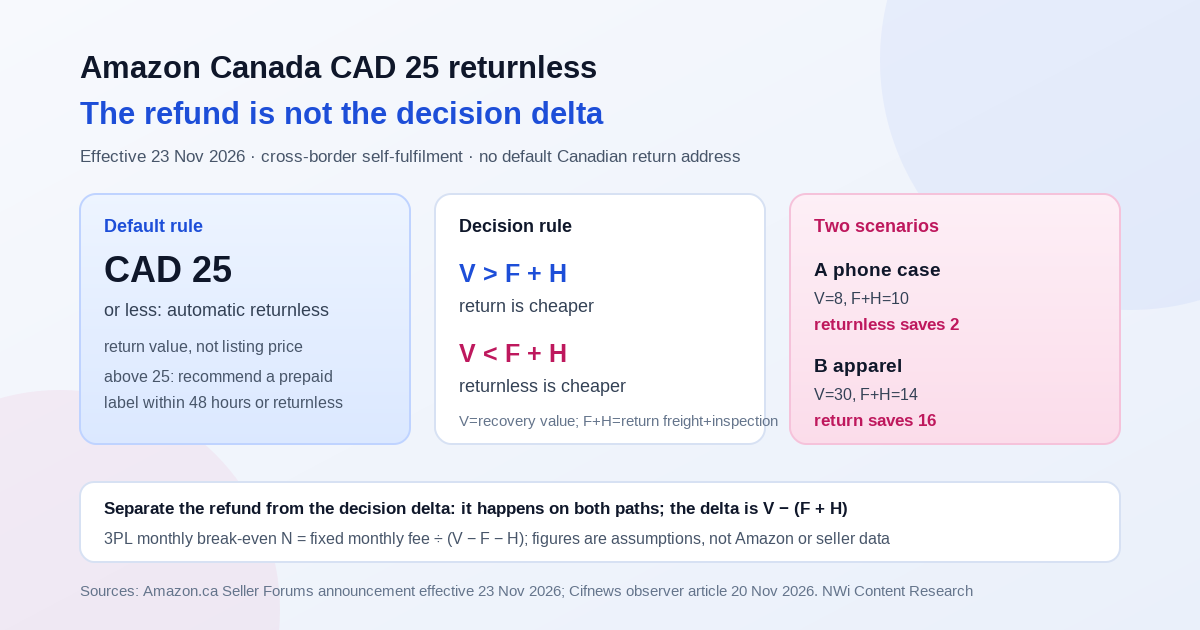
If you ship to Canada from China and your seller account has no default Canadian return address, the question from 23 November 2026 is not whether a CAD 25 refund is large. It is a SKU-level choice: accept the platform's automatic returnless refund, set up a Canadian return address or 3PL that can actually receive returns, or reprice/exit that price band. This article separates the refund amount from the decision delta: the refund happens on both paths, so what changes contribution is the recovery value minus return freight and inspection/repack. Two scenarios, a CAD 19.99 phone case and CAD 49.99 apparel, produce a recovery-value break-even, a monthly-return break-even for a 3PL, and stop conditions for a repricing test.
1. What the announcement says: two mechanisms, not one
The official Amazon.ca Seller Forums announcement states that from 23 November 2026 sellers can set automatic returnless rules by price range, product category or return reason. It also states that if a seller fulfils orders in Canada from outside Canada without a default Canadian return address, returns valued at CAD 25 or less will be refunded automatically without the item being returned.
These are two different mechanisms. The first is a Returnless Resolutions rule the seller configures; the second is a default treatment the platform applies when the order meets the 'fulfilled from outside Canada + no default Canadian return address' condition. For returns above CAD 25, the announcement uses the word 'recommend': a prepaid return label within 48 hours, or a returnless refund. It is not a mandatory rule that every return above CAD 25 must be automatically refunded within 48 hours.
The announcement also gives the path: Return settings → Resolutions → Create a returnless resolution rule → set a name, price range and criteria → save. The path is a back-office entry point; it does not mean every account sees the same options. The interface and available conditions depend on the account.
FBA is a separate arrangement. This article did not directly read an official announcement for the FBA returnless programme, so FBA is not included in the calculations below. If you use FBA, check the FBA return settings and the official notice; do not apply this cross-border self-fulfilment default to FBA orders.
2. Evidence boundary: CAD 25 is the return value, not the listing price
The announcement says 'returns valued at CAD 25 or less', not 'listed price at CAD 25 or less'. The two can differ: discounts, tax, shipping, multi-item orders and the platform's actual refund record can all affect the return value. A seller cannot screen SKUs by the storefront price alone; export the after-sales records and segment by the actual refund/return value.
The announcement does not give a detailed formula for return value, nor does it explain how discounts, tax, shipping and multi-item orders are allocated. This article treats 'return value' as the amount the platform uses in the return record and calls it P in the scenarios. If your back office uses a different definition, replace P and recalculate.
The announcement does not publish seller counts, return rates, category mix, fee treatment, tax treatment, penalties or a transition period.
It also does not say every order below CAD 25 is refunded unconditionally: the conditions include fulfilment from outside Canada, no default Canadian return address, a return value of CAD 25 or less, and a return request that itself complies with platform rules.
This article uses two sources: the official Amazon.ca Seller Forums announcement (primary, read directly) and a Cifnews observer article (secondary, read directly). The latter analyses the return-value definition, the 48-hour recommendation and the local-warehouse boundary, but its event facts come from the same Amazon announcement and cannot be treated as a second independent measurement; its numerical examples are assumptions, not platform data. The Amazon.ca customer help page returned 503 at access, and the Seller Central Returnless Resolutions help page returned only a login shell; neither was used as evidence.
There is also a product boundary: at the time of this review, the public coverage.json lists Amazon sites as US, EU and JP, not Canada. This article is a public-source policy and cost analysis, not a Canada marketplace measurement by NWi, and it does not mean Canada data is commercially available.
3. Mechanism: the refund amount is not the decision delta
Split an approved return into two paths. Returnless: the seller refunds P, does not get the item back, saves return freight F and inspection/repack H, but forgoes recovery value V. Return: the seller also refunds P, pays F and H, gets the item back and recovers V.
Both paths refund P, so P cancels in the difference; referral fees, tax and payment processing also cancel if they are treated the same on both paths.
What actually changes the decision is that the return path spends F + H more and recovers V more.
So return is cheaper when V is above F + H; returnless is cheaper when V is below F + H; the two are equal at V = F + H.
This formula does not depend on CAD 25 or the listing price. CAD 25 only decides which path is the default or the option; it does not decide which path is more economic.
Absolute loss can be written as: returnless loss = C + O; return loss = C + O + F + H − V. C is unit COGS and O is outbound fulfilment already incurred; both are sunk when the return happens. This separates the refund amount from the decision delta and avoids treating P as the loss.
A Canadian 3PL or local return capability adds a fixed monthly cost M. A 3PL can recover M from return handling only when V is above F + H; the monthly return break-even is N = M ÷ (V − F − H). If V is at or below F + H, the 3PL never pays back on per-unit return economics alone, unless it also provides local delivery, inventory or other services.
This compares the two handling paths after a return has happened, not 'return vs no return'. The refund P occurs on both paths and does not enter the difference. If you want the loss relative to a sale that was not returned, add the original sale contribution and the refund; that is a different question.
4. Scenario A: a CAD 19.99 phone case under the default returnless rule
Assumptions: return value P = CAD 19.99; unit COGS C = 5.00; outbound fulfilment O = 4.00; return freight F = 7.00; inspection/repack H = 3.00; recovery value V = 8.00; referral fees, tax and payment processing are the same on both paths and are excluded. All figures are assumptions, not Amazon data or any seller's actual bill.
Because P is 25 or less and there is no default Canadian return address, the return falls into automatic returnless. The platform applies the default path automatically; the announcement does not provide a per-order switch to the return path. To move the flow to returns systematically, the seller must first establish and configure a usable Canadian return address.
Returnless loss = 5.00 + 4.00 = CAD 9.00. Return loss = 5.00 + 4.00 + 7.00 + 3.00 − 8.00 = CAD 11.00. Returnless is cheaper by CAD 2.00. The break-even is V = 7.00 + 3.00 = CAD 10.00; below 10 returnless is cheaper, above 10 return is cheaper.
If the SKU has 30 returns a month and the 3PL fixed fee is M = CAD 150, the per-unit saving is V − F − H = 8 − 10 = −2; the 3PL not only fails to recover the fixed fee but loses another CAD 2 per return. There is no monthly volume break-even at V=8. Even at V=12, the saving is 2 per return, or 60 a month, still below 150; the break-even is 150 ÷ 2 = 75 returns a month. For a low-value phone case, return handling alone is unlikely to support a dedicated 3PL.
Decision: accept returnless; do not set up a 3PL for this SKU alone; first verify that the actual return value is really ≤25 and that the account really has no default address. If abuse or claims for the same SKU are abnormal, add order limits and claim review; do not assume a rule can opt out of the default policy.
5. Scenario B: CAD 49.99 apparel, return or returnless?
Assumptions: return value P = CAD 49.99; C = 18.00; O = 5.00; F = 9.00; H = 5.00; recovery value V = 30.00; referral fees, tax and payment processing are the same on both paths and are excluded. All figures are assumptions.
Because P is above 25, the return does not fall into the CAD 25 default; the seller can choose a prepaid return label (return) or a returnless refund.
Returnless loss = 18.00 + 5.00 = CAD 23.00. Return loss = 18.00 + 5.00 + 9.00 + 5.00 − 30.00 = CAD 7.00. Return is cheaper by CAD 16.00. The break-even is V = 9.00 + 5.00 = CAD 14.00; above 14 return is cheaper, below 14 returnless is cheaper.
If V is only 12.00, return loss = 18 + 5 + 9 + 5 − 12 = CAD 25.00, which is CAD 2.00 more than the 23.00 returnless loss. This counter-example shows that 'above CAD 25 means return' is false; recovery value, not price, is the key.
With a 3PL fixed fee M = CAD 150 and a per-return saving of 16.00, the monthly break-even is N = 150 ÷ 16 = 9.375, about 10 returns a month. At 20 returns a month the saving is 320, or 170 net of the fee; at 5 returns the saving is 80, below 150, so return handling alone does not pay.
Decision: when V is above 14 and monthly returns exceed 10, prefer a Canadian local return address/3PL; when V is below 14 or monthly returns are below 10, use returnless or a per-use return service and do not rent a fixed warehouse. If the 3PL fee also covers local delivery and inventory, include only the share allocated to return handling in this formula.
6. Scenario C: is it worth moving CAD 24.99 to 26.99?
Assumptions: old price P0 = 24.99, new price P1 = 26.99; C = 8.00; O = 4.00; referral fee 15% (assumption, actual fee depends on category); return rate 10% (assumption); at the old price the return value is ≤25 and goes returnless; at the new price the return value is >25 and the seller chooses return, with V = 15.00, F = 9.00, H = 5.00. All figures are assumptions.
At the old price, per 100 orders: 90 sold, unit contribution = 24.99 − 8 − 4 − 15% × 24.99 = 9.2415; returnless loss = 8 + 4 = 12 per return, 120 for 10 returns; total contribution = 90 × 9.2415 − 120 = CAD 711.74.
At the new price, per 100 orders, assuming the same units: 90 sold, unit contribution = 26.99 − 8 − 4 − 15% × 26.99 = 10.9415; return loss = 8 + 4 + 9 + 5 − 15 = 11 per return, 110 for 10 returns; total contribution = 90 × 10.9415 − 110 = CAD 874.74.
Difference = 874.74 − 711.74 = CAD 163.00 per 100 orders. To keep the new contribution at least equal to the old one, the new price needs at least 711.74 ÷ 8.7474 = 81.37 orders, meaning unit sales can fall by no more than about 18.6%. If the price increase cuts units by more than 18.6%, the increase is worse.
This calculation assumes the return rate, return value and referral fee stay constant, and that the return value moves one-for-one with price. In practice, discounts, shipping, tax and multi-item orders may keep the return value below 25, and the return rate may change. So raising the price is not automatically better once it crosses 25; it is a conditional decision that needs a small test.
Decision: consider raising the price only if the post-increase unit decline is below 18.6% and the return path is operational; if you cannot measure price elasticity, run a 2–4 week small-traffic test and do not change the whole store. If the unit decline exceeds the break-even, revert or use a bundle/return-rate reduction instead.
| Scenario | Key assumptions | Result | Decision |
|---|---|---|---|
| A phone case | P=19.99, V=8, F+H=10 | Returnless saves CAD 2.00 | Accept returnless |
| B apparel | P=49.99, V=30, F+H=14 | Return saves CAD 16.00 | Use 3PL if V is above 14 and returns≥10/month |
| C repricing | 24.99→26.99, 10% return rate | +CAD 163 per 100 orders | Raise only if unit decline is below 18.6% |
7. Counter-cases and alternative explanations
Counter-case one: high-return, low-recovery apparel may prefer returnless even above CAD 25, because return freight and inspection can eat most of the recovery value.
Counter-case two: a low-return, high-recovery accessory may justify a Canadian return address even below CAD 25, because V is above F + H and monthly returns are enough to amortise the fixed cost; but the address must actually receive and inspect returns, not just be a form field.
Counter-case three: having a Canadian address does not automatically opt out of the default. The announcement's condition is 'without a default Canadian return address'; the address must be correctly configured as the default and must actually receive, inspect, repack and dispose of returns. An address that cannot receive goods does not change the order's condition.
Counter-case four: 48 hours is a recommendation, not a blanket mandatory refund. Treating it as 'every return above 25 must be refunded within 48 hours' leads to wrong customer-service and cash-flow plans.
Counter-case five: a local warehouse is not automatically cheaper. Fixed monthly fees, inventory cash, storage, return inspection and compliant disposal all count; the 3PL break-even in this article covers return handling only, not the full cost of local stocking.
Counter-case six: returnless can be abused. The announcement provides no anti-abuse mechanism; sellers need to monitor claims, return reasons and buyer behaviour, but the existence of abuse does not justify ignoring the default policy.
8. Action list and stop conditions
Who needs to act most: sellers shipping to Canada from China or a third country, with no default Canadian return address, SKUs whose return values cluster around CAD 25, return rates above the category norm, and a recoverable resale value.
Do five things this week: first, export the last 90 days of Canada orders and returns and segment by fulfilment location, default return address, return value, return reason and SKU; second, identify SKUs whose return value is at or below 25 and that have no default address, the default returnless zone; third, estimate C, O, F, H and V for each SKU and calculate V − (F + H); fourth, for SKUs priced near 25, check the actual return-value distribution, not the sticker price; fifth, if considering a 3PL, confirm it can receive, inspect, repack and dispose before configuring the default address.
A minimum return-value distribution check: export the last 90 days of each return's refund amount, discount, shipping, tax and item count; calculate the median and 75th percentile by SKU. If the 75th percentile is already above 25, part of that SKU's returns fall outside the default returnless zone, and a single sticker price cannot represent the whole SKU.
Observation fields: fulfilment location (outside/inside Canada), default return address status, actual return value, return reason, return rate, recovery value, return freight, inspection/repack cost, referral/refund fee treatment, 3PL fixed and per-use fees, abuse/claim rate, post-repricing conversion and units, and refund cash-flow timing.
The test parameters below are examples: run a 60-day test in a category with stable return value, at least 20 returns a month, and V above F + H; use a 3PL or per-use return service for 60 days; record actual V, F, H, return count and processing time. Stop if actual V stays below F + H for two consecutive months; stop if the 3PL's total cost exceeds the recovery benefit for eight weeks; stop if processing time exceeds the promise and claims rise.
Other stop conditions: a post-repricing unit decline above 18.6% (recalculate with your own fee and return rate); most return values actually above 25, which means the segmentation is wrong; an address that cannot receive/inspect, which is not a return capability; an abuse rate above twice the category baseline (an example threshold), which calls for controls first, not treating returnless as the only cause.
If you want to put Canadian orders, returns, fulfilment cost and contribution on one table, see NWi CrossborderGo for platform and site coverage, or request a demo with your Canada order structure. To turn selection, pricing and return rules into a daily operations checklist, see NWi Operations; for expert research support, see NWi Cross-border Agent. At the time of this review, the public coverage.json lists Amazon sites as US/EU/JP, not Canada; these links show product scope, not commercial availability of Canada data.
9. Method and disclosure
Data basis: the Amazon.ca return policy and Returnless Resolutions rules effective 23 November 2026 are taken from the official Amazon.ca Seller Forums announcement (accessed 2026-11-26; the page showed a relative time and the absolute publication date was not used in the calculations); the return-value definition, 48-hour recommendation, local-warehouse boundary and FBA distinction draw on a Cifnews observer article (2026-11-20) whose event facts come from the same Amazon announcement, so it is not an independent measurement and its numerical examples are assumptions; the Amazon.ca customer help page returned 503 at access and the Seller Central help page returned only a login shell, so neither was used as evidence. C, O, F, H, V, referral rate, return rate, 3PL monthly fee and the repricing scenario are explicitly labelled assumptions, not Amazon data, any seller's actual bill or NWi measurements; all calculations use the rule that the refund is the same on both paths and the delta = V − (F + H). The public coverage.json lists Amazon sites as US/EU/JP, not Canada; this article makes no claim of Canada data coverage.
This article did not access any seller's Canadian back office and has no NWi Canada marketplace measurement; all scenarios are assumptions.
This article was prepared with the assistance of an automated research workflow, based on the public sources listed at the end, and was not manually reviewed. It is not platform, tax, legal or operational advice; return value, default return address, fee treatment, FBA rules and back-office interfaces are governed by Amazon's official pages, Seller Central and your actual statements.
10. Sources
- Amazon.ca Seller Forums announcement, accessed 2026-11-26
- Cifnews observer article, 2026-11-20 (Chinese original)