
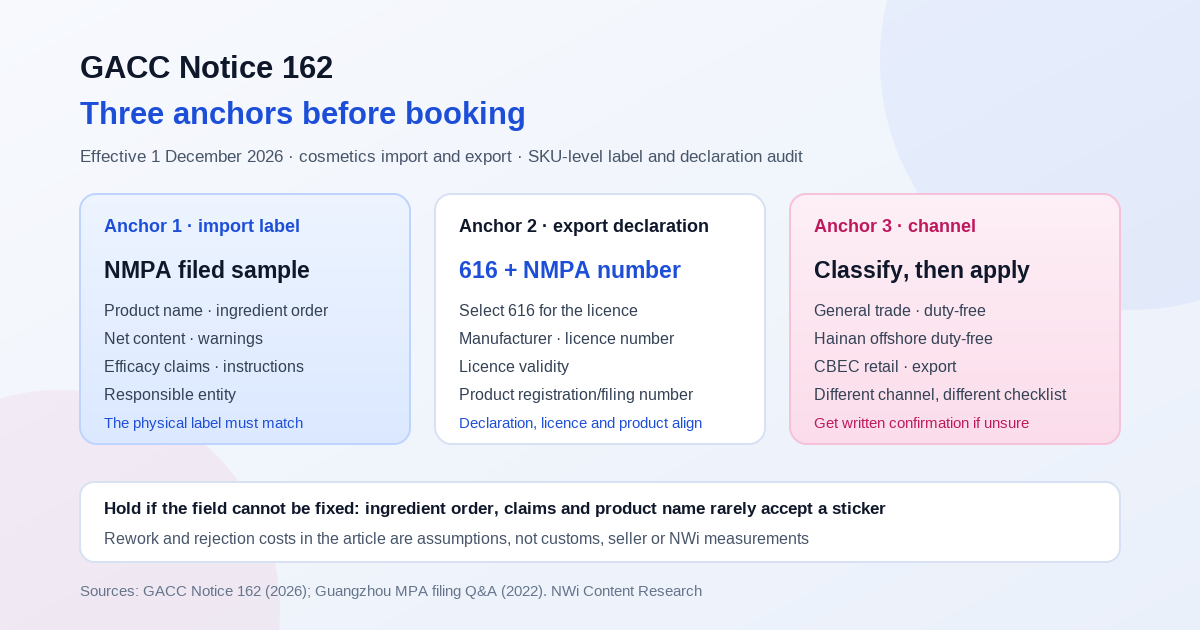
If you import cosmetics into China or export cosmetics from China, the question after 1 December 2026 is not whether the notice carries a fine. It is a SKU-level question: which products have a physical Chinese label that differs from the NMPA filed label sample, which export inspection declaration fields cannot be completed, and whether the shipment should be held until those fields are fixed. GACC Notice 162 of 2026 puts import labelling and export declaration in one document, but they are two different compliance chains. This article does not restate the notice. It turns the requirements into three anchors — label vs filed sample, declaration vs licence/filing, channel vs rule — and uses an import relabel scenario and an export rejection scenario to calculate rework and delay costs, with a SKU-level audit table and stop conditions. All costs, quantities and ratios are explicitly labelled assumptions, not measurements by customs, a seller or NWi.
1. Two lines in the notice: import labels, export declarations
The General Administration of Customs of China (GACC) issued Notice No. 162 of 2026 on 23 November 2026; it takes effect on 1 December 2026. The first article addresses imports: the Chinese label on imported cosmetics must be consistent with the relevant content of the product label sample filed on the National Medical Products Administration (NMPA) cosmetics registration and filing information service platform.
The same article sets out two exceptions: imported duty-free cosmetics are exempt from affixing a Chinese label, except cosmetics under the Hainan offshore duty-free policy; labels for cosmetics imported through cross-border e-commerce (CBEC) retail are governed by the relevant provisions. The notice does not merge general imports, duty-free, Hainan offshore duty-free and CBEC retail into one rule; this article uses “general trade” for the default import channel under the first article, a category the notice does not itself elaborate, which is why the channel matrix matters.
The second article addresses exports: in the export inspection and quarantine application, the manufacturer, consignor or agent must select “616 – Cosmetic Production Licence” in the enterprise qualification number field and enter the cosmetic manufacturer's name and production licence number; under commodity information – product qualification, it must enter the product's registration or filing number on the NMPA platform.
The closing clause says that, where earlier GACC provisions on imported and exported cosmetics conflict with this notice, this notice prevails. That means old operating guidance gives way on 1 December, but the notice itself does not publish a penalty schedule, a transition period, an inspection ratio or a field-level tolerance. It is a prevailing-clause rule, not a transition-period rule: it does not say old label stock may be sold until a later date.
2. The mechanism: three anchors, not one universal checklist
The first anchor is the NMPA filed label sample. The comparison object for an imported label is not a competitor's label or the brand owner's English artwork, but the product label sample filed on the platform. The fields to compare include at least the product name, ingredient list and order, net content, warnings, efficacy claims, instructions, and the responsible entity/domestic responsible person; the exact fields depend on the product category and the filed sample.
The second anchor is the export declaration's licence chain. 616 is the cosmetic production licence; the declaration carries the manufacturer's name and licence number. Product qualification carries the NMPA registration or filing number. The licence must be valid, the manufacturer name must match the licence, and the number must correspond to the specific product. The notice does not ask merely for “a licence”; it asks for declaration information, licence and product to line up.
The third anchor is the channel. General trade imports, duty-free imports other than Hainan offshore duty-free, Hainan offshore duty-free, CBEC retail imports and exports are governed by different rules. Classify the channel first, then choose the checklist; applying the general-trade label rule to a CBEC retail import, or treating Hainan offshore duty-free as ordinary duty-free, leads to the wrong rework decision.
Together, the three anchors form a consistency check: label vs filed sample, declaration vs licence/filing, channel vs rule. If any one fails, stop before booking freight or printing labels.
3. Evidence boundary: what the notice does not say
The notice is a GACC supervisory announcement on import labels and export inspection declarations; it is not a universal rule for every cross-border parcel. For cosmetics imported through CBEC retail, labels are “governed by the relevant provisions”, and the notice does not set out those provisions. The general-trade Chinese label rule cannot be applied to CBEC retail without checking the separate rules.
The notice does not publish a penalty schedule, a transition period, an inspection ratio, a field-level tolerance, or the port-level method for deciding whether content is consistent. Local customs practice may differ, and a customs broker's oral assurance is not a substitute for written confirmation.
The export-only filing path is not established by Notice 162 itself. A 2022 Q&A from the Guangzhou Municipal Market Supervision Administration states that special and ordinary cosmetics for export only must be filed on the NMPA registration and filing information service platform, with the manufacturer submitting the product name, intended export destination and label images. That supports the existence of an export-only filing, but the 2022 Q&A is not a new requirement of Notice 162; the declaration must be able to produce the registration or filing number corresponding to the product, and the exact number is a matter of the platform record.
This article did not access the customs declaration system, the NMPA filing system or any company's back office; all costs, quantities and delays are assumptions, not measurements.
4. Scenario A: an import label mismatch — can a sticker fix it?
Assumptions: three SKUs of 5,000 units each, 15,000 units in total; unit cost C = RMB 12; one SKU's Chinese label differs from the filed sample in the net-content/warning field, while the other two SKUs match; the affected SKU's labels are already printed but can be corrected with a sticker at R = RMB 0.8 per unit; air freight is already booked at RMB 4 per unit, RMB 60,000 in total, a sunk cost; the rework causes a 10-day delay, and the capital/missed-window cost is 5% of unit cost, or RMB 0.6 per unit. All figures are assumptions.
Rework cost = 5,000 × 0.8 = RMB 4,000; delay cost = 5,000 × 12 × 5% = RMB 3,000; incremental total = RMB 7,000, or RMB 1.40 per unit. The RMB 60,000 air freight does not enter the incremental calculation, but if customs finds the label inconsistent at the port, the whole batch may be rejected or returned, an exposure far larger than RMB 7,000.
Decision: if the difference is limited to fields a sticker can cover, such as net content or warnings, and the sticker does not obscure mandatory information, apply and re-check the sticker before shipment, then release the batch; RMB 7,000 is a manageable rework cost. If the difference is in the ingredient list and order, efficacy claims or product name, a sticker usually cannot solve it; the filing sample must be changed first, then the label reprinted or the product rerun. For the same 5,000 units at RMB 12 unit cost, a new production run costs RMB 60,000, plus RMB 3,000 delay, RMB 63,000 in total, before scrapping the old labels or losing the sales window.
So “can a sticker fix it?” is not an aesthetic question; it is a field question. List the differing field for every SKU, classify it as sticker-fixable, filing-change required or production-rerun required, and only then decide whether to book freight.
5. Scenario B: a missing export declaration field — what does one rejection cost?
Assumptions: 1,000 units of exported cosmetics, unit cost RMB 8; sea/air freight RMB 3 per unit, RMB 3,000 in total, a sunk cost; the declaration is rejected because the enterprise qualification did not select 616 or the product qualification lacks the NMPA number; the cargo sits at the port for seven days at RMB 200 per day; re-declaration or rebooking costs RMB 1,500; capital and delay cost RMB 500. All figures are assumptions.
Storage = 7 × 200 = RMB 1,400; re-declaration/rebooking = RMB 1,500; capital/delay = RMB 500; total = RMB 3,400, or RMB 3.40 per unit. This does not include customer penalties, destination demurrage, return-to-origin or air rebooking costs.
Decision: if the 616 licence or the NMPA number cannot be produced before booking, stop booking; do not ask the broker to “declare first and fix later”. An export-only product may have a filing number, but the brand owner or contract manufacturer must be able to produce the number corresponding to the product; the licence must be valid, and the manufacturer name must match the licence. Run one test declaration to confirm the fields pass before scaling.
Counter-case: if the product is export-only and a filing number exists but the brand owner does not know it, retrieve the filing information from the NMPA platform or the contract manufacturer instead of guessing a number; if the licence belongs to the contract manufacturer, confirm that the manufacturer name on the declaration matches the licence, and do not insert the brand owner's name.
6. Scenario C: a channel mistake can make the rework itself wasteful
Assumptions: two SKUs of 3,000 units each, 6,000 units in total; the company reprints labels for a CBEC retail import SKU to meet the general-trade Chinese label rule, at RMB 1.2 per unit, RMB 7,200 in total; but that channel's labels are governed by the CBEC retail import provisions, and the notice does not require the general-trade label to be applied. All figures are assumptions.
If the channel is confirmed as CBEC retail and its applicable rules do not require the general-trade Chinese label, the RMB 7,200 may be wasted rework; if the channel is actually general trade, the RMB 7,200 is necessary. The difference is not in the label but in the channel classification. Another common error is Hainan offshore duty-free: the notice expressly excludes it from the “imported duty-free cosmetics are exempt from a Chinese label” exception, so it cannot be treated as ordinary duty-free.
Decision: build the channel matrix before reprinting. Mark every SKU as general trade, duty-free, Hainan offshore duty-free, CBEC retail import or export, with the applicable label rule, declaration fields and owner. If the channel is uncertain, obtain written confirmation from local customs or the broker before printing.
7. A SKU-level audit table
Put the three anchors into a SKU table with at least the columns below. The table is an internal audit table, not a regulatory template; the exact declaration fields are those of the customs system and the local customs district.
| Check | Anchor document | Fields to verify | Action if inconsistent |
|---|---|---|---|
| Import label | NMPA filed label sample | Product name, ingredient list and order, net content, warnings, efficacy claims, instructions, responsible entity/domestic responsible person | Sticker-fixable: apply and re-check; ingredient/claim/name mismatch: change the filing and reprint; cannot fix: hold the shipment |
| Export declaration | 616 cosmetic production licence; NMPA registration/filing number | Manufacturer name, licence number and validity, product registration/filing number, destination standard/contract | Missing licence/number mismatch: stop booking; run a test declaration first |
| Channel | Notice and the applicable channel rules | General trade/duty-free/Hainan offshore duty-free/CBEC retail/export | Uncertain channel: get written confirmation; do not apply the general-trade checklist to CBEC retail |
The important part is not the number of fields but that every field points to an anchor document. Do not fill a field from experience when there is no anchor; do not ship a SKU whose physical label does not match its anchor.
8. Counter-cases and alternative explanations
Counter-case one: a valid NMPA filing does not prove that the physical label is compliant. The filed sample is the anchor, and the printed label can differ through version, sticker, promotional overlay or old packaging; the existence of a filing number does not prove that the label on the shelf matches it.
Counter-case two: a CBEC retail import does not necessarily need the general-trade Chinese label. Applying the general-trade checklist to CBEC retail creates unnecessary reprint cost; conversely, treating a general-trade import as CBEC retail creates a larger risk.
Counter-case three: export-only filing is not “no filing”. An export-only product may have an NMPA filing number, but its scope differs from a domestic-sale filing; the brand owner, contract manufacturer and broker must confirm which product and channel the number belongs to.
Counter-case four: a sticker is not universal. Ingredient order, efficacy claims and product name usually cannot be fixed with a sticker; a pre-printed bottle or tube may need a new production run, with a lead time and cost far above a sticker.
Counter-case five: a broker's oral assurance is not evidence. The notice publishes no field-level tolerance, and local practice may differ; ask for written confirmation or run a test declaration, and do not treat “it passed before” as a guarantee after 1 December.
Counter-case six: the absence of a penalty schedule does not mean there are no consequences. Cargo may be rejected, returned, detained or delayed, and the specific treatment is a customs decision; this article does not invent a fine amount.
9. Action list and stop conditions
Do five things before 1 December: first, build a SKU × channel matrix; second, pull the NMPA filed label sample for every SKU; third, compare the physical label field by field and mark it sticker-fixable, filing-change required or production-rerun required; fourth, for export SKUs verify the 616 licence, manufacturer name, licence validity and NMPA number; fifth, run one low-risk test declaration and record the customs response.
Stop conditions: the ingredient list, efficacy claims or product name differ from the filed sample and cannot be changed before shipment; the 616 licence is expired or the manufacturer name does not match the licence; the NMPA number cannot be tied to the specific product; the channel classification is uncertain and there is no written confirmation; local customs has raised a written objection to the field requirements. If any applies, stop booking/shipment and fix it first.
Fields to observe: SKU, channel, NMPA filing number, label version, differing field, 616 licence number and validity, manufacturer name, declaration date, customs receipt/rejection reason, rework cost, delay days, and whether the booking was changed.
Example test parameters: choose one to three SKUs, one declaration per SKU, and a cargo value you can afford to hold; scale only after the test declaration passes. If the test is rejected, fix the fields rather than trying a second declaration “to see”; if the same field is rejected twice, stop shipping through that channel and move to written confirmation.
If you want to put SKU, channel, label version and declaration fields into one audit table, see NWi CrossborderGo for its marketplace data scope, or request a demo with your channel structure; for beauty-category research questions, see NWi Cross-border Agent. NWi CrossborderGo provides marketplace data, not customs clearance, NMPA filing agency services or customs-system access; the specific compliance judgment rests with customs and NMPA.
10. Limitations and unknowns
This article has no access to the customs declaration system, the NMPA filing system or any company's back office; it has no seller declaration forms, rejection rates, rework costs or delay data, and every number is an assumption rather than an industry average.
The notice does not provide a penalty schedule, a transition period, an inspection ratio, a field-level tolerance or local implementation details; the specific operation of CBEC retail labels, Hainan offshore duty-free and the export-only filing scope must be based on the current rules of the competent authorities and written answers from local customs.
This article is not legal, tax, customs or compliance advice; the exact declaration fields, licence requirements and label review must follow GACC, NMPA, local customs and your broker.
NWi CrossborderGo's public coverage.json covers marketplace data, not customs declarations or NMPA filings; this article does not claim that NWi provides customs clearance, filing agency services or customs-system access. The Cross-border Agent's beauty product-innovation advisor focuses on beauty research and does not replace a statutory compliance review.
11. Method and disclosure
Data basis: the notice text comes from the GACC Notice No. 162 of 2026 PDF (23 November 2026, accessed 26 November 2026), read in full; English terminology and the notice's points were cross-checked against ChemLinked's 24 November 2026 report, an independent regulatory publication whose event facts come from the same announcement, so it is not an independent measurement; the export-only filing path draws on the Guangzhou Municipal Market Supervision Administration's 14 April 2022 ordinary cosmetics filing Q&A (a primary reference, but not Notice 162 itself). Calculation basis: all costs, quantities, delays and ratios are explicitly labelled assumptions; rework cost = units × per-unit rework fee; delay cost = units × unit cost × capital/window ratio; rejection cost = storage per day × days + re-declaration/rebooking fee + capital/delay cost; all figures are in RMB, excluding VAT, duty, refunds and exchange rates.
This article was prepared with automated research assistance from the public sources listed at the end and has not been reviewed by a human; it does not invent customer data, expert review or ranking results. It is not legal, customs, tax or compliance advice.
The original increment here is not a restatement of the notice but a three-anchor and stop-rule framework: ask which field differs, whether it can be fixed before shipment, and whether the fix costs less than the exposure of the whole batch. The framework can be reused for other label or declaration changes without relying on whether the notice publishes a penalty table.
12. Sources
- GACC Announcement No. 162 of 2026 (PDF, General Administration of Customs of China), 23 November 2026; accessed 26 November 2026
- GACC Announcement No. 162 of 2026 (China-Africa SPS Cooperation Information Network reprint, source: GACC), reprint 25 November 2026; accessed 26 November 2026
- ChemLinked: China Clarifies Labeling and Declaration Requirements for Imported and Exported Cosmetics, 24 November 2026; accessed 26 November 2026
- Guangzhou Municipal Market Supervision Administration: Ordinary Cosmetics Filing Q&A (23), 14 April 2022; accessed 26 November 2026