
If you export through 9610 in Guangdong (excluding Shenzhen), the real question is not whether the 1% is a new tax. It is when the 1% is paid, on which revenue base, by whom, and whether the annual settlement returns an overpayment or demands a top-up. The consultation draft combines a platform-handled export declaration with a 1% income-tax prepayment, so it changes not only the timing of the tax but also who holds the export evidence and who reconciles platform revenue with the seller's books. This article separates the mechanics first, then runs three seller cases.
1. The decision: join the pilot, keep self-filing, or wait for the final announcement?
The real question is not whether the 1% is a new tax, but when it is paid, on which revenue base, by whom, and whether the annual settlement returns an overpayment or demands a top-up.
The draft was jointly prepared by the Guangdong Tax Service and the Guangdong Department of Commerce on 20 November 2026. It would create a voluntary pilot for 9610 retail exports in Guangdong (excluding Shenzhen). A platform must have an operating entity in Guangdong (excluding Shenzhen), actually conduct business there and be confirmed by the Guangdong Tax Service; a seller must be registered in Guangdong as a legal entity (non-branch), a sole proprietorship or an individual business.
So there is no single answer to 'should I join?'. For a seller already filing compliantly in a comprehensive pilot zone at a 4% deemed income rate and 25% CIT, the 1% prepayment equals the final tax, and the main gain is the platform-handled export declaration and the agency export certificate. For a small low-profit or low-margin seller, the 1% can create an overpayment for the year. For a high-margin seller, the 1% can be too low and the annual settlement can require a top-up. The decision depends on four things: the entity, the actual tax burden, whether the platform participates, and whether the books can separate the revenue.
One point is easy to miss: the pilot covers only the cross-border e-commerce sales revenue the seller receives from the pilot platform, not other platforms, offline sales or other export modes. A multi-platform seller cannot treat the 1% as the final tax on all revenue, and cannot treat the platform-handled export evidence as evidence for the whole business.
2. The mechanics: what the platform handles and what the seller still does
The platform or its agent handles the export declaration, applies for the agency export certificate and prepays 1% of sales revenue, while the seller still files VAT, consumption tax and income tax and completes the annual settlement itself.
The platform or its agent handles three things: the export declaration, the application for the agency export certificate (cross-border e-commerce list), and the prepayment of corporate income tax (CIT) or individual business income tax at 1% of the seller's sales revenue. The prepayment filing is completed within five working days after each quarter, and the tax is paid where the seller is located. The platform must also fill in the actual exporting party in the customs declaration list, and the seller must confirm the exported goods information.
The seller still does three things: file VAT, consumption tax and income tax itself; credit the prepaid income tax against the tax payable; and complete the annual income-tax settlement within the prescribed period the following year. Sellers that meet Caishui [2018] No. 103, SAT Announcement 2019 No. 36 or other policies can still enjoy the relevant support.
The 1% is not arbitrary: the drafting notes derive it from two simplified deemed-assessment formulas. For CIT, a 4% deemed income rate at the 25% rate gives 4% × 25% = 1%; for individual business income, a 5% commercial deemed income rate at the 20% third-tier rate gives 5% × 20% = 1%. This is only the prepayment rate at the agency stage, not the final tax rate; the final burden still depends on the seller's actual deemed rate, entity type and settlement result.
Timing is the other key: the draft says it would take effect on publication, but it is a consultation draft, not a final announcement. The platform list, seller confirmation, system integration and start date are not fixed. The article must not turn 'proposed pilot' into 'in force', or 'the platform may prepay 1%' into 'the platform is already withholding'.
3. Evidence boundary: one consultation draft, two attachments, one official deadline
This article checked the Guangdong Department of Commerce consultation page and the two attachments, the draft announcement and the drafting notes. The visible 'published/deadline' fields are blank and the attachment list renders as 'no attachments', but both attachment URLs still return .doc files; the body was extracted from the WordDocument stream as UTF-16LE. The page's embedded data shows deadline 2026-12-20 23:59:00, status collecting and created_at 2026-11-20 10:23:33. The article therefore records 20 December 2026, 23:59 as the official deadline, while reminding readers to check the page's actual display before acting.
The materials establish what the consultation draft says; they do not establish that the pilot is in force, that any platform has joined, or that a particular seller will pay less or more after joining.
Media reports are background, not a substitute for the original. The Sina Finance reprint of the Ebang report confirms the Guangdong (excluding Shenzhen) scope, the 1%, the five-working-day quarterly filing and the annual settlement, and says comments close on 20 December. This article uses it as auxiliary reading, not as a second independent official source. The rule text remains the two .doc attachments.
4. The arithmetic: three relationships between the 1% prepayment and the final tax
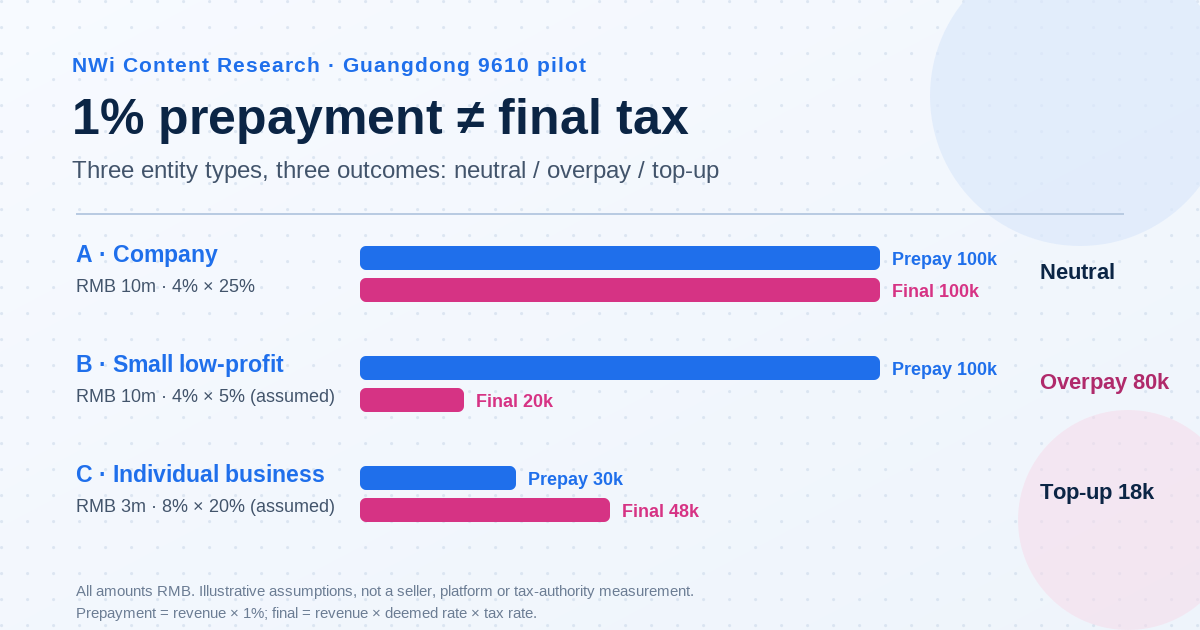
Separate the 1% prepayment from the final tax: prepayment = pilot-platform revenue × 1%; final CIT = revenue × deemed income rate × 25%; only the difference is refunded or topped up at the annual settlement.
When the deemed rate and tax rate sit exactly on the drafting notes' calibration points, the 1% equals the final tax: 4% × 25% = 1%, and 5% × 20% = 1%. The 1% is then not an extra cost; it simply moves tax that would have been paid at the annual settlement into four quarterly instalments. The cash-flow effect is 'paid earlier', not 'paid more'.
If the actual burden is below 1%, the seller overpays; if it is above 1%, the seller tops up. The cost of an overpayment is not only the principal but also the funding cost, the refund wait and the reconciliation labour; the cost of a top-up is a cash reserve that was not set aside for stock or advertising. The three scenarios below cover neutral, overpay and top-up.
| Scenario | Annual revenue | Deemed rate | Tax rate | Prepayment | Final tax | Difference |
|---|---|---|---|---|---|---|
| A Company | RMB 10m | 4% | 25% | RMB 100k | RMB 100k | 0 |
| B Small low-profit | RMB 10m | 4% | 5% | RMB 100k | RMB 20k | Overpay RMB 80k |
| C Individual business | RMB 3m | 8% | 20% | RMB 30k | RMB 48k | Top-up RMB 18k |
The table is arithmetic only; it does not represent any seller's actual tax burden. A real settlement also includes costs and expenses, tax adjustments, loss carryforwards, local surcharges, VAT and consumption tax, and eligibility for small low-profit policies. Change any variable and the difference changes.
5. Three scenarios: neutral, overpay and top-up
All three scenarios are illustrative, not seller, platform, tax-authority or NWi measurements. Every revenue, deemed rate, tax rate and funding cost can be replaced with your own data.
Scenario A: RMB 10m revenue, 4% deemed income rate, 25% CIT (illustrative)
Assume RMB 10m of annual pilot-platform revenue, a 4% deemed income rate, a 25% CIT rate, and no other income, incentives, local surcharges or refunds; the seller joins for the full year and the platform prepays quarterly.
Calculation: prepayment = RMB 10m × 1% = RMB 100k, or RMB 25k a quarter; final CIT = RMB 10m × 4% × 25% = RMB 100k; difference = 0. If the actual deemed rate is 3%, final tax = RMB 10m × 3% × 25% = RMB 75k, an overpayment of RMB 25k.
Prepayment is RMB 100k and final CIT is RMB 100k, so the year is neutral; if the actual deemed rate is only 3%, final tax is RMB 75k, an overpayment of RMB 25k that waits for the annual settlement to be refunded or credited.
If the quarterly RMB 25k outflow is manageable and the platform-handled export declaration and evidence chain have real value, the seller can join; otherwise recalculate with its own deemed rate first.
Scenario B: RMB 10m revenue, 4% deemed income rate, 5% effective CIT for a small low-profit company (illustrative)
Assume RMB 10m of annual pilot-platform revenue, a 4% deemed income rate and RMB 400k of taxable income; the seller qualifies as a small low-profit company with a 5% effective CIT rate that remains available at settlement; no other income, incentives or surcharges.
Calculation: prepayment = RMB 10m × 1% = RMB 100k; final CIT = RMB 400k × 5% = RMB 20k; overpayment = RMB 100k − RMB 20k = RMB 80k, or 0.8% of revenue. If the cash is tied up for six months at a 6% annual funding cost, the financing cost is about RMB 80k × 6% × 0.5 = RMB 2,400, before reconciliation and refund-waiting labour.
Prepayment is RMB 100k and final CIT is RMB 20k, so the seller overpays RMB 80k for the year, equal to 0.8% of revenue; six months of funding at 6% costs about RMB 2,400, before reconciliation and refund-waiting labour.
A small low-profit seller should compare the RMB 80k overpayment and the roughly RMB 2,400 funding cost with the value of the platform service; if the service is not essential, keeping the current compliant route or waiting for the final announcement is safer.
Scenario C: RMB 3m revenue, 8% deemed income rate, 20% individual business income tax (illustrative)
Assume RMB 3m of annual pilot-platform revenue, an individual business or sole proprietorship, an 8% deemed income rate and a 20% individual business income tax rate; no other income, deductions, incentives or surcharges; the platform prepays quarterly.
Calculation: prepayment = RMB 3m × 1% = RMB 30k; final individual income tax = RMB 3m × 8% × 20% = RMB 48k; top-up = RMB 48k − RMB 30k = RMB 18k.
Prepayment is RMB 30k and final individual income tax is RMB 48k, so the seller must top up RMB 18k for the year; the 1% is not a tax ceiling, and a high-margin seller must reserve cash for the settlement.
If a top-up is expected, put the RMB 18k into the annual cash budget and confirm that enough cash remains after the quarterly prepayments; do not treat all revenue as spendable because only 1% was prepaid.
Put the three together: A shows that the 1% can be a neutral cash-flow timing point; B shows that a low actual burden turns the 1% into an overpayment for the year; C shows that a high margin makes the 1% insufficient and requires a top-up. The common lesson is that the seller must calculate its final tax before joining, not just look at the 1%.
6. Counter-cases: not every seller should join
If the seller already files compliantly in a comprehensive pilot zone at a 4% deemed income rate and 25% CIT, the 1% prepayment equals the final tax and the main gain is the platform-handled export declaration and evidence chain, not a lower tax bill. If the platform fee, reconciliation cost or system change costs more than the convenience, the current compliant route is simpler.
Counter-case two: a small low-profit or low-margin seller can overpay for the year. The overpayment is not a loss of principal, but it ties up cash; if the refund or credit waits until the next annual settlement, the funding cost and reconciliation labour can exceed the convenience of the platform service.
Counter-case three: a high-margin seller may need to top up. The 1% is not a cap; if the actual deemed rate is above 4% for a company or 5% for an individual business, the annual settlement will require the difference. Treating the 1% as the total tax understates the cash need.
Counter-case four: a seller with multiple platforms, online and offline sales and several export modes is covered only on the pilot-platform revenue. The platform data cannot cover the whole business, and the seller still has to file everything; if the books cannot separate the revenue by platform, the pilot adds reconciliation work.
Counter-case five: Shenzhen sellers, sellers outside Guangdong, sellers on non-pilot platforms and sellers without a Guangdong market-entity registration are outside the pilot. A platform that has not been confirmed and a seller that has not been confirmed cannot operate under the pilot.
Counter-case six: data or confirmation errors create follow-up work. The customs declaration list, the agency export certificate, the platform revenue, the prepayment form and the seller's books must agree; any mismatch may need an explanation or correction.
7. Action list and stop conditions
Confirm the entity and platform eligibility first, then separate pilot-platform revenue from other platforms, offline sales and other export modes, and finally use the final tax and cash flow to decide whether to join, wait or keep the current route.
- 1. Check the entity: is it registered in Guangdong (excluding Shenzhen); is it a legal entity (non-branch), a sole proprietorship or an individual business; does it export through 9610?
- 2. Check the platform: does it have an operating entity in Guangdong (excluding Shenzhen) and actually conduct business there; has it applied and been confirmed by the Guangdong Tax Service; has the seller been reported and confirmed?
- 3. Separate revenue: split pilot-platform revenue, other-platform revenue, offline revenue and other export modes; the 1% applies only to pilot-platform revenue.
- 4. Calculate the final tax: use the current deemed rate, CIT or individual income tax rate and available incentives to estimate the annual tax, then compare it with the 1% prepayment to find the overpayment or top-up.
- 5. Calculate cash flow: put quarterly prepayments, the annual settlement, the refund or credit wait and the funding cost in one table; small low-profit sellers focus on the overpayment, high-margin sellers on the top-up.
- 6. Match the evidence: platform orders, customs declaration list, agency export certificate, prepayment form and the seller's books must reconcile item by item; run a one-month or one-quarter mock reconciliation first.
- 7. Ask a professional: confirm the interaction with VAT, consumption tax, export refund or exemption, local surcharges and deemed assessment with a local tax adviser or the competent tax authority; this article is not tax advice.
- 8. Watch the announcement: if you prefer to wait, record the official page status and deadline, and decide after the final announcement, platform list and start date are clear; do not sign long-term contracts or set prices on the draft.
Write the stop conditions down as well, so 'join first and see' does not become the plan:
- The final announcement is not published or the platform is not confirmed: do not join; keep filing under the current compliant route.
- The seller is in Shenzhen, outside Guangdong, on a non-pilot platform or in an ineligible entity: stop; the pilot does not apply.
- The seller cannot separate pilot-platform revenue from other revenue: do not join until the books support the split.
- The expected overpayment funding cost plus reconciliation labour exceeds the value of the platform-handled export service: wait or keep the current route.
- The platform cannot provide the export declaration, agency export certificate or quarterly data: do not hand over the compliance responsibility.
- The final rule changes the 1% rate, eligible entities, platform list or start date: recalculate; do not reuse this article's numbers.
To put market, category and SKU data back into this calculation, use NWi CrossborderGo for platform, category and brand data (platform, site, fields and history by contract); the operations team can use NWi Operations to put revenue, cost and contribution margin back into the SKU; for a walkthrough based on your entity and revenue structure, go to Request a demo. These tools do not provide tax filing, customs declaration, export refunds or tax-authority data, and do not replace a local tax adviser.
8. Limitations and unknowns
This article has no seller-level revenue, margin, refund or platform-participation data; the revenue, deemed rates and tax rates in the three scenarios are clearly labelled assumptions.
- The consultation draft is not a final rule; the 1% rate, eligible entities, platform list and start date may change.
- The visible date fields on the official page are blank; the deadline comes from the page's embedded data, and the page display or a tax-authority notice should be checked before acting.
- The two .doc attachments were extracted from the WordDocument stream; formatting, tables and tracked changes were not reviewed item by item.
- The final tax also depends on costs, tax adjustments, loss carryforwards, local surcharges, VAT, consumption tax and incentives; this article calculates income tax only.
- No real join test was run, and there is no confirmed platform or tax-authority sample; the article cannot claim that joining will reduce tax, raise profit or improve a compliance score.
- A cross-border seller's multi-platform, multi-entity and multi-export-mode structure may be more complex than the three scenarios; the actual decision needs the seller's own books.
- This article is not tax, legal, platform-operations or investment advice.
9. Original analytical contribution
The increment is to reduce the 1% from a supposed new tax to a cash-flow timing point and to calculate three outcomes — overpay, neutral and top-up — for a company, a small low-profit company and an individual business.
The second increment is to show that the pilot changes not only who pays but also who holds the export evidence: the platform handles the export declaration and the agency export certificate, while the seller still files all taxes and completes the annual settlement. That division defines the seller's reconciliation duty; compliance is not outsourced to the platform.
The third increment is to break 'join or not' into four checkable conditions: entity eligibility, platform confirmation, separable revenue and a calculable final tax. If any one fails, the correct action is to wait or keep the current route, not to be drawn in by the 1% headline.
10. Conclusion
In one sentence: confirm the deadline and final-announcement status on the official page, then recalculate with your own entity, platform, revenue split and final tax. The 1% prepayment is not the final tax: small low-profit sellers should guard against an overpayment, high-margin sellers against a top-up, and multi-platform sellers against treating pilot-platform revenue as the whole business.
11. Sources
- 1. Guangdong Department of Commerce, 'Notice of public consultation on the Announcement of the Guangdong Tax Service and the Guangdong Department of Commerce on the pilot of a new tax-collection model for cross-border e-commerce (consultation draft)' (official consultation page; embedded deadline 20 December 2026, 23:59; status collecting; accessed 26 November 2026): original
- 2. Guangdong Tax Service and Guangdong Department of Commerce, 'Announcement on the pilot of a new tax-collection model for cross-border e-commerce (consultation draft)' (official attachment; draft dated 20 November 2026; 1% prepayment, five-working-day quarterly filing, seller self-filing and settlement; accessed 26 November 2026): original
- 3. Guangdong Tax Service and Guangdong Department of Commerce, drafting notes to the consultation draft (official attachment; 4% × 25% and 5% × 20% derivation of the 1%; accessed 26 November 2026): original
- 4. Sina Finance reprint of the Ebang report, 'Guangdong proposes a pilot of a new cross-border e-commerce tax-collection model; the platform may prepay 1% of sales' (25 November 2026, 21:02; background only, not a second official source): original
12. Method and disclosure
Data basis: the pilot scope, the 1% prepayment, the five-working-day quarterly filing, the seller's self-filing and annual settlement, and the link to Caishui [2018] No. 103 and SAT Announcement 2019 No. 36 come from the Guangdong Department of Commerce consultation page and its attachments, the draft announcement and the drafting notes (draft dated 20 November 2026; the page's embedded data shows a deadline of 20 December 2026, 23:59, and status collecting). The visible date fields on the page are blank and the attachment list renders as 'no attachments', but both attachment URLs returned .doc files; the body was extracted from the WordDocument stream as UTF-16LE. The embedded page data and the attachment text were re-checked on 26 November 2026 at 11:05. The Sina Finance reprint of the Ebang report (25 November 2026) is used only for background and cross-reading of the deadline, not as a second official source. Calculation basis: prepayment = pilot-platform revenue × 1%; final CIT = revenue × deemed income rate × 25%; final individual business income tax = revenue × deemed income rate × applicable rate; difference = prepayment − final. All revenue, deemed rates, tax rates, funding costs and waiting periods in the scenarios are clearly labelled assumptions, not seller, platform, tax-authority or NWi measurements. NWi CrossborderGo provides market, category and brand data, and NWi Operations provides selection and operating tools; neither provides tax filing, customs declaration, export refunds or tax-authority data, and the calculations do not rely on NWi product data.
This article was prepared with automated research assistance and analysed from the public sources listed at the end; it was not manually reviewed. It does not invent customer data, expert review, tax incentives, sales lift, ranking results or platform/tax-authority endorsement. It is not tax, legal, platform-operations or investment advice.