
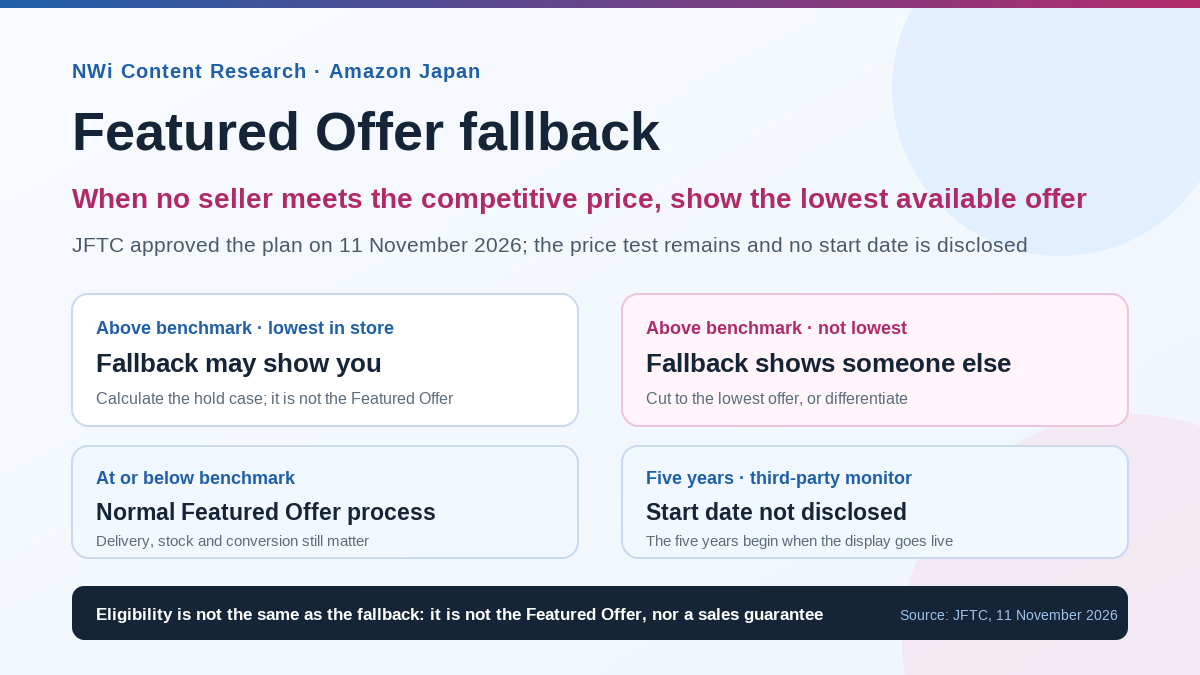
If you sell on Amazon.co.jp above the “competitive price,” the decision after the JFTC approved the plan on 11 November 2026 is not simply whether to chase the Featured Offer. It is whether your offer will be the lowest-priced offer shown in the store when no Featured Offer appears; and if it will not, whether to cut, hold, or recover visibility another way. Japan's Fair Trade Commission (JFTC) approved Amazon Japan's commitment plan that day. When no seller meets the competitive price and the product page has no Featured Offer, Amazon Japan must show, in a readily visible way, the lowest-priced available offer (price, delivery conditions, ship-from and seller) and a purchase entry point, for five years from the start of operation. The plan does not remove the Featured Offer price test and does not disclose a start date. This article separates “meets the competitive price” from “lowest offer in the store,” turns the choice into a decision tree, recalculates the break-even volume for holding versus cutting in two hypothetical scenarios, and sets out the fields to watch and the stop conditions; it is not legal, tax or marketplace-operations advice.
1. Separate eligibility from the fallback display
The JFTC approved the commitment plan submitted by Amazon Japan G.K. on 11 November 2026. The case concerned the algorithm Amazon Japan has used since September 2019 to decide which offers qualify for the “Featured Offer.” Eligibility required a sale price at or below the “competitive price.” When no seller met that benchmark, the product detail page showed no seller's offer at all, including the lowest offer in the Amazon store. The JFTC suspected the arrangement of breaching Article 19 of the Antimonopoly Act (paragraph 12, trading on restrictive terms), but approval of the commitment plan is not a finding that the prior conduct violated the law.
Four terms need to be separated. First, the Featured Offer is the single seller's offer next to the Add to Cart and Buy Now buttons; other offers appear only on a separate all-offers page. The JFTC said most purchases in the Amazon store come from the Featured Offer without the all-offers page being opened. Second, the sale price is the product price plus shipping, minus the value of points awarded on the purchase. Third, the competitive price is the lowest sale price for the identical product among a considerable number of online stores that Amazon Japan considers consumers could use instead of Amazon.co.jp, including stores with large transaction volumes. Fourth, the competitive price is not the lowest price inside the Amazon store; it is the lowest price at the external stores Amazon Japan treats as substitutes.
The plan requires Amazon Japan, when no seller meets the competitive price and no Featured Offer appears, to display in a readily visible way the price, delivery conditions, ship-from and seller of the lowest-priced offer available for purchase, plus an entry point that lets consumers proceed to buy. It must explain the display in seller and consumer help pages, keep it for five years from the start of operation, adopt the measures through its business-execution decision body, notify sellers and train relevant employees, adopt an Antimonopoly Act compliance code for seller pricing with periodic training and legal audits, and entrust monitoring to a third party approved by the JFTC that reports annually. There is no fine and no finding of a violation.
| Item | Commitment-plan requirement | What did not change |
|---|---|---|
| Trigger | No seller meets the competitive price and the page has no Featured Offer | If at least one seller meets the competitive price, the normal Featured Offer process applies |
| Display | The lowest-priced available offer: price, delivery conditions, ship-from, seller and a purchase entry point | Not every offer above the competitive price is displayed |
| Duration | Five years from the start of operation | The start date is not disclosed; the five years begin when the display goes live |
| Monitoring | A JFTC-approved third party monitors and reports annually | The monitor's identity and whether reports are public are not disclosed |
| Legal effect | The plan is approved; no fine | Approval is not a finding that the prior conduct violated the Antimonopoly Act |
The key distinction is this: the plan adds a fallback for the case in which there is no Featured Offer. It does not remove the Featured Offer price test and does not change the eligibility algorithm. If your price is above the competitive price but another seller meets it and holds the Featured Offer, the page still shows that seller's offer; the fallback does not make you appear. The fallback starts only on products where no seller meets the competitive price, and it shows the lowest-priced available offer, usually the lowest offer in the Amazon store, not necessarily yours.
That is the layer many headlines miss. The remedy is not “Amazon must show every seller's lowest price.” It is “when nobody meets the external competitive price, at least show consumers the lowest price still available in the store.” For a seller, the real question is whether you are the lowest-priced offer in the store. If you are, the fallback may restore visibility. If you are not, the fallback may keep you hidden or make the cheaper alternative easier to see.
2. Who is affected: four seller positions
The real decision is whether to hold your Amazon.co.jp price, cut to the lowest offer in the store, or cut all the way to the external competitive price to chase the Featured Offer; the answer depends on your position in the store, whether the fallback shows you, and whether extra volume can replace the contribution you give up.
The mechanism is narrower than the headlines: Featured Offer eligibility still requires a sale price at or below the competitive price, and the commitment only adds a fallback display of the lowest-priced available offer and a purchase entry point when no seller meets that benchmark. Crossing “meets the competitive price” with “lowest offer in the store” produces four positions. “Lowest offer in the store” is this article's analytical label, not Amazon's official term; the commitment says “lowest-priced offer available for purchase.”
| Seller position | What happens on the page | Priority action |
|---|---|---|
| A. Above the competitive price but the lowest offer in the store | When there is no Featured Offer, the fallback may show your offer | Calculate the break-even for holding; do not cut to the external lowest price just because you lost the Featured Offer |
| B. Above the competitive price and not the lowest offer in the store | The fallback shows a cheaper offer; you remain off the product page | Decide whether to cut to the lowest offer in the store, accept lower visibility, or differentiate on delivery, ads or bundles |
| C. At or below the competitive price | You are eligible for the Featured Offer; delivery terms and other factors still decide | Focus on delivery, stock and conversion, not the fallback |
| D. Also supplying external stores | The external price may become the competitive price; the JFTC considered requests to raise external prices or stop supply | Do not ask external stores to raise prices or stop supply; that is an antitrust compliance risk |
Position A deserves the most attention: you are above the external competitive price but are the lowest-priced offer inside Amazon. In the past, the page might not show your offer at all; after the fallback starts, you may reappear on the product page. This is not the Featured Offer, and the form of the purchase entry point is not disclosed. It may bring visibility, but it is not the old Buy Box position.
Position B is the mirror image: you are above the competitive price and a cheaper offer exists in the store. The fallback shows that cheaper offer, not yours. Waiting for the fallback to rescue you makes no sense; you either cut to the lowest offer in the store, accept lower visibility, or use delivery speed, ads, bundles or other differentiation to bring buyers back. Before cutting, calculate how much extra volume is needed to replace the contribution.
Position C is already eligible for the Featured Offer. The fallback does not change that unless no seller on the product meets the competitive price, in which case you also enter the fallback comparison. Do not read “Amazon must show the lowest price” as the end of the Featured Offer test; the test remains, and delivery terms still matter.
Position D involves external supply. The JFTC's review noted a concern: sellers that also supply external stores might expect the competitive price to rise and ask those stores to price at or above their Amazon price, or stop supplying them. The commitment plan does not make that conduct lawful; the concern is part of the case. Cross-border sellers that supply several channels should review external prices, supply relationships and Amazon pricing together, not use external stores to manipulate the Amazon benchmark.
The decision tree is: first ask whether your price is at or below the competitive price. If yes, you are in the Featured Offer logic; watch delivery, stock and conversion. If no, ask whether you are the lowest offer in the store. If yes, the fallback may help; calculate the case for holding. If no, the fallback will not help you; decide whether to cut to the lowest offer in the store or differentiate. That order is closer to reality than cutting as soon as you see the words “lowest price.”
3. Two scenarios: the break-even volume for holding or cutting
The two scenarios below are hypothetical. Every number is an example, not an Amazon, JFTC or NWi measurement. Common assumptions: product cost JPY 1,800; commission rate 10%; fulfillment JPY 350; advertising JPY 150; returns and other costs JPY 50; no currency, tax, promotion stacking or return-rate change. Unit contribution = price minus product cost, commission, fulfillment, advertising and returns/other; commission = price times the commission rate.
Scenario A: above the competitive price but the lowest offer in the store
Assumptions: price JPY 3,000; competitive price JPY 2,900; you are the lowest-priced offer in the Amazon store; monthly sales 1,000 units; cost, commission, fulfillment, ads and returns follow the common assumptions above.
Result: unit contribution = 3,000 - 1,800 - 300 - 350 - 150 - 50 = JPY 350; monthly contribution = JPY 350,000. At JPY 2,900, unit contribution = 2,900 - 1,800 - 290 - 350 - 150 - 50 = JPY 260; to keep JPY 350,000, you need 350,000 ÷ 260 = 1,347 units, about +34.6%.
Decision: if the fallback display shows your offer and monthly sales stay above 1,347 units, holding at JPY 3,000 earns more contribution; only consider a cut if sales fall below 1,347 or the fallback does not show you. Do not cut to JPY 2,900 simply because you lost the Featured Offer.
Scenario B: above the competitive price and not the lowest offer in the store
Assumptions: price JPY 3,100; competitive price JPY 2,900; another seller in the store is at JPY 3,050; your monthly sales are 800 units; cost, commission, fulfillment, ads and returns follow the common assumptions above.
Result: unit contribution = 3,100 - 1,800 - 310 - 350 - 150 - 50 = JPY 440; monthly contribution = JPY 352,000. At JPY 3,000, unit contribution = 3,000 - 1,800 - 300 - 350 - 150 - 50 = JPY 350; to keep JPY 352,000, you need 352,000 ÷ 350 = 1,006 units, about +25.7%.
Decision: if cutting to JPY 3,000 makes you the lowest-priced offer in the fallback and monthly sales exceed 1,006 units, the cut pays; if the fallback lift is below 25.7%, the cut only gives contribution away. Test for two to four weeks and record whether the fallback appears, clicks, conversion and returns before continuing.
| Scenario | Price | Unit contribution | Monthly units | Monthly contribution | Unit contribution after cut | Break-even units | Required volume lift |
|---|---|---|---|---|---|---|---|
| A lowest in store | JPY 3,000 | JPY 350 | 1,000 | JPY 350,000 | JPY 260 (2,900) | 1,347 | +34.6% |
| B not lowest in store | JPY 3,100 | JPY 440 | 800 | JPY 352,000 | JPY 350 (3,000) | 1,006 | +25.7% |
| B direct to competitive price | JPY 3,100 | JPY 440 | 800 | JPY 352,000 | JPY 260 (2,900) | 1,354 | +69.2% |
The third row is the one many sellers miss. If you cut from JPY 3,100 directly to JPY 2,900 to try to qualify for the Featured Offer, unit contribution falls to JPY 260, and you need 1,354 units to recover the original contribution, about +69.2%. Meeting the competitive price only makes you eligible; delivery terms and other factors can still keep the Featured Offer from you. Taking a 69.2% volume risk for an uncertain Featured Offer is usually worse than testing the fallback first.
Sensitivity: at a 15% commission rate, Scenario A's unit contribution falls to JPY 200, the post-cut contribution at JPY 2,900 is JPY 115, and break-even rises to 1,740 units (+74.0%). Scenario B's unit contribution falls to JPY 285, the post-cut contribution at JPY 3,000 is JPY 200, and break-even rises to 1,140 units (+42.5%). The higher the commission rate, the less attractive the cut and the lower the bar for holding. Replace the assumptions with your own invoice figures; the conclusion can change completely.
On the stated assumptions, holding at JPY 3,000 in Scenario A produces JPY 350,000 a month, while cutting to JPY 2,900 needs 1,347 units to break even; in Scenario B, cutting to JPY 3,000 needs 1,006 units.
4. Counter-cases: a fallback display is not a sales recovery
The counter-case is that if you are not the lowest-priced offer in the store, the fallback shows someone else's lower price, so sales may fall further rather than recover.
Counter-case 1: you are not the lowest offer in the store. The fallback shows someone else's offer, not yours; it may even make it clearer that you are more expensive than the lowest offer. Waiting for the fallback will not restore sales; it only delays dealing with price or differentiation.
Counter-case 2: meeting the competitive price does not guarantee the Featured Offer. The commitment plan does not change the eligibility algorithm; meeting the price only makes you eligible, and delivery conditions, stock, performance and other factors still affect the final display. Cutting to the external lowest price to chase a possible Featured Offer may lose contribution without winning the position.
Counter-case 3: the start date is not disclosed. The JFTC release does not give the date the fallback begins, the monitor's name or each measure's deadline; the five years start when the display goes live. Treating any second-hand timing as a fixed date and repricing in advance turns second-hand information into an announcement. Prepare the data and rules, then wait for Amazon Japan's launch notice or help-page update.
Counter-case 4: the commitment plan is not permanent law. It is a plan approved by the JFTC; if Amazon Japan does not implement it, the JFTC can revoke approval and resume the investigation. There is no fine, and approval is not a finding of a violation. Do not read “approved” as “the rule is fixed forever,” or “five years” as “nothing will change for five years.”
Counter-case 5: the competitive price is not the sticker price. The sale price adds shipping and deducts points; the competitive price is the lowest price at comparable external stores. Compare sticker prices only and you may miscalculate the distance. Free shipping, point rebates and member prices all change the effective price.
Counter-case 6: the fallback may increase price transparency. In the past, a page with no Featured Offer might show nothing; now it shows at least the lowest price in the store. That is more information for buyers and more pressure for sellers above the lowest offer. Do not assume the fallback protects a premium; it may make “who is cheaper” easier to compare.
Counter-case 7: “Amazon must show the lowest price” does not mean every product will show the lowest price. The commitment applies only when no seller meets the competitive price; if at least one seller meets it, the normal Featured Offer process applies. The “lowest price” in the headline is not the lowest price across all stores, and not every offer is displayed. That scope difference decides whether your SKU is affected at all.
5. Evidence boundary: what the JFTC did and did not say
The official text proves the nine measures, the five-year term, third-party monitoring and that approval is not a violation finding, but it does not prove the start date, the display format or seller-level traffic and conversion effects.
The official material read for this article is the JFTC release of 11 November 2026 and the commitment-plan PDF; the English tentative translation returned 403 from this network, so the English wording was checked against the Japanese text and independent reports. The full PPC Land and Tokyo Brief articles were read; both are independent publications, but both are based on the same JFTC release, so they are not independent evidence of seller outcomes.
What the official text proves: the review covers the Featured Offer eligibility algorithm since September 2019; the definitions of the competitive price and sale price; that no offer is shown when no seller meets the competitive price; the nine measures; the five-year term; third-party monitoring and annual reports; no fine; and that approval is not a finding of a violation.
What it does not prove: the start date; the monitor's identity; each measure's deadline; the form of the purchase entry point (the release says “an entry point” but not whether it is the Add to Cart or Buy Now button); seller-level price distribution, traffic, conversion, advertising or returns; whether the fallback will raise or lower prices; or whether Amazon Japan will change the algorithm beyond the display. This article does not fill those gaps with numbers.
The two scenarios are hypothetical examples, not Amazon or NWi measurements. Cost, commission, fulfillment, advertising, returns, monthly sales and the competitive price are all assumptions; readers should replace them with their own invoice figures. The article does not forecast prices or promise that holding or cutting will work.
The product boundary matters too. NWi CrossborderGo covers Amazon Japan sales, units, ASP, brand share and price bands, updated monthly; the exact sites, history and fields depend on the contract. It does not provide a seller back end, Featured Offer eligibility, Buy Box share, real-time page display or the seller's pricing algorithm. This article uses public policy as a decision framework, not product data as a substitute for platform policy or seller measurements.
6. Action list: before launch, after launch, and stop conditions
Before launch, classify each SKU by whether it meets the competitive price and whether it is the lowest offer in the store, then calculate the break-even volume for holding versus cutting; after launch, spend two to four weeks checking whether the fallback appears, whether it shows you, and how clicks, conversion and returns change.
Before launch, build a SKU table: price, shipping, points, product cost, commission rate, fulfillment, advertising, returns, unit contribution and monthly units. Add the competitive price, whether you are the lowest offer in the store, and whether you meet the competitive price. Without that table, “cut or hold” is a guess.
Step 1: fix the basis. Recalculate the sale price as product price plus shipping minus points; recalculate the competitive price as the lowest price at comparable external stores; do not use the sticker price. Step 2: calculate break-even. Divide the prior monthly contribution by the post-cut unit contribution to get the minimum monthly units; compare that with current sales to get the required lift. Step 3: set priorities. Start with the SKUs that are above the competitive price but the lowest offer in the store, because they are the most likely to benefit from the fallback; then handle the SKUs that are above the competitive price and not the lowest offer, because they are the most likely to be exposed by it.
After launch, verify three things: whether your offer appears in the fallback; whether the offer shown is yours; and whether clicks, conversion, returns and contribution change. Observe for at least two to four weeks and compare with control SKUs that are not shown. Do not judge on one day of sales or mistake normal variation for a display effect.
For a SKU that is the lowest offer in the store but above the competitive price: hold if monthly sales stay above break-even; if they fall below, consider cutting to the competitive price or lower, but calculate the volume threshold first. For a SKU that is not the lowest offer: if the lift needed to become the lowest offer (for example, 25.7%) is clearly above what you can achieve, do not cut; use delivery speed, ads, bundles or differentiation instead. For a SKU that already meets the competitive price: focus on delivery and conversion; do not relax Featured Offer operations because of the fallback.
Stop conditions: the fallback does not show you; monthly sales fall below break-even; the post-cut volume lift is below the calculated threshold; delivery or stock prevents you from participating reliably; Amazon Japan changes the scope or start date; or you cannot confirm the competitive-price basis. If any of these occurs, stop and re-check rather than cutting further.
Do not do four things: do not assume the Featured Offer price test has disappeared; do not cut directly to the external lowest price to chase a possible Featured Offer; do not use the sticker price instead of the shipping- and points-adjusted sale price; and do not ask external stores to raise prices or stop supply to lift the competitive price. The last point is not only a marketplace-rule issue; it is the competition concern the JFTC identified.
If you need to put Amazon Japan price bands, brand/store/product data and monthly trends into one table, see [Amazon data analysis](/platforms/amazon/) and [NWi CrossborderGo](/product/). For a custom category entry or pricing study, talk to us through the [Cross-border Agent](/page/agent.html) or [book a demo](/demo/). Product capabilities depend on the contract and actual authorization.
7. Limitations and original contribution
This article has no start date, no monitor name, no seller-level price distribution, traffic, conversion, advertising or returns data, and every scenario number is a hypothetical example.
The original contribution is to separate Featured Offer eligibility from the fallback display, show that the fallback only applies when no seller meets the competitive price, and give a four-position decision tree and a break-even method.
Most coverage stops at “Amazon must show the lowest price.” This article goes further: which seller, under what conditions, and what to do. If you remember one sentence, make it this: first confirm whether you are the lowest offer in the store, then calculate the break-even for holding versus cutting; the Featured Offer test has not disappeared, and the fallback is not a sales guarantee.
Data basis: the JFTC release of 11 November 2026 and the commitment-plan PDF were read in full; the English tentative translation returned 403 from this network, so the English wording was checked against the Japanese text and independent reports; the full PPC Land and Tokyo Brief articles were read. Calculation basis: unit contribution = price minus product cost, commission, fulfillment, advertising and returns/other; commission = price times the commission rate; break-even units = prior monthly contribution divided by post-cut unit contribution; every price, cost, commission rate, fulfillment, advertising, returns and volume figure in the scenarios is a labeled assumption, not an Amazon, JFTC or NWi measurement. Product basis: NWi CrossborderGo covers Amazon Japan sales, units, ASP, brand share and price bands, updated monthly; sites, history and fields depend on the contract, and it does not provide Featured Offer eligibility, Buy Box share, a seller back end or real-time page display.
This article was prepared with automated research assistance from the public sources listed at the end and has not been manually reviewed; it does not invent customer data, expert review, platform penalties, search rankings or official endorsement. It is not legal, tax, compliance or marketplace-operations advice.
Sources
- JFTC: Approval of the Commitment Plan Submitted by Amazon Japan G.K. (Japanese original, 11 November 2026)
- JFTC: Approval of the Commitment Plan Submitted by Amazon Japan G.K. (English tentative translation)
- PPC Land: Amazon Japan faces 5-year monitor over rule pegging sellers to rival prices (12 November 2026)
- Tokyo Brief: Amazon Japan to show cheapest offer when none meets rival-price test (11 November 2026)