
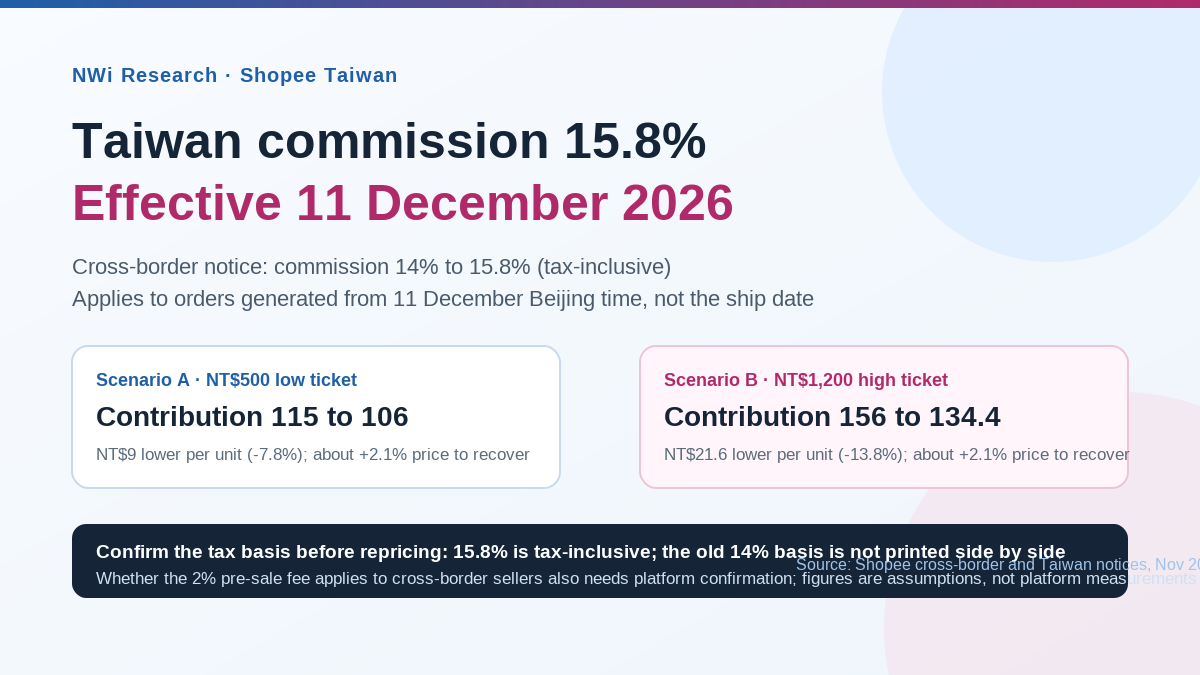
If you sell cross-border into Shopee Taiwan at an order value of roughly NT$300 to NT$1,500, the decision on 11 December 2026 is not whether the commission will rise. It is which SKUs fall below your contribution floor after the tax-inclusive 15.8% rate, and whether to reprice, cut ads, re-bundle or move budget first. Shopee China's cross-border notice says the Taiwan commission rate becomes 15.8% (tax-inclusive) for orders generated from 11 December 2026 Beijing time, and that commission equals product price plus Shopee-funded subsidy minus seller discount, excluding order shipping, multiplied by the rate. The Taiwan local notice also changes the transaction-fee calculation and the pre-sale service fee, while telling cross-border sellers to follow the cross-border rules. This article separates the tax basis, the order-generation date, the 2.5% transaction fee and the 2%/3% pre-sale fee, recalculates unit contribution in three scenarios, and sets out the actions and stop conditions before 11 December; it is not tax or marketplace advice.
1. What changes on 11 December: align four definitions first
The real decision is not whether the commission rises, but which SKUs fall below the contribution floor after the tax-inclusive 15.8% rate takes effect on 11 December 2026, and whether to reprice, cut ads, re-bundle or move budget first.
The mechanism is that commission equals product price plus Shopee-funded subsidy minus seller discount, excluding order shipping, multiplied by the commission rate; the new rate applies to orders generated from 11 December 2026 Beijing time, not to the ship date.
The first definition is the target. The 15.8% rate comes from the Taiwan cross-border notice, not from the local transaction-fee schedule. The local notice covers the calculation of the local transaction fee for mall and non-mall stores and explicitly says cross-border sellers should follow the cross-border notice. Applying the local fee table to a cross-border store gets both the target and the rate wrong.
The second definition is time. The new rate applies to orders generated from 11 December 2026 Beijing time, not to the ship date or the settlement date. An order generated on 10 December and shipped on 12 December should still follow the old rate under the notice's wording; an order generated on 11 December and shipped on 20 December follows the new rate. Sellers should reconcile by order-export time and order ID, not by the billing month.
The third definition is tax. The notice states 15.8% (tax-inclusive), but it does not print the tax basis of the old 14% rate side by side. If the old 14% was tax-exclusive and the new 15.8% is tax-inclusive, Taiwan's 5% business tax makes the old rate roughly 14.7% on the same basis, so the real increase is about 1.1 points; if both rates are tax-inclusive, the increase is 1.8 points. That difference changes every scenario below, so confirm it with the Shopee account manager first.
The fourth definition is the fee stack. Beyond commission, there is a 2.5% transaction fee, a 3% pre-sale service fee (possibly 2% for two-day handling), a cross-border return-service fee from 0.12%, and promo-period rates that may stack. On fees, the notice changes commission only; the other fees are outside this change. Calculating commission without the transaction fee and pre-sale fee overstates unit contribution.
| Fee item | Before | After | Scope | Effect on unit contribution |
|---|---|---|---|---|
| Commission | 14% | 15.8% (tax-inclusive) | Taiwan cross-border, orders generated from 11 Dec | Adds 1.8 points; about 1.1 points if the old 14% was tax-exclusive |
| Transaction fee | 2.5% | 2.5% | Not changed | Unchanged, but still part of cost |
| Pre-sale fee (two-day handling) | 3% | 2% | Taiwan local notice; cross-border follows cross-border rules | If it applies cross-border, a NT$500 SKU saves NT$5 per unit |
| Pre-sale fee (three-day-plus handling) | 3% | 3% | Not reduced | No offset |
| Cross-border return-service fee | From 0.12% | From 0.12% | Not changed | Unchanged |
| Promo-period rates | Not listed | Not listed | May stack | Check separately; may exceed 1.8 points |
Put the four definitions together and 11 December is not a uniform 1.8-point cost increase for every SKU. It is a recalculation of cross-border commission at a tax-inclusive 15.8%, with other fees on their existing rules and the tax basis still to be confirmed. That sentence decides whether to move price, ads or the pre-sale classification first.
2. Translate 1.8 points into unit contribution: three scenarios
The unit-contribution formula is simple: unit contribution = price minus product cost, fulfilment, ads, commission and other fees; contribution rate = unit contribution divided by price. When price is unchanged, a commission move from 14% to 15.8% cuts unit contribution by 1.8% of price. But the size of the cut does not by itself say whether the SKU still works; what matters is whether the post-change contribution rate stays above your floor.
Scenario A: NT$500 low-ticket apparel accessory, in stock (assumed) Assumptions: price NT$500; product cost NT$225 per unit (45% of the current price, held as a fixed amount after repricing); fulfilment NT$40; ads NT$50; commission 14% to 15.8% (tax-inclusive); other costs unchanged; no promo-period stacking. Result: old contribution = 500 - 225 - 40 - 50 - 70 = NT$115; new commission NT$79, contribution NT$106, NT$9 lower (-7.8%); a price-only recovery needs about NT$510.7 (+2.1%). Decision: the contribution rate falls from 23.0% to 21.2%; absorb it if it stays above the 20% floor, otherwise raise price by about 2.1% or cut NT$9 of ads per unit, not both at once.
Scenario B: NT$1,200 high-ticket home goods, in stock (assumed) Assumptions: price NT$1,200; product cost NT$720 per unit (60% of the current price, held as a fixed amount after repricing); fulfilment NT$60; ads NT$96; commission 14% to 15.8%; other costs unchanged. Result: old contribution = 1,200 - 720 - 60 - 96 - 168 = NT$156; new commission NT$189.6, contribution NT$134.4, NT$21.6 lower (-13.8%); a price of about NT$1,225.7 (+2.1%) recovers it. Decision: the absolute exposure is larger; test a 2.1% increase for two weeks, and if orders fall more than 10%, switch to an ad cut or a bundle instead of assuming unverified cost savings.
Scenario C: NT$500 three-day pre-sale with a 3% pre-sale fee (assumed) Assumptions: price NT$500; product cost NT$225; fulfilment NT$40; ads NT$50; commission 14% to 15.8%; pre-sale service fee 3% (the 2% two-day rate is calculated separately if it applies to cross-border sellers); other costs unchanged. Result: old contribution = 500 - 225 - 40 - 50 - 70 - 15 = NT$100; new commission NT$79, pre-sale fee still NT$15, contribution NT$91, NT$9 lower (-9.0%); if the 2% fee applies, contribution is NT$96, NT$4 lower, and a price rise of about 1.0% recovers it. Decision: first confirm whether the 2% pre-sale fee applies to cross-border sellers; if it does, move to two-day handling and raise price by about 1.0%; if not, raise price by about 2.2% or cut NT$9 of ads per unit; do not promise two-day dispatch just to save NT$5.
| Scenario | Price | Old contribution | New contribution (1.8 points) | Change | Price to recover |
|---|---|---|---|---|---|
| A low-ticket, in stock | NT$500 | NT$115 | NT$106 | -NT$9 (-7.8%) | About +2.1% |
| B high-ticket, in stock | NT$1,200 | NT$156 | NT$134.4 | -NT$21.6 (-13.8%) | About +2.1% |
| C three-day pre-sale | NT$500 | NT$100 | NT$91 | -NT$9 (-9.0%) | About +2.2% |
| C if 2% pre-sale applies | NT$500 | NT$100 | NT$96 | -NT$4 (-4.0%) | About +1.0% |
The common point is that the same 1.8 points produces a small absolute loss and a small change in contribution rate at a low ticket, and a larger absolute loss at a high ticket, while the percentage price needed to recover is the same because the contribution base is larger. The real difference is the contribution floor. A falls from 23.0% to 21.2%, still 1.2 points above a 20% floor; B falls from 13.0% to 11.2%, already below a 12% floor; C falls from 20.0% to 18.2%, below a 20% floor.
That is why a uniform 2.1% price increase is not the answer. A may absorb the change, B may have to reprice, and C may need the pre-sale fee confirmed first. Ranking SKUs by contribution buffer is closer to the decision than ranking by price or sales.
Tax sensitivity belongs in the same table. If the old 14% was tax-exclusive and the new 15.8% is tax-inclusive, the 5% business tax makes the real increase about 1.1 points: A's new contribution is about NT$111.5 (NT$3.5 lower, -3.0%), B about NT$147.6 (NT$8.4 lower, -5.4%), and C about NT$96.5 under the 3% pre-sale fee (NT$3.5 lower); if C also gets the 2% pre-sale fee, contribution is about NT$101.5, slightly above the old figure. That does not mean no price change is needed; it means do not over-react to the 1.8-point ceiling before the tax basis is confirmed.
3. Counter-cases: who should not reprice immediately
The counter-case is a high-ticket SKU with a contribution rate above 25% in a price band where buyers are not highly price-sensitive: the 1.8-point commission change may be absorbed, and a premature price increase can cost search visibility and conversion.
Counter-case one: a functional product with a contribution rate above 30%, stable repeat purchase and low price sensitivity. At NT$500, 1.8 points is NT$9; if the SKU contributes NT$150, the loss is only 6% of contribution, and a 2.1% price increase may hurt conversion more than it recovers. Absorb the commission for two weeks and watch conversion before repricing.
Counter-case two: orders concentrated in promo periods. A promo period may carry its own rates, subsidies or free-shipping thresholds, and the stack can exceed 1.8 points; looking only at commission understates the real cost of peak orders. Split promo orders from normal orders before deciding which batch needs a price change.
Counter-case three: subtracting 14% from 15.8% when one rate is tax-inclusive and the other is not. The different bases overstate the real increase by about 0.7 points; if the old 14% was already tax-inclusive, 1.8 points is correct. The point is not to be optimistic but to confirm the basis before choosing the number for the budget.
Counter-case four: moving budget to another site. Shopee Singapore, Malaysia, Thailand and Brazil each had their own fee, returns and fulfilment changes in 2026; Taiwan's 1.8 points is not evidence that another site is cheaper. Before shifting budget, put the target site's commission, transaction fee, fulfilment, returns and ad costs in the same table.
Counter-case five: using a bundle to hide a loss. Bundling two low-contribution SKUs raises order value, but product cost, fulfilment and returns may rise too; if the bundled contribution rate is still below the floor, the loss has only moved into a larger order. Bundle only after recalculating with the bundled cost and return rate.
4. The order of four levers: pre-sale fee, price, ads, bundle
On the stated assumptions, the commission increase is NT$9 per unit in Scenario A and NT$21.6 in Scenario B; moving a three-day pre-sale SKU to two-day handling would save NT$5 per unit if the 2% pre-sale fee applies, offsetting more than half of the commission increase.
The first lever is the pre-sale service fee, but its scope is limited. The Taiwan local notice cuts the pre-sale service fee from 3% to 2% for two-day handling and keeps 3% for three-day-plus handling; the same notice tells cross-border sellers to follow the cross-border rules, and the cross-border notice covers only the removal of pre-sale quantity/proportion limits and the commission change, not the pre-sale fee cut. Cross-border sellers therefore cannot treat the 2% rate as an available discount; confirm it with the account manager before changing a SKU to two-day handling.
If the 2% rate applies, a NT$500 SKU saves NT$5 per unit; Scenario C's net loss falls from NT$9 to NT$4, its contribution rises from NT$91 to NT$96, and a price increase of about 1.0% recovers it. If the 2% rate does not apply, do not promise two-day dispatch just to save NT$5; late-dispatch rate, cancellations and bad reviews can cost more than the commission increase.
The second lever is price. At 1.8 points, A and B need about a 2.1% increase to recover; at 1.1 points, about 0.8%. Higher is not better: run a two-week 2.1% test and watch orders, conversion and ad ACOS; if orders fall more than 10%, stop and use ads or a bundle instead.
The third lever is ads. A's commission increase is NT$9 per unit; if ad ACOS is above the break-even line, cutting NT$9 of ineffective ads per unit is more direct than a price increase, but an ad cut can reduce impressions and orders, so cut only high-ACOS, low-conversion terms rather than across the board. B's increase is NT$21.6 per unit, which leaves more room, but check ad attribution first and do not count organic orders as ad orders.
The fourth lever is the bundle. Bundling low-ticket SKUs into a higher order value dilutes fixed fulfilment cost, but it also raises product cost, packaging and return complexity; a bundle is right only when the bundled contribution rate is above the floor and the return rate does not rise. Do not use a bundle to hide a low-contribution SKU.
The order is not fixed. If the 2% pre-sale fee is confirmed, change the pre-sale classification first; if ad ACOS is clearly above break-even, cut ads first; if the price band is insensitive and the contribution buffer is large, absorb first; if every lever has been tried and contribution is still below the floor, delist or replace the SKU. Write the order as a decision tree instead of deciding on 11 December.
5. Evidence boundary: 15.8% is tax-inclusive, and the old 14% tax basis is not printed side by side
The primary material read for this article is Shopee Taiwan's local fee notice, Shopee China's Taiwan fee baseline and the cross-border notice; the 15.8% figure was checked against full-text reprints by Chwang and Cifnews, and the platform has not published seller-level impact, demand elasticity or conversion data.
What the primary material proves: the cross-border notice establishes the 15.8% tax-inclusive rate, the 11 December Beijing-time order-generation rule and the commission formula; the Taiwan local notice establishes the local transaction-fee calculation change, the two-day/three-day pre-sale fee changes and the cross-border scope caveat; the baseline page establishes the previous Taiwan cross-border direct-mail commission of 14%, transaction fee of 2.5%, pre-sale service fee of 3% and return-service fee from 0.12%.
What the primary material does not prove: the platform has not published the tax split inside 15.8%, the tax basis of the old 14%, category-level commission invoices, seller-level demand elasticity, conversion changes, promo-period stacking rules, a transition period or an appeal mechanism. The notice says the rate applies to orders generated from the effective date, but it does not say how an order generated before 11 December and refunded after 11 December is treated; reconcile those cross-period orders by order ID and refund date.
A further boundary is local versus cross-border. The local transaction-fee change is not the cross-border commission rule, and the cross-border 15.8% is not the local transaction-fee rate. Mixing them gets both the rate and the scope wrong.
The last boundary is notice versus invoice. The notice is the rule; the invoice is the result. The platform may add promotions, subsidies, refunds, disputes and currency adjustments to the invoice. The scenarios here are rule-level recalculations, not invoice-level measurements; replace the assumptions with the seller's own settlement reports and order ledger before deciding.
6. Action list: what to do before 11 December
Before 11 December, pull the SKU-level fee ledger, confirm the tax basis of the old 14% rate and whether the 2% pre-sale fee applies to cross-border sellers, then pre-set a 2.1% price test, an ad-cut threshold and a two-week stop rule.
Step one, by 30 November, pull the Taiwan site's SKU-level ledger for the last 90 days: price, product cost, fulfilment, ads, commission, transaction fee, pre-sale fee, return rate and contribution rate. Rank by contribution buffer and mark three groups: below the floor, buffer under 2 points, and buffer above 5 points.
Step two, by 5 December, confirm three things with the Shopee account manager: whether the old 14% was tax-inclusive or tax-exclusive; whether the 2% pre-sale fee applies to cross-border sellers; and which rate applies to an order generated before 11 December but refunded after it. Keep the written reply or a backend screenshot, not just a verbal answer.
Step three, by 10 December, pre-set actions for the three groups: below the floor, raise price by 2.1% or cut NT$9 of ads per unit; buffer under 2 points, run a two-week 2.1% test; buffer above 5 points, absorb and watch conversion. Keep pre-sale SKUs in a separate group and change to two-day handling only after the 2% rate is confirmed.
Step four, from 11 to 25 December, review weekly: orders, conversion, ad ACOS, return rate, late-dispatch rate and unit contribution. Do not look only at GMV; after a commission increase, GMV growth can coexist with falling contribution.
The stop conditions are: if the old 14% is confirmed tax-inclusive and contribution is still above the floor, stop the price increase; if orders fall more than 10% in the two-week test, stop the increase and cut ads or re-bundle; if two-day handling raises the late-dispatch rate, stop the reclassification; if every lever has been tried and contribution is still below the floor, delist or replace the SKU rather than relying on unverified cost savings.
7. What it means for data and operations
The data lesson is not that there is one more rate field. It is to separate the rule-level rate from the seller's actual contribution. The platform notice gives the rate; the seller's ledger gives orders, costs, returns and ads. Only when the two are joined by SKU and order ID can you see which SKUs really fall below the floor.
NWi CrossborderGo covers the Shopee Taiwan site with site-level sales, units, ASP, brand share and price bands, updated monthly (prior month published on the 10th to 15th). It helps rank categories, price bands and brand concentration by sensitivity to a price change; it does not provide seller-level commission invoices, order-level conversion, ad attribution, promo-period fees or return-logistics tracking, which must come from the seller's own backend and ledger.
This article has no seller-level commission invoice, order-level conversion, ad attribution, promo-calendar fee or Taiwan tax opinion; all scenario numbers are stated assumptions, not platform or NWi measurements.
The original contribution is to separate the 15.8% change into four layers - tax basis, order-generation date, pre-sale service fee and unit contribution - and to order the pre-sale, price, ad and bundle levers instead of repeating the headline.
You can see the Taiwan coverage on the Shopee platform page, explore market, category, brand, store and product research in NWi CrossborderGo, review product and operations tools in NWi Operations, see expert research in the Cross-border Agent, learn about data access on the MCP page, or use book a demo to walk through Taiwan price bands and SKU contribution together. Product capability, coverage and update frequency are subject to the actual contract and page descriptions; a menu entry is not an activated data set, and a market estimate is not a seller settlement statement.
8. Method and disclosure
Data basis: the cross-border notice is taken from shopee.cn/edu/article/28807, published 13 November 2026 and checked on 27 November 2026 against full-text reprints by Chwang and Cifnews; the Taiwan local notice is taken from seller.shopee.tw/edu/article/28668, published 12 November 2026 and read on 27 November 2026; the Taiwan cross-border fee baseline is taken from shopee.cn/edu/article/25770, updated 22 September 2026 and read on 27 November 2026. Calculation basis: commission equals price plus platform subsidy minus seller discount, excluding shipping, multiplied by the rate; 1.8 points is 15.8% minus 14%; 1.1 points is 15.8% minus 14% times 1.05 (that is, 15.8% minus 14.7%); unit contribution and the price needed to recover it are recalculated line by line from the assumptions in the text; all amounts are in NT$ with no currency conversion. Product basis: NWi CrossborderGo covers the Shopee Taiwan site with site-level sales, units, ASP, brand share and price bands, updated monthly (prior month published on the 10th to 15th); it does not provide seller-level commission invoices, order-level conversion, ad attribution or promo-period fees.
This article was prepared with automated research assistance from the public sources listed at the end and has not been manually reviewed; it does not invent customer data, expert review, platform penalties, search rankings or official endorsement. It is not tax, legal, compliance or marketplace-operations advice.
9. Sources
- 1. Shopee China Seller Learning Center, 13 November 2026, Shopee Taiwan market pre-sale policy and commission rate adjustment notice: cross-border notice with the 15.8% tax-inclusive rate, the 11 December Beijing-time order rule and the commission formula; checked on 27 November 2026 against full-text reprints by Chwang and Cifnews.
- 2. Shopee Taiwan Seller Help Center, 12 November 2026, Platform service upgrade and fee adjustment: Taiwan local notice with the transaction-fee calculation change, the two-day/three-day pre-sale fee changes and the instruction that cross-border sellers follow cross-border rules; read on 27 November 2026.
- 3. Shopee China Seller Learning Center, updated 22 September 2026, Commission, service fees and transaction fees: Taiwan cross-border baseline with 14% commission, 2.5% transaction fee, 3% pre-sale service fee and return-service fee from 0.12%; read on 27 November 2026.
- 4. Chwang, 13 November 2026, Shopee Taiwan market pre-sale policy and commission rate adjustment notice: full-text reprint whose structured data names shopee.cn/edu/article/28807 as the source; read on 27 November 2026.
- 5. Cifnews, 13 November 2026, Shopee Taiwan removes pre-sale limit and raises commission to 15.8% from 11 December: independent media full-text reprint with the 15.8% tax-inclusive rate, the 11 December Beijing-time order rule and the commission formula; read on 27 November 2026.