
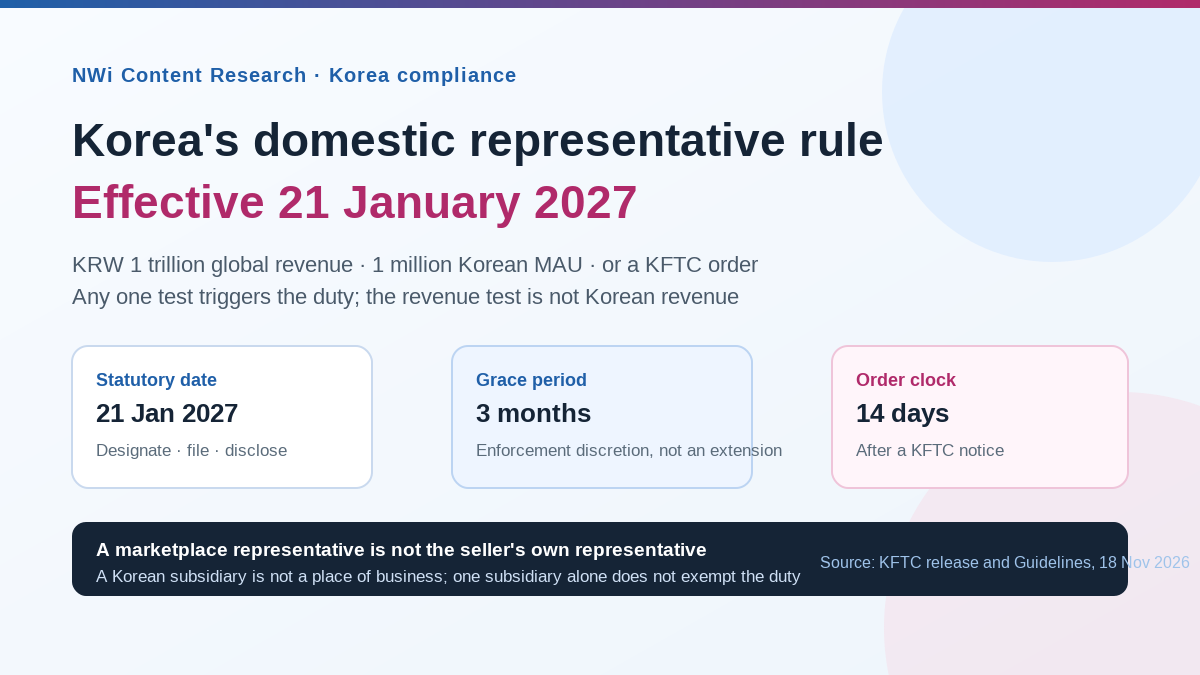
If you sell into Korea but your company has no Korean address or place of business, the decision due on 21 January 2027 is not whether Korea will protect consumers more strongly. It is whether your global consolidated revenue, Korean monthly active users, or a KFTC information order puts you inside the domestic-representative regime, and if so, whether you can complete designation, filing, and disclosure before the deadline. The Korea Fair Trade Commission (KFTC) published Guidelines on the Designation of Domestic Representatives under the Act on Consumer Protection in Electronic Commerce on 18 November 2026. Three alternative tests trigger the duty, and the first is global consolidated revenue of KRW 1 trillion. The three-month grace period defers proactive enforcement, not the 21 January date. A significant-consumer-harm information order generally starts a 14-day designation clock. This article separates the statutory date, the grace period, and the order clock, then tests the global-revenue definition and the platform-representative and Korean-subsidiary assumptions in three scenarios. It is not legal advice.
1. Run three tests before you look for an agent
The real decision is whether your business falls within Korea's domestic-representative regime before 21 January 2027, not whether you can react after a KFTC notice arrives.
The mechanism is Article 20-5 of Korea's Act on Consumer Protection in Electronic Commerce, which places the designation duty on an overseas seller or intermediary that has no Korean address or place of business, affects the Korean market, and meets one of three tests.
First, does the company have a Korean address or place of business? Second, do its activities affect the Korean market? Third, does it meet one of the three tests? The questions are cumulative on the first two and alternative on the third: no Korean address or place of business, activities affecting Korea, and at least one test. If any answer is no, do not jump straight to appointing an agent.
On the first question, a Korean branch may be treated as a place of business, but a separately incorporated Korean subsidiary is not. The Guidelines say an independent legal entity is not automatically the overseas business's place of business; conversely, if the overseas business established or controls a Korean entity, it must designate one of those entities. BKL puts it plainly: a Korean subsidiary alone does not exempt the overseas business from the designation duty.
On the second question, the Guidelines list factors to weigh together: Korean-language service or KRW settlement, advertising or solicitation in Korea, delivery to Korean addresses, and the need to protect Korean consumers. It is not enough that a Korean consumer can open the website, and a single incidental sale does not automatically decide the issue; but the Guidelines provide no safe harbor for incidental access, and BKL treats it as a fact-specific question.
The third question has three tests, and any one is enough: prior-year global consolidated revenue of at least KRW 1 trillion; average Korean MAU of at least 1 million in the final three months of the prior year; or a KFTC order to submit reports or information after a violation caused or threatened significant consumer harm.
| Test | Official basis | Data to prepare | Common misread |
|---|---|---|---|
| Global revenue ≥ KRW 1 trillion | Prior-year (or prior fiscal-year) global consolidated revenue, converted to KRW at the prior-year average exchange rate; includes subsidiaries and eliminates intercompany transactions (consolidated reading per BKL) | 2026 consolidated statements, subsidiary list, exchange-rate basis | Looking only at Korean revenue or the parent-company standalone statements |
| Korean MAU ≥ 1 million | Average monthly Korean consumers who accessed the business's own online mall in the final three months of the prior year, counted as distinct active users | Korean MAU from platform or analytics tools, with the measurement period | Using global MAU, downloads, or social followers as Korean MAU |
| KFTC information order | An order to submit reports, data, or objects after a violation caused or threatened significant consumer harm | Order date, proof of delivery, subject matter | Treating an ordinary inquiry as an order; missing the 14-day clock |
The most important definition is that KRW 1 trillion is global consolidated revenue, not Korean revenue. A China-based seller may book only a small share of its revenue in Korea while its group's global consolidated revenue exceeds KRW 1 trillion; if its activities affect the Korean market, the revenue test alone can bring it in. Conversely, a Korea-focused SME below KRW 1 trillion in global revenue and below 1 million Korean MAU does not automatically owe a designation under these Guidelines.
MAU has its own definition: average monthly Korean consumers who accessed the business's own online mall in the final three months of the prior year, counted as distinct active users. It is not global MAU, downloads, or social followers. A marketplace seller without its own online mall should first confirm whether it is an online seller or an intermediary, then choose the data basis; do not substitute a store-follower count from the marketplace front end.
The third test runs on a different clock. It is not annual: after a KFTC notice or information order, the business must generally designate within 14 days; the period can be extended with KFTC approval, and the KFTC may notify the business that the duty has ended if the investigation closes or the harm risk disappears. The first two are annual tests; the third is an event test.
2. 21 January 2027, the three-month grace period, and 14 days are three different clocks
The first clock is the statutory date. The Guidelines state that the regime takes effect with the amended Act on Consumer Protection in Electronic Commerce on 21 January 2027. A qualifying overseas seller or intermediary should in principle complete designation, file the representative's details with the KFTC, and disclose them on the online mall's homepage by that date.
The second clock is the grace period. The Guidelines are explicit: the three-month grace period is not a suspension of the legal obligation. It defers proactive enforcement, including ex officio investigations. A business subject to the duty must still designate, file, and disclose by 21 January 2027. Reading the grace period as permission to wait until April mistakes enforcement discretion for a statutory extension.
The third clock is the order clock. If the KFTC notifies a business because of significant consumer harm, the business should generally designate within 14 days of the notice; an extension is possible with KFTC approval. The 14 days are not a general preparation period and do not replace 21 January; they apply only when the third test is triggered.
| Date / clock | Starts | Action for the seller |
|---|---|---|
| 21 January 2027 | Statutory effective date | A business meeting an annual test completes written designation, KFTC filing, and homepage disclosure; this is not the date to start preparing |
| Three-month grace period (calendar-month approximation: about 21 April 2027) | After the effective date | Defers proactive enforcement only; the legal duty is unchanged; the actual end date is subject to KFTC announcement |
| 14 days | KFTC designation notice or information order | Designate within 14 days; an extension can be requested |
| Three business days | Representative receives an ordinary consumer inquiry | Obtain an appropriate response from the overseas business, excluding non-business days |
| 24 hours | Urgent consumer harm or a KFTC data request | Obtain an appropriate response from the overseas business, excluding non-business days |
The three-business-day and 24-hour standards measure effective contact between the representative and the overseas business, not a 24-hour consumer hotline. The representative must be able to obtain an appropriate response within those periods. If an urgent matter arrives on a Friday evening, the 24-hour clock may expire on Saturday while the phone desk is staffed only from 9:00 to 18:00 Korean time; the representative therefore needs an evening and weekend escalation contact. Treating these clocks as a customer-service roster misses the real break point.
Intermediaries also have consumer-facing clocks: after receiving a complaint, notify the consumer of progress within three business days and of the investigation result or handling plan within ten business days. The 3/10 is the intermediary's duty to consumers; it is not the same pair as the representative's 3/24 toward the overseas business. Keep them separate in the SOP so the support team does not apply the wrong deadline.
The two most common errors are treating the three-month grace period as an extension and waiting until April, or treating the 14 days as a general preparation period and ignoring 21 January. The first misses the statutory date; the second makes a business without an order think it has only 14 days.
3. Platform representative, Korean subsidiary, and “independent entity”: three common misreads
Misread one: the marketplace has a Korean representative, so the seller does not need one. The Guidelines state that a seller subject to the duty cannot claim the marketplace intermediary performs it merely because the intermediary handles certain consumer-dispute obligations; the seller and the intermediary bear the duty independently unless they have a separate agreement. BKL adds that the marketplace representative's responsibility does not automatically cover the seller; a seller may publish its representative's contact details on its seller profile or product pages, but that is not an exemption.
Misread two: a Korean subsidiary equals a place of business. A Korean subsidiary is a separate legal person, not the overseas business's place of business; if the overseas business established or controls a Korean entity, it must designate one of those entities, not an arbitrary third party. Treating “we have a subsidiary” as “we are compliant” fails twice: no designation has been made, and the wrong entity may be chosen.
Misread three: the Korean subsidiary operates independently, so the overseas business is not operating in Korea. The Guidelines list five factors: whether the overseas business is the contracting party with Korean consumers; whether the Korean entity provides goods or services on its own account and at its own risk; whether it independently sets terms, refund policy, and prices; whether profits are retained and disposed of independently; and whether personnel, organization, and key management decisions are independent. The factors are weighed together, not reduced to “separate legal entity.” The Guidelines recommend submitting evidence to the KFTC and obtaining a determination in advance if the business wants to rely on the independent-entity exception; do not wait for an investigation to assemble it.
There is also the boundary question: do the activities affect the Korean market? The Guidelines point to Korean-language service, KRW settlement, advertising or solicitation in Korea, delivery to Korean addresses, and the need to protect Korean consumers. If Korean consumers merely access the site incidentally and buy, while the overseas business does not target Korea, can it argue that it does not affect the Korean market? The Guidelines provide no safe harbor, and BKL treats this as a fact-specific question. This article does not conclude that incidental sales are always safe; take traffic sources, ad records, delivery scope, and contract terms to counsel or the KFTC.
Together, the three misreads point to one issue: the duty attaches at the subject level, not at the store or marketplace level. Marketplace customer service, a Korean subsidiary, or a Korean logistics provider does not automatically replace the overseas business's own designation, filing, and disclosure.
4. Designation is not a name on a form: Korean phone, email, filing, and disclosure
Designation must be in writing. The representative may be a natural person or a legal entity; if there is no Korean entity, the business may use an existing customer-service center, a professional service provider, or a law firm. The representative must be able to communicate in Korean, answer during Korean business hours, and cooperate with the KFTC; a mailing address is not enough.
After designation, the business must promptly file the representative's name (or the entity's name and representative's name), address (or business location), telephone, and email with the KFTC, and disclose them on the online mall's homepage; a change requires a new filing and disclosure. For marketplace sellers, the Guidelines say “online mall homepage, etc.,” while BKL mentions the seller profile or product pages. The Guidelines do not give marketplace sellers a specific rule on how those locations relate; this article does not decide the point for the KFTC and recommends confirming before filing.
The operating standards are concrete: consumers must be able to contact the representative directly by phone and email without first completing another procedure or a complex interface; Korean-speaking staff must answer the phone directly during Korean business hours, 9:00 to 18:00; email responses must be in Korean and cover status and outcome; ARS, AI chatbots, and online forms may supplement but cannot be the only channel, and consumers cannot be forced to switch to email.
The penalties matter too: failure to designate, failure to designate the required Korean entity, or failure to file or disclose the representative's information carries a corrective order and a fine of up to KRW 20 million; failure to maintain effective contact carries a corrective order; failure to submit threshold data carries a fine of up to KRW 20 million; a representative's violation in consumer-dispute handling, disclosure, or staffing and resources carries a corrective order, with a fine of up to KRW 20 million for intermediary representatives or prolonged staffing/resource failures; failure to cooperate with KFTC information orders carries a fine of up to KRW 30 million. A representative's violation in the performance of statutory duties is attributed to the overseas business that designated it.
The fine cap is not the price of compliance. KRW 20 million is only the administrative fine ceiling; corrective orders, repeat enforcement, marketplace contract review, consumer trust, and the opportunity cost of entering Korea are not in that number. Do not use “the fine is cheaper than compliance” to justify non-designation. This article does not quote staffing or legal fees, and it does not treat the fine cap as a compliance budget ceiling.
5. Three scenarios: thresholds, dates, and response clocks
Scenario A: an SME with 250,000 Korean MAU and KRW 800 billion in global revenue (hypothetical) Assumptions: 2026 global consolidated revenue of KRW 800 billion, Korean MAU of 250,000, no Korean address or place of business, no KFTC information order, and sales mainly through Coupang. Result: revenue is 80% of the threshold and MAU is 25%, so neither test is met and the third trigger is absent; the Guidelines do not by themselves create a designation duty, but the calculation and the marketplace contract should still be documented. Decision: do not appoint a representative or add compliance budget now; keep the self-check on file and start the process if 2027 revenue or MAU crosses a threshold or a KFTC order arrives.
Scenario B: an overseas seller with KRW 1.2 trillion in global revenue and 400,000 Korean MAU (hypothetical) Assumptions: 2026 global consolidated revenue of KRW 1.2 trillion, Korean MAU of 400,000, no Korean address or place of business, and sales to Korean consumers mainly through Coupang. Result: revenue is 120% of the threshold, KRW 200 billion above it; even at 400,000 MAU, the “any one test” rule triggers the designation duty, with written designation, KFTC filing, and homepage disclosure due by 21 January 2027. Decision: start the designation process in December 2026 and finish no later than 21 January 2027; treat the three-month grace period as enforcement discretion, not an extension.
Scenario C: a seller with a Korean subsidiary and KRW 1.05 trillion in global revenue (hypothetical) Assumptions: 2026 global consolidated revenue of KRW 1.05 trillion, a Korean subsidiary but no Korean branch, a belief that Coupang's representative already covers the seller, and no separate written agreement with the marketplace. Result: revenue is 105% of the threshold, so the duty is triggered; a Korean subsidiary is not itself a place of business, and a marketplace representative does not automatically cover the seller, so without a separate agreement the seller must still designate; if a KFTC order arrives, the 14-day designation clock starts from notice. Decision: review the five independence factors for the Korean entity and the marketplace contract first; if independence or a separate agreement cannot be evidenced before 21 January 2027, proceed with the seller's own designation.
The threshold ratios are easy to compare: A is at 80% of the revenue threshold and 25% of the MAU threshold; B is at 120% and 40%; C is at 105%. Because the tests are alternative, B and C trigger on revenue alone, and low MAU does not exempt them; A misses both and has no third-test order, so it does not trigger.
The dates use the same baseline. If B starts on 1 December 2026, it has 51 days until 21 January 2027; if it waits until 5 January 2027, it has 16 days. If C receives a KFTC order on 15 December 2026, 14 days later is 29 December 2026, not 21 January 2027. If a representative receives an ordinary inquiry at 17:00 on Friday 18 December 2026, counting from the next business day gives three business days ending at 17:00 on Wednesday 23 December 2026; an urgent matter at the same time gives 24 hours ending at 17:00 on Saturday 19 December 2026.
All of these numbers are hypothetical, not KFTC, marketplace, or NWi measurements. Change the revenue, MAU, order date, or counting convention and the conclusion changes. They are here to show the threshold ratios and date differences, not to give a specific business a compliance conclusion.
6. The recomputable boundary: fine caps, compliance cost, and stop conditions
At an assumed KRW 1,350 per USD, KRW 1 trillion is about USD 741 million; the KRW 20 million fine cap is about USD 14,800 and the KRW 30 million cap is about USD 22,200. The exchange rate is an assumption in this article; the official thresholds remain in KRW. BKL gives approximately USD 750 million, USD 15,000, and USD 22,300 as rounded approximations; the difference comes from the exchange rate and rounding, not from a different threshold or penalty in KRW.
Let annual compliance cost be C, the fine cap be F = KRW 20 million, the expected enforcement probability be p, and non-fine costs be N (corrective orders, repeat inspections, contract review, consumer trust). Non-designation is financially preferable only when C > F × p + N. This article has no observations for C, p, or N, and it does not recommend replacing legal judgment with that inequality. Its purpose is to show why comparing KRW 20 million with a one-time designation quote is the wrong comparison: ongoing operations and the tail risk of non-compliance belong in the same table.
The stop conditions should be explicit. First, global consolidated revenue below KRW 1 trillion, Korean MAU below 1 million, and no KFTC order: stop adding designation work for this Guideline and keep the calculation file. Second, the Korean entity can evidence all five independence factors and has obtained an advance KFTC determination: stop treating the overseas business as subject because of that entity and keep the determination. Third, a separate written agreement with the marketplace expressly covers the seller's relevant obligations: stop duplicate designation and keep the contract and its scope. Fourth, any test is met: do not stop; work back from 21 January 2027. Fifth, a KFTC order arrives: do not wait for the grace period; use the 14-day clock. Sixth, independence or marketplace coverage cannot be evidenced: do not gamble; proceed with the seller's own designation.
From now through December 2026, calculate 2026 global consolidated revenue and Korean MAU, then map the Korean entity structure and marketplace contracts; if any test is met, put designation, filing, homepage disclosure, and Korean phone and email staffing on the calendar before 21 January 2027. The steps are: by December 2026, calculate 2026 global consolidated revenue and Korean MAU, draw the Korean entity structure, and collect marketplace contracts; by 21 January 2027, complete written designation, KFTC filing, and disclosure if a test is met; as soon as possible after designation, run the Korean phone, email, three-business-day/24-hour escalation path, and record retention, not waiting for the first consumer complaint; after April 2027, review enforcement after the grace period and the 2027 threshold data.
7. Evidence boundary, counter-cases, and open questions
The primary material read for this article is the KFTC press release of 18 November 2026 and the full Guidelines attached to it; the BKL and The Korea Times analyses are secondary, and the National Assembly statute text and later KFTC enforcement cases were not checked line by line.
The primary material includes the KFTC press release of 18 November 2026, its four-page PDF, and the full Guidelines. The secondary material is BKL's legal update of 24 November 2026 and The Korea Times report of 18 November 2026. The Guidelines state that they are not legally binding, but they set out the KFTC's interpretation and enforcement standards; do not ignore them because they are “not law.”
The counter-case is an SME with prior-year global consolidated revenue below KRW 1 trillion, fewer than 1 million Korean MAU, and no KFTC information order: the Guidelines do not by themselves create a designation duty for that seller.
Counter-case two: the Korean entity genuinely meets all five independence factors and has an advance KFTC determination. The overseas business may then not be treated as an online seller targeting Korean consumers because of that entity, and may not need to designate solely because of it; but each factor needs evidence, not just an ownership chart. Counter-case three: the marketplace and the seller have a separate written agreement that expressly covers the seller's designation duty. The seller may then argue the marketplace arrangement covers the duty; keep the contract, scope, and exceptions. Counter-case four: Korean consumers only access and buy incidentally, and the overseas business has no Korean-language service, no KRW settlement, no Korean advertising, and no delivery to Korean addresses. This is the least certain case; the Guidelines provide no safe harbor, and this article does not treat it as an automatic exemption.
This article does not estimate the actual cost of Korean-speaking staff, representative services, or legal counsel, and it has no KFTC enforcement precedent on where a marketplace seller must publish the disclosure; those unknowns need quotes from providers and confirmation from the KFTC or counsel.
Open questions include: whether a marketplace seller must publish the representative on the “online mall homepage” or on the seller profile/product page; how the KFTC verifies MAU and global consolidated revenue; how enforcement changes after the three-month grace period; whether incidental sales are treated as affecting the Korean market; how detailed a marketplace-seller agreement must be to count as coverage; and how exchange rates and consolidation choices are resolved. The Guidelines do not provide marketplace-specific operating detail on these points, and this article does not decide them for the KFTC or a court.
This article is not legal, compliance, or platform-operations advice. Whether a specific business meets a threshold, whether its Korean entity is independent, and whether a marketplace agreement covers its duty should be checked against its financial data, contracts, and facts with Korean counsel or the KFTC.
8. What it means for data and operations: turn the threshold into a table
The data lesson is not “add a compliance field.” It is to move a subject-level threshold into three tables: group, entity, and marketplace contract. A group may have several Korean entities, several marketplace stores, and several business units; managing only stores or SKUs makes it hard to say in January 2027 who met a threshold, who designated a representative, and who disclosed what.
Start with three tables. The subject table lists global consolidated revenue, Korean MAU, Korean address or place of business, Korean entities, and control relationships. The marketplace table lists the contract, representative clauses, seller disclosure location, and separate agreements. The operations table lists the representative's name, designation date, KFTC filing date, disclosure URL, Korean phone, Korean email, and the three-business-day/24-hour escalation contact. Join them on one subject ID; that is more reliable than looking for the answer in news coverage.
NWi CrossborderGo provides Coupang market, category, brand, store, and product data, updated monthly (the prior month is published on the 10th–15th), with Korean attribute cleaning. It can help you assess category structure, brand concentration, and price bands in Korea, but it cannot determine whether you meet a KFTC threshold, and its third-party sales estimates are not global consolidated revenue or Korean MAU. When you need to read Korean market data together with internal entity and contract information, the Cross-border Agent can support research; when you need to connect internal data, MCP data access is the relevant entry point, with compatibility and permissions subject to testing; data scope and access terms are subject to the contract and demo.
The original contribution is to separate the domestic-representative rule into the threshold test, three clocks, and three common subject-level misreads, and to show that the KRW 1 trillion test uses global consolidated revenue while neither a marketplace representative nor a Korean subsidiary automatically replaces the seller's own duty.
You can review Korea coverage on the Coupang marketplace page, explore market, category, brand, store, and product research in NWi CrossborderGo, see category and operations tools in NWi Operations, learn about expert research in the Cross-border Agent, review data access in MCP, or bring the Korea entry decision and the compliance self-check into a demo. Product capabilities, coverage, and update frequency are subject to the contract and the page descriptions; a menu entry is not activated data, and a data product is not a legal or compliance certification.
9. Method and disclosure
Data basis: the KFTC press release was read from korea.kr on 27 November 2026 (published 18 November 2026); the full Guidelines were read from the HWPX attachment to that release (fileId=198592287) on 27 November 2026; the BKL legal update (24 November 2026) and The Korea Times report (18 November 2026) were read on 27 November 2026 as independent secondary analysis. Calculations: KRW 1 trillion is shown as about USD 741 million at an assumed KRW 1,350 per USD; KRW 20 million and KRW 30 million are shown as about USD 14,800 and USD 22,200 at the same assumed rate; revenue and MAU ratios are scenario value divided by the threshold; the three-month grace period is approximated as ending on 21 April 2027 on a calendar-month basis, with the actual end date subject to KFTC announcement; the three-business-day example counts from the next business day after receipt. Product basis: NWi CrossborderGo provides Coupang market, category, brand, store, and product data, updated monthly (prior month published on the 10th–15th), with Korean attribute cleaning; it does not provide legal advice, representative designation, KFTC filings, compliance determinations, or real-time consumer data.
This article was prepared with automated research assistance from the public sources listed at the end and was not manually reviewed. It does not invent customer data, expert review, penalty amounts, platform penalties, search rankings, or official endorsement. It is not legal, compliance, platform-operations, or investment advice.
10. Sources
- 1. KFTC, 18 November 2026, Guidelines on the Designation of Domestic Representatives under the E-Commerce Act: press release with the 21 January 2027 effective date, the three tests, the three-month grace period, and the Korean-language response standards; read on 27 November 2026.
- 2. KFTC, 18 November 2026, press release PDF (4 pages): threshold table, grace-period wording, 3-business-day/24-hour standard, and contact rules; read on 27 November 2026.
- 3. KFTC, November 2026, Guidelines on the Designation of Domestic Representatives (full annex): HWPX annex with Article 20-5, Enforcement Decree Article 25-4, the 14-day order clock, the Korean-entity rules, the five factors, disclosure, and the penalty table; unpacked and read on 27 November 2026.
- 4. BKL, 24 November 2026, KFTC Issues Guidelines on the Designation of Domestic Representatives under the E-Commerce Act: independent legal analysis of the consolidated-revenue definition, the seller-versus-platform distinction, the Korean subsidiary, and the penalties; read on 27 November 2026.
- 5. The Korea Times, 18 November 2026, Apple, Google, OpenAI face tighter FTC scrutiny over Korean representative rule: independent report confirming the effective date, the three criteria, and that the grace period does not delay the deadline; read on 27 November 2026.