
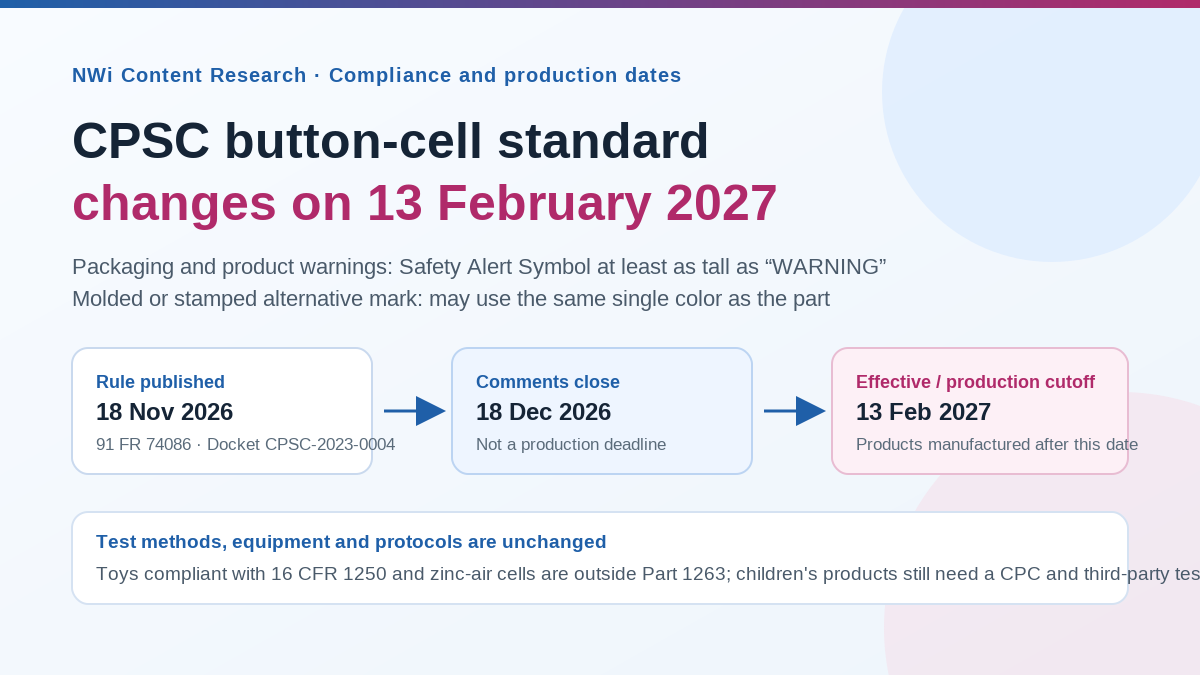
If you sell consumer products containing button or coin cells in the United States, the question after 13 February 2027 is not whether the CPSC will ban the category. It is whether the batch manufactured after that date carries packaging and product warnings updated to the 2026 edition. On 18 November 2026 the US Consumer Product Safety Commission published a direct final rule (91 FR 74086, Docket CPSC-2023-0004) that replaces ANSI/UL 4200A-2023 with ANSI/UL 4200A-2026 in 16 CFR 1263.3. The rule takes effect on 13 February 2027 unless the CPSC receives a significant adverse comment by 18 December 2026. The two changes it describes are specific: the Safety Alert Symbol in the packaging and product warning figures must be at least as tall as the signal word “WARNING”, and an alternative product mark that is molded or stamped into the product may use the same single color as the part. Test methods, equipment and protocols are unchanged; children's products still need third-party testing and general-use products still need a GCC. This article treats the effective date as a production cutoff, separates the toy and zinc-air exclusions, works through three scenarios and a reproducible artwork timeline, and lists the SKU fields, actions and stop conditions for US sellers. It does not turn the update into a recall, and it does not invent test costs, fines or marketplace penalties.
1. This is a standard-version and marking change, not a recall or a new compartment test
Start with what the rule is. On 18 November 2026 the CPSC published a direct final rule, 91 FR 74086, revising 16 CFR 1263.3 to replace ANSI/UL 4200A-2023 with ANSI/UL 4200A-2026, revised on 22 July 2026. The rule takes effect on 13 February 2027 unless the CPSC receives a significant adverse comment by 18 December 2026; if it does, the agency will publish a withdrawal before the effective date.
This is not a recall. The rule names no product, brand or batch and orders no removal from sale; it updates the standard version referenced by 16 CFR 1263.3. It is also not a new compartment test. The rule states that UL 4200A-2026 did not change the testing requirements, testing equipment or testing protocols; existing CPSC-accepted laboratories are considered competent to test to the 2026 edition, the existing Notice of Requirements remains in place, and laboratories are expected to update the scope of their accreditation in the normal renewal cycle.
The changes described in the rule are about markings. The first is the Safety Alert Symbol in the packaging and product warning figures (Figures 7B.1, 7B.2, 7B.3, 7B.4 and 7C.1): in the 2023 figures it was slightly smaller than the signal word “WARNING”, and the 2026 edition requires it to be at least as tall as the signal word, aligning with ANSI Z535.4 section 6.3. The second is the alternative product mark in section 7C.2 (the Safety Alert Symbol combined with a button or coin cell symbol): on a printed label that uses more than one color, the mark must use the color shown in Figure 7C.2; when the mark is stamped or molded into the product, the icon may be the same color as the molded or stamped part. The 2023 edition did not directly address molded or stamped parts; the 2026 edition does.
One requirement did not change: section 7A.1 requires every warning statement or icon to be prominent, legible, easily discernible under normal lighting and permanently marked. A single-color molded or stamped mark is subject to that rule too. In other words, permission to use one color is not permission to be faint, illegible or easy to wear off.
Note that the CPSC's own business guidance has not caught up. The Button Cell and Coin Battery Business Guidance page, read directly on 27 November 2026, still says it incorporates ANSI/UL 4200A-2023 and still lists the 2023 and 2024 implementation dates; it does not mention UL 4200A-2026 or 13 February 2027. Using it as a 2026 checklist would miss both marking changes. It remains useful for the baseline compartment, packaging, product, literature and GCC/CPC requirements.
| Marking location | 2023 baseline | 2026 change | What to do now |
|---|---|---|---|
| Packaging warning figures (7B.1-7B.4) | Safety Alert Symbol slightly smaller than “WARNING” | At least as tall as the signal word | Redraw the packaging artwork and check the actual height in the file |
| Product warning figure (7C.1) | Same | Same | Redraw the product label or print artwork and check the printed height |
| Printed multi-color alternative mark (7C.2) | Use the color shown in the figure | Keep using the Figure 7C.2 color | Approve a proof; do not apply the single-color rule to a multi-color label |
| Molded or stamped alternative mark (7C.2) | Not directly addressed | May use the same single color as the part | Check clarity and permanence; a single-color molded part does not need a color change |
| Test methods, equipment and protocols | Unchanged | Unchanged | No new test method; confirm the laboratory reports to the 2026 edition |
| Certificate and technical file | GCC/CPC citing 16 CFR 1263.3 | Same obligation | Update the test report or technical file to the 2026 edition and keep the 1263.3 citation |
2. Where the two changes land: packaging, product labels and molded parts
The first change lands on the figures, not on the wording. The rule refers to the height of the Safety Alert Symbol in Figures 7B.1 through 7B.4 and 7C.1. The direct action is to pull the warning artwork on the principal display panel, the product warning and any instructions or hangtag that reuse the same figure, then measure the height of the triangle and exclamation mark against the height of the letters in “WARNING”. In the 2023 figures the symbol was slightly smaller; the 2026 edition requires it to be at least as tall. If the artwork file still carries the old symbol, the printed item does not meet the 2026 edition.
The second change lands on color, and it is conditional. The alternative mark in section 7C.2 combines the Safety Alert Symbol with a button or coin cell symbol. On a multi-color printed label, the mark must use the Figure 7C.2 color; when it is molded or stamped into the product, the icon may use the same color as the part. The key is not to mix the two paths: a multi-color printed label cannot rely on the single-color molded-part clarification, and a molded part does not need a mold change just for color.
The molded or stamped clarification can save tooling cost, but it is not unconditional. The rule keeps the 7A.1 requirements for clarity, legibility and permanent marking. If the single-color mark is hard to see on the part, wears off easily or is hidden by the structure, it still fails. For a SKU that already has a molded or stamped mark, the first task is to check whether it is visible and durable, not to declare that no change is needed.
Keep packaging and product scopes separate. 16 CFR 1263.4 sets separate warning requirements for button or coin cell battery packaging (including a Safety Alert Symbol at least as tall as the signal word and black letters on an orange background); the UL 4200A-2026 change concerns product packaging and product warning figures. They are different provisions, but they point in the same direction: the symbol should not be smaller than the signal word. Do not treat the 1263.4 battery-packaging rule as the whole product-packaging requirement, and do not use this update to replace the battery-packaging compliance check.
3. Who is affected: US consumer products with button or coin cells, not every cross-border seller
Start with the definition. 16 CFR 1263.2 defines a button cell or coin battery as a single cell battery with a diameter greater than its height, or any other battery that the Commission determines poses an ingestion hazard. A consumer product containing button or coin batteries means a product that contains or is designed to use one or more such batteries, regardless of whether the consumer replaces them, whether they are included with the product or sold separately. That definition is broader than “remote control” and broader than “toy”.
Common examples include remote controls, key fobs, thermometers, kitchen scales, flameless candles, Bluetooth trackers, musical greeting cards, small electronics and wearable accessories. These are product types, not a compliance finding for a specific SKU; whether a product is in scope depends on its battery type, its compartment design and whether the toy exemption applies.
Three common “out of scope” cases: first, zinc-air batteries. The CPSC has determined that these do not present an ingestion hazard and expressly excludes them from Part 1263; hearing-aid batteries are the typical example. Second, toys for children under 14 that comply with the battery accessibility and labeling requirements of 16 CFR 1250; those toys are exempt from Part 1263. Third, products that contain no button or coin cell and are not designed to use one.
The toy exemption has a trap: it is a toy exemption, not a children's-product exemption. A product aimed at children but not a toy (a children's lamp or children's headphones, for example) may still be in scope, and a toy that does not comply with 16 CFR 1250 cannot rely on “it is a toy” for an automatic pass. Keep “children's product”, “toy” and “16 CFR 1250 compliance” as three separate questions; none of them is a universal passport.
The sales channel is not an exemption. Amazon US, Walmart, TikTok Shop US and a direct-to-consumer store all face the same federal standard; a marketplace may add its own document requirements, but this article did not verify any marketplace's specific compliance file list, so it does not turn marketplace policy into the rule. Children's products also need a CPC and third-party testing by a CPSC-accepted laboratory; general-use products need a GCC based on a test of each product or a reasonable testing program. Certificates continue to cite 16 CFR 1263.3, while the technical file and test report should be updated to the 2026 edition.
4. Mechanism: why 13 February is a production date, not a listing date
The timeline is not “the CPSC publishes a rule today and the whole market changes packaging tomorrow”. Section 2(f) of Reese's Law provides that when a voluntary standards organization revises a standard the CPSC has adopted and notifies the agency, the revision becomes the mandatory standard 180 days later unless the CPSC rejects it within 90 days or sets a later date in the Federal Register. ULSE published UL 4200A-2026 on 22 July 2026 and notified the CPSC on 17 August 2026; 180 days later is 13 February 2027. The CPSC did not reject the revision, so on 18 November 2026 it published the direct final rule updating the CFR reference to the 2026 edition.
The mechanism is the 180-day clock in section 2(f) of Reese's Law: ULSE notified the CPSC on 17 August 2026, the revision becomes the mandatory standard on 13 February 2027, and the direct final rule updates the 16 CFR 1263.3 reference to the 2026 edition.
The 180 days can be rebuilt month by month: 17 August to 31 August 2026 is 14 days; September 30 (44); October 31 (75); November 30 (105); December 31 (136); January 2027 31 (167); 1-13 February 13 (180). The effective date is therefore 13 February 2027.
The key sentence is in section XI of the rule: unless a significant adverse comment is received, the rule takes effect on 13 February 2027 and applies to products manufactured after the rule's effective date. The compliance date therefore attaches to production, not to listing, arrival or order date. A batch manufactured before 13 February 2027 while the 2023 edition was in force remains under that edition; a batch manufactured after 13 February 2027 needs the 2026 edition. Sellers have to read production records, purchase orders, factory schedules and packaging print batches together, not just the date a listing went live.
The comment window is not a delay lever. The rule says that if a significant adverse comment is received by 18 December 2026, the CPSC will withdraw the direct final rule; but the preamble also says UL 4200A-2026 takes effect as the mandatory standard by operation of law on 13 February 2027, and the direct final rule updates the CFR reference. On that wording, withdrawing the direct final rule removes the CFR update, not necessarily the statutory effective date, unless the CPSC takes a separate action. “File a comment, wait for the outcome, then schedule production” is a high-risk strategy.
From 18 December 2026 to 13 February 2027 is 57 calendar days: 18-31 December 13 days, January 31 (44), 1-13 February 13 (57). For printed packaging, 57 days is not generous: any delay in design, approval, proofing, printing or factory scheduling can push the first batch produced after 13 February back onto the old packaging.
| Date | Event | What it means for sellers |
|---|---|---|
| 22 July 2026 | ULSE publishes UL 4200A-2026 | The standard text changes, but it is not yet mandatory |
| 17 August 2026 | ULSE notifies the CPSC | The 180-day clock starts |
| 3 September 2026 | CPSC notice of availability (91 FR 56604) | Comments due 17 September 2026; 37 comments received |
| 18 November 2026 | CPSC direct final rule (91 FR 74086) | The CFR reference moves to the 2026 edition |
| 18 December 2026 | Significant-adverse-comment deadline | Not a production deadline; do not use it as the scheduling end point |
| 13 February 2027 | The 2026 edition becomes mandatory | Applies to products manufactured after that date |
5. Three scenarios: printed packaging, a molded mark and a toy exemption
All figures in the three scenarios are assumptions, used only to show the timeline and the order of decisions; they are not CPSC, laboratory, factory or NWi measurements, and they do not determine compliance for any specific product.
Scenario A: five multi-color printed packages with two weeks for design and approval, four weeks for printing and two weeks of buffer (hypothetical) Assumptions: all five SKUs contain button cells, none qualifies for the toy exemption, the front panel carries a 7B.1-type warning, and the factory still has production scheduled after 13 February 2027. Result: the latest artwork freeze is 13 February 2027 minus eight weeks, or 19 December 2026; if design and approval take three weeks, printing five weeks and buffer two weeks, it becomes 13 February 2027 minus ten weeks, or 5 December 2026. Decision: put the artwork freeze date on the production calendar ahead of the 18 December 2026 comment deadline; if it cannot be met, move the post-13-February run to the new packaging or schedule the old packaging batch to finish production before 13 February.
In Scenario A, two weeks for design and approval, four weeks for printing and two weeks of buffer put the latest artwork freeze at 13 February 2027 minus eight weeks, or 19 December 2026. The point is not the exact date of 19 December; it is the order: the comment deadline comes later, and the artwork freeze comes earlier. For most printed packaging, the date that matters is the last day the factory can change the file, not the day the CPSC closes comments.
Scenario B: three SKUs with a single-color alternative mark molded into the part and multi-color printed packaging (hypothetical) Assumptions: the molded mark is legible, visible and still discernible after normal use and abuse testing; the packaging warning still uses the old symbol height. Result: the molded mark may keep the same single color as the part without a mold change, but the packaging warning still needs the Safety Alert Symbol at least as tall as “WARNING”, and the product mark still has to meet the clarity, legibility and permanence requirements in 7A.1. Decision: do not change the molded color; check clarity and permanence instead, and move the packaging artwork on Scenario A's timeline.
Scenario B is the easiest to misread: hearing “molded parts can be single-color” and concluding that the whole SKU needs no change. What is saved is the color change on the molded part, not the symbol-height change on the packaging warning; the two tracks have to be handled separately.
Scenario C: two SKUs are toys for children under 14 that already comply with 16 CFR 1250 (hypothetical) Assumptions: the products are designed, manufactured and marketed as toys, and their battery accessibility and labeling comply with 16 CFR 1250; they are not non-toy children's products such as a children's lamp or headphones. Result: the two SKUs are exempt from Part 1263 and do not need UL 4200A-2026 packaging or product warning changes, but the exemption basis has to stay in the technical file and compliance with 16 CFR 1250 cannot lapse. Decision: record the toy exemption as a conditional conclusion supported by 16 CFR 1250 test or conformity evidence; if the product is not actually a toy, return it to the Scenario A/B process.
Scenario C's boundary is “toy”, not “children's product”. Treating a children's lamp or children's headphones as a toy exemption can leave an in-scope SKU out of the review; conversely, a toy that does not comply with 16 CFR 1250 cannot pass on the word “exemption”.
Put the three scenarios together and the priority is clear: first decide whether the product is in scope (battery type, toy exemption, whether it contains a cell), then decide whether the change is to packaging artwork, product artwork or a molded mark, and finally work back from the production schedule to the artwork freeze date. Do not start redrawing every package before the scope is settled, and do not treat “molded parts can be single-color” as a no-change conclusion for the whole SKU.
6. Fields to watch and when to act: what to audit now, before 18 December and before 13 February
The real decision is when a consumer product containing a button or coin cell, manufactured after 13 February 2027, should have its packaging, product label and molded or stamped mark moved to UL 4200A-2026, rather than waiting for the effective date or the comment deadline.
Between now and 18 December 2026, run a SKU audit before changing any artwork. The unit is “SKU × factory × packaging version”, not the listing. The nine fields below can go straight into the SKU master data.
- Battery type: button or coin cell, zinc-air, or no battery; whether the diameter is greater than the height.
- Product category: a toy for children under 14 that complies with 16 CFR 1250, a children's product, or a general-use consumer product? Each answer leads to a different path.
- Battery compartment: does it need a tool or at least two independent and simultaneous hand movements to open; can the cell be accessed after normal use and abuse testing?
- Packaging warning version: which figure is on the principal display panel; the ratio of the Safety Alert Symbol height to the “WARNING” letter height.
- Print process: multi-color, single-color or molded/stamped; which 7C.2 path the alternative mark uses.
- Product mark: printed label, screen print, molded or stamped; color, clarity, position and wear resistance.
- Instructions or manual: does the warning page match the packaging and product figures; does it include the applicable warnings?
- Test and certificate: does the test report cite the 2023 or 2026 edition; is the GCC/CPC current; is the laboratory CPSC-accepted?
- Production schedule: which batches finish production before 13 February 2027 and which after; packaging print lead time and factory holidays.
Audit the in-scope SKUs' packaging, product labels, instructions and molded or stamped marks first, then work back from the production schedule to the artwork freeze date; anything that can be frozen before 18 December 2026 should not wait for the comment deadline. Before 18 December 2026, do four things. First, pull the packaging, product and instruction artwork for the in-scope SKUs and mark each item against the table above. Second, ask the factory and packaging supplier for a proof and revision timeline under the 2026 edition; do not accept “we will deal with it later”. Third, update the test report and technical file to the 2026 edition and confirm the laboratory can report to the new standard; keep the GCC for general-use products and the CPC plus third-party testing for children's products. Fourth, file a comment only if you have a substantive adverse issue (for example, a specific clause, test method or scope problem); do not comment just to “have a record”, because a comment will not redraw your packaging.
From 18 December 2026 to 13 February 2027, work by production batch: approve the new packaging proof, count the old packaging inventory, lock the new files for batches produced after 13 February, and keep the old files and production records for batches produced before 13 February. Do not use “we still have old packaging” as a reason to keep using it; the old packaging can only go on batches that finish production before 13 February.
Write the stop conditions down. If the product uses a zinc-air cell, stop the Part 1263 update and keep the exclusion basis. If the product is a toy for children under 14 that complies with 16 CFR 1250, stop the UL 4200A-2026 packaging and product warning change and keep the toy-exemption evidence. If the product contains no button or coin cell, stop. If the molded or stamped mark is single-color, clear and permanent, stop changing the mold for color, but still check clarity. If the packaging is multi-color printed, stop applying the “molded single-color” rule. If the factory cannot provide a 2026-edition test report or a proof confirmation, stop scheduling production after 13 February; do not produce first and fill in the documents later.
If the CPSC receives a significant adverse comment by 18 December and withdraws the direct final rule, do not immediately revert to the old packaging. According to the preamble, the 2026 edition may still take effect by operation of law on 13 February; read the withdrawal document and legal advice before changing the schedule. Treating “withdrawal” as “automatic delay” is a misreading.
7. Evidence boundary, counter-cases and open questions
The readable primary record is the CPSC rule text, eCFR Part 1263, the CPSC business guidance and the 3 September 2026 notice of availability; the full text of UL 4200A-2026 is copyrighted and was not read for this article. The rule text gives the summary of the two changes, the effective date, the comment deadline and the manufactured-after scope; eCFR gives the scope, definitions, toy exemption and zinc-air exclusion; the business guidance gives the baseline compartment, packaging, product, literature and GCC/CPC requirements.
The CPSC business guidance lag is a concrete observation: when read on 27 November 2026, the page still said UL 4200A-2023 and still listed the old 2023/2024 dates. That does not make the page “wrong”; it makes it not a real-time 2026 checklist. It is fine for the compartment and certification baseline, but using it to decide whether the 2026 edition changes the symbol height or the molded color would miss items.
The counter-case is a seller that only sells inventory manufactured before 13 February 2027 and does not produce the same item afterwards: that inventory is not covered by the 2026 edition, but it still has to meet the 2023 edition in force when it was made, and the production records have to be kept. Counter-case two: the product is a toy for children under 14 that complies with 16 CFR 1250, or it uses a zinc-air cell. Those are genuinely outside Part 1263 and do not need packaging changes for this update; but the exemption basis has to be producible. Counter-case three: the product mark is single-color molded or stamped. The color can stay, but clarity, permanence and the packaging figure height still have to pass.
Another counter-case is “wait for the comment result”. The comment deadline is 18 December, the effective date is 13 February, and the gap is only 57 days; for printed packaging, the artwork freeze may fall between 5 December and 19 December, before or right at the comment deadline. Waiting for the comment result before scheduling production bets the production calendar on a procedure that does not necessarily change the statutory effective date.
This article did not read the full text of UL 4200A-2026, and the rule does not provide operational detail on manufacturing-date verification, customs enforcement or marketplace document checks; all scenario figures are assumptions and do not determine compliance for any specific product. Open questions include whether the CPSC updates its business guidance before 13 February; whether it receives a significant adverse comment and withdraws the direct final rule; how customs or marketplaces verify the manufacturing date; whether the 2026 edition contains editorial changes the rule does not describe; and how mixed inventory (the same SKU with units made before and after 13 February) is distinguished in files and on marketplaces. The rule does not supply those operating details, and this article does not decide them for the CPSC or a marketplace.
This article is not legal, compliance, testing or platform-operations advice. Whether a specific product is in scope, whether it complies with 16 CFR 1250, and whether it needs a GCC or a CPC should be confirmed by the seller with the product facts, a laboratory and qualified legal or compliance advice.
8. What it means for data and operations: turn the compliance date into SKU fields
The lesson for data work is not “add one more regulatory field”; it is that the compliance date has to attach to SKU × factory × production batch. One listing can map to several production batches; one packaging version can cover several SKUs; one mold can span several colors or accessories. Managing by listing or SKU number alone makes it hard to say, on 13 February, which batch used which packaging version.
The contribution is to split the standard update into three operational questions — the production date, the mark type and the artwork timeline — and to show that for printed packaging the artwork freeze often falls before the 18 December 2026 comment deadline. The nine fields above can go into the SKU master data with three derived fields: whether the SKU is in Part 1263 scope (yes/no/to confirm), the mark change needed (packaging figure/product figure/molded mark/none), and the latest artwork freeze date (worked back from the factory lead time). Those three fields do not need a complex scoring model; sorting by “in scope → has a mark change → longest lead time” is enough to decide which SKUs to do first.
For operations, 13 February is a production milestone, not a listing milestone. Procurement should put packaging print lead time, factory holidays and inspection scheduling on one table; customer service should know how to distinguish old-packaging and new-packaging batches; finance should record artwork and plate costs separately from obsolete packaging, not bury them in routine purchasing. For product selection, a button-cell SKU gains a “marking version” gate after 2027, so the factory's ability to produce 2026-edition artwork should be a development-stage question.
NWi CrossborderGo provides US market, category, brand, store and product data (monthly, by contracted module and scope) to identify categories, price bands and product structures that contain button cells, as an input to the SKU audit; it does not read your packaging artwork, test reports, production batches or GCC/CPC records, and it cannot determine compliance for a seller. When a regulatory change has to be read together with category and brand research, the Cross-border Agent can help; when internal SKU master data, packaging versions and test records have to be connected, MCP is the integration path, with compatibility and permissions confirmed in a trial; the actual data scope and connection method are set by the contract and the demo.
You can check US data coverage on the Amazon platform page, see market, category and product research in NWi CrossborderGo, review category and operations tools in NWi Operations, explore expert research in the Cross-border Agent (consumer insight is limited to selected brands), learn about data access in MCP, or walk through a button-cell category and SKU audit in a demo. Product capability, coverage and update frequency follow the contract and the page description; a menu entry is not an activated data set, and a data product is not a compliance certificate.
9. Method and disclosure
Data basis: the rule text comes from the Federal Register of 18 November 2026, volume 91, number 221, pages 74086-74090 (FR Doc. 2026-23435, Docket CPSC-2023-0004), read directly as HTML and raw text on 27 November 2026. The current 16 CFR Part 1263 text comes from eCFR, read on 27 November 2026. The CPSC business guidance comes from cpsc.gov, read on 27 November 2026; it still describes UL 4200A-2023. The 3 September 2026 notice of availability comes from the Federal Register (91 FR 56604), with comments due 17 September 2026. Calculation: the 180 days are rebuilt month by month from 17 August 2026; the comment deadline to the effective date is 57 calendar days; the artwork freeze date is calculated as the effective date minus the design and approval weeks, printing weeks and buffer weeks; the SKU set and all three scenarios are labelled assumptions, not CPSC, laboratory, factory or NWi measurements. Product basis: NWi CrossborderGo provides US market, category, brand, store and product data (monthly, by contracted module and scope); it does not provide packaging artwork, test reports, production batches, GCC/CPC records or a compliance determination.
This article was prepared with automated research assistance from the public sources listed at the end. It was not manually reviewed. It does not invent customer data, expert review, test costs, fine amounts, marketplace penalties, search rankings or official endorsement. It is not legal, compliance, testing, platform-operations or investment advice.
10. Sources
- 1. Federal Register, 18 November 2026, Safety Standard for Button Cell or Coin Batteries and Consumer Products Containing Such Batteries: direct final rule (91 FR 74086), with the 13 February 2027 effective date, the 18 December 2026 comment deadline, the two marking changes, the unchanged test protocol and the manufactured-after scope; read on 27 November 2026.
- 2. eCFR, 16 CFR Part 1263: current text, including scope, definitions, the toy exemption, the zinc-air exclusion, the current 2023 reference in section 1263.3 and the battery-packaging warnings in section 1263.4; read on 27 November 2026.
- 3. CPSC, Button Cell and Coin Battery Business Guidance: baseline compartment, packaging, product and literature warnings, and GCC/CPC guidance; read on 27 November 2026, when it still described UL 4200A-2023 and was therefore used as the baseline, not the 2026 checklist.
- 4. Federal Register, 3 September 2026, Notice of Availability and Request for Comment: Revision to the Voluntary Standard for Products Containing Button Cell or Coin Batteries: 91 FR 56604, comments due 17 September 2026; used for the timeline and not confused with the December comment window.