
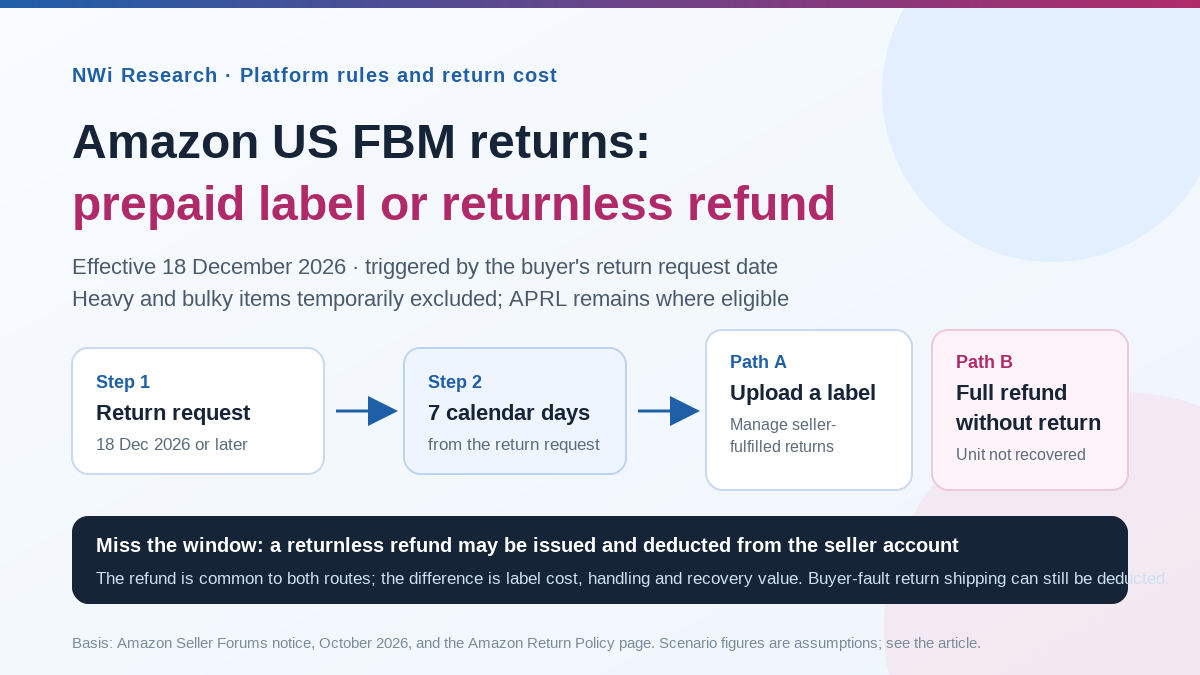
If you sell on Amazon US with seller-fulfilled (FBM) shipping, the question after 18 December 2026 is not whether Amazon still provides return labels. It is whether a given return request should be answered within seven calendar days with a merchant prepaid label or with a full refund without return. Amazon Services told sellers in October 2026 that, from 18 December 2026, all US returns for seller-fulfilled orders, excluding heavy and bulky items, will require a prepaid return shipping label. Address-only labels that make the customer pay return postage will no longer meet the requirement. Within seven calendar days of a return request, the seller must either upload a prepaid label in the Manage seller-fulfilled returns workflow or issue a full refund without requiring the item back. If neither is done, Amazon may issue a returnless refund automatically and deduct the balance from the seller account. Moderator replies add four scope points: 18 December refers to the buyer return request date, not the order date; Amazon-generated APRL remains for eligible returns, and the merchant-label (MPRL) or returnless choice applies where Amazon does not provide a label; category rules such as Custom, Handmade and Dangerous Goods are unchanged; and buyer-fault return shipping can still be deducted in the refund workflow. This article separates the common refund from the route choice, compares label cost plus handling with recovery value, and uses three hypothetical scenarios to set a per-SKU break-even before the 18 December start.
1. What changes is the seven-day action after a return request, not a blanket duty to buy every label
The notice changes the default from an address-only return, with the customer paying postage, to a seller action within seven calendar days: upload a prepaid label or refund in full without return, or Amazon may issue a returnless refund and deduct it.
Start with scope. The notice says that from 18 December 2026 all US returns for seller-fulfilled orders, excluding heavy and bulky items, will require a prepaid return shipping label. Address-only labels that require the customer to pay return postage will no longer meet the requirement, except temporarily for heavy and bulky items. Seller-fulfilled means the seller, not an Amazon warehouse, ships the order; it is not a synonym for every third-party seller, and FBA orders are outside this notice.
The seven-day action is the core. Within seven calendar days of a return request, the seller must upload a prepaid label in the Manage seller-fulfilled returns workflow or issue a full refund without requiring the item back. Both actions comply; the choice depends on cost. Doing nothing is not a third compliant option: the notice says that if no prepaid label or returnless refund is provided within the window, Amazon may issue a returnless refund automatically and deduct the balance from the selling account.
This is also not a removal of Amazon-generated labels. The moderator reply says the change does not remove Amazon-generated prepaid return labels (APRL). For eligible returns, Amazon will continue to provide an APRL. Only where Amazon does not provide one may the seller buy a prepaid label from a carrier and upload it as a Merchant Prepaid Return Label (MPRL), or issue a returnless refund.
The delivery channel is narrower too. Labels shared through Buyer-Seller Messaging or other channels outside the Manage Returns workflow do not meet the requirement. A PDF or link sent in a seller message does not stop the seven-day clock.
Category rules were not rewritten. The moderator says Custom, Handmade and Dangerous Goods continue under their current return rules; what changes is the label requirement. If a return is already eligible under current policy, the seller needs to provide a prepaid label. Do not read “category rules unchanged” as an exemption from the label requirement.
Buyer-fault return shipping can still be deducted. The moderator says sellers may deduct return shipping costs for buyer-fault returns in the Seller Central refund workflow. The claim that every return leaves the seller bearing the full label cost is therefore too broad; the net cost depends on the return reason, the deduction, the label price and recovery value.
2. Who is most exposed: FBM sellers, low-value high-return SKUs and sellers without a US return address
The first group is sellers still handling US FBM returns with an address-only label and customer-paid postage. After 18 December, an in-scope return request cannot be answered that way; the seller must upload a prepaid label or refund without return within seven days. For low-ticket items, the label can approach or exceed the item value, so returnless is often cheaper. For high-ticket, inspectable and resalable items, the label route is more likely to pay.
The second group is categories with high return rates and mixed reasons. The change turns a return request into a work item with a hard seven-day clock: the route is chosen at request time, not after the parcel reaches the warehouse. The larger the return volume, the more likely that staffing, label purchasing and upload steps become the constraint. These sellers need SKU tiers, not case-by-case improvisation.
The third group is cross-border sellers with no US return address, shipping from China or a third country. The Amazon customer Return Policy page currently lists three options for third-party sellers: a US return address, a prepaid return label, or a full refund without requesting the item back. The seller notice says address-only labels stop meeting the requirement on 18 December. The two statements differ; the customer page may lag, or the flows may not be identical. Sellers should follow the requirement shown in their own Seller Central account.
One cross-border detail is unresolved. PPC Land reported on 19 October 2026 that the Seller Central help page it captured required a merchant prepaid label within two days for international returns and mentioned a SKU exemption route. That help page is login-gated and was not read for this article, so it is not confirmed whether the two-day deadline becomes seven days after 18 December, or whether SKU exemptions survive. Sellers without a US return address must verify this in Seller Central rather than applying the seven-day window by assumption.
Heavy and bulky is the only exception named in the notice, but the notice gives no weight or size threshold and no end date for the temporary treatment. Custom, Handmade and Dangerous Goods keep their return-eligibility rules, but that does not automatically exempt them from the label requirement. Sellers need to check their account and category rules; heavy and bulky is not a category that can be inferred from a listing title.
3. Mechanism: the refund is common; the difference is label cost, handling and recovery value
The real decision is whether a US seller-fulfilled return requested on or after 18 December 2026 should be handled with a prepaid label or with a full refund without return for that SKU.
Put both routes on one ledger and remove the common item. Whether the seller uploads a label or refunds without return, the same full refund R goes to the buyer. The label route pays a label cost L and possibly an inspection or repacking cost H, and may recover the unit at a net recovery value V. The returnless route pays no label and recovers nothing, so its incremental net cost is zero.
The label route therefore has a relative net cost of L + H - V, and returnless has zero. The label is cheaper when V is greater than L + H; the break-even is V* = L + H. This removes the refund from the comparison and avoids counting a refund that happens on both routes. It also excludes the original cost of goods, which is already incurred on both routes unless the question is full profit and loss rather than the incremental cost of handling the return.
| Route | Refund | Label | Handling | Recovery | Relative net cost | Key action |
|---|---|---|---|---|---|---|
| Upload a prepaid label | R | L | H | V | L + H - V | Upload in Manage seller-fulfilled returns within seven calendar days |
| Refund without return | R | 0 | 0 | 0 | 0 | Refund in full within seven calendar days; the unit is not recovered |
| Do nothing past the deadline | R | 0 | 0 | 0 | 0, but an automatic returnless refund and deduction may follow | The platform acts for you; highest process risk |
The table explains a common misread. The change does not add a refund that was not already due; it changes who pays for the label, when the choice must be made, and which route the platform chooses if the seller does not decide. For a low-value item, returnless may already be optimal. For a high-value item, the real loss is turning recoverable stock into a unit that never comes back.
Treat the seven-day clock as a cost line too. Assume 100 returns a month, with 20 percent at risk of missing the seven-day window, and a 7 dollar saving per return when the label route is chosen. The expected monthly loss is 100 × 0.20 × 7 = 140 dollars; at a 40 percent risk rate it is 280 dollars. These are not Amazon data; they translate process risk into money. Staffing and upload discipline are cost variables, not administration.
4. Three scenarios: when the label is cheaper and when returnless is cheaper
Every figure in the three scenarios is a hypothesis used to demonstrate the break-even. None is an Amazon, seller or NWi measurement. All three assume a seller-fault reason, so no buyer-fault return shipping is deducted; a deduction would lower the label-route net cost and move the break-even.
Scenario A: a 60 dollar order, an 11 dollar label and an 18 dollar recovery (hypothetical) Assumptions: the return is requested on 20 December 2026; the item is not APRL-eligible; the merchant label costs 11 dollars; handling is zero; the reason is seller-fault, so no buyer-fault deduction applies; the unit can be resold for an 18 dollar net recovery after refurbishment and fees. Result: the label route costs 60 + 11 + 0 - 18 = 53 dollars; returnless costs 60 dollars; the label route is 7 dollars cheaper. If recovery falls below 11 dollars, the ranking reverses. Decision: preset the prepaid label for SKUs with recovery above 11 dollars and returnless for low-value SKUs below it.
In Scenario A, a 60 dollar refund, an 11 dollar label, zero handling and an 18 dollar recovery give a label-route net cost of 60 + 11 + 0 - 18 = 53 dollars versus 60 dollars for returnless, a 7 dollar saving; the break-even recovery is 11 dollars.
Scenario B: an 18 dollar accessory, a 9 dollar label and no recovery value (hypothetical) Assumptions: the return is requested on 2 January 2027, inside the holiday window; the item is not APRL-eligible; the label costs 9 dollars; handling is 2 dollars; an opened unit has no resale value; the reason is seller-fault, so no buyer-fault deduction applies. Result: the label route costs 18 + 9 + 2 - 0 = 29 dollars; returnless costs 18 dollars; returnless is 11 dollars cheaper. The break-even is still 11 dollars, and recovery is zero. Decision: set a returnless rule before 18 December for low-value SKUs with no recovery after opening, instead of letting the seven-day window trigger it.
Scenario C: a 220 dollar item, an 18 dollar label and a 150 dollar recovery (hypothetical) Assumptions: the return is requested on 10 January 2027; the item is not APRL-eligible; the label costs 18 dollars; inspection and repacking cost 4 dollars; the unit can be resold for a 150 dollar net recovery after refurbishment, fees and markdown; the reason is seller-fault, so no buyer-fault deduction applies. Result: the label route costs 220 + 18 + 4 - 150 = 92 dollars; returnless costs 220 dollars; the label route is 128 dollars cheaper. The break-even recovery is 22 dollars, far below 150 dollars. Decision: prefer the prepaid label for high-value, inspectable, serialized SKUs; do not turn valuable stock into a returnless refund to save the label fee.
Read together, the rule is simple: label plus handling is the break-even, and recovery above it favors the label while recovery below it favors returnless. The break-even is 11 dollars in Scenario A, 11 dollars in Scenario B and 22 dollars in Scenario C. What decides the route is the net recovery per unit, not the selling price by itself. An expensive item with low recovery, because it cannot be resold after opening, is out of season, or is costly to inspect, can still fall on the returnless side.
Now add the holiday window. Most items purchased between 1 November and 31 December 2026 can be returned through 31 January 2027; Apple-branded products through 15 January 2027. Because the new rule starts on 18 December, return requests received in the 45 calendar days from 18 December to 31 January inclusive can fall under it; the Apple window is 29 days. An order placed or shipped before 18 December is not automatically out of scope: the moderator says the buyer return request date is the trigger.
That means the rule covers the holiday return season, not just 18 December. An order placed on 31 December may generate a return request in January; a seller who screens only by order date will miss that cohort. The real exposure period comes from reading the return-by date together with the return request date.
5. Fields to watch and when to act: before 18 December and from 18 December to 31 January
Before 18 December, calculate label plus handling per SKU, compare it with expected recovery, preset returnless for low-value SKUs below the break-even and prepaid labels for high-value recoverable SKUs, and put the seven-day upload clock into the returns SOP. The four steps are: first, list US FBM SKUs and tier them by label plus handling cost and expected recovery value. Second, preset returnless for low-value SKUs below the break-even and prepaid labels for high-value recoverable SKUs above it. Third, confirm APRL coverage, the heavy-and-bulky exception and the current rules for Custom, Handmade and Dangerous Goods. Fourth, run one test return through the Manage seller-fulfilled returns upload and confirm that a label sent by message does not count.
- Return request date and time: the start of the seven-day clock, not the order or ship date.
- Whether an APRL was generated: if yes, no merchant label is needed; if no, compare MPRL with returnless.
- Label upload time and channel: whether it was completed in Manage seller-fulfilled returns, and whether less than two days remain.
- Refund method: a full refund before receipt without return, or a refund after receipt; the inventory and cash effects differ.
- Return reason and buyer-fault flag: whether return shipping is deducted, and the net cost after deduction.
- Net recovery and handling per unit: resale, refurbishment and liquidation values, plus inspection and repacking cost.
- Automatic returnless refunds and account deductions: a direct signal of process failure, not just a higher return rate.
- SAFE-T or dispute outcome: whether an appeal path exists when the platform refunds automatically; the notice does not say, so verify in the account.
- Return-by date for holiday orders: requests before 31 January, or 15 January for Apple, can fall under the new rule.
From 18 December to 31 January, review four numbers weekly: automatic returnless refunds, account deductions, time to label upload, and net recovery per unit. The first two measure process health; the second two test whether the route choice still holds. If automatic refunds rise, fix staffing and the upload SOP first; if they remain high after the fix, move low-value SKUs to returnless.
Write stop conditions explicitly. If recovery is below label plus handling, stop uploading labels and switch to returnless. If APRL already covers the return, stop buying merchant labels. If the item is heavy and bulky and the temporary exception still applies, an address-only label remains available. For high-value, serialized, inspectable and resalable goods, do not switch to returnless just to save a label fee. If an SOP still cannot get uploads inside seven days after two weeks, stop accepting that low-value return profile, change the rule or change the assortment.
6. Evidence boundary, counter-cases and open questions
The readable primary record is the Amazon Seller Forums notice and moderator replies plus the Amazon customer return policy; the Seller Central help page linked from the notice is login-gated and was not read.
Three kinds of direct material were read: the notice reproduced on Amazon Seller Forums, two moderator replies, and the Amazon customer Return Policy page. The notice is a seller repost of an Amazon Services email; the forum does not show an exact send date, and PPC Land reported the email on 19 October 2026. The moderator replies are official Amazon responses to seller questions, but a forum is not the full policy text; execution still follows Seller Central.
The Manage seller-fulfilled returns help page linked from the notice is login-gated and was not read. This article therefore cannot confirm whether the current help page already states the 18 December date, the seven-day window, the reported two-day international deadline, SKU exemptions or a tracking requirement. PPC Land reported that its 19 October capture did not yet describe the change and that the page required a merchant prepaid label within two days for international returns. Those are secondary observations, recorded as items to verify, not as the basis for any scenario.
There is also an apparent conflict between the customer page and the seller notice. The customer page still lists a US return address as one of three options for third-party sellers, while the seller notice says address-only labels stop meeting the requirement on 18 December. The customer page may lag, the two may describe different flows, or “address” and “address label” may not be the same operation. This article does not resolve the conflict; sellers should follow the requirement shown in their account.
The counter-case is a return already covered by APRL: Amazon still generates the prepaid label, so the seller does not buy one, and buyer-fault return shipping can still be deducted in the refund workflow. For low-value goods, returnless can be cheaper, and forcing a label would raise cost. Sellers already providing merchant prepaid labels for international returns face a seven-day clock and a route choice, not a label process built from zero. Writing the change as “every return now needs a seller-bought label” overstates the cost and understates the choice.
Amazon has published no share of address-only returns, average label cost, automatic returnless-refund volume or appeal outcomes, and the notice defines neither heavy and bulky nor an end date for the temporary exception; all scenario figures are assumptions.
Open questions include the weight and size threshold and end date for heavy and bulky; whether an automatic returnless refund can be appealed or reimbursed; whether the reported two-day international deadline becomes seven days; whether SKU exemptions continue; whether tracking is required; and how categories differ in execution. None of these is answered by the notice, and none should be filled by assumption.
7. What this means for data and operations: turn a return rate into a decidable SKU rule
The contribution is to strip the common refund out of both routes, compare only label plus handling with recovery value, and treat inaction as a third path that can produce an automatic returnless refund rather than a free option.
The data lesson is not that there is one more return metric. Return rate has to be read with label cost, handling cost and recovery value. A return rate alone cannot tell you whether a SKU should use a label or a returnless refund, and selling price alone cannot tell you recovery value. The break-even appears only when return reason, item condition, resale markdown and label quotes sit in the same SKU table.
For operations, the seven-day clock is a new service-level agreement. Every return request needs an owner, a due date and an escalation path when it enters the queue; the warehouse receipt cannot be the trigger. For finance, automatic returnless refunds and account deductions should be recorded separately from ordinary refunds, otherwise a process failure looks like a higher return rate. For assortment, low-value, high-return SKUs with no recovery value become more expensive under the new rule; pricing and packaging need to carry that cost.
NWi CrossborderGo provides Amazon US market, category, brand, store and product data (monthly, by contracted module and scope) to identify return-heavy or price-band-concentrated categories as inputs to SKU tiers and scenario assumptions. It does not read order-level returns, APRL eligibility, label costs or settlement deductions, and cannot decide an individual return. When platform rules, category context and return reasons need to be researched together, the Cross-border Agent can help; when return reports and internal order tables need to be joined, MCP describes the access path, with actual compatibility and permissions subject to integration testing. Data scope and access terms follow the contract and a demo.
You can review US coverage on the Amazon platform page, explore market, category and product research in NWi CrossborderGo, see category and product/store research in NWi Operations, learn about expert research in the Cross-border Agent (review insights are limited to selected brands), read about data access in MCP, or use the demo request to walk through return structure and label cost together. Product capability, coverage and update frequency follow the contract and the current page; a menu entry is not an activated data set.
8. Method and disclosure
Data basis: the notice and moderator replies come from three Amazon Seller Forums posts dated October 2026 (the reproduced notice, the return-request-date clarification, and the APRL/MPRL and category clarification), reopened on 27 November 2026. The holiday return window comes from the Amazon customer Return Policy page, read directly on 27 November 2026 (HTTP 200). The independent PPC Land report of 19 October 2026 is used only for dating the email and for the reported help-page lag; none of its numbers or conclusions is used. Calculation: the refund R is common to both routes, so the article compares only the label cost L, handling cost H and recovery value V. The label route net cost is L + H - V and the returnless route is 0; the break-even recovery is V* = L + H. Every amount, ratio, order count and risk percentage is a labelled assumption, not an Amazon, seller or NWi measurement. Product basis: NWi CrossborderGo provides Amazon US market, category, brand, store and product data (monthly, by contracted module and scope); it does not provide order-level returns, APRL eligibility, label costs or settlement deductions.
This article was prepared with automated research assistance from the public sources listed at the end. It was not manually reviewed. It does not invent customer data, expert review, label costs, automatic-refund volumes, appeal outcomes, search rankings or platform endorsement. It is not legal, tax, platform-operations or investment advice.
9. Sources
- 1. Amazon Seller Forums, October 2026, Seller-fulfilled returns to require prepaid labels as of Dec 18: the reproduced notice, including the 18 December start, the seven calendar days, the two compliant actions, the automatic returnless refund and the exclusion of labels sent by message; reopened and checked on 27 November 2026.
- 2. Amazon Seller Forums, October 2026, new return label policy for FBM: KJ_Amazon reply confirming that 18 December refers to the buyer return request date, so orders placed or shipped earlier may still be covered; checked on 27 November 2026.
- 3. Amazon Seller Forums, October 2026, Amazon’s December 18 Return Policy Change: KJ_Amazon reply confirming that APRL remains, that MPRL or returnless applies where Amazon does not provide a label, that category rules are unchanged, and that buyer-fault return shipping can be deducted; checked on 27 November 2026.
- 4. Amazon Customer Service, 2026, Amazon Return Policy: the 2026 holiday window (purchases from 1 November to 31 December 2026 returnable through 31 January 2027; Apple through 15 January 2027) and the third-party seller return options; read directly on 27 November 2026.
- 5. PPC Land, 19 October 2026, Amazon forces prepaid return labels on US seller orders from December 18: independent report used for the email date and the reported help-page lag; its help-page details were not independently read and are not used for any number.