
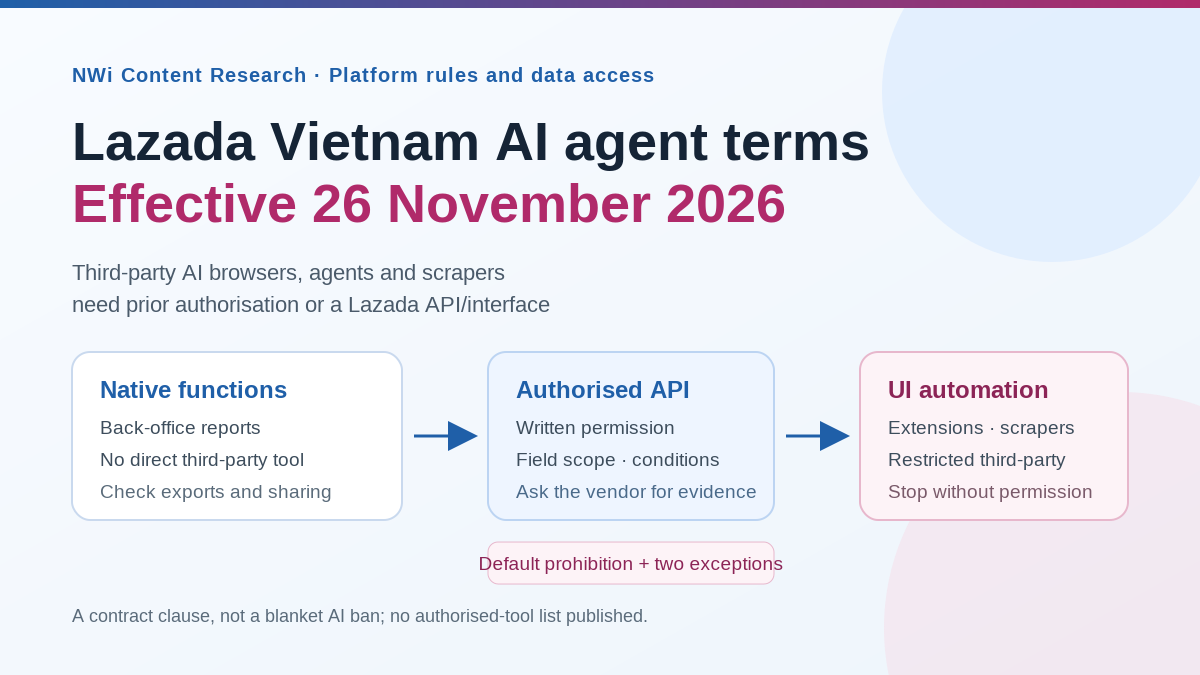
If you sell on Lazada Vietnam and use a third-party AI tool for product research, listing optimisation, customer service or browser-extension work in Seller Center, the decision after 26 November 2026 is not “can we still use AI?” but “does this tool chain have Lazada’s written authorisation or an API or interface Lazada provides?” Lazada Vietnam updated its Terms of Use on 18 November 2026, effective 26 November 2026, and added Clause 1.6, “Artificial Intelligence Agents and Automated Means”. The default rule prohibits third-party bots, spiders, crawlers, scrapers, scripts, LLMs, generative AI, AI agents or autonomous agents, and AI-enabled browsers or browser extensions from accessing, navigating, interacting with or operating the platform, or extracting, copying or collecting platform data. There are two exceptions: Lazada’s express prior written authorisation, or an API or other interface or protocol Lazada makes available for that purpose, in each case subject to its conditions. The clause also covers orders, payments, reviews, seller communications, AI training, fine-tuning, grounding, price-comparison or product databases, and data resale, and it makes the seller responsible for the tool’s acts. This article compares the July version, separates three access routes, and uses three scenarios plus an illustrative 12-tool register to decide what to stop, what evidence to demand, and when to stop. It does not present the clause as a blanket AI ban or invent an authorised-tool list, penalties or enforcement data.
1. What took effect on 26 November: a default prohibition with two exceptions, not a blanket AI ban
Lazada Vietnam’s Terms of Use were updated on 18 November 2026 and took effect on 26 November 2026. The new Clause 1.6 is headed “Artificial Intelligence Agents and Automated Means”. It starts with a default rule: unless one of two exceptions applies, no third-party bot, spider, crawler, scraper, script or other automated program (including a manual process designed to replicate one), and no software, model or system that uses AI — including large language models, generative AI tools, agentic or autonomous agents, and AI-enabled browsers or browser extensions — may access, navigate, interact with or operate the Lazada platform or services, or access, extract, copy or collect materials or data. The two exceptions are Lazada’s express prior written authorisation, or an API or other interface or protocol Lazada makes available for that purpose, and both remain subject to any conditions Lazada imposes.
Clause 1.6 makes third-party automation and AI tools prohibited by default, leaving only two exceptions — express prior written authorisation or an API or other interface Lazada makes available for that purpose — and allows Lazada to impose conditions. It is not only a scraping clause: it explicitly names placing orders, making payments, submitting reviews, communicating with sellers, training, fine-tuning, grounding or providing outputs from AI or machine-learning models, building price-comparison or product databases, and reselling data. An AI browser extension that merely “helps the seller click through Seller Center” still falls within the text if a third party provides it and it operates the platform with the seller’s account. A price-comparison database that does not sell data still hits Clause 1.6(a) and Clause 4.2 if it collects platform product information without permission.
The change is clearer when the July and November versions are read side by side.
| Item | Version of 21 July 2026 (effective 29 July) | Version of 18 November 2026 (effective 26 November) |
|---|---|---|
| Clause 1.6 in the main text | No AI or automation clause; the Clause 1.6 in the definitions schedule is the definition of “Order” | New “Artificial Intelligence Agents and Automated Means” |
| Third-party AI tools | Not separately addressed | Prohibited by default unless written authorisation or a Lazada-provided API or interface |
| AI browsers and extensions | Not separately addressed | Explicitly names AI-enabled browsers and browser extensions |
| Data use | Clause 4.2 already restricts copying and reverse engineering, but does not separately address AI training | Clause 1.6(a) names training, fine-tuning, grounding, price-comparison or product databases and resale; Clause 4.2 says this applies regardless of automated protocol, API or default consent |
| Credentials and liability | Not separately addressed | Username, password, biometric verification, OTP and payment credentials may not be given to an unauthorised interface; the seller is responsible for the tool’s acts |
| Withdrawal of permission | Not separately addressed | Lazada may withdraw authorisation at any time, and may detect, block, limit, require additional verification or cancel orders |
| Licence over user submissions | Clause 5.1 grants a non-exclusive right | Clause 5.1 expands this to a non-exclusive, worldwide, royalty-free, irrevocable and sub-licensable right |
Clause 1.6(b) leaves a narrow opening: operators of generally available search engines may use restricted third-party tools to index publicly accessible pages solely to display search results with links to Lazada, and Lazada may grant other permissions by express statement in robots.txt. That is not a pass for seller-side AI tools; the clause requires compliance with robots.txt and other machine-readable instructions and prohibits circumventing access controls. Clause 5.2 puts Lazada’s own AI features under a separate User Disclaimer on Use of AI Services. Reading either provision as “the platform allows AI” gets the boundary wrong: the platform allows its own features and the interfaces it expressly authorises, not any third-party extension.
Clause 4.2 separately prohibits using AI tools to generate fake reviews, manipulate ratings, or create synthetic media that falsely attributes actions to Lazada or its sellers. That matters for review management and content operations: even if the seller thinks it is “only asking AI to polish a review”, a third-party tool that writes, posts or manipulates reviews is not just a data-access problem; it is a prohibited content practice.
One connected change is easy to miss: Clause 5.1 expands the licence over user submissions — questions, reviews, comments and suggestions — from the July version’s “non-exclusive right to use” to a “non-exclusive, worldwide, royalty-free, irrevocable and sub-licensable” right, in accordance with the Privacy Policy, for organising, operating and improving the platform and services. It does not directly answer whether a third-party AI tool may be used, but sellers that hand reviews, images or product content to a third party for analysis need to re-check the permission chain.
2. Three access routes: native functions, authorised APIs, and UI automation or scraping
The real question is not whether Lazada will ban AI, but whether this tool chain has written authorisation or a Lazada-provided API or interface after 26 November. The clause turns on how a tool connects, not what it calls itself. At least three access routes need different treatment.
| Access route | Where the clause applies | What is needed | What to do first |
|---|---|---|---|
| Native platform functions or Seller Center reports | Clause 1.6(a) does not directly name third-party tools | Clause 4.2 and other data-use terms still apply | Check whether export, sharing, long-term storage and secondary use are permitted |
| Authorised API or interface | Express exception in Clause 1.6(a) | Lazada’s prior written authorisation, or a Lazada-provided API or interface, subject to conditions | Ask the vendor for authorisation, field scope, sub-processors and data-retention evidence |
| UI automation, browser extensions or scripts | Restricted Third-Party Tool under Clause 1.6(a) | Prior written authorisation or a Lazada-provided interface | Stop without evidence; “read-only” or “human in the loop” does not create an exemption |
| Scrapers or price-comparison databases | Clause 1.6(a) and Clause 4.2 | Prior written permission | Stop collection; move to licensed or API-authorised data |
Category is not the dividing line; workflow is. A high-SKU category with frequent price changes is more likely to use automation, but the clause gives no category an exemption. It names orders, payments, reviews, seller communications, price-comparison databases, product databases, AI training and data resale. Listing optimisation, price monitoring, review management and automated customer service all fall to be judged by access route when a third-party tool performs them.
“The vendor has an API” is not the same as “you have authorisation”. The Clause 1.6(a) exception is a Lazada-provided API or interface, subject to Lazada’s conditions; the vendor needs to show its own authorisation or developer status, and the seller still needs to confirm which scopes it authorised, where the data goes and whether it is reused. If an API tool uses platform data to train its own model, Clause 4.2 still requires Lazada’s or the rights holder’s prior written permission.
The counter-case is a seller that uses only native platform reports and does not give data to a third-party tool: the clause does not directly name that operation, but the seller still needs to check whether exports, sharing and long-term storage cross Clause 4.2. Another counter-case is a “human in the loop” AI assistant: if third-party software still accesses the platform, reads pages or submits actions, human confirmation does not turn it into a native platform function.
3. The liability sits with the seller: the tool’s acts are your acts
Clause 1.6(c) is direct: if you use a restricted third-party tool, whether or not it is authorised, you remain solely responsible for all its acts and omissions, and any access, use of the services, order, payment, user submission or communication made through it using your Lazada account is deemed to be made by you. Clause 1.6(c)(ii) adds that you must not give your username, password, biometric verification, one-time pin or payment credentials to the tool or its provider other than through an interface Lazada authorises; any such disclosure is at your own risk. Clause 1.6(c)(iii) says any order, payment, submission, communication or other action it takes is binding on you, and Lazada is not liable, to the maximum extent permitted by law, for losses arising from the tool’s error, malfunction, misinterpretation or action.
That changes where the evidence burden sits between the seller and the vendor. The old response — “the vendor built the tool, so the vendor is responsible” — does not protect the account holder on the platform side. The seller needs a saveable authorisation file, API scope, data-processing terms and a vendor change-notification commitment, not a sentence saying “we are compliant”.
Clause 1.6(c)(iv) lists technical measures that must not be touched: do not circumvent, disable or interfere with robots.txt, rate limits, CAPTCHA, bot detection or authentication; do not conceal, disguise or misrepresent the tool’s identity or authorisation status; do not bypass or crack security verification; and respond truthfully when verification is triggered. Clause 1.6(d) preserves Lazada’s right to withdraw any authorisation or permission at any time, apply technical restrictions and risk-management measures, and without prior notice detect, block, limit or require additional verification of a restricted tool, and cancel any order or transaction it reasonably suspects was made by an unauthorised tool. Authorisation is not a one-time onboarding checkbox; it is a status that can be withdrawn and must be evidenced continuously.
Clause 1.6(e) says access in breach of Clause 1.6 is unauthorised, and Lazada reserves all rights and remedies under the Terms of Use and applicable law, including terminating or suspending access under Clause 6.1 and seeking injunctive relief where permitted. For a seller, the risk is not only that a tool stops working; it can include loss of account access, interrupted order processing and downstream business disruption.
4. What the clause does not settle: authorised-tool lists, enforcement and version gaps
The clause is a contract text, not an operating manual. The clause publishes no authorised-tool list, approval timeline, penalty ladder or enforcement cases, and the public terms index and contract CDN may not be in sync, so sellers still need to verify the operative version in Seller Center. It also publishes no approval process, response time or transition period, and does not say whether existing tools will be cut off automatically after 26 November. It does not define the outer boundary of “AI technology”, and does not say whether “read-only”, “human in the loop” or “the extension does not place orders automatically” creates an exemption. Those gaps cannot be filled with confident conclusions.
Version differences also matter. The November version on the contract CDN says “Updated on 18 November 2026” and “This version takes effect on 26 November 2026”; the July version says “Updated on 21 July 2026” and “This version takes effect on 29 July 2026”. Sellers should still verify the operative version in Seller Center, because the public index, cached pages and contract page may not be in sync. If the back office shows another version, follow the back office and the platform’s written notice.
The territorial boundary matters too. The definitions identify Lazada as Recess Company Limited (Vietnam enterprise registration No. 0308808576); this is the Lazada Vietnam contract, not a universal policy for every Lazada market. Other sites may use different wording, effective dates or API conditions. Applying the Vietnam clause directly to Thailand, Indonesia or the Philippines can overstate or understate the risk.
The search-engine exception also needs a precise reading: Clause 1.6(b) allows operators of generally available search engines to index publicly accessible pages solely to display search results and links, subject to robots.txt and other machine-readable instructions and without circumventing access controls. It does not authorise seller-side AI tools, price-comparison databases or data resale. Treating “search engines can index” as “third-party tools can scrape” reads a narrow exception as a general licence.
Finally, interpretation may differ. This article is a text analysis, not a substitute for legal advice on your entity, contract and specific tool; if the tool touches payments, orders or consumer data, have legal counsel or a local lawyer review it. The clause publishes no enforcement data; that does not mean the platform will not enforce it, and it does not mean enforcement has started. It means the text is what can be confirmed now, not the enforcement intensity.
5. Three scenarios: an extension login, an API integration and a scraped price database
The three scenarios below are illustrative examples used to separate access routes; they do not represent any real seller, vendor or platform enforcement outcome.
Scenario A: an AI browser extension logs into the seller’s account (illustrative)
Assumptions: no written authorisation and no API; the extension uses the seller’s username and password to operate the Seller Center interface.
Result: it falls within the Restricted Third-Party Tool definition in Clause 1.6(a); Clause 1.6(c)(ii) separately restricts giving the extension a password, OTP or payment credential; orders and actions taken through it are treated as the seller’s own, and the platform may block or cancel orders it reasonably suspects came from an unauthorised tool.
Decision: stop the pilot immediately; ask the vendor for a Lazada-authorised API route or written permission; if it cannot provide one, move back to native functions or an authorised tool.
Scenario B: an ERP/BI vendor holds Open Platform API credentials (illustrative)
Assumptions: the vendor holds Lazada API credentials, approved data fields and written data-processing terms, and the seller has authorised the relevant scopes.
Result: API access is the express exception in Clause 1.6(a), but it remains subject to Lazada’s conditions and the developer agreement; Clause 4.2 separately prohibits using platform materials to train, fine-tune or develop AI models without prior written permission.
Decision: keep it, but audit the field scope, data retention, sub-processors and the vendor’s authorisation evidence, and re-check before renewal.
Scenario C: a third-party price-comparison database scrapes Lazada product pages (illustrative)
Assumptions: no written permission; a third party automatically collects Lazada product pages into a price-comparison database.
Result: Clause 1.6(a) and Clause 4.2 both prohibit it; the clause also names price-comparison databases, product databases, AI training and data resale.
Decision: stop collection; switch to licensed or API-authorised data, or use only permitted public sources, and document the change.
6. An illustrative 12-tool register: stop five first, or collect three evidence packs?
Put the classification into an illustrative seller register: 12 tools that touch Lazada Vietnam, of which four are native platform functions or back-office reports, three are vendors with API/BI integrations, two are UI automation tools, and three are scrapers or AI browser extensions. The register is an assumption, not an industry survey; replace it with your own list and recalculate with the same method.
Under a “stop if there is no authorisation” rule, the two UI automation tools and the three scrapers or AI extensions — five tools — stop first: 5 ÷ 12 = 41.7%. The three API tools are not automatically cleared; they stay only after authorisation, field, sub-processor and data-retention evidence: 3 ÷ 12 = 25.0%. The four native functions do not directly fall within Clause 1.6(a): 4 ÷ 12 = 33.3%. The three shares sum to 100%.
On the illustrative 12-tool register: five tools without authorisation stop immediately, or 41.7%; three API tools stay only after evidence, or 25.0%; four native functions account for 33.3%, and the three shares sum to 100%. If the two UI automation tools can show Lazada’s written authorisation, they move from “stop now” to “collect evidence”: the immediate-stop count becomes three (25.0%), the evidence-required count becomes five (41.7%), and native functions remain four (33.3%). The number to manage is not “how many AI tools” but “how many tools have no authorised route and also touch credentials, orders, payments or reviews”.
The value of this method is that it is reproducible and replaceable. You do not need to trust an industry average; fill your own tool register into four columns: access route, whether it touches credentials, whether it touches orders, payments or reviews, and whether authorisation can be shown. If any column cannot be answered, put the tool in the “stop” or “collect evidence” bucket.
7. A 30-day action plan and stop conditions
In days 0 to 3, list every tool, credential, field and data destination that touches Lazada Vietnam; in days 4 to 7, stop tools that ask for passwords or bypass verification; then use three weeks to collect vendor authorisation and API evidence.
- Days 0–3: build the tool register. For each tool, record its purpose, access route, whether it uses the seller’s password or OTP, which fields it reads, where the data is stored, the contract owner and the last review date.
- Days 4–7: stop immediately. Stop tools that ask for a password, OTP or payment credential; bypass robots.txt, rate limits, CAPTCHA or bot detection; scrape product pages or reviews without authorisation; or conceal identity or authorisation status. Rotate credentials afterwards and check recent orders and actions.
- Week 2: ask vendors for evidence. At minimum: the Lazada authorisation file or API documentation; available fields and call scope; the sub-processor list; data retention and deletion; whether the vendor trains, fine-tunes or grounds models on Lazada data; whether it builds a price-comparison or product database or resells data; security-incident notification; and migration help if authorisation changes or ends.
- Week 3: verify the API chain. Confirm which scopes the seller authorised, who holds the keys, whether call frequency is within limits and whether the data is reused. AI-training permission under Clause 4.2 must be obtained separately; it cannot be inferred from API access.
- Week 4: change contracts and procurement. Make authorisation evidence a condition of go-live, add change-notification, audit, termination and data-deletion clauses, and re-check before renewal rather than waiting for a platform letter.
Stop conditions: the vendor cannot show Lazada’s written authorisation or a Lazada-provided API or interface; it asks you for a password, OTP or payment credential; it trains, fine-tunes or grounds models on Lazada data without written permission; it builds or resells a price-comparison or product database; it bypasses robots.txt, rate limits, CAPTCHA or bot detection; it conceals or misrepresents the tool’s identity or authorisation status; or it refuses to disclose sub-processors or data destinations.
When to act: stop credential-sharing or scraping tools immediately; complete evidence before renewing an API tool; and review the access route before adding any new AI tool. A seller that uses only native functions and does not give data to a third party does not need to panic, but should still check whether exports, sharing and long-term storage cross Clause 4.2.
8. Limitations and conclusion
This article reads only the Lazada Vietnam contract text and the previous version; it has no official FAQ, authorised-tool list, enforcement data or vendor authorisation file, and it cannot replace legal advice for your entity and contract. The clause is a contract text, not a statute; it applies to Lazada Vietnam and may not apply to other markets; enforcement intensity, approval time and penalties may vary by case.
Conclusion: Clause 1.6 is not a ban on AI. It allocates the risk of third-party tools: prohibited by default unless the seller has Lazada’s written authorisation or uses an API or interface Lazada provides; even then, the seller remains responsible for the tool’s acts, and authorisation can be withdrawn. The seller’s real task is to replace “is the tool good?” with “is there evidence for this access route?”
The article’s increment is to split “the AI ban” into three tables — access route, liability and vendor evidence — and use a reproducible tool register to show which five to stop first and why three others need an evidence pack. It does not tell you which vendor is definitely compliant, and it does not promise that any tool will be approved; it gives you a repeatable order of judgment for after 26 November.
Product boundary: NWi CrossborderGo provides Lazada Vietnam and other site-level market, category, brand, store and product data, updated monthly under activated modules and contract authorisation, for site-level comparison; it can support price-band, category and product research. It is not a Lazada Seller Center login tool, does not provide order-level, advertising-account or settlement data, and does not mean Lazada has approved any third-party AI tool or MCP connection. Related pages: Lazada data analysis, NWi CrossborderGo, MCP data access, Cross-border Agent, request a demo.
9. Sources
- 1. Lazada Vietnam, Terms Of Use, updated 18 November 2026 and effective 26 November 2026; read in full on 27 November 2026: read the original
- 2. Lazada Vietnam, Terms Of Use, previous version updated 21 July 2026 and effective 29 July 2026; used to compare Clause 1.6 and Clause 5.1; read in full on 27 November 2026: read the original
10. Method and disclosure
Data basis: the clause text comes from Lazada Vietnam’s Terms of Use, updated on 18 November 2026 and effective on 26 November 2026, read in full through the contract CDN on 27 November 2026 at about 12:05 Asia/Shanghai. The previous version, updated on 21 July 2026 and effective on 29 July 2026, is used only to establish what changed in Clause 1.6 and Clause 5.1. Both are contract texts published by Lazada Vietnam, not two independent sources; no independent third-party full-text report of the clause was found in this check, so the comparison confirms the text change but is not presented as independent cross-verification. The definitions identify Lazada as Recess Company Limited (Vietnam enterprise registration No. 0308808576). Calculations: in the illustrative 12-tool register, the immediate-stop count ÷ 12, the evidence-required count ÷ 12 and the native-function count ÷ 12 are rounded to one decimal place; all tool counts, classifications and percentages are stated assumptions, not an industry survey, seller measurement or NWi customer data. Product scope: NWi CrossborderGo provides Lazada Vietnam and other site-level market, category, brand, store and product data, updated monthly under activated modules and contract authorisation, for site-level comparison; it is not a Lazada Seller Center login tool, does not provide order-level, advertising-account or settlement data, and does not mean Lazada has approved any third-party AI tool or MCP connection.
This article was prepared with automated research assistance and is based on the public sources listed at the end. It was not reviewed by a human editor; it does not invent customer data, expert review, an authorised-tool list, penalties, enforcement rates, ranking results or platform endorsement. It is not legal, compliance, platform-operations or investment advice.