
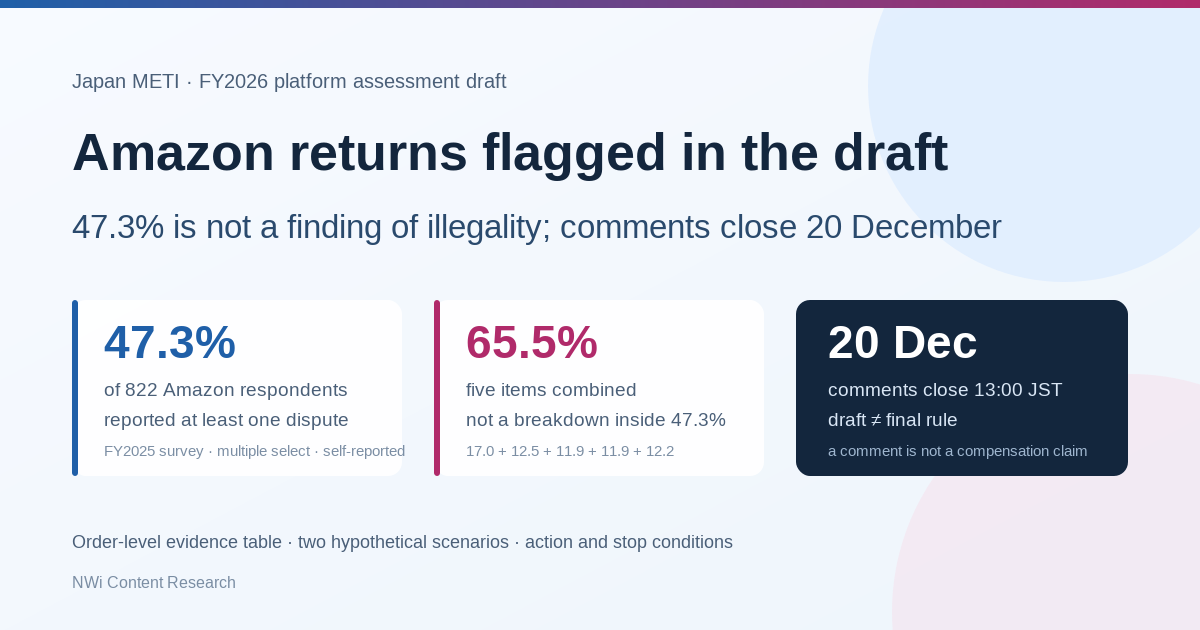
If you sell on Amazon.co.jp and had a 2025 dispute where the platform refunded before the item came back, or where a returned item could not be resold, the decision is not whether Japan will issue a new rule. It is whether to submit order-level evidence to METI before 13:00 Japan time on 20 December, or to rely on platform appeals. METI's 2026 draft assessment under the Act on Improving Transparency and Fairness of Digital Platforms, published on 20 November 2026, makes Amazon's return and refund communication a focus and cites a fiscal 2025 seller survey: 47.3% of Amazon respondents had experienced at least one type of return or refund dispute. The document is a draft, not a final rule, and a public comment is not a compensation claim. This brief reads the 47.3% base, the five multiple-select items and the legal route, then sets out an order-level evidence table, two costed scenarios and the action and stop conditions before 20 December.
1. The 20 December deadline is a consultation, not a new rule taking effect
e-Gov public comment case 595320123 shows that the draft assessment was published on 20 November 2026, with comments open from 13:00 on 20 November to 13:00 Japan time on 20 December. Two drafts are covered: the comprehensive online mall field and the digital advertising field. The online mall field covers Amazon.co.jp (Amazon Japan G.K.), Rakuten Ichiba (Rakuten Group) and Yahoo! Shopping (LINE Yahoo). The digital advertising field covers Google, Meta, LINE Yahoo and TikTok. The draft says 2026 is the fifth assessment of the online mall field and the fourth of digital advertising.
Two boundaries are easy to confuse. First, this is a draft: neither the final text nor its publication date is fixed, and a request in the draft is not a platform rule already in force. Second, TikTok appears in the digital advertising field, where the issue is communication between its Japanese entity and overseas units; it is not the subject of a TikTok Shop marketplace assessment. TikTok Shop sellers cannot apply this article's Amazon return and refund conclusions to their shop operations.
The direct question for a seller is therefore not whether Japan will regulate platforms, but whether you hold enough order-level evidence to justify a public comment before 20 December. If you do not, a platform appeal is the more direct route.
If you sell on Amazon.co.jp and had return or refund disputes in 2025, the decision is not whether Japan will issue a new rule, but whether to submit order-level evidence before 20 December or rely on platform appeals.
2. The 47.3% base is 822 Amazon respondents, not orders
The figure in draft section 1-2-3-1 comes from METI's fiscal 2025 survey of sellers using online malls. The draft rounds it to 'about 47%'; the survey presentation gives 47.3%. The survey was fielded from 3 to 5 March 2026 and produced 1,111 valid responses: 822 for Amazon, 844 for Rakuten, 699 for Yahoo and 197 for Qoo10. It asked about return and refund disputes on goods sold in 2025, and Q31 explicitly allowed multiple answers.
| Platform | Respondents | At least one dispute | No dispute | Do not know / prefer not to answer |
|---|---|---|---|---|
| Amazon | 822 | 47.3% | 34.7% | 18.0% |
| Rakuten | 844 | 42.7% | 39.5% | 17.9% |
| Yahoo | 699 | 39.9% | 41.2% | 18.9% |
| Qoo10 | 197 | 65.0% | 21.8% | 13.2% |
Do the addition first: for Amazon, 47.3% + 34.7% + 18.0% = 100.0%. The 47.3% is therefore the net share that experienced at least one type of dispute, with the 822 respondents as the denominator. It is not a share of orders, not a share of GMV, and not a statement that 47.3% of orders go wrong. Multiplying 47.3% by your order count mistakes a seller-level experience for an order-level probability.
| Amazon survey item (multiple select) | Share of respondents | What it describes |
|---|---|---|
| Platform accepted a return/refund even though the rules did not allow it | 17.0% | Platform decision conflicts with the rules |
| Platform refunded first, but the buyer did not return the item | 12.5% | Refund paid, goods not recovered |
| Returned item had a problem after the refund | 11.9% | Damaged, incomplete or unsellable |
| Item damaged or lost in the platform warehouse | 11.9% | Asked only for Amazon and Rakuten |
| Compensation for warehouse damage/loss was too low | 12.2% | Below cost or purchase price |
| Other | 0.5% | Unclassified |
The five substantive items add up to 65.5% (with another 0.5% for 'other'), above 47.3%, because they are options in one multiple-select question and a respondent can tick several. The draft's prose links 47.3% to about 17%, about 13% and about 12% with 'of which', but the item total exceeds 47.3%, so each item can only be read as a share of all Amazon respondents, not as a breakdown inside 47.3%. That difference changes how you build the evidence table: one seller may have both a 'refunded without return' case and a 'returned item was damaged' case, and the two need separate records rather than one merged case.
The survey has two further limits. First, the sample comes from a screened online survey: 112,425 businesses that might work in online malls were approached, 54,134 passed screening, 4,421 used an online mall, 1,288 were involved in some way and 1,111 entered the analysis; this is not a random sample of all Amazon.co.jp sellers. Second, footnote 4 of the draft warns that answers rest on sellers' transaction experience and understanding, which may differ from the platform's view of the facts or its rules; sellers provide information voluntarily, so the details of individual cases may be incomplete, and some questions allow multiple answers. The 47.3% therefore supports a statement that return and refund disputes are common among these 822 respondents. It does not support 'the platform broke the law', '47.3% of cross-border sellers face this', or a specific compensation or remediation figure.
The 47.3% is the share of Amazon respondents who experienced at least one type of return or refund dispute, not a share of orders, a finding of illegality, or a cross-border-seller-specific rate.
3. The mechanism: assessment, publication, effort obligation, and a separate petition route
Article 9(1) of the Act on Improving Transparency and Fairness of Digital Platforms (Act No. 38 of 2020) requires specified digital platforms to submit an annual report to METI. Article 9(2) requires METI to assess the platform's transparency and fairness on the basis of the report, the facts raised under Article 10(1) and other facts it holds, taking the guidelines into account. Article 9(5) requires publication of the assessment and the report summary. Article 9(6) says the platform must endeavor to improve transparency and fairness voluntarily in light of the published assessment.
Three points matter. First, this is an assessment, not an administrative penalty: the statute creates an effort obligation to improve, not automatic compensation or automatic reversal of an individual case. Second, the draft's specific request to Amazon is to capture cases where a return or refund did not meet the conditions, including through appeals, investigate causes broadly by problem type, improve the review process and quality, build a mechanism that prevents recurrence, and describe it in the periodic report. Third, sellers have a separate petition route under Article 10: if they believe the platform has not taken the measures required by Article 5(1)-(4) or Article 7(1), they can petition METI, and the platform must not refuse to deal with them or treat them unfavorably because of the petition.
Why do returns and refunds fall under the Transparency Act? Article 5(2)(i)(to) allows the METI ordinance to specify provision terms that particularly need disclosure; the draft cites ordinance Article 6(4), which lists the content and conditions of returns, refunds and other compensation borne by the seller. Article 7(1) requires the platform to take necessary measures to promote mutual understanding with sellers. The draft is therefore concerned not only with whether a refund happens, but with whether the platform explains the conditions, reasons and decision process clearly enough for sellers to predict the outcome.
METI evaluates the platform under Article 9(2) of the Transparency Act using the annual report and the facts it holds; once published, the assessment creates an effort obligation to improve, not automatic compensation.
On timing, 20 December is the comment deadline, not the date the final assessment appears. The draft gives no date for the final assessment, no weight for comments in the final text, and no timetable for putting improvements into the next periodic report. Treating 20 December as the effective date of a new rule would misread the action window.
4. Who is affected: Amazon.co.jp FBA and FBM sellers, not TikTok Shop
The draft's Amazon section covers both FBA and seller-fulfilled orders. With FBA, when a buyer requests a return, Amazon's fulfillment center in principle inspects the returned item and decides whether and how much to refund under the applicable return conditions; the decision is communicated to the seller through Seller Central or email, and the seller can appeal. With FBM, the seller decides whether to accept the return and refund, but the Amazon Marketplace Guarantee may step in; the draft notes that mutual understanding is important when a seller decides not to accept a return or refund and the Marketplace Guarantee applies, and when FBA return policy is applied to an item for which the Marketplace Guarantee has already refused a refund.
The five survey items translate into four evidence types: (1) the platform accepted a return or refund where the rules did not allow it; (2) the platform refunded before the buyer returned the item; (3) the returned item was damaged, incomplete or unsellable after the refund; and (4) an item was damaged or lost in the platform warehouse, or the compensation was below cost. Each needs different proof: rules, the platform decision and item condition for type 1; the refund record, delivery confirmation and proof of non-return for type 2; unboxing records, photos and an unsellable assessment for type 3; inbound records, inventory adjustments and compensation details for type 4. Merging them into one 'too many returns' table gives the platform nothing to act on and gives a public comment nothing to cite.
Rakuten and Yahoo are also in this online mall assessment, but their focus is not Amazon-style return and refund handling: Rakuten's is complaint counting and reporting plus disclosure of paid services attached to listings, and Yahoo's is complaint counting. Qoo10 appears in the survey (65.0%) but is not a specified platform in this assessment, and its sample cannot be extrapolated to other platforms. On cross-border sellers, the survey does not separate domestic from cross-border sellers, so 47.3% cannot be presented as a China-based cross-border seller rate. What can be said is narrower: among 822 respondents who use Amazon, this type of dispute is common.
That is why this article limits the action to Amazon.co.jp third-party sellers. TikTok Shop sellers are not in the return and refund issue of this online mall assessment; if you sell on several platforms, build a separate evidence table for each and do not copy Amazon's survey shares, legal route or appeal path onto TikTok Shop.
5. A recomputable order-level evidence table and two scenarios
Start with the minimum fields. Without them, 'the platform treated me unfairly' is a feeling that can neither support an appeal nor be cited in a comment.
- Order ID, order date, order value, currency and fulfillment method (FBA or FBM).
- Dispute type (not received, damaged, incomplete, not as described, other), buyer request date, and the date of the platform or seller decision.
- Platform decision: refund, return, compensation, rejection; refund amount, compensation amount, and whether the item came back.
- Condition of the returned item: resalable, damaged, incomplete, unsellable; unboxing photo or video reference.
- Appeal date, grounds, platform response, whether it was within the deadline, and the final outcome.
- Evidence list: rule screenshot, delivery confirmation, warehouse inbound or inventory adjustment record, and the original platform notice.
The calculation has three lines: exposure = number of cases × average order value; expected recovery = exposure × appeal success rate; net benefit of the evidence table = exposure × (new success rate − old success rate) − evidence cost. The break-even uplift is evidence cost ÷ exposure. Every case count, order value, success rate and hourly rate must be the seller's own data; the scenario numbers in this article are labeled assumptions.
Scenario A: an FBA seller with 30 'refunded without return' cases and a ¥7,000 order value (hypothetical)
Assumptions: 30 cases in 2025 where the platform refunded before receiving the return, an average order value of ¥7,000, six hours to build the evidence table at an internal rate of ¥5,000 per hour, and an appeal success rate rising from 20% to 40%.
Exposure first: 30 × ¥7,000 = ¥210,000. Evidence cost: 6 × ¥5,000 = ¥30,000. If the success rate rises from 20% to 40%, the incremental recovery is ¥210,000 × 20% = ¥42,000, leaving ¥12,000 after cost. The break-even point is ¥30,000 ÷ ¥210,000 = 14.3%: the table pays if it lifts the success rate by 14.3 percentage points. Below that, the hours are better spent on appeals and containing the SKU.
At 30 disputes and ¥7,000 per order, exposure is ¥210,000; with a ¥30,000 evidence cost, the ledger pays if it raises the appeal success rate by 14.3 percentage points.
Result: exposure is 30 × ¥7,000 = ¥210,000; the evidence cost is 6 × ¥5,000 = ¥30,000; a 20-point gain adds ¥42,000 of expected recovery, leaving ¥12,000 net of cost.
Decision: build the table only if it can raise the success rate by at least 14.3 percentage points; otherwise spend the time on platform appeals and SKU containment.
What matters is not whether ¥7,000 or 40% is realistic, but that you can substitute your own numbers into the same formula. If your average order value is ¥3,000, 30 cases give ¥90,000 of exposure and the break-even uplift is 33.3%. With only 10 cases, exposure is ¥30,000 and the break-even uplift is 100%, which appeal recovery is very unlikely to cover.
Scenario B: an FBM small seller with six cases and a ¥3,000 order value (hypothetical)
Assumptions: six disputes in 2025, an average order value of ¥3,000, the same six hours and ¥30,000 to build the table, and total disputed value of ¥18,000.
6 × ¥3,000 = ¥18,000, below the ¥30,000 evidence cost; ¥30,000 ÷ ¥18,000 = 166.7%, so even full recovery cannot cover it. The conclusion is not that a small seller should not defend itself, but that six small disputes do not justify a custom six-hour table. Use the platform's standard appeal template and keep the unboxing photos and platform notices; if you want to express an industry view, a trade group summary is more efficient than filing alone.
Result: even recovering all six cases yields ¥18,000, below the ¥30,000 cost; break-even would require a 166.7% improvement in the success rate, which is impossible.
Decision: skip the custom table, use the platform's standard appeal template, and if you want to express an industry view, route it through a trade group rather than filing alone.
| Cases × average order value | Exposure | Break-even success-rate uplift |
|---|---|---|
| 10 × ¥5,000 | ¥50,000 | 60% |
| 30 × ¥5,000 | ¥150,000 | 20% |
| 60 × ¥5,000 | ¥300,000 | 10% |
Use the table backwards: count the disputes you have evidence for and have not resolved, take the average order value, then see how much the ¥30,000 evidence cost requires the success rate to rise. If any input fails, do not build a custom table.
6. Action and stop conditions before 13:00 on 20 December
If your conclusion is that a submission is worth it, follow this order; do not write the comment first and look for evidence afterwards.
- Export all 2025 return and refund cases and tag them by the four dispute types; keep only cases with an order ID, amount, platform decision and evidence.
- Check the platform appeal deadline and outcome for each case; resolved or out-of-time cases leave the unresolved pool but can serve as background.
- Use the formula to calculate exposure, evidence cost and the break-even uplift; if the threshold is not met, do not build a custom table.
- If the threshold is met, aggregate the cases into a table with no buyer personal data: group by dispute type, month, amount band, platform decision and appeal outcome, and keep only the last four digits of the order ID or an internal reference.
- In the comment, name the draft section you address (for example 1-2-3-1 or 1-2-4-2), the pattern you observed, the specific process change you propose, and the aggregate evidence.
- Fill in the Japanese comment form and submit it through e-Gov, email or post; the e-Gov and email window closes at 13:00 Japan time on 20 December, and posted submissions must arrive by 20 December.
Check three things before submitting. First, a comment is not a compensation claim: the guidelines say comments are used as a reference for the final decision and receive no individual reply, so a claim for an individual case will not be processed as one. Second, comments may be published: everything except name or company name, address, telephone and email may be made public, so buyer or counterparty personal data and trade secrets must be removed or anonymized. Third, keep the scope accurate: for Amazon returns and refunds, cite the relevant online mall draft section; do not mix in TikTok's digital advertising issue or present Rakuten's complaint-counting issue as an Amazon issue.
Write the stop conditions down as well. Do not submit, or pause, if any of these applies:
- Fewer verifiable unresolved cases than the number whose full recovery would still be below the evidence cost (for example, fewer than five at a ¥7,000 order value).
- The dispute was already compensated or reversed on appeal, or the platform deadline has passed.
- You do not sell on Amazon.co.jp, or the disputes come mainly from another platform.
- You cannot express the comment accurately in Japanese, or cannot remove buyer personal data or trade secrets.
- You expect individual compensation or an immediate platform reversal rather than a process change.
Before 13:00 on 20 December, use the order-level evidence table to decide whether the submission threshold is met; if not, use platform appeals only, and if it is, submit the Japanese form with all customer personal data removed.
7. Evidence boundaries, counter-cases and unknowns
Start with the draft's own warning. Footnote 4 says the seller survey and the voices at the consultation desk rest on transaction experience and understanding, which may differ from the platform's view of the facts or its rules; sellers provide information voluntarily, the details of individual cases may be incomplete, and some questions allow multiple answers. That matters: 47.3% is an experience reported by sellers, not a platform violation rate verified by METI.
Counter-case one: the dispute was resolved on appeal, or the platform compensated within the deadline; such a case should not be written up as 'the platform does not act', though it can serve as a control showing that the process works. Counter-case two: a seller with few, small disputes where a custom evidence table costs more than it can recover; a standard appeal template fits better. Counter-case three: an FBA seller may already have had the return inspected at an Amazon fulfillment center, so the issue is more likely compensation or item condition than a unilateral refund; an FBM seller may face Marketplace Guarantee intervention. Counter-case four: if the core issue is buyer fraud, such as 'item not received' despite delivery confirmation, the evidence should point to delivery and signature, not to the platform's return policy. Counter-case five: TikTok Shop sellers are not in this online mall assessment's return and refund issue and should not apply this article's conclusions.
Keep an alternative explanation as well: 47.3% may reflect a gap in sellers' understanding of the rules, unclear platform notices and incomplete case evidence, not only unfair review. Footnote 4 and the draft's language about mutual understanding both point that way. For a seller, that means the evidence table must show not only 'I lost money' but also how the platform should have handled the case under its rules, how it actually handled it, and where the difference lies.
Unknowns: the final assessment text and publication date; the weight of comments in the final text; the specific improvements and their timing; whether the Marketplace Guarantee, FBA return policy or appeal windows change; the share of cross-border sellers in the survey; appeal success rates by dispute type; and whether individual cases can obtain compensation. None of these is public, so this article does not fill them with numbers.
The counter-case is a dispute already resolved through a platform appeal, an amount below the cost of evidence, or a seller who does not operate on Amazon.co.jp; in those cases a public comment has little marginal value.
The draft is not the final assessment; comment weight, final text, platform implementation timing and appeal success rates are unpublished, and the survey does not split cross-border from domestic sellers.
The contribution is reading 47.3% against a 100% denominator and a 65.5% multiple-select total, then setting a break-even point for the cost of the evidence table, rather than repeating a consultation notice.
8. Method, sources and product boundary
Data basis: the event comes from e-Gov public comment case 595320123 (published 20 November 2026; comments close at 13:00 Japan time on 20 December 2026), reopened and saved as raw HTML on 27 November 2026. Draft figures come from METI's 'Assessment of Transparency and Fairness of Specified Digital Platforms (Comprehensive Online Mall Field) (Draft)', section 1-2-3-1 and footnote 4, downloaded as a PDF and read page by page on 27 November 2026. Sample size, field dates and multiple-select shares come from the survey presentation cited by the draft (2026 monitoring meeting, reference 3-1: fielded 3-5 March 2026, 1,111 valid responses, Amazon n=822, Q31 multiple answers). Submission language, methods, deadline and comment handling come from the same case's public-comment guidelines. The legal route comes from the Act on Improving Transparency and Fairness of Digital Platforms (Act No. 38 of 2020), Articles 5(2)(i)(to), 7(1), 9(1), 9(2), 9(5), 9(6) and 10, verified through the e-Gov law API v2 on 27 November 2026. Calculation: exposure = number of cases × average order value; expected recovery = exposure × appeal success rate; net benefit of the evidence table = exposure × (new success rate − old success rate) − evidence cost; break-even uplift = evidence cost ÷ exposure. The 30 cases, six cases, ¥7,000, ¥3,000, 20%, 40%, six hours and ¥5,000 are labeled assumptions, not measurements by the platform, a seller or NWi. Survey shares such as 47.3% are respondent-level, multiple-select, self-reported experiences, not a share of orders or a finding of illegality.
Product boundary: in NWi CrossborderGo's published coverage list, Amazon sites include the United States, Europe and Japan. The product provides site-level market data such as sales, units, average selling price, brand concentration and price bands (public market data are estimates, not platform transaction or seller-backend settlement figures), updated monthly (the previous month is refreshed between the 10th and 15th). The exact sites, history and fields depend on the contract. It does not provide seller-backend order-level return or refund decisions, appeal outcomes, compensation amounts or METI assessment data; the evidence table in this article must use the seller's own orders and platform notices. NWi data can show which categories, price bands or SKUs have larger sales, which you can combine with your own return rate to estimate dispute value and decide which group to handle first, but it cannot replace the platform's return and refund records. See [Amazon data analysis](/platforms/amazon/) and [NWi CrossborderGo](/product/); to discuss category and site scope, [request a demo](/demo/).
Sources: 1. e-Gov Public Comment, 'Public comment on the METI Minister's assessment (draft) under the Act on Improving Transparency and Fairness of Digital Platforms', case 595320123, 20 November 2026: read the original; 2. METI, 'Assessment of Transparency and Fairness of Specified Digital Platforms (Comprehensive Online Mall Field) (Draft)', November 2026: read the PDF; 3. METI, 'Overview of the FY2026 Ministerial Assessment (Draft)', November 2026: read the PDF; 4. METI, '2026 First Monitoring Meeting, Reference 3-1: Seller Survey Results': read the PDF; 5. METI, 'Public Comment Guidelines', 20 November 2026: read the PDF; 6. e-Gov Law Search, 'Act on Improving Transparency and Fairness of Digital Platforms' (Act No. 38 of 2020): read the original.
This article was prepared with automated research assistance from the public sources listed at the end. It was not manually reviewed; it does not invent customer data, expert review, enforcement rates, comment weights, appeal success rates, platform remediation results, search rankings or platform endorsement. It is not legal, compliance, tax or platform-operations advice.