
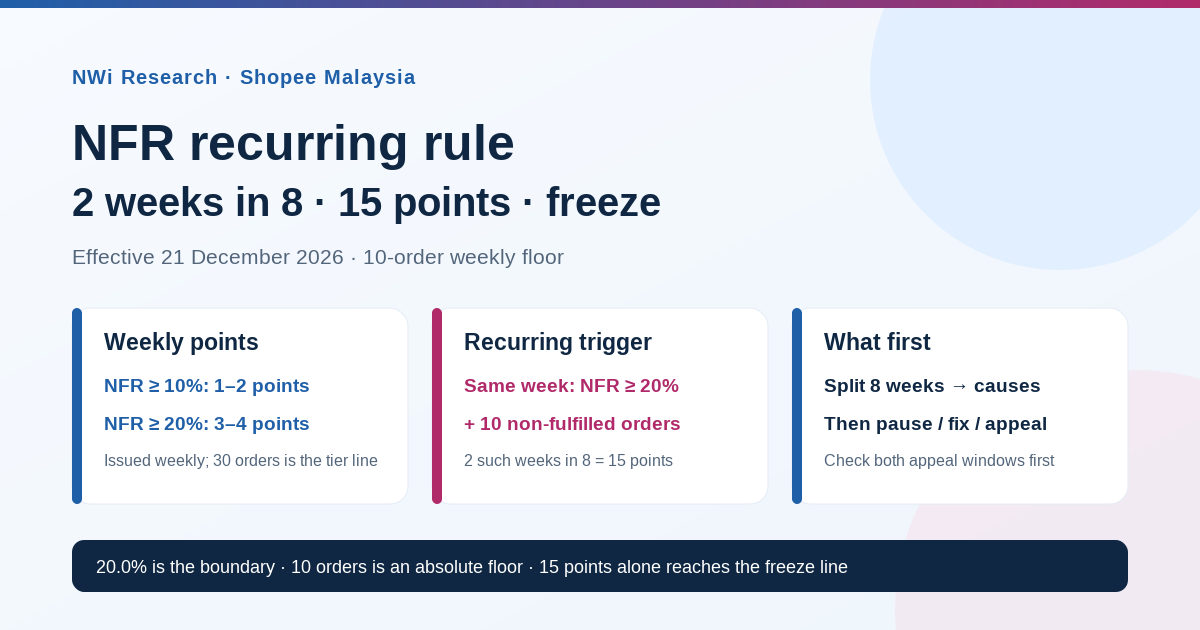
If you sell on Shopee Malaysia, the question to settle now is not whether an NFR above 20% leads to a penalty. It is whether two of your past eight weeks met both conditions at once: NFR at 20% or higher, and at least 10 non-fulfilled orders in the same week. Shopee Malaysia's Seller Education Hub published the recurring rule on 10 November 2026; it takes effect on 21 December 2026. Two qualifying weeks bring 15 penalty points and an account freeze. This brief separates the NFR numerator and denominator, the 10-order floor, weekly points and the recurring penalty, then uses two labelled scenarios to calculate how many orders remain before the trigger and to choose between pausing a SKU, changing the dispatch calendar or appealing. It does not invent seller data, enforcement rates or freeze duration.
1. The 21 December rule is not '20% means a freeze'; it needs two qualifying weeks
Start with the official wording. The Shopee Malaysia Seller Education Hub announcement says that from 21 December 2026, sellers with NFR above 20% in two of the past eight weeks and at least 10 non-fulfilled orders per week will receive 15 penalty points, resulting in an account freeze. The same page's table and worked example say 'NFR reaches 20% or higher'. The lead uses 'above 20%', while the table and example use 'at or above 20%'; the two readings differ at exactly 20.0%. This article takes the more conservative reading, treats 20.0% as the trigger, and flags the discrepancy as a boundary to confirm with Shopee.
| Track | Trigger | Non-fulfilled orders in the week | Penalty points | Consequence |
|---|---|---|---|---|
| Weekly points | NFR ≥ 10% | fewer than 30 | 1 | Accumulates weekly |
| Weekly points | NFR ≥ 10% | 30 or more | 2 | Accumulates weekly |
| Weekly points | NFR ≥ 20% | fewer than 30 | 3 | Accumulates weekly |
| Weekly points | NFR ≥ 20% | 30 or more | 4 | Accumulates weekly |
| Recurring rule (new) | NFR ≥ 20% in 2 of the past 8 weeks | 10 or more in each of those weeks | 15 | Account freeze |
Two readings are easy to get wrong. First, the weekly points and the recurring rule are separate tracks: weekly points are issued week by week, while the recurring rule counts weeks in an eight-week window that meet both conditions. Second, the official page does not say whether the two tracks stack. It does not need to: 15 points alone reaches Shopee's freeze threshold, so the freeze can be triggered without assuming that weekly points are added on top.
The 15-point freeze is not this article's inference. Shopee's penalty-point FAQ states that an account is frozen once it accumulates 15 penalty points or more, and that points reset to zero on the last Monday of each quarter (28 December 2026 for the December quarter). That creates two timing questions: an existing balance makes a 15-point addition cross the line sooner, and a freeze notice that lands near a quarterly reset may behave differently in practice. The official pages do not explain that interaction; check Account Health for the actual effective date.
2. The NFR numerator is three seller-fault order types; the denominator is all orders in the past seven days
NFR is not a synonym for cancellation rate. The official definition is the percentage of total orders in the last seven days that are cancelled by the seller, cancelled by the system because the seller failed to ship on time, or returned or refunded because of the seller's fault. The formula is: NFR = (seller-initiated cancellations + system cancellations caused by the seller + seller-fault returns/refunds) ÷ total orders in the last seven days × 100%. The official example is 40 non-fulfilled orders ÷ 250 total orders = 16%.
Both sides of the ratio have boundaries. Official pages say non-fulfilment caused by a logistics partner's fault is excluded from the seller's metrics; non-receipt and 'item does not fit / wrong size' returns are excluded from NFR; a buyer-initiated cancellation that the seller accepts does not increase NFR; and a return that the seller disputes successfully and for which the seller receives compensation does not count. The reverse also applies: if the seller misses the dispute window, disputes without valid evidence, or does not receive compensation, the return remains in NFR.
There is also an operational boundary. Shopee explicitly prohibits sellers from asking buyers to cancel an order; that violation carries 2 penalty points. 'Ask the buyer to cancel' is not a lawful way to lower NFR; it converts an NFR problem into a penalty-point problem.
The official pages do not say whether a return counts in the week the order was placed or the week the return was approved, and they do not state the rounding rule. The scenarios below use the official example's arithmetic only; they do not assume a return week, and they do not treat a rounded percentage as exact.
3. The 10-order floor: small sellers may avoid the 15-point freeze but still collect weekly points
The recurring rule requires both conditions in the same week: NFR at 20% or higher, and at least 10 non-fulfilled orders. The 10 is an absolute count, not a ratio. For a seller with fewer than 50 orders a week, 10 non-fulfilled orders is already above 20%, so the effective trigger is 10 orders, not 20%. That changes the risk calculation for smaller sellers.
| Orders per week | Non-fulfilled orders at 20% | 10-order floor | Recurring trigger | Maximum non-fulfilled orders below 20% | Note |
|---|---|---|---|---|---|
| 40 | 8 | 10 | 10 (25.0%) | 7 (17.5%) | 8-9 orders reach or exceed 20% NFR but miss the 10-order floor, so the recurring rule does not trigger |
| 50 | 10 | 10 | 10 (20.0%) | 9 (18.0%) | Exactly 20% with 10 orders triggers |
| 100 | 20 | 10 | 20 (20.0%) | 19 (19.0%) | One order from the trigger |
| 200 | 40 | 10 | 40 (20.0%) | 39 (19.5%) | A larger absolute buffer, but one stockout can add many orders |
| 500 | 100 | 10 | 100 (20.0%) | 99 (19.8%) | Even high-volume sellers have a one-order boundary |
The table is not a licence to cancel a certain number of orders. It turns 'how many orders remain before the trigger' into a checkable risk boundary. At 40 orders a week, 8-9 non-fulfilled orders already reach or exceed 20% and earn 3 weekly points, but because the week has fewer than 10 non-fulfilled orders, it does not enter the recurring count; the 10th order meets both conditions. At 50 orders a week there is no such buffer: the 10th order is exactly 20% and triggers the recurring test. Above 100 orders, the absolute number at 20% is larger, but the boundary is still one order.
This is why 'grow orders to dilute NFR' is not a reliable strategy. More orders do lower the percentage for the same absolute number of non-fulfilled orders, but if the added orders come from low-margin, stockout-prone SKUs, the absolute count also rises; and the recurring rule counts weeks, not monthly averages. A week of volume followed by a week of stockouts can produce two qualifying weeks inside the same eight-week window.
4. Scenario A: 40 orders a week and 10 non-fulfilled orders, just enough to trigger the recurring rule (illustrative)
Scenario A: 40 orders a week and 10 non-fulfilled orders, just enough to trigger the recurring rule (illustrative)
Assumptions: 40 orders a week; weeks 3 and 8 each have 10 seller-fault non-fulfilled orders and an NFR of 25%; all other weeks are below 20%; the account starts with no penalty points; the store's weekly contribution is assumed to be RM5,000; one SKU contributing RM20 per order and 10 orders a week is paused for two weeks.
First, the trigger. 10 ÷ 40 = 25%, which meets both the 20% NFR and 10-order conditions; weeks 3 and 8 both qualify, so the eight-week window contains exactly two qualifying weeks. Fifteen points alone reaches the freeze threshold; following the official example's sequence, the review happens in week 9 and the freeze takes effect in week 10.
Result: both weeks meet the 20% and 10-order conditions, giving two qualifying weeks in eight; 15 points are enough to freeze the account; on the week-9 review and week-10 freeze sequence, pausing the SKU for two weeks costs RM400 in contribution, while a one-week store-wide freeze at an assumed RM5,000 weekly contribution costs RM5,000.
Decision: fix the root cause before the second qualifying week; if the cause is a single SKU running out of stock, pausing that SKU for two weeks is cheaper than waiting for the freeze; if the SKU's two-week contribution exceeds the expected freeze loss, change the dispatch calendar or replenish stock instead of pausing it.
The point is not that RM400 is smaller than RM5,000; both numbers must come from the seller's own data. The cost of pausing = orders lost per week × contribution per order × weeks paused. The cost of a freeze = contribution that would have been earned during the freeze. Shopee does not publish the freeze duration, so 'one week' is a scenario assumption, not a promise; a two-week freeze doubles the loss and can reverse the decision.
Counter-case: if the 10 non-fulfilled orders come mainly from a logistics partner's fault, or from system cancellations not caused by the seller's failure to ship, pausing the SKU will not fix the problem; check responsibility and appeal first. If some of the 10 are buyer-initiated cancellations that the seller accepted, the official rule says they should not count toward NFR; reconcile the order-level detail before acting.
5. Scenario B: 100 orders a week and an NFR of 18%, two orders from the 20% line (illustrative)
Scenario B: 100 orders a week and an NFR of 18%, two orders from the 20% line (illustrative)
Assumptions: 100 orders a week; 18 seller-fault non-fulfilled orders this week, for an NFR of 18%; three of them come from one damaged SKU; without a fix, two more returns from the same cause arrive next week.
First, the distance. 18 ÷ 100 = 18%, two orders below 20%; next week, 20 non-fulfilled orders would meet both the 20% and 10-order conditions. Fixing the damaged SKU removes the three returns and lowers NFR to 15 ÷ 100 = 15%, reopening a five-order buffer to 20%.
Result: 18/100 = 18% and 20/100 = 20%; next week, 20 non-fulfilled orders would satisfy both the 20% and 10-order tests; fixing the SKU lowers NFR to 15% and reopens a five-order buffer.
Decision: fix the damaged SKU and keep packing evidence; dispute eligible returns within the deadline; if the three returns include non-receipt or wrong-size cases, check first whether they are excluded from NFR, then decide whether to pause the SKU.
The counter-case here is 'dilute with volume'. If next week's orders rise from 100 to 120, 20 non-fulfilled orders produce an NFR of 16.7%, apparently below 20%; but the absolute count is still 20, and the added orders may bring new returns and service pressure. Removing the three same-cause returns is more reliable than enlarging the denominator with low-margin orders.
6. Action list: check eight weeks first, split the causes second, decide whether to pause a SKU last
Start by exporting the past eight weeks of NFR and non-fulfilled orders, split them into seller cancellations, system cancellations and seller-fault returns, and then use the cause to decide whether to pause a SKU, change the dispatch calendar or appeal.
- Open Account Health > Fulfilment Performance in Seller Centre and click View Detail to see every order that affected NFR; do not rely on a dashboard badge or a rounded percentage.
- Mark each of the past eight weeks: which weeks had NFR at 20% or higher, and which had at least 10 non-fulfilled orders. Only a week that meets both conditions enters the recurring count.
- Split non-fulfilled orders into three buckets: seller-initiated cancellations, system cancellations for late shipment, and seller-fault returns/refunds. Keep logistics-partner faults separate; they do not belong in the NFR numerator.
- Split returns by reason: non-receipt and wrong size are normally excluded; damage, malfunction, wrong item and incomplete shipments depend on whether you disputed within the deadline and received compensation. Treat an undisputed or under-evidenced return as counted.
- For stockout-driven cancellations, fix inventory sync or pause the high-risk SKU; for capacity-driven system cancellations, change DTS, cut-off times and packing staff; for return-driven NFR, fix packaging, quality control and the listing description.
- Check the penalty-point balance and the next quarterly reset (28 December 2026). If points are already on the account, a 15-point addition crosses the line sooner; calculate the freeze risk before ranking actions.
- If a 15-point notice arrives, check both appeal windows: one week to appeal the high NFR in week 8; 14 calendar days to appeal the penalty points; 'High NFR Penalty Point' and 'Recurring NFR Penalty Point' must be appealed separately.
Stop conditions:
- If Account Health does not show NFR or penalty points, or the MY shop is managed in a different Seller Centre and the page does not state cross-border/SIP applicability, confirm with Shopee before applying these thresholds.
- If the non-fulfilment comes from a logistics partner's fault, non-receipt, wrong size, or a return that was disputed and compensated, do not treat it as a certain NFR numerator; check responsibility and compensation first.
- If only one week qualifies, or the second qualifying week has not appeared in the eight-week window, do not pause a high-contribution SKU in advance; monitor and avoid trading real sales for a freeze that has not happened.
- If the contribution lost by pausing the SKU exceeds the expected freeze loss, change the dispatch calendar, replenish stock or appeal instead of pausing mechanically.
- If the official page or Account Health shows different thresholds, dates or scope, follow the platform's current display.
7. Evidence boundary, counter-cases and unknowns
All readable sources are official Shopee pages; they confirm the rule text and dates, but they do not prove enforcement rates, freeze duration or whether cross-border shops are in scope.
The core rule text appears on two official Shopee pages: the Seller Education Hub update and the NFR fulfilment policy page; the penalty-point, non-fulfilment-type and return FAQs on the same hub add the boundaries. All are published by Shopee, not independent sources; they can cross-check wording, but they cannot prove strict enforcement, how often sellers are penalised or how long a freeze lasts. This article keeps 'the rule exists' separate from 'the rule's impact'.
Counter-case 1: a high NFR with fewer than 10 non-fulfilled orders in the week does not trigger the recurring rule; that does not mean there are no weekly points or other penalties.
Counter-case 2: one qualifying week does not trigger the recurring rule, but weekly points, other violations and an existing balance can still reach 15. Counter-case 3: the 15-point consequence is an account freeze, not a permanent store closure; the official page does not say it is permanent, so 'permanent ban' overstates it. Counter-case 4: logistics-partner faults, non-receipt, wrong-size returns, original/sealed returns and accepted buyer cancellations may all be excluded from NFR; pausing a SKU without checking the reason can target the wrong cause. Counter-case 5: a return that is disputed successfully and compensated does not count, but a missed deadline or weak evidence leaves it in NFR; a dispute is not a formality.
The official pages do not publish the first evaluation window, which week a return is counted in, how NFR is rounded, how long a freeze lasts, appeal success rates or whether cross-border shops are covered; these unknowns cannot be replaced with scenario assumptions.
There is also a timing boundary. The new rule takes effect on 21 December 2026, while penalty points reset on the last Monday of each quarter; the next reset is 28 December 2026. The official pages do not say when the first eight-week window starts, or whether the 28 December reset affects points issued under the new rule. Do not assume 'the 28 December reset means I can ignore this', and do not assume a full eight-week history exists without checking Account Health.
The contribution here is to split '20%' into the NFR numerator, the 10-order floor and the two-weeks-in-eight test, and to give a recalculable boundary for how many orders remain before the trigger, rather than repeating a freeze headline.
The three most useful actions are: check the relationship between weekly order volume and the 10-order floor, split the past eight weeks of non-fulfilled orders by cause, and compare the contribution lost by pausing a SKU with the cost of a freeze.
8. Method, sources and product boundary
Data basis: the event comes from Shopee Malaysia Seller Education Hub's 'Update to Shopee Shipping Policy and Operational Metrics', published on 10 November 2026; the full page was read through the server-rendered HTML returned to a Googlebot user agent on 27 November 2026 and the raw HTML was saved. NFR definitions, the 40 ÷ 250 = 16% example, the two-weeks-in-eight timeline, the one-week appeal for a high NFR in week 8, the week-9 review, the week-10 freeze and the 14-calendar-day penalty appeal come from the same hub's 'Shopee's fulfilment policy: Non-fulfilment rate'. The 15-point freeze, the last-Monday-of-the-quarter reset and the Account Health path come from 'FAQs on Seller Penalty Points system' and 'Checking my Non-Fulfilment Rate and Late Shipment Rate'. The logistics-partner exclusion comes from 'Types of Non-fulfilled Orders and Impact on Performance Metrics'. Return-reason exclusions and the dispute/compensation rule come from 'Return/Refund FAQ for sellers'. The rule that an accepted buyer cancellation does not raise NFR, and the 2-point penalty for asking a buyer to cancel, come from 'What happens when I reject the buyer's cancellation request?'. Calculation: NFR = three seller-fault non-fulfilled order types ÷ total orders in the past seven days × 100%. The recurring trigger requires NFR at 20% or higher and at least 10 non-fulfilled orders in the same week, in two of the past eight weeks. The maximum non-fulfilled count below 20% = ceiling(0.2 × weekly orders) − 1. Scenario A's pause cost = orders lost per week × contribution per order × weeks paused; the freeze cost = contribution that would have been earned during the freeze. All order counts, non-fulfilled counts, NFR values, contribution figures, freeze duration and pause losses are labelled assumptions, not Shopee, seller or NWi measurements.
Product boundary: NWi CrossborderGo's current published coverage list includes Shopee Indonesia, Thailand, Malaysia, the Philippines, Singapore, Vietnam, Taiwan and Brazil. It provides site-level market data such as sales, units, ASP, brand share and price bands, updated monthly, for site-level comparison. It does not provide seller NFR, order-level cancellation or return reasons, penalty points, Account Health or freeze status. The NFR calculation in this article must use the seller's own orders and Account Health data; NWi data is useful for ranking which SKU to pause first by sales, price band and SKU priority, but it cannot replace the platform's fulfilment metrics. See [/platforms/shopee/](/platforms/shopee/), [/product/](/product/), [/products/zhiying/](/products/zhiying/) and [/demo/](/demo/) for the relevant capabilities; for a research brief that combines the rule, the order ledger and scenario calculations, see [/page/agent.html](/page/agent.html).
Sources: 1. Shopee MY Seller Education Hub, 'Update to Shopee Shipping Policy and Operational Metrics', 10 November 2026: read the original; 2. Shopee MY Seller Education Hub, 'Shopee's fulfilment policy: Non-fulfilment rate', 10 November 2026: read the original; 3. Shopee MY Seller Education Hub, 'FAQs on Seller Penalty Points system', publication date not stated: read the original; 4. Shopee MY Seller Education Hub, 'Types of Non-fulfilled Orders and Impact on Performance Metrics', publication date not stated: read the original; 5. Shopee MY Seller Education Hub, 'Return/Refund FAQ for sellers', publication date not stated: read the original; 6. Shopee MY Seller Education Hub, 'What happens when I reject the buyer's cancellation request?', publication date not stated: read the original; 7. Shopee MY Seller Education Hub, 'Checking my Non-Fulfilment Rate and Late Shipment Rate', publication date not stated: read the original.
This article was prepared with automated research assistance from the public sources listed at the end. It was not manually reviewed; it does not invent customer data, expert review, enforcement rates, freeze duration, appeal success rates, search rankings or platform endorsement. It is not legal, compliance, tax or platform-operations advice.