
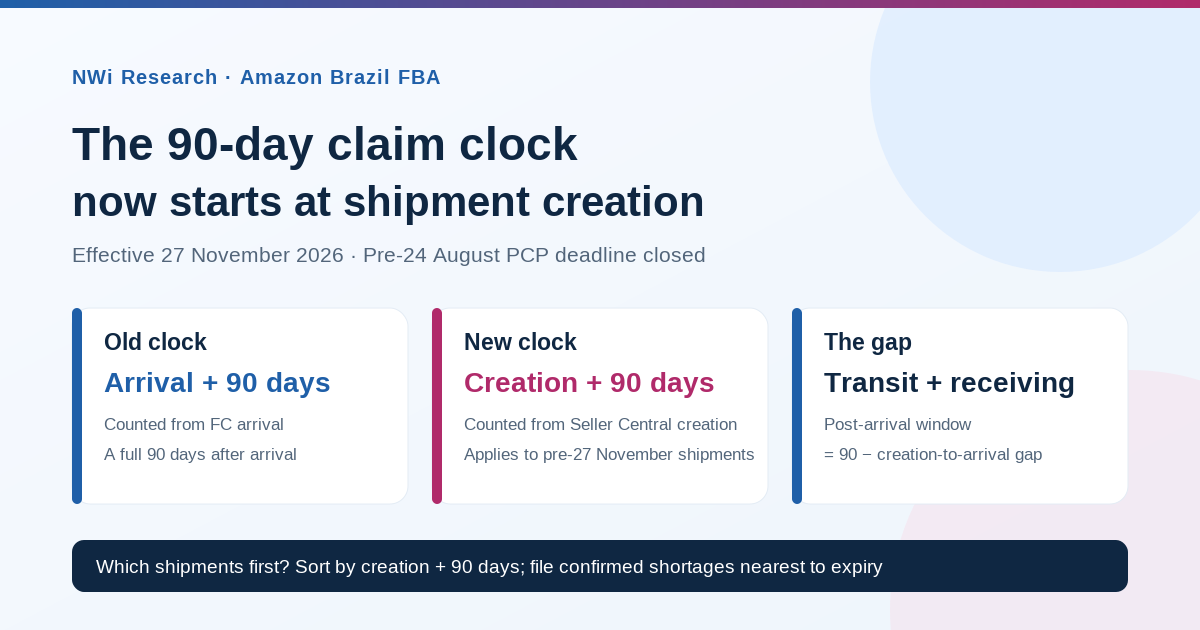
If you sell through FBA in Brazil, the countdown for an inbound lost-item claim no longer starts when the shipment reaches the fulfillment center. From 27 November 2026, it starts on the day you create the shipment in Seller Central. Brazil had already cut the lost-inventory claim period from nine months to three months after fulfillment-center delivery on 30 April 2026; this change moves the start of that three-month period forward, subtracting the entire transit and receiving gap from the claim window. The real question is not how long 90 days is, but which shipments are already out of window or about to expire under the creation-date rule, whether old PCP losses can still be counted as recoverable cash, and which batch to file first. This brief uses the official announcement, two labelled scenarios and a deadline table to set the order, actions and stop conditions. It does not turn the announcement into legal text or invent approval rates, reimbursement amounts or seller data.
1. The 27 November change moves the start date; it does not lengthen the 90 days
The official Amazon Brazil seller-forum announcement is specific: from 27 November 2026, the 90-day period for submitting a lost-item reimbursement claim starts on the shipment creation date, not the date the shipment arrives at the fulfillment center. The change applies to all FBA shipments, including those created before 27 November 2026, and it extends coverage to PCP (Partnered Carrier Program) shipments that never reach the fulfillment center. The announcement does not say the 90 days became longer; it changes the starting point.
This is not Brazil's first cut. From 30 April 2026, Brazil had already reduced the lost-inventory claim period from nine months to three months after fulfillment-center delivery. The 27 November change moves the start of the same window from arrival to creation. The two changes compound, and the practical window is much shorter than it was at the start of 2026.
| Date | Rule | Clock starts | Window |
|---|---|---|---|
| Before 30 April 2026 | Inbound lost-item claim | After FC delivery | 9 months |
| From 30 April 2026 | Inbound lost-item claim | After FC delivery | 3 months (90 days in the November post) |
| From 27 November 2026 | Inbound lost-item claim | Shipment creation | 90 days |
Scope matters. The announcement only addresses lost items in inbound FBA shipments. It does not restate the clocks for fulfillment-center lost/damaged inventory, customer returns or removals, and this article does not mix those paths into one calculation.
PCP is split at 24 August 2026. PCP shipments created before 24 August 2026, lost in transit and not claimed, had a final filing date of 26 November 2026; after that, claims are not eligible if more than 90 days have passed since creation. PCP shipments created on or after 24 August 2026 with carrier-confirmed lost units have claims opened automatically. Sellers who already filed for the older PCP shipments need no further action. The announcement does not explain why 24 August is the cut-off; this article follows the published split and does not invent a reason.
2. The mechanism: creation + 90 days subtracts transit and receiving time from the window
The new rule moves the 90-day start from arrival to creation, subtracting the entire transit and receiving gap from the claim window. The formulas are simple: new deadline = creation date + 90 calendar days; old deadline = arrival date + 90 calendar days; the difference = arrival − creation, which is the transit and receiving time. Because both windows are recalculated at 90 days, the time left after arrival = 90 − transit/receiving days. A 24-day transit and receiving gap leaves 66 days after arrival; a 40-day gap leaves 50 days.
The table below spreads the formula across five hypothetical dates. All dates are calendar days, not business days. The old deadline is calculated as arrival + 90 days; the April post used the phrase "three months", which may differ by a few days on a calendar-month reading. The direction and ranking do not change.
| Creation | Arrival at FC | Transit + receiving (days) | New deadline (creation + 90) | Old deadline (arrival + 90) | Days earlier |
|---|---|---|---|---|---|
| 30 August 2026 | 22 September 2026 | 23 | 28 November 2026 | 21 December 2026 | 23 |
| 1 September 2026 | 25 September 2026 | 24 | 30 November 2026 | 24 December 2026 | 24 |
| 1 October 2026 | 10 November 2026 | 40 | 30 December 2026 | 8 February 2027 | 40 |
| 15 October 2026 | 30 November 2026 | 46 | 13 January 2027 | 28 February 2027 | 46 |
| 1 November 2026 | 20 November 2026 | 19 | 30 January 2027 | 18 February 2027 | 19 |
The creation dates, arrival dates and unit counts in the table are assumptions used to demonstrate the formula, not Amazon, seller or NWi measurements.
The important point is not one date but the sorting key. Sellers used to sort by "arrival + 90"; they now need to sort by "creation + 90". The difference is exactly the transit and receiving time. For shipments created in late August or early September, that difference can pull a December deadline into late November.
Now PCP. PCP is Amazon's partnered-carrier program; the announcement covers PCP shipments that never reach the fulfillment center. For old PCP shipments (created before 24 August 2026, lost in transit, not claimed), the final filing date was 26 November 2026 and has passed. For new PCP shipments (created on or after 24 August 2026), a claim opens automatically only when the carrier confirms the loss. If the carrier has not confirmed the missing units, the seller still has to file within the applicable window. Auto-open is not "every PCP shortage is paid automatically".
Use the official flow. The April post describes: go to the shipment queue, select the shipment with a discrepancy, open the Content tab, use the Status column to choose "Search for missing units", upload the required documents, add information and preview the request. The November post points older PCP claims to "Get help and resources". UI labels vary by version and language; use what Seller Central currently shows.
One more boundary: the announcement does not publish the reimbursement basis, approval rate, processing time or appeal rules. The article multiplies missing units by an assumed unit cost to size exposure; that is not the amount Amazon will pay. Actual payment and timing depend on the policy page and Seller Central.
3. Scenario A: created 30 August, received 22 September, 40 units missing (labelled example)
Scenario A: created 30 August, received 22 September, 40 units missing (labelled example)
Assumptions: a non-PCP shipment created on 30 August 2026, received at the fulfillment center on 22 September 2026, 40 units short, an assumed BRL 30 unit cost, no claim filed yet, and the shortage is confirmed.
Dates first. Creation on 30 August 2026 + 90 days = 28 November 2026; arrival on 22 September 2026 + 90 days = 21 December 2026; the difference is 23 days, exactly the 23-day creation-to-arrival gap. The window left after arrival is 90 − 23 = 67 days, not 90.
Result: the new deadline is 28 November 2026, the old deadline is 21 December 2026, 23 days earlier; exposure at the assumed cost is 40 × 30 = BRL 1,200, and only 67 days remain after arrival.
With creation on 30 August 2026, arrival on 22 September 2026, 40 missing units and an assumed BRL 30 unit cost, the new deadline is 28 November 2026, the old deadline is 21 December 2026, 23 days earlier, and exposure is BRL 1,200.
The "23 days earlier" is not a rounding error. It pulls a shipment that looked like a late-December task into the weekend after Thanksgiving. A seller who plans around the old date will miss 28 November; the announcement gives no separate grace period for this non-PCP old shipment.
Decision: file before 28 November 2026 and keep the case number; if the shortage is not yet confirmed or the shipment is still under investigation, complete the evidence first, but do not treat 21 December as the new deadline.
Counter-case: if the 40 units are only a scanning delay, a later transfer or already under reconciliation, do not file before the shortage is confirmed. If a claim was already filed, do not duplicate it. If the shipment is still under investigation, keep the evidence and follow up before the deadline instead of waiting for the investigation to end.
40 units × an assumed BRL 30 unit cost = BRL 1,200 of exposure, not a recoverable amount. Actual reimbursement may use cost, sales price or another basis; this article does not assume a recovery rate and does not put BRL 1,200 into a cash forecast.
4. Scenario B: PCP shipment created 20 August, 100 units lost in transit (labelled example)
Scenario B: PCP shipment created 20 August, 100 units lost in transit (labelled example)
Assumptions: a PCP shipment created on 20 August 2026, 100 units lost in transit, an assumed BRL 20 unit cost, no claim filed, and the carrier has confirmed the loss.
Three dates. Creation on 20 August 2026 + 90 days = 18 November 2026; the official final filing date for pre-24-August PCP shipments was 26 November 2026; the research date is 27 November 2026. Two of the three dates are deadlines, and both have passed.
Result: creation + 90 days is 18 November 2026, and the official final filing date for old PCP shipments was 26 November 2026; as of 27 November 2026 both dates have passed, so the BRL 2,000 cannot be counted as recoverable cash.
Decision: treat this old PCP loss as zero recovery; for PCP shipments created on or after 24 August 2026 with carrier-confirmed losses, check the automatic claim status shipment by shipment instead of opening a new claim.
Why separate old PCP? Its treatment differs from an ordinary inbound shortage. An ordinary shipment follows creation + 90; old PCP had an explicit 26 November final filing date. The announcement also says that after that date a claim is not eligible if more than 90 days have passed since creation. The two conditions compound: an unclaimed old PCP loss should be treated as zero recovery.
Counter-case one: if the PCP claim was filed before 26 November, no further action is needed; the announcement says so explicitly. Counter-case two: if the carrier confirmed the loss after 26 November, the announcement publishes no "reopen after confirmation" exception; do not assume the window revives. Counter-case three: even if the Amazon claim is zero, carrier insurance, supplier credit or another contractual recovery may exist. This article only addresses the Amazon claim, does not decide the other channels, and does not double-count the same loss.
5. Action list and stop conditions
Build a table today, not an appeal email. Fields: shipment ID, creation date, arrival date, units sent, units received, units missing, assumed unit cost, PCP flag, carrier loss confirmation, claim filed, case number and current Seller Central status.
Export the last 120 days of shipments, calculate creation + 90 and arrival + 90 for each, sort by the new deadline, and file confirmed shortages with the nearest deadline first.
- Export FBA shipments created in the last 120 days, not only the last 90. For non-PCP shipments created on or before 29 August 2026, creation + 90 is on or before 27 November 2026; check whether a claim was already filed. If not, treat it as out of window unless Seller Central shows a different status.
- For each shipment, calculate four numbers: creation + 90, arrival + 90, the difference and the post-arrival window. Sort by creation + 90, not by arrival date.
- For confirmed shortages with no claim, start with the nearest deadline. Use the official flow, attach invoices, packing lists, carrier documents and reconciliation evidence, and record the case number.
- Split PCP into three buckets: created before 24 August, lost in transit and unclaimed → the 26 November old-PCP deadline has passed; created on or after 24 August with carrier-confirmed loss → verify the automatic claim status shipment by shipment; created on or after 24 August without carrier confirmation → file as an ordinary shortage within the applicable window.
- For shipments still in transit or being received, do not file early. Set reminders at creation + 75 and creation + 90, confirm the discrepancy, then decide.
- Remove unclaimed old PCP losses from Q4 recoverable cash. Keep exposure and actual reimbursement in separate columns; do not treat the assumed cost as confirmed cash.
Stop conditions: stop when the shortage is not confirmed; wait for evidence while the shipment is still being received or investigated; stop duplicate filings for a shipment already claimed; stop adding evidence when its cost exceeds the expected recovery; when Seller Central or the current policy page shows a different deadline or condition, follow the platform; do not fill missing approval rates, reimbursement rates or processing times with assumptions.
Who acts first? Three groups: first, non-PCP shipments created in late August or early September with confirmed shortages and no claim; second, pre-24-August PCP shipments lost in transit and unclaimed (cash treatment, not a new filing); third, Q4 inbound shipments created after September, whose creation + 90 deadlines fall in December and January.
6. Evidence boundaries, counter-cases and unknowns
The official post publishes no approval rate, average missing rate, typical transit time, affected-seller count, reimbursement basis, payment timing or appeal rule. The official post is an announcement, not the full policy; the policy page body requires a login, and this article only verified the official indexed clause that the 90 days start at creation. The available official documents confirm the rule and dates, but not approval rates, average missing rates, typical transit times, affected-seller counts, the reimbursement basis, payment timing or appeal outcomes.
A second boundary is the path: the post only changes the 90-day start for inbound lost items. It does not restate the clocks for fulfillment-center lost/damaged inventory, customer returns or removals. Mixing them into a single "60-day rule" or "90-day rule" will produce the wrong date.
A short receipt may be a scanning delay, a split delivery, a label problem or a later transfer; filing before the shipment finishes receiving can be rejected or require repeated evidence. More specifically, a short receipt can come from a scanning delay, a split delivery, a label problem or a later transfer; filing before the shipment finishes receiving can be rejected or require repeated evidence.
More counter-cases: a pre-24-August PCP claim already filed needs no duplicate; a non-PCP shipment created on or before 29 August may already be out of window on 27 November, so do not take comfort in the old December date; use the Seller Central creation date, not the ERP or factory ship date; unit cost is not the reimbursement basis; carrier insurance, supplier credit or another contractual recovery may exist, and this article neither counts nor double-counts them.
This article has no seller back end, actual claim outcomes, approval rate or reimbursement amount; every unit count, cost and date is a labelled assumption, not Amazon or seller measurement. Unknowns also include why 24 August is the cut-off, whether an overdue old PCP claim can be appealed, whether auto-open covers every carrier-confirmed unit, whether the policy page has other conditions, and actual processing times. None of these are in the readable material, and scenario assumptions cannot replace them.
The contribution is to split "90 days" into creation date, arrival date and the gap between them, and to give the old PCP cohort a clear closed-window boundary instead of repeating a generic claim deadline. The three most useful actions are: re-sort deadlines by creation date, remove old PCP from the cash forecast, and file confirmed shortages early instead of waiting for a quiet day.
7. Method, sources and product boundary
Data: the event comes from the Amazon Brazil Seller Forums announcement dated 12 November 2026 in the search index (the page shows "2 weeks ago"), read in full on 27 November 2026 and saved as raw HTML; the 30 April 2026 announcement is used to verify the prior cut from nine months to three months after fulfillment-center delivery; the official policy page is a login/JS shell, so only its indexed 90-day-from-creation clause is used. Calculations: new deadline = creation date + 90 calendar days; old deadline = arrival date + 90 calendar days (the April post says "three months", which may differ by a few days on a calendar-month reading; this article standardises on 90 days and labels it); transit/receiving days = arrival − creation; post-arrival window = 90 − transit/receiving days; exposure = missing units × assumed unit cost. All unit counts, costs, dates and recovery treatments are labelled assumptions, not Amazon, seller or NWi measurements. The article does not assume an approval rate, reimbursement rate or payment timing.
Product boundary: in the current public coverage list, NWi CrossborderGo covers Amazon US, major European sites and Japan, not Brazil. It provides market, category, brand, store, product and price-band data for covered sites, updated monthly under activated modules and contract terms. It does not provide FBA shipment, inbound discrepancy, claim status, reimbursement amount or Seller Central data. The deadline and exposure calculations in this article use the seller's own shipment ledger and do not rely on NWi data. If you also sell on Amazon US, Europe or Japan, or across platforms, [Amazon data analysis](/platforms/amazon/) and [NWi CrossborderGo](/product/) put market data into one framework; to turn the rule, ledger and scenarios into a research brief, see [NWi Cross-border Agent](/page/agent.html); for a walkthrough, see [request a demo](/demo/).
Sources: 1. Amazon Brazil Seller Forums, "Período de reivindicação de 90 dias do FBA - Logística da Amazon agora começa na criação do envio", page shows "2 weeks ago", search-index date 12 November 2026, accessed 27 November 2026: read the source; 2. Amazon Brazil Seller Forums, "O período reduzido de reembolso do programa FBA começa em 30 de abril de 2026", page shows "8 months ago", rule effective 30 April 2026, accessed 27 November 2026: read the source; 3. Amazon Brazil Seller Central Help, "Política de reembolso por inventário perdido ou danificado com o FBA - Logística da Amazon", body requires login; the official indexed clause is 90 days from shipment creation, accessed 27 November 2026: read the source.
This article was prepared with automated research assistance from the public sources listed at the end. It was not human-reviewed. It does not invent customer data, expert review, reimbursement amounts, approval rates, search rankings or platform endorsement. It is not legal, financial or marketplace-operations advice.