
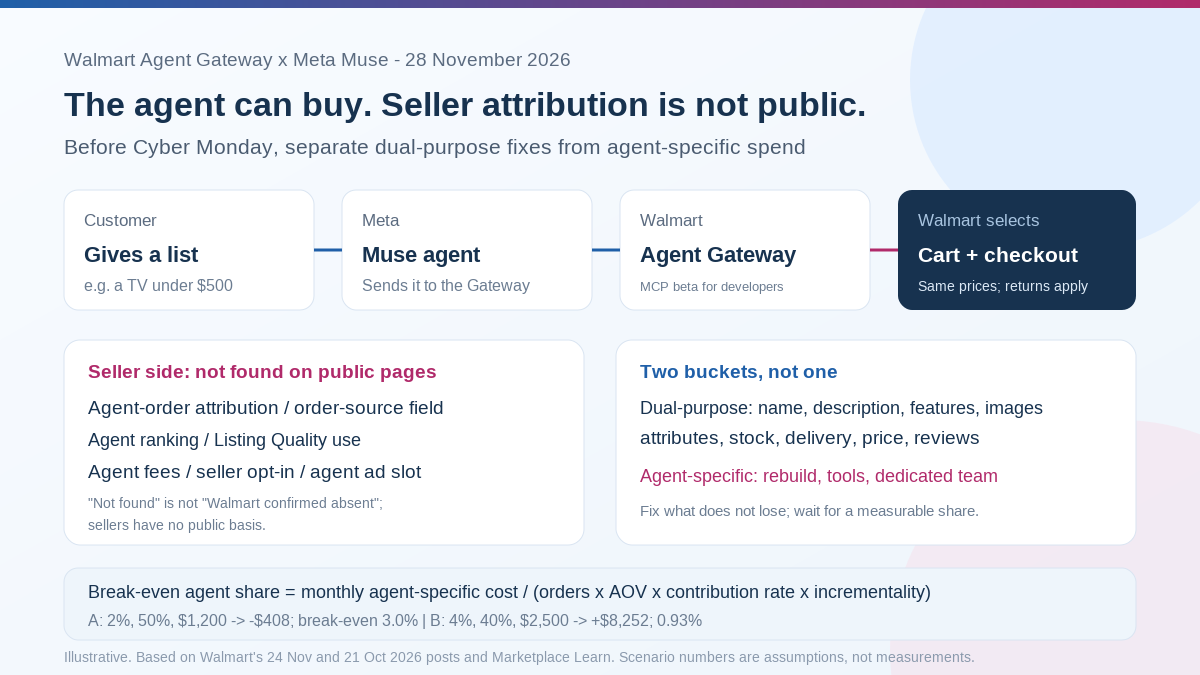
If you sell on Walmart Marketplace in the United States, the question after 24 November 2026 is not whether to do AI agents. It is narrower: Meta's Muse can now buy Walmart Black Friday items through the Walmart Agent Gateway, but on the public pages we read Walmart has not published seller-side agent-order attribution. How much product-data work should you do before Cyber Monday, and what can wait? This article separates the public facts, the evidence boundary and two labelled scenarios, then draws the line between dual-purpose fixes and agent-specific spend, with a review date you can execute.
Start with what is confirmed. On 24 November 2026 Walmart Corporate Newsroom said customers can shop Walmart's Black Friday deals directly through Muse, Meta's personal AI agent. The customer gives Muse a shopping list; Muse passes it to Walmart; Walmart finds matching products, builds the basket and completes the purchase in the conversation. Prices match Walmart.com and the returns policy still applies. The 21 October framework post adds that the Agent Gateway is an MCP beta for companies and developers, and Walmart's post calls MCP "model text protocol"; Agent Profiles let customers give an agent a separate profile, a spending limit (the post gives $50, $100 and $200 as examples), purchase approvals and a record of agent purchases; agents that break the terms are blocked.
One easy misreading: Walmart did not say sellers can optimize for agent ranking. The announcements describe the customer experience and the agent terms, not a seller tool. Muse does not browse your product page like a person; it sends the shopping list through the Gateway to Walmart, which returns matching products and builds the cart. Walmart selects the products; on the public pages we read, there is no agent placement or agent ad slot for sellers to buy, and no seller opt-in, fee or attribution field is published. As of 28 November 2026, the public pages we read from Walmart Corporate Newsroom, Walmart Marketplace Learn and TechCrunch did not contain seller-side agent-order attribution, ranking, fees or a seller opt-in. Turning "agents can check out" into "rebuild your catalogue for agents now" skips a step in the evidence.
This is not the Shopify agentic-checkout story
In our earlier article we covered Shopify's 23 November 2026 agentic checkout: it is a switch and attribution question inside the merchant's own checkout, where orders land in the merchant's back office with channel or referrer data, and the merchant decides whether to keep, limit SKUs or turn it off. Walmart's Gateway is a platform-side catalogue and checkout entry: Walmart controls product selection, content display and the customer relationship, and the seller sees a marketplace order, not a checkout channel it can configure. Both raise the question of how to count agent orders, but the available levers differ. For a Walmart seller, the closest lever is not checkout integration; it is the product's content, attributes, stock, delivery promise and price competitiveness inside Walmart's catalogue.
Content control is the second difference. Walmart Marketplace Learn says Walmart selects the best content for each item attribute, giving priority to content provided directly by brand owners and their authorized resellers; sellers without those privileges cannot update some fields, including blank fields. For a reseller, that means the data work may hit an access limit before it hits a budget limit. That constraint does not exist in the Shopify direct-to-consumer story, and it is why this article starts the action order with "check whether you can edit it".
The seller decision: dual-purpose fixes or agent-specific spend
The real decision is how much product-data work to do now, before any agent-order attribution exists, and which work should wait. The answer is not "do everything" or "wait for everything"; it is to split the work in two. Dual-purpose fixes cover item name, description, key features, images, attributes, stock, delivery promise, price competitiveness and reviews. These map to the five Listing Quality components; Walmart says quality listings drive higher conversion and product visibility, whether or not the agent channel succeeds. Agent-specific spend covers rebuilding the catalogue for agents, buying an "AI agent optimization" tool, hiring a dedicated team or running agent-only promotions. That spend pays back only when agent orders reach a certain scale.
The split has a practical benefit: the first bucket does not become waste if the agent channel stalls, while the second cannot be proven effective before attribution exists. The two scenarios below put a number on the second bucket's payback condition.
The break-even math: what agent share justifies a monthly cost
Let O be monthly orders, A the average order value, m the contribution rate, s the agent-order share, i the share of agent orders that are truly incremental, and C the monthly agent-specific cost. Agent orders = O x s; incremental orders = O x s x i; incremental contribution = O x s x i x A x m; net contribution = incremental contribution minus C. The break-even condition is O x s x i x A x m = C, so the break-even agent share is s* = C / (O x A x m x i). The formula answers only whether C pays back if s and i hold; it does not prove that s or i exist.
Scenario A: a smaller seller with 8,000 monthly orders and a 2% agent share
Assumes 8,000 monthly orders, a $45 AOV, a 22% contribution rate, a 2% agent-order share, 50% of agent orders incremental and a $1,200 monthly agent-specific cost; returns, unpublished agent fees and price wars are excluded.
Step by step: agent orders = 8,000 x 2% = 160; incremental orders = 160 x 50% = 80; incremental revenue = 80 x $45 = $3,600; incremental contribution = $3,600 x 22% = $792; net contribution = $792 - $1,200 = -$408. Break-even incremental orders = $1,200 / ($45 x 22%) = $1,200 / $9.90 = 121.21, rounded up to 122; corresponding agent orders = 122 / 50% = 244; break-even agent share = 244 / 8,000 = 3.05%, or about 3.0% on the unrounded formula.
Result: 160 agent orders, 80 incremental orders, $3,600 incremental revenue, $792 incremental contribution, -$408 net; break-even is 122 incremental orders, 244 agent orders and an agent share of about 3.0%. Decision: at a 2% agent share, do not spend $1,200 a month on agent-specific work; do the dual-purpose fixes first and revisit when attribution exists or the share exceeds about 3.0%.
Scenario B: a larger seller with 40,000 monthly orders and a 4% agent share
Assumes 40,000 monthly orders, a $60 AOV, a 28% contribution rate, a 4% agent-order share, 40% of agent orders incremental and a $2,500 monthly agent-specific cost; returns, unpublished agent fees and price wars are excluded.
Step by step: agent orders = 40,000 x 4% = 1,600; incremental orders = 1,600 x 40% = 640; incremental revenue = 640 x $60 = $38,400; incremental contribution = $38,400 x 28% = $10,752; net contribution = $10,752 - $2,500 = $8,252. Break-even incremental orders = $2,500 / ($60 x 28%) = $2,500 / $16.80 = 148.81, rounded up to 149; corresponding agent orders = 149 / 40% = 372.5, rounded up to 373; break-even agent share = 373 / 40,000 = 0.9325%, or about 0.93%.
Result: 1,600 agent orders, 640 incremental orders, $38,400 incremental revenue, $10,752 incremental contribution, $8,252 net; break-even is 149 incremental orders, 373 agent orders and an agent share of about 0.93%. Decision: if the 4% agent share can be measured and incrementality is at least 40%, $2,500 a month pays back; without attribution, both inputs remain assumptions, not a budget.
The two scenarios do not say large sellers should spend and small sellers should not. They show that the payback threshold depends jointly on order volume, AOV, contribution, agent share and incrementality, and the last two are exactly the numbers Walmart has not published on the pages we read and sellers have not measured. That is why dual-purpose fixes come first, and agent-specific spend waits until s and i can be measured.
The listing checks you can do now
Walmart splits Listing Quality into five components: content quality (item name, description, key features, images), price competitiveness (compared with similar products on external marketplaces), shipping (promised delivery speed), published and in stock (the last seven days), and ratings and reviews. For a seller, this is not agent optimization; it is the listing-quality score the platform already uses. Before Cyber Monday, start with the SKUs that carry the most sales or GMV and check three things: the fields flagged under attributes with issues, whether published and in stock is stable, and which fields you cannot edit at all because Walmart prioritizes brand-owner or authorized-reseller content.
The actions can be light: use the Bulk Attribute Editor for fields you can change; do not change prices solely for the agent; do not buy an "AI agent ranking" tool; cap the review at 20 internal hours. Twenty hours is a management cap, not a Walmart recommendation; its job is to stop agent anxiety from becoming a large, unmeasured rebuild. If most fields turn out to be uneditable, the next step is to check brand-owner or authorized-reseller access, not to add headcount.
Counter-cases and alternative explanations
The counter-case is that agent orders may simply move an order that would have happened on Walmart.com anyway, leaving near-zero incrementality, so a monthly agent-specific cost may never pay back. Another counter-case: the agent may care more about price, stock and delivery than about extra sentences in the content, in which case dual-purpose fixes still help but agent-only copy work may not. A third: because Walmart prioritizes brand-owner content, a reseller may not control the final page even after the work; the bottleneck is access, not effort.
Waiting can be wrong too. If the agent channel does scale, sellers that fixed attributes, stock and delivery early may get more stable matching; the cost of dual-purpose fixes is relatively low, so waiting is not free. Amazon is blocking third-party agents from making purchases while Walmart opens its Gateway to more developers, which means the channel structure is still moving; this article does not predict which side wins, only an order that does not lose in either case.
Actions and stop conditions
The order is: before Cyber Monday, do only capped dual-purpose fixes, starting with Listing Quality's attributes with issues and published and in stock, then list the fields you cannot edit and check brand-owner or authorized-reseller access. On timing: do not change prices broadly, rebuild the catalogue or buy agent-only tools before 30 November 2026; by 12 December 2026, complete an audit capped at 20 hours, record each SKU's field gaps, editability and fix cost, and write "agent-order attribution exists: yes or no" instead of guessing.
Set the review date at 31 January 2027, because Black Friday/Cyber Monday orders, returns and platform rules usually settle in January. Triggers to scale: Walmart publishes a seller-side agent-order attribution or order-source field; you can measure the agent-order share and it exceeds your break-even share; or Walmart publishes agent-related fees, ranking or seller tools that change the math. Stop conditions: by the review date there is still no attribution and no measurable lift; the agent remains a beta for companies and developers with no seller controls; or the audit shows most fields are uneditable, so access is the bottleneck. If any stop condition holds, pull the agent-specific budget back and keep only the dual-purpose fixes.
Unknowns and limitations
This article has no seller's Seller Center, agent orders, Listing Quality score or actual returns data, and no Walmart ranking, fee or attribution rules; the order counts, AOVs, contribution rates, agent shares and incrementality in both scenarios are labelled assumptions. Walmart's posts do not give agent order volume, GMV, conversion or seller adoption; TechCrunch confirms the launch and the Amazon contrast but has no seller outcome data. This article covers Walmart US only; the 21 October framework also mentions Sam's Club, which is outside scope here. The five Listing Quality components are Walmart's product-health measure, and this article does not present them as an agent-ranking input.
Original contribution
The contribution is not a retelling of Walmart adding Meta; it separates agent visibility into dual-purpose fixes and agent-specific spend, gives a break-even agent-share formula, and puts the platform's content-control limit into the action order. For a seller, the useful output is not the conclusion that AI agents have arrived, but an executable order: fix what does not lose, then wait for what can be measured.
Method and disclosure
Method: on 28 November 2026 this article re-read Walmart Corporate Newsroom's 24 November 2026 post "Walmart's Black Friday Deals Continue. Meta's Muse Can Now Shop Them, Too." and its 21 October 2026 post "Walmart Makes It Possible for Agents to Shop on Behalf of Customers, While Keeping Customers in Control", plus Walmart Marketplace Learn's "Listing Quality: Overview" (page last updated 9 April 2026) and "How to update content: Overview" (page last updated 3 April 2026). It used TechCrunch's independent 24 November 2026 report to check the launch facts and Amazon's block on third-party agents. The purchase flow, product selection, prices, returns policy, Agent Profiles, MCP beta and AI-agent terms in Walmart's two posts, and the five Listing Quality components, content priority and field-edit limits in Marketplace Learn, are recorded as published. Walmart's posts do not give agent order volume, GMV, conversion, seller adoption, seller opt-in, ranking logic, fees or an order-attribution field; this article records those as not found rather than as Walmart confirming they do not exist. Calculations: Scenario A uses 8,000 monthly orders, a $45 AOV, a 22% contribution rate, a 2% agent share, 50% incrementality and a $1,200 monthly agent-specific cost; Scenario B uses 40,000 orders, a $60 AOV, a 28% contribution rate, a 4% agent share, 40% incrementality and a $2,500 monthly cost. Contribution means variable contribution after COGS, marketplace fees, fulfillment and ads, before agent-specific costs, returns and unpublished fees. Every order count, AOV, contribution rate, agent share, incrementality and cost is a labelled assumption, not a Walmart, Meta, TechCrunch, NWi or seller measurement. Product scope: NWi CrossborderGo provides category, brand, store and product data for Walmart US and other activated platforms, including sales, units, ASP and brand share, updated monthly; exact sites, history and fields depend on the contract; it does not provide Walmart Seller Center orders, agent-order attribution, listing editing, real-time inventory or ad delivery data.
This article was prepared with automated research assistance and is based on the public sources listed at the end; it was not reviewed by a human. It does not invent customer data, expert review, agent orders, actual sales, profit or ranking effects. Nothing here is platform-operations, financial, tax or legal advice; the rules, availability and fees of Walmart Agent Gateway, Muse, Agent Profiles and Listing Quality may change, and the official Walmart pages, Seller Center, contract and actual invoices control.
To see Walmart US category, brand, store and price-band data before choosing which SKUs to audit, see NWi CrossborderGo. To turn a category or market question into a research task, see the Cross-border Agent. To discuss data access, see MCP. For a walkthrough or quote, use the inquiry and demo page. Product capability, site coverage, update frequency and fields depend on the activated modules and the contract.
- 1. Walmart Corporate Newsroom, 24 November 2026, Walmart's Black Friday Deals Continue. Meta's Muse Can Now Shop Them, Too.: Muse can shop Black Friday items; the list goes from Muse to Walmart; Walmart selects, builds the basket and checks out; prices match Walmart.com; returns apply; Agent Profiles set spending limits, approvals and agent purchase history; read 28 November 2026.
- 2. Walmart Corporate Newsroom, 21 October 2026, Walmart Makes It Possible for Agents to Shop on Behalf of Customers, While Keeping Customers in Control: the Agent Gateway is an MCP beta for companies and developers (the post calls MCP "model text protocol"); Agent Profiles; AI-agent terms; non-compliant agents are blocked; agent prices match human prices; read 28 November 2026.
- 3. Walmart Marketplace Learn, Listing Quality: Overview: five components; content quality, price competitiveness, shipping, published and in stock, ratings and reviews; Bulk Attribute Editor; page last updated 9 April 2026; read 28 November 2026.
- 4. Walmart Marketplace Learn, How to update content: Overview: content definition; brand-owner/authorized-reseller priority; sellers without access cannot update some fields, including blank fields; single-item, bulk, API and Approved Solution Provider methods; page last updated 3 April 2026; read 28 November 2026.
- 5. TechCrunch, 24 November 2026, Walmart teams up with Meta to bring Black Friday deals to AI agent Muse: confirms the launch; Muse sends the request to Walmart, which returns products and helps build the cart; Amazon blocks third-party AI agents; Instacart also works with Muse; Walmart plans to open the Gateway to more developers and AI platforms; read 28 November 2026.