
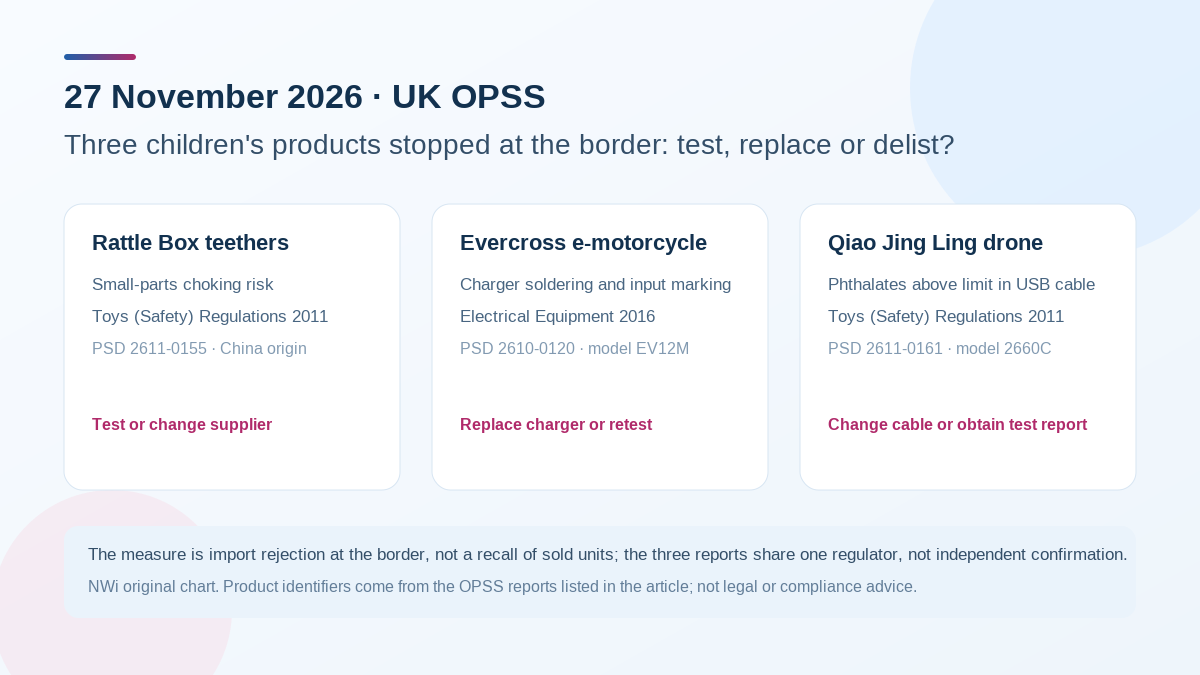
If you sell or import children’s toys, teethers, ride-on electric motorcycles or USB-charged toys in the UK, the decision on 27 November 2026 is not whether OPSS published another report. It is whether the next consignment should be tested by product family, moved to a new supplier, or delisted or returned before shipment. OPSS published three children’s-product safety reports on the same day covering Rattle Box teethers, an Evercross children’s electric motorcycle and a Qiao Jing Ling toy drone; all three measures are border rejection, not a recall of sold units. The answer is not “delist everything”; it is a risk matrix built by product family, batch and documents.
The decision is whether to test the next children’s-product consignment by product family, change supplier, or delist or return it before shipment, rather than waiting for a border rejection to force the choice.
What changed on 27 November: three reports, three failure modes
All three reports carry a publication and alert date of 27 November 2026. Rattle Box Safe Teethers (PSD 2611-0155) is rated serious and placed in the toys category; the Evercross children’s electric motorcycle (PSD 2610-0120) is rated high and placed in hobby/sports equipment; the Qiao Jing Ling Mini-Flight Indoor Micro Air Vehicle (PSD 2611-0161) is rated serious and placed in toys. All three measures are “import rejected at the border”, not a recall, and the reports do not say what happened to units already sold.
| Product | PSD | Model and identifiers | Hazard | Regulations cited | Measure |
|---|---|---|---|---|---|
| Rattle Box Safe Teethers | 2611-0155 | Model DP/BP:20260901A; Amazon product identifiers FBA15MBZZTD0U000037, BR-3241, X002NC2HZR; China origin | Breaks into small parts under impact or tension testing; the parts fit entirely in the small-parts cylinder and present a choking risk to children under three | Toys (Safety) Regulations 2011 | Border rejection |
| Evercross children’s electric motorcycle | 2610-0120 | Model EV12M; charger batch 260412; bike serial MBEV12M604100578; carton identifier MB-UK-TC-60602; China origin | Charger wires soldered directly to the PCB without adequate strain relief; connections could loosen or fail, causing shock, overheating, fire or explosion; the bike is marked 100–240 V but should be charged at 42 V DC | Electrical Equipment (Safety) Regulations 2016; Supply of Machinery (Safety) Regulations 2008 | Border rejection |
| Qiao Jing Ling toy drone | 2611-0161 | Model 2660C; Amazon product identifiers FBA15MBZZTD0U000052, X002DKUH7J, X002DL3JHX; SKU FR-7394-1; China origin | USB cable plastic contains DBP 1.00%, DEHP 1.40%, DIBP 0.12% and DINP 0.99%, above the 0.1% limit; may harm children’s health, including possible reproductive damage | Toys (Safety) Regulations 2011 | Border rejection |
The reports only say “Amazon product identifiers”; they do not say whether these are ASINs, FNSKUs or another identifier, and they are not confirmed as live ASINs. The reports also provide no product links. Sellers should not stop at “is my ASIN on the list?”; they should match brand, model, charger batch, cable supplier and test report as well.
The common thread is not the product type but the route by which a child-accessible part or charging accessory carries the risk: small parts in the teether, the charger in the motorcycle, and the USB cable in the drone. All three also show that border checks test whether the product meets the applicable regulations, not whether the listing is well written.
Mechanism: how three failure modes pass through a marketplace listing
The teether fails by breaking into small parts under impact or tension, the electric motorcycle fails through charger soldering and incorrect input marking, and the toy drone fails through phthalates in its USB cable; all three are children’s-product safety duties, not a single platform rule.
The teether failure is mechanical. The report says the product can break during impact or tension testing, creating small parts that fit entirely within the small-parts cylinder and therefore present a potential choking hazard to children under three. The product does not meet the Toys (Safety) Regulations 2011. The key question is not whether a teether is called a toy, but whether its intended use, size and features point to children under three; the report has already made that judgment.
The motorcycle failure is both electrical and labelling-related. The report says the charger has wires soldered directly to the printed circuit board without adequate strain relief, so connections could loosen or fail and cause electric shock, overheating, fire or explosion. The bike is also marked with the charger’s 100–240 V mains input instead of the bike’s 42 V DC charging input. The charger does not meet the Electrical Equipment (Safety) Regulations 2016 and the bike does not meet the Supply of Machinery (Safety) Regulations 2008.
The drone failure is chemical. The report says the USB charging cable’s plastic contains excessive phthalates: DBP at 1.00%, DEHP at 1.40%, DIBP at 0.12% and DINP at 0.99%, all above the 0.1% limit. Phthalates may harm children’s health, including possible damage to the reproductive system. The product does not meet the Toys (Safety) Regulations 2011.
Why is an ASIN not enough? An ASIN is a listing-level identifier, not a product-family, charger-batch or cable-supplier identifier. The same product can return under a new ASIN, the same charger batch can be fitted to motorcycles sold under different brands, and the same USB cable can be used across several toy SKUs. Screening only by ASIN misses relisted items, private labels and other products from the same supplier.
A marketplace listing is only the entry point; the compliance evidence sits with the supplier and importer: technical documentation, the declaration of conformity, test reports, batch records, and the charger and cable bills of materials. Border rejection happens when that evidence cannot show conformity, and a well-written listing cannot replace the file or the test.
Evidence boundary: what the three reports prove and what they do not
All three reports come from the same regulator, OPSS; they prove the products, models, hazards and border-rejection measure in the reports, but not defect rates, sales, recalls of sold units or the current status of any Amazon listing.
The three reports are three different documents from one regulator on one day, not independent cross-verification by three bodies. They prove the products, models, hazards and measures in the reports; they do not prove a market-wide defect rate, nor that every product sold by a particular platform or seller is affected.
The measure is border rejection, not recall. The reports do not say what happened to units already sold, and they do not give sales losses, testing costs or appeal outcomes. The current status of any Amazon listing was not verified; the Amazon product identifiers are not necessarily ASINs and cannot be used to decide whether a listing is still live.
Read the regulation references as written: the teether and drone reports cite the Toys (Safety) Regulations 2011; the motorcycle charger cites the Electrical Equipment (Safety) Regulations 2016, and the bike cites the Supply of Machinery (Safety) Regulations 2008. Do not merge the three reports into one “new toy rule” or “new Amazon rule”.
Counter-cases and alternative explanations: when not to delist everything
The same model does not mean every batch is non-compliant; if the supplier can provide batch-specific test reports, a different cable or a different charger version, with traceable documents, the whole consignment need not be delisted.
Counter-case one: a different batch. If the supplier can provide a charger from a different batch, test reports for a different cable supplier, and technical documentation and a declaration of conformity that match the batch, the whole consignment need not be treated as one risk.
Counter-case two: the product is not for children under three. Age grading for the teether and the toy drone depends on function, size, features and marketing, not only the age label on the pack; a product genuinely intended for children over three and without small parts faces different requirements. But the reports have already assessed these as children’s products on their intended use, so a seller cannot rebut them with “it says 3+” alone.
Counter-case three: the seller is not the importer. The UK importer duty may sit with another entity; check the contract, invoice and customs party first, and do not assume every obligation is yours. This is not legal advice.
Alternative explanation: a border rejection may reflect a specific batch, charger version or cable rather than a design defect across the model, and a passing test may simply have missed a defective unit. The reports give no defect rate or sampling method, so this article supports a product-family and batch screen, not a conclusion that everything is recalled or everything is safe.
Reproducible analysis: test, replace or delist
The three scenarios below are assumptions, not OPSS, NWi or seller measurements. The currency is pounds sterling and the figures exclude freight, VAT, destruction fees, penalties, lost sales, refunds and customer compensation; use your own landed cost, contribution, batch and supplier terms.
Scenario A: 800 teethers, test before shipment or ship now
Assume 800 teethers at GBP 2.50 landed each, with testing and file review costing GBP 350.
The consignment value is GBP 2,000, so the break-even rejection probability is 350 divided by 2,000, or 17.5%; at a 10% rejection probability the expected loss is GBP 200, below the GBP 350 test fee; at 25% it is GBP 500, above the fee.
If the rejection probability is below 17.5% and the test cannot be shared, complete the test reports and batch file before shipping; if it is above 17.5%, or one test covers several SKUs, test first.
Scenario B: 120 electric motorcycles, replace the charger or release by batch
Assume 120 electric motorcycles at GBP 180 landed each, with charger replacement, re-marking and retesting costing GBP 2,400.
The consignment value is GBP 21,600, so the break-even rejection probability is 2,400 divided by 21,600, or 11.1%; at 15% the expected loss is GBP 3,240, above the GBP 2,400 replacement cost; at 5% it is GBP 1,080, below that cost.
If charger batch 260412 is in the consignment and no batch-specific test report exists, replace the charger or retest; if the batch is different and the documents are traceable, release by batch.
Scenario C: 2,000 toy drones, change the USB cable or test the cable
Assume 2,000 toy drones at GBP 4.20 landed each, a replacement USB cable at GBP 0.35 per unit, and cable testing at GBP 500.
The consignment value is GBP 8,400; cable replacement plus testing is 0.35 times 2,000 plus 500, or GBP 1,200, so the break-even rejection probability is 1,200 divided by 8,400, or 14.3%; at 5% the expected loss is GBP 420, below GBP 1,200; at 20% it is GBP 1,680, above GBP 1,200.
If the same USB cable is used across several SKUs, spread the GBP 1,200 over all affected SKUs; for a single SKU with a rejection probability below 14.3%, obtain a cable test report rather than replacing the whole batch.
| Scenario | Key assumptions | Calculation | Result | Decision meaning |
|---|---|---|---|---|
| A: teether testing | 800 units at GBP 2.50; testing GBP 350 | 350 ÷ 2,000 | Break-even 17.5%; 10% rejection loses GBP 200, 25% loses GBP 500 | Below 17.5% and no shared test, complete the file first; above 17.5% or a shared test, test first |
| B: motorcycle charger replacement | 120 units at GBP 180; replacement and retest GBP 2,400 | 2,400 ÷ 21,600 | Break-even 11.1%; 15% rejection loses GBP 3,240, 5% loses GBP 1,080 | If batch 260412 is in the consignment and no batch report exists, replace or retest |
| C: drone cable replacement | 2,000 units at GBP 4.20; cable GBP 0.35 per unit; testing GBP 500 | 0.35 × 2,000 + 500; 1,200 ÷ 8,400 | Replacement plus test GBP 1,200; break-even 14.3%; 5% rejection loses GBP 420, 20% loses GBP 1,680 | Spread over several SKUs; for one SKU below 14.3%, obtain a cable test report first |
Sensitivity: if the teether test fee falls from GBP 350 to GBP 200, Scenario A’s break-even rejection probability falls from 17.5% to 10%; if the motorcycle replacement cost rises from GBP 2,400 to GBP 3,600, Scenario B’s break-even rises from 11.1% to 16.7%; if the drone cable cost falls from GBP 1,200 to GBP 700, Scenario C’s break-even falls from 14.3% to 8.3%. These changes move the thresholds, not the order of the decision.
Scenario A’s break-even rejection probability is 350 divided by 2,000, or 17.5%; Scenario B is 2,400 divided by 21,600, or 11.1%; Scenario C is 1,200 divided by 8,400, or 14.3%. Put together, testing and replacement are not “the more expensive the safer”; they are ranked by rejection probability and by how many SKUs can share the test. The more SKUs a shared test covers, the lower the break-even point for each SKU.
Action list and stop conditions
Step one, fix the scope: list every teether, children’s electric motorcycle and USB-charged toy drone purchased or imported in the past 12 months, plus every SKU sharing the supplier, model, charger batch or cable, including private labels and different brand names.
Step two, build a product-family table: product name, model, PSD number, Amazon product identifier, charger model and batch, cable supplier, test-report number, importer and supplier.
Step three, request the file: declaration of conformity, technical documentation, test reports, batch records, charger and cable bills of materials, and change notices.
Step four, quarantine: place stock that matches a risk field on quality hold before labelling or shipping.
Step five, test or replace: decide by product family and batch whether to test, replace the charger, replace the USB cable, return or destroy; a qualified laboratory should set the test plan under the applicable regulations.
Step six, decide: handle each batch on its rejection probability, shared testing cost and batch evidence; do not release an entire product family on one SKU’s test report.
First fix the scope by product family and Amazon identifier, then request batch, cable and charger-version test reports and conformity documents, and finally decide whether to test, replace, return or delist using the rejection probability and shared testing cost.
Observation fields: product name, model, PSD number, Amazon product identifier, charger model and batch, cable supplier and batch, test-report number and date, declaration of conformity and technical-file version, importer name and address, supplier change notices, customer returns and reviews mentioning small parts, heat, burning smells, shock or cable odour, and the current status of the Amazon UK listing.
Trigger points: before the next shipment; before relisting; when a new OPSS report matches the model, charger batch or cable; when a customer complaint mentions small parts, heat, a burning smell, shock or cable odour; or when the supplier cannot produce traceable documents. Stop conditions: the specific batch is shown to use a different charger version, cable or supplier, with traceable test reports and a declaration of conformity; the supplier accepts a replacement or return at a cost below the risk of continuing to sell; a regulator recalls, delists or otherwise acts on the product; or testing and file review show the batch conforms.
Limitations and unknowns
This article has no sales, defect-rate, test-standard, laboratory-quote or sold-unit recall data, and it did not verify the current status of any Amazon UK listing; the cost figures are assumptions.
All three reports come from OPSS, the same regulator; they are different documents from one publisher, not independent third-party cross-verification. They prove the products, models, hazards and measures in the reports, not a market-wide defect rate.
The reports give no sales, shipment volumes, importer identity, defect rate, test standard or sold-unit recall data, and the current status of any Amazon UK listing was not verified. Amazon product identifiers are not necessarily ASINs and cannot be used to decide whether a listing is still live.
The landed costs, test fees, replacement prices, rejection probabilities and defect rates in the scenarios are assumptions; obtain actual values from purchase contracts, supplier quotes, laboratory quotes and your own sales data. This is not legal, compliance, tax or investment advice; questions about importer duties, product liability and test standards should be referred to a qualified professional.
Product scope: [NWi CrossborderGo](/product/) provides global overview, industry analysis, brand and store research, product research and custom-market analysis to help map affected ASINs, brands, stores and live markets; to map affected SKUs to sites and categories, use [request a demo](/demo/) to discuss the data scope. Available sites, history and fields depend on account authorisation and the contract. It does not read OPSS notices or provide compliance certification, defect rates or recall status.
Method and disclosure
The contribution is to place three same-day OPSS children’s-product reports in one risk matrix and use reproducible break-even arithmetic to show when to test, replace or delist, rather than repeating a recall headline.
Data basis: this article reopened and read the three OPSS product safety reports on 27 November 2026 for Rattle Box teethers (2611-0155), the Evercross children’s electric motorcycle (2610-0120) and the Qiao Jing Ling toy drone (2611-0161), together with the GOV.UK pages for the Toys (Safety) Regulations 2011, the Electrical Equipment (Safety) Regulations 2016: Great Britain guidance and the Supply of Machinery (Safety) Regulations 2008: Great Britain guidance. Product names, PSD numbers, models, product identifiers, hazard wording, regulation references and measures come from those pages; all three reports were published on 27 November 2026 and all three measures are border rejection. Arithmetic: Scenario A consignment value = 800 × 2.50 = GBP 2,000; break-even rejection probability = 350 ÷ 2,000 = 17.5%. Scenario B consignment value = 120 × 180 = GBP 21,600; break-even = 2,400 ÷ 21,600 = 11.1%. Scenario C consignment value = 2,000 × 4.20 = GBP 8,400; cable replacement plus testing = 0.35 × 2,000 + 500 = GBP 1,200; break-even = 1,200 ÷ 8,400 = 14.3%. All landed costs, test fees, replacement costs, rejection probabilities and defect rates are labelled assumptions, not OPSS, NWi or seller measurements. Product scope: NWi CrossborderGo provides global overview, industry analysis, brand and store research, product research and custom-market analysis; available sites, history and fields depend on account authorisation and the contract, and it does not read OPSS notices or provide compliance certification, defect rates or recall status.
This article was prepared with automated research assistance and analysed from the public sources listed at the end; it was not manually reviewed. It does not invent customer data, expert review, sales lift, ranking results or platform endorsement. It is not legal, compliance, tax or investment advice; questions about importer duties, product liability, test standards or recall status should be referred to a qualified professional.
Sources:
- OPSS product safety report: Rattle Box Safe Teethers (2611-0155)
- OPSS product safety report: Evercross Children's Electric Motorcycle (2610-0120)
- OPSS product safety report: Qiao Jing Ling Mini-Flight Indoor Micro Air Vehicle (2611-0161)
- Toys (Safety) Regulations 2011
- Electrical Equipment (Safety) Regulations 2016: Great Britain
- Supply of Machinery (Safety) Regulations 2008: Great Britain