
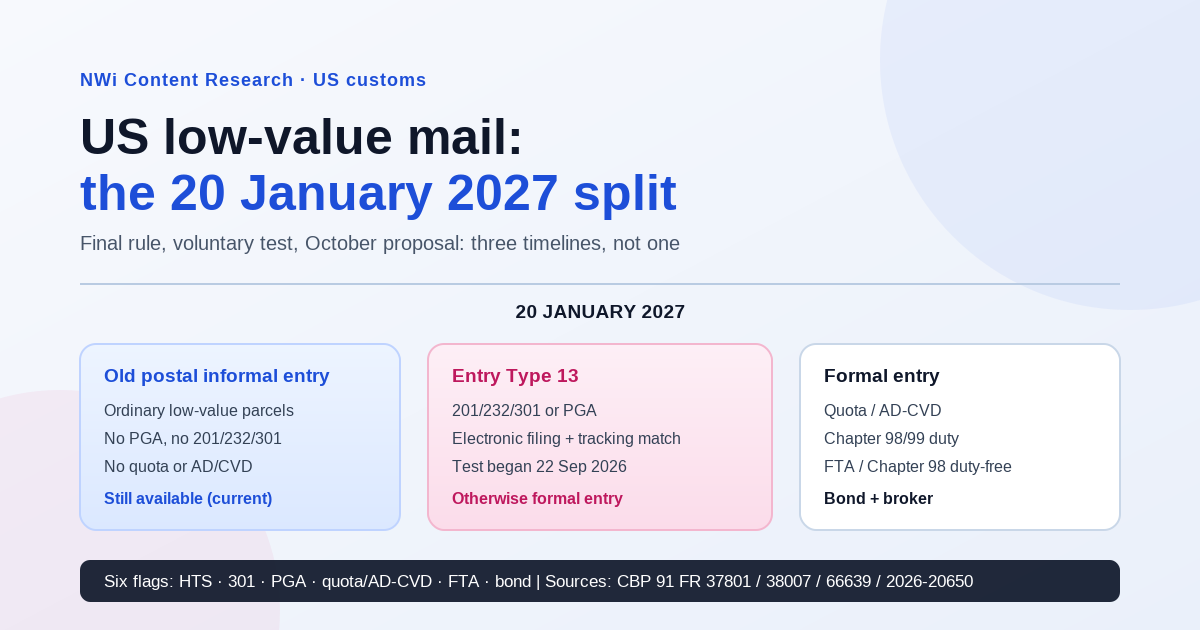
US Customs and Border Protection (CBP) has extended the mandatory implementation date for international mail Entry Type 13 from 22 October 2026 to 20 January 2027. The real question is not whether the US ended low-value parcel duty relief, but which of my postal parcels can no longer use the old postal informal entry process after 20 January 2027 and must move to Entry Type 13 or formal entry, and whether I should have the data chain ready before the comment deadline. The rule already in force is the 24 June 2026 interim final rule: the de minimis exemption for mail shipments valued at $800 or less is suspended indefinitely, and a postal informal entry process for goods valued at $2,500 or less is created. Goods subject to PGA requirements, Chapter 98/99 duties, quota or AD/CVD, or an FTA/Chapter 98 duty-free claim cannot use that process and must use formal entry. The 22 October 2026 final rule moved the formal-entry compliance date to 20 January 2027. A 14 October 2026 CBP release says postal shipments subject to Section 201, 232 or 301 duty, or to PGA jurisdiction, must file electronically through Entry Type 13 from 20 January 2027, otherwise formal entry applies. The 8 October 2026 proposal would extend the new electronic entry and data requirements (Entry Type 13) to all international mail parcels except letters and flats, with comments due 7 December 2026 — that part is not law yet. This article uses a trigger table, a 15-day abandonment formula and three scenarios to decide what to do now, what to wait for, and when to stop.
1. The decision: which parcels change on 20 January 2027?
20 January 2027 is not a single switch for every postal parcel. The 24 June 2026 interim final rule (91 FR 37801) limits the goods that cannot use the new postal informal entry process to several groups: goods subject to quota, anti-dumping or countervailing duty (AD/CVD); goods subject to Chapter 98 or Chapter 99 duties; goods subject to import or entry-related Partner Government Agency (PGA) data requirements; and goods for which duty-free treatment is claimed under Chapter 98 or a free trade agreement (FTA). Those goods must use formal entry. Other mail goods valued at $2,500 or less and classifiable in HTS chapters 1–97 may use the new postal informal entry process.
CBP’s 14 October 2026 release uses a different formulation: international postal shipments subject to Section 201, 232 or 301 duty, or to PGA jurisdiction, must file electronically in ACE through Entry Type 13 from 20 January 2027, otherwise formal entry applies. The two texts are not identical: the final rule also lists quota, AD/CVD, Chapter 98/99 and FTA/Chapter 98 duty-free claims, while the release summarises the scope as 201/232/301 and PGA. For a compliance plan, start with the broader final-rule list to flag each SKU, then check the release’s 201/232/301/PGA list item by item; do not decide on the shorter list alone.
Ordinary low-value postal parcels that do not meet those conditions can still use the current postal informal entry process. The 8 October 2026 proposal (Docket USCBP-2026-0298) would extend the new electronic filing and data requirements to all international mail parcels except letters and flats, and would deem unentered mail voluntarily abandoned after 15 days; but that is only a proposal, with comments due 7 December 2026, and the final text may change. Treating “the proposal covers all mail” as a fact already in force on 20 January 2027 is the first misreading this article avoids.
2. The mechanism: filing time, data responsibility and release conditions
Under the old postal informal entry process, data moved inside the mail stream and CBP and the postal operator processed it after arrival, so the filing point came relatively late. The new process makes the entry electronic: Entry Type 13 requires the importer of record (IOR), the owner/purchaser or a licensed customs broker to submit an electronic informal entry in ACE; the 8 October proposal would further require ET11/ET13 filing before or upon arrival and would move the ET11 deadline from 15 days after arrival. If the carrier voluntarily joins the test, it reports the tracking number in the manifest; only when both the carrier and the filer participate can CBP match the manifest tracking number with the entry tracking number. The 8 October proposal would make the manifest tracking number mandatory. If the tracking number does not match, CBP cannot confirm that the shipment was timely entered, and the goods are not released.
Entry Type 13 turns the informal mail entry that postal operators and customs used to handle inside the mail stream into an electronic filing in ACE; the October proposal would require filing before or upon arrival, and, when the carrier voluntarily joins the test, matches the manifest tracking number with the entry tracking number; if the numbers do not match, the shipment is not released, and the October proposal would make the manifest tracking number mandatory.
Entry Type 13 is not “no entry”. It is still an informal entry for international mail goods valued at $2,500 or less; the test also temporarily covers goods subject to PGA requirements or Chapter 98/99 duties that normally cannot use informal entry, but AD/CVD and quota goods remain ineligible. The ET13 test data set includes filer code, IOR number, merchandise description, country of origin, HTS classification, quantity/weight (if specific duty rates apply), duty rate, value, total duty, carrier name, tracking number and arrival port; the 8 October 2026 proposal would add the shipper/sender and the Final Deliver-To Party, and would require the carrier manifest tracking number to match the entry tracking number.
The bond is another threshold that is easy to miss. The 24 June 2026 interim final rule requires a single-transaction or continuous bond containing the conditions in 19 CFR 113.62 for goods using the new postal informal entry process; without a bond, the entry is not accepted and the goods are not released. The 8 October 2026 proposal would add a minimum liquidated-damages amount of $1,000 for each breach of a listed bond condition for ET11 and ET13. The seller must confirm who holds the bond, who acts as IOR, whether the carrier advances the bond, and who bears the loss if the entry fails. Treating “the carrier clears it” as “the seller has no bond duty” is the second common misreading.
3. The evidence boundary: three timelines, not one
The first line is the rule already in force. The 24 June 2026 interim final rule (91 FR 37801) suspends the de minimis exemption for international postal shipments valued at $800 or less indefinitely, effective 24 July 2026, and creates a postal informal entry process for goods valued at $2,500 or less. Goods subject to PGA, quota/AD/CVD, Chapter 98/99 duties, or an FTA/Chapter 98 duty-free claim cannot use that process and must use formal entry; the original compliance date was 22 October 2026.
The second line is the test. CBP published the Entry Type 13 test notice on 24 June 2026 (91 FR 38007). The test began on 22 September 2026 and continues until CBP concludes it by announcement; comments remain open during the test. Participation is voluntary, and the test gives eligible mail goods valued at $2,500 or less an alternative to formal entry. CBP’s 14 October 2026 release encourages filers, brokers and logistics providers to use it during the transition so they are ready before 20 January 2027.
The third line is the proposal. On 8 October 2026 CBP published the “Low-Value Shipments” proposed rule (91 FR 64532), with comments due 7 December 2026. It proposes electronic filing for ET11 and ET13 before or upon arrival; a shipper/sender and tracking number for ET13; a tracking number in the carrier manifest; bond requirements and a $1,000 minimum liquidated-damages amount for ET11/ET13; deemed voluntary abandonment after 15 days for unentered mail; and an extension of the new entry and data requirements to all international mail parcels except letters and flats. The 22 October 2026 final rule (91 FR 66639) moved the compliance date for 19 CFR 145.12(a)(2)(v) and (vi) to 20 January 2027 and confirmed that, during the extension, goods subject to PGA, Chapter 98/99 or FTA/Chapter 98 may still use the postal informal entry process temporarily.
Where is the evidence boundary? CBP itself said in the 24 June 2026 rule that, because the postal environment lacks product classification data, it does not know what share of postal entries will lose eligibility for the new process and therefore cannot estimate the total cost. That sentence matters: any precise claim about “what percentage of parcels is affected” is an estimate unless it is based on CBP or carrier classification data. CBP’s e-commerce page says nearly 4 million low-value shipments enter the US each day; that is enforcement context, not the share subject to Section 201/232/301 or PGA. This article does not multiply those two numbers to derive an affected-parcel count.
What is already in force is the 24 June 2026 interim final rule and the 22 October 2026 extension of the compliance date; the 8 October 2026 rule is still a proposal with comments due 7 December 2026, so the 15-day abandonment and the all-mail-parcels scope cannot be written as current law.
The release calls Entry Type 13 mandatory from 20 January, while the test notice calls participation voluntary; both can hold: covered parcels must leave the old process, using ET13 if they join the test and formal entry if they do not. For the seller, the practical question is no longer “should I use ET13?” but “can my carrier or broker already file ET13, and do I have a formal-entry fallback signed if they cannot?”
4. The trigger table: six flags per SKU
Break “does my parcel change route” into six checkable flags. The table is a triage, not a legal classification; the HTS code, PGA status and origin-preference eligibility must be confirmed by a licensed broker or specialist, not guessed from the product title.
| Flag | What to check | Can it still use the old postal informal entry after 20 Jan 2027? | Available route |
|---|---|---|---|
| Chapter 99 additional duty | Whether Section 201/232/301 or another additional duty applies | No | Entry Type 13 test (if eligible) or formal entry |
| PGA jurisdiction | Whether FDA, CPSC, FCC, USDA or another agency has an import data requirement | No | Entry Type 13 test (if supported) or formal entry |
| Quota / AD-CVD | Whether a quota, anti-dumping or countervailing duty applies | No | Formal entry |
| Chapter 98/99 duty | Whether duty is paid or special treatment is claimed under Chapter 98/99 | No | Formal entry or Entry Type 13 (if eligible) |
| FTA / Chapter 98 duty-free | Whether an FTA or Chapter 98 duty-free claim is made | No | Formal entry; Entry Type 13 eligibility must be confirmed under the test |
| Ordinary low-value mail | No flags above, value $2,500 or less, HTS 1–97 | Yes (current) | Postal informal entry; the October proposal could change this |
| Letters and flats | Letters, flat printed matter, etc. | Proposal exempts them | Current mail process; confirm in the final rule |
Use the table by excluding first, then deciding. If any row hits “No”, do not look at the ordinary low-value route; only if all six flags are clear does the ordinary mail process apply, and even then the 8 October proposal remains a watch item. Note that Section 201/232/301 are a subset of Chapter 99 additional duties; the release uses 201/232/301 as examples, while the final rule uses the broader Chapter 98/99 and PGA formulation. The lists overlap but are not identical.
5. Scenario A: a Section 301 postal parcel at 5,000 units a day
Scenario A: a Section 301 postal parcel at 5,000 units a day
Assumptions: 5,000 parcels a day, $60 average declared value, all subject to Section 301 duty, HTS chapters 1–97, no PGA, quota, AD/CVD or FTA/Chapter 98 duty-free claim; the carrier and broker can file Entry Type 13; $0.80 per parcel for electronic filing and data, $35 per formal entry; duty, freight, returns and working capital are excluded.
Annual Entry Type 13 filing cost = 5,000 × 365 × $0.80 = $1,460,000; annual formal-entry cost = 5,000 × 365 × $35 = $63,875,000; the gap is $62,415,000. As long as the one-off data integration cost is below the gap, Entry Type 13 has the lower total cost; at 5,000 parcels a day, a $1m integration cost is covered by the gap in about six days.
Decision: join the Entry Type 13 test before December 2026 and run a two-week pilot; scale only after the tracking-match rate reaches 98% and the entry-acceptance rate reaches 99%; if not, fix the data first and do not wait until 20 January 2027 to switch.
The point of this scenario is not the exact fee but the order of magnitude: when formal entry costs tens of dollars more per parcel than Entry Type 13, a seller at thousands of parcels a day cannot cover every parcel with formal entry; the real constraint is data integration and carrier cooperation, not the entry fee itself. Conversely, if the SKU mix is complex, the PGA data is unavailable, or the carrier is not in the test, the low-cost route is unavailable and formal entry must be ready.
6. Scenario B: an ordinary postal parcel at 2,000 units a day
Scenario B: an ordinary postal parcel at 2,000 units a day
Assumptions: 2,000 parcels a day, $25 average declared value, no Section 201/232/301 duty, PGA, quota, AD/CVD, Chapter 98/99 or FTA/Chapter 98 duty-free claim; the current postal informal entry process continues to apply; if the 8 October proposal is finalised, unentered mail is deemed voluntarily abandoned after 15 days; the unentered share is assumed at 1%.
15-day pipeline exposure = 2,000 × 15 × $25 × 1% = $7,500; annual expected loss = 2,000 × 365 × $25 × 1% = $182,500; at a 0.1% unentered share it is $18,250, and at 2% it is $365,000. If pre-filing costs $0.50 per parcel, the expected loss per parcel at 1% is only $0.25, so pre-filing does not pay; it breaks even only above a 2% unentered share.
Decision: do not treat 15 days as a loss multiplier; measure the unentered share and tracking-match rate first. If the unentered share is below 2%, fix data and reconciliation before pre-filing every parcel; if it is above 2%, compare the pre-filing cost with the expected loss.
This scenario deliberately puts the 15 days back where they belong: 15 days is the cure window and the length of the pipeline exposure, not a multiplier that turns the per-parcel loss into 15 times its value. Many models treat “15 days × value × unentered share” as the per-parcel loss, overstating the benefit of pre-filing; the correct expected loss per parcel is “unentered share × value”, and the 15 days only determine how much time remains to correct the entry before the goods are abandoned.
7. Scenario C: a high-value PGA parcel at 50 units a day
Scenario C: a high-value PGA parcel at 50 units a day
Assumptions: 50 parcels a day, $300 average declared value, subject to a PGA requirement (for example FDA data), and therefore required to leave the old postal informal entry process; $35 per formal entry; $2 per parcel for Entry Type 13 plus a $10,000 one-off data integration; duty, freight, returns and working capital are excluded.
Annual formal-entry cost = 50 × 365 × $35 = $638,750; annual Entry Type 13 cost = 50 × 365 × $2 + $10,000 = $46,500; the gap is $592,250. If the PGA data is not supported by the Entry Type 13 test, however, Entry Type 13 is unavailable and formal entry is the only route.
Decision: confirm first whether the PGA data is supported by the Entry Type 13 test; if it is, pilot at small scale; if it is not, sign a formal-entry broker before 20 January 2027 and do not assume the carrier will solve PGA data for the seller.
High-value, low-volume sellers are the most likely to misread this: they see that Entry Type 13 is cheaper and assume they can use it, but PGA data support, the HTS chapter, whether the goods are letters or flats, and whether the carrier is in the test can all push the route back to formal entry. Confirm eligibility first, then discuss cost; reversing the order only saves money on paper.
8. The reproducible stop line: 15-day abandonment
The reproducible stop line is: pre-filing cost per parcel is lower than the unentered share times average value; the 15 days define the cure window and the pipeline exposure, not a multiplier on the per-parcel loss. At a $25 average value and a 1% unentered share, the expected loss per parcel is $0.25; if pre-filing costs $0.50 per parcel, it only pays above a 2% unentered share.
| Average value | Unentered 0.1% | 1% | 2% | 5% |
|---|---|---|---|---|
| $25 | $0.025 | $0.25 | $0.50 | $1.25 |
| $60 | $0.06 | $0.60 | $1.20 | $3.00 |
| $120 | $0.12 | $1.20 | $2.40 | $6.00 |
The figures in the table are “expected abandonment loss per parcel = unentered share × average value”, not “15 × unentered share × value”. If the pipeline also needs a budget line, calculate “15-day pipeline exposure = daily parcels × 15 × unentered share × average value”; that is the inventory exposure at a point in time, not the annual loss. Do not mix the two measures.
How to use the stop line: measure your own unentered share and tracking-match rate, then insert the per-parcel pre-filing cost. If the cost is below the expected loss per parcel, pre-filing is financially justified; if it is above, reduce the unentered share first rather than adding a filing layer to every parcel. For a seller at 2,000 parcels a day and a $25 value, a 1% unentered share gives an expected loss of only $0.25 per parcel; a $0.50 pre-filing cost breaks even only above a 2% unentered share.
9. Countercases and alternative explanations
The countercase is that not every postal parcel changes route. Ordinary low-value parcels with no PGA, no Section 201/232/301 duty, no quota or AD/CVD, and no FTA or Chapter 98 duty-free claim can still use the current postal informal entry process; only if the proposal is finalised would the requirement expand to all international mail parcels except letters and flats.
Countercase two: the carrier or broker may file Entry Type 13 for the seller, so the seller may not need to build a system. If the carrier is already in the test, the seller may only need to provide the tracking number and the commercial data the carrier requests, and write into the contract who bears a failed entry and abandonment. In that case the “build your own data pipeline” cost assumption does not hold.
Countercase three: formal entry is not always more expensive. For high-value, low-volume parcels with complex PGA data, a formal broker’s per-entry service may already include classification, PGA data and the bond; Entry Type 13’s apparent saving may simply shift cost to the carrier or seller. Put all costs in one table and the conclusion can reverse.
Countercase four: the proposal may be modified or delayed. The 8 October 2026 rule is only a proposal, with comments due 7 December 2026; CBP may adjust the 15-day abandonment, the $1,000 minimum liquidated damages or the “all mail parcels” scope after comments. Treating the proposal as law can lock in the wrong carrier and broker contract too early.
Countercase five: the platform fulfilment model can change the IOR and filing duty. If the platform acts as importer or IOR in a particular fulfilment programme, the seller’s filing obligation may differ; the same SKU can fall on different routes under different platforms and fulfilment models. Split the analysis by platform × fulfilment model × SKU, not by seller alone.
10. Action list and stop conditions
Start with a SKU-level trigger table: HTS code, Section 201/232/301 flag, PGA flag, quota or AD/CVD flag, FTA or Chapter 98 duty-free flag, declared value and mail channel; then ask the carrier and broker for the Entry Type 13 data fields, cut-off times and tracking-match rate.
Second, ask the carrier and broker for a data mapping table: which fields ET11/ET13 need, which the seller provides, which the carrier manifest provides, what the cut-off time is, what the historical tracking-match rate is, who files a correction when an entry fails, and who holds the bond. Do not sign an annual contract without that table.
Third, run a small pilot: choose 500–1,000 parcels covering Section 201/232/301 or PGA, run it for two weeks, and record the entry-acceptance rate, tracking-match rate, release time, correction count, per-parcel cost and abandonment count. Scale only after the pilot passes; if it fails, fix the data rather than betting on 20 January.
Stop conditions: the carrier cannot provide the manifest tracking number; the HTS classification or PGA status cannot be confirmed; the goods are letters or flats but were wrongly included; the Entry Type 13 test does not support the PGA data; formal entry is the only lawful route; the per-parcel pre-filing cost is above the expected abandonment loss; or the bond duty cannot be assigned to a contracting party. If any applies, stop the switch and return to formal entry or manual review.
Fields to watch: SKU, HTS code, Chapter 99 flag, PGA flag, quota/AD-CVD flag, FTA/Chapter 98 flag, declared value, mail channel, carrier, entry type, filing time, tracking number, match result, release time, correction count, per-parcel cost, abandonment count and bond holder. Put them in one table and review weekly around 20 January 2027.
To put the low-value parcel filing route back into platform, market and category context, use NWi CrossborderGo for Amazon US market, category, brand/store and price-band data; use NWi Operations to organise SKUs, pricing and costs; see the Amazon platform page for platform context; use the NWi Cross-border Agent to put policy, category and fulfilment costs into one research brief; see MCP data access for integration questions; and use request a demo to model your own SKU structure. NWi does not provide customs brokerage, legal or tax advice; CrossborderGo site, history and field coverage depend on the contract and account authorisation, NWi Operations market figures are third-party estimates, and neither promises a customs outcome or ranking result.
11. Limitations and unknowns
This article has no seller back office, carrier quote or CBP enforcement sample; every per-parcel cost, unentered share and value is a clearly labelled assumption, not CBP statistics or an NWi measurement; the final proposal text, carrier participation and PGA data support can still change.
Four unknowns are most likely to change the conclusion. First, whether the 8 October 2026 proposal is finalised, and whether the 15-day abandonment, the $1,000 minimum liquidated damages and the “all mail parcels” scope survive. Second, whether carriers and brokers join the Entry Type 13 test, and how well tracking-match and PGA data are supported. Third, whether CBP publishes more detailed HTS/PGA guidance and the share of parcels subject to Section 201/232/301 or PGA. Fourth, whether platform fulfilment models change the IOR and filing duty. Re-run the trigger table and scenarios when the final rule, carrier notice or actual quote arrives.
This article is not legal, tax, customs or platform-operations advice; classification, PGA requirements, bond duties and filing responsibility are governed by the final CBP rule, the broker’s advice and the actual contract.
12. Method and disclosure
Data basis: the 24 June 2026 interim final rule (91 FR 37801) for the de minimis suspension, the $2,500 postal informal entry process, the PGA/quota/AD-CVD/Chapter 98/99/FTA exclusions and the bond requirement; the 24 June 2026 Entry Type 13 test notice (91 FR 38007) for the 22 September 2026 test start, voluntary participation and the $2,500 limit; the 22 October 2026 final rule (91 FR 66639) for the 20 January 2027 compliance date, the extension treatment and the Entry Type 13 alternative; the 8 October 2026 proposal (91 FR 64532) for the 7 December 2026 comment deadline, the ET11/ET13 data, 15-day abandonment, $1,000 minimum liquidated damages and the extension to all international mail parcels except letters and flats; the 14 October 2026 CBP release for the 201/232/301/PGA wording and the “Entry Type 13 mandatory from 20 January” language; and the CBP e-commerce page for the “nearly 4 million low-value shipments a day” context and the 20 November 2026 page update. Calculation basis: expected abandonment loss per parcel = unentered share × average value; 15-day pipeline exposure = daily parcels × 15 × unentered share × average value; annual Entry Type 13 or formal-entry cost = daily parcels × 365 × per-parcel cost (formal entry per entry). Every per-parcel cost, unentered share, value and daily volume is a clearly labelled assumption, not CBP statistics, a carrier quote or an NWi measurement.
This article was prepared with automated research assistance and is based on the public sources listed at the end; it was not manually reviewed. It does not invent customer data, expert review, customs outcomes or ranking results. It is not legal, tax, customs or platform-operations advice.
The contribution is to split 20 January into three layers: the de minimis suspension already in force for mail, the confirmed extension of the compliance date, and the unresolved 8 October proposal; and to give a reproducible threshold for whether pre-filing pays, using the 15-day abandonment rule.
Channel note: this run first tried agent-reach search and web-reading channels, but the environment has no agent-reach CLI, mcporter has no configured MCP server, and Jina Reader failed to connect. The article therefore uses direct reads of the CBP website, the Federal Register API and full text, and the CBP release. Every cited rule text comes from an official primary page; no competitor data vendor’s text, estimates, charts, screenshots, methods or API/MCP output was used.
13. Sources
- 1. US Customs and Border Protection, “E-Commerce” (primary: nearly 4 million low-value shipments a day; extension from 22 October 2026 to 20 January 2027; page updated 20 November 2026): read the source, accessed 26 November 2026.
- 2. US Customs and Border Protection, “International Mail Entry Type 13 mandatory implementation date extended to Jan. 20, 2027” (primary: released 14 October 2026; postal shipments subject to Section 201/232/301 or PGA must use Entry Type 13 or formal entry; the 8 October proposal extends the requirement to all mail parcels except letters and flats): read the source, accessed 26 November 2026.
- 3. Federal Register, “Indefinite Suspension of the De Minimis Exemption for Mail Shipments and New Postal Informal Entry Process” (91 FR 37801, 24 June 2026 interim final rule; $800 mail de minimis suspension, $2,500 postal informal entry, PGA/quota/AD-CVD/Chapter 98/99/FTA exclusions, bond requirement): read the source, accessed 26 November 2026.
- 4. Federal Register, “Test of the New Electronic Informal Entry Process for Mail” (91 FR 38007, 24 June 2026 notice; Entry Type 13 test starts 22 September 2026, voluntary, $2,500 limit): read the source, accessed 26 November 2026.
- 5. Federal Register, “Indefinite Suspension of the De Minimis Exemption for Mail Shipments and New Postal Informal Entry Process; Delayed Compliance Extension” (91 FR 66639, 22 October 2026 final rule; 19 CFR 145.12(a)(2)(v)-(vi) compliance date moved to 20 January 2027; postal informal entry may continue during the extension): read the source, accessed 26 November 2026.
- 6. Federal Register, “Low-Value Shipments” (8 October 2026 proposed rule, Docket USCBP-2026-0298; comments due 7 December 2026; ET11/ET13 electronic filing, Shipper/Sender, carrier manifest Tracking Number, Final Deliver-To Party, bond and $1,000 minimum liquidated damages, 15-day abandonment, extension to all international mail parcels except letters and flats): read the source, accessed 26 November 2026.
- Note: all six are official US government pages; items 1–2 are on the CBP website and items 3–6 are in the Federal Register. They are not independent third-party experiments but the rule, notice, proposal and agency explanation within one regulatory framework. The article uses them to separate “in force”, “under test” and “proposed”, and does not present the proposal as law. No competitor data vendor’s text, estimates, charts, screenshots, methods or API/MCP output was used; every scenario figure is labelled as an assumption in the body.