
SHEIN's Q3 2026 results announcement, published on 25 November 2026, shows Europe net revenue falling from US$4.113bn a year earlier to US$2.977bn, down 27.6%, while group net revenue was US$10.271bn, down 5.9%. Management primarily attributes the European decline to price increases and lower online advertising after the removal of the €150 customs duty relief, and says the additional €2 per-item handling fee from 1 November 2026 will continue to weigh on Europe in the near term. For a China-based seller sending low-value direct-mail parcels to the EU, when the €3 duty (only for consignments up to €150) and the €2 fee (any value) are both charged per declaration line, should the seller reprice, consolidate lines, move top SKUs to EU local stock, or exit low-AOV multi-line baskets? At what AOV, declaration lines per order and monthly volume does local stock's landed cost fall below the direct-mail fixed charge? Note that SHEIN's Q3 covers July–September only; the €2 fee started on 1 November and is not in those results, so the 27.6% decline is not evidence of the €2 effect. That distinction frames the analysis.
1. The event: SHEIN's Europe revenue fell 27.6%, but the €2 fee is not in Q3
Start with the disclosed numbers. Q3 2026 group net revenue was US$10.271bn, down 5.9% year on year; Europe was US$2.977bn, down 27.6% from US$4.113bn, a reduction of US$1.136bn. Total orders were 264m, against 272m a year earlier; active customers were 291m, against 265m. On the disclosed numbers, Europe's share of group net revenue fell from about 37.7% to about 29.0%, a drop of about 8.7 percentage points.
Management's explanation is that, after the removal of the €150 duty relief, it raised prices to cover the additional cost, reallocated marketing spend on the basis of ROI, and lowered online advertising, so sales volume declined. Q3 was the first full quarter after the removal and reflected the full-quarter impact of pricing adjustments that began in Q2. The company also says its local-fulfilment model, FFDI, covers more than 40% of deliveries to European customers, more than double the Q2 level, and is expected to reach about 50% by the end of the year and the majority of deliveries in the second half of 2027.
The evidence boundary matters. Q3 ended on 30 September; the €2 handling fee only applied from 1 November, so the 27.6% decline mainly reflects the €3 duty, price increases and lower advertising, not the €2 fee. The incremental effect of the €2 fee will show up in Q4 and later. Management attributes the decline primarily to pricing and advertising, but this is not a controlled experiment: category mix, competition, macro consumer caution and marketplace-model changes also matter. The announcement does not disclose unit costs, SKU-level fee incidence or local-stock P&L, so the 27.6% cannot be attributed wholly to the €3 duty, nor treated as the effect of the €2 fee.
2. The mechanism: €5 is per declaration line, not per parcel
The EU has two separate instruments. First, Council Regulation (EU) 2026/382 applies, from 1 July 2026 to 1 July 2028, a temporary €3 customs duty per item to a consignment whose intrinsic value does not exceed €150, replacing the eliminated duty relief. A consignment above €150 does not get the €3 treatment; normal duty at the HS rate applies. Second, Commission Delegated Regulation (EU) 2026/2152 sets the Union handling fee at €2 per item from 1 November 2026, irrespective of value; goods in consignments above €150 also pay the €2 fee.
The key is the definition of an item: one or more goods in a consignment sharing the same tariff classification, description and, where required, origin. In practice, the €3 duty and the €2 fee are applied per declaration line irrespective of the number of articles on that line. Ten identical T-shirts on one line count as one item; a T-shirt, a watch and a hat on three lines count as three items. Sharing an HS code is not enough on its own: a different description or origin can still produce a separate line.
The €3 duty applies only to a consignment whose intrinsic value is up to €150; the €2 fee applies at any value. Both are charged per item, and an item is goods sharing the same tariff classification, description and origin, applied in practice per declaration line, so ten identical units on one line count once while a T-shirt, a watch and a hat on three lines count as three items.
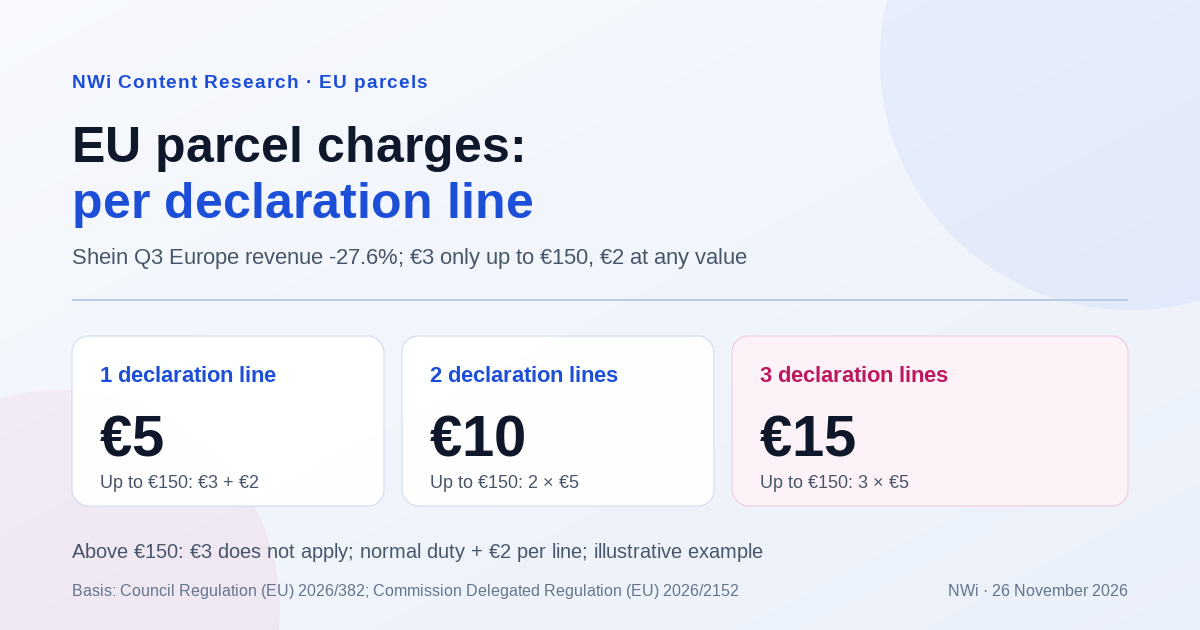
So a three-line order up to €150 pays 3 × (€3 + €2) = €15 in fixed charges. The same three lines above €150 do not pay the €3 duty; they pay 3 × €2 = €6 plus normal duty at the HS rate. A one-line order up to €150 pays €5. Applying €5 to every order is the first common mistake; treating “category” as the legal “item” is the second.
| Consignment value | 1 declaration line | 2 declaration lines | 3 declaration lines | Note |
|---|---|---|---|---|
| Up to €150 | €5 | €10 | €15 | €3 + €2, per line |
| Above €150 | €2 + normal duty | €4 + normal duty | €6 + normal duty | €3 does not apply; €2 still per line; normal duty at the HS rate |
The official examples make it concrete. Irish Revenue describes a €10 parcel containing a pen, a notebook and a key ring: three different items, so €3 duty of €9 plus a €2 fee per item of €6, a total of €15. If the parcel contained two identical pens, they count as one item and the total is €5. Dutch Customs describes a parcel with two shirts, three sweaters and one hat: three declaration lines, so the handling fee is 3 × €2 = €6. In both examples, the number of declaration lines, not the number of parcels or physical units, drives the charge.
3. Evidence boundary: law, implementation guidance and company results are different evidence
What this article can verify item by item: the €3 duty, the €150 threshold and the 1 July 2026 to 1 July 2028 period in Regulation (EU) 2026/382; the €2 amount and 1 November 2026 start in Regulation (EU) 2026/2152; the Commission's 5 October 2026 guidance on the definition of an item, per-declaration-line application and the €2 fee above €150; and the Dutch and Irish customs pages on the per-line fee, non-refundability, VAT treatment and above-€150 examples.
What cannot be inferred from public sources: how many lines your orders will actually produce, whether customs will accept your HS classification and origin, how the €3/€2 charges are split between platform and seller, how much demand falls after a price increase, and your local-stock unit costs. SHEIN's quarterly report describes one large player's results and management attribution; it does not prove that every seller will decline by the same amount, nor that local stock is always better.
The legal texts in force are Regulation (EU) 2026/382 (€3, 1 July 2026 to 1 July 2028, only up to €150) and Regulation (EU) 2026/2152 (€2, from 1 November 2026, any value); SHEIN's Q3 covers July–September only, the €2 fee is not in those results, and the 27.6% decline cannot be treated as the effect of the €2 fee.
One more distinction: the EU removed the customs duty relief for goods up to €150, not VAT itself. The €3 and €2 are duty/handling-fee measures; VAT is handled separately under the applicable VAT rules. This article does not analyse VAT, but a seller building a landed-cost model must not merge the €3/€2 charges and VAT into one number.
SHEIN's announcement uses the phrase “each distinct item category”. That is the company's summary of the rule. The legal definition in the Commission guidance is “item”, based on tariff classification, description and origin, and applied per declaration line. The two may be close on many orders, but “category” is not a legal term: it does not prove that different products in the same category can be consolidated, and it is not a basis for customs classification.
4. Who feels it most: multi-line baskets, low AOV and non-refundable fees
Once the charge is seen as a fixed cost per line, the most exposed seller is not every low-AOV seller, but the “low AOV + multiple declaration lines” combination. At the same €30 AOV, one line pays €5 and three lines pay €15; the fixed charge rises from 16.7% to 50% of AOV. By contrast, a high-AOV single-item order at €120 pays €5, only 4.2% of AOV, and a €5 price increase (+4.2%) restores the original contribution.
Returns are the second amplifier. The €2 fee is non-refundable, and the €3 duty is also non-refundable on a non-quality return (Irish Revenue says the €3 duty is refundable only where the goods are faulty; normal duty above €150 may be refundable on returns within 90 days, but the handling fee is not). For high-return apparel and footwear, the fixed charge can recur with each return, so the real cost is higher than the headline charge on completed orders.
The third factor is the fulfilment model. If a platform acts as importer of record (IOR) in a particular programme, or takes on an IOSS/collection role, the €3/€2 declaration and incidence may already be embedded in platform fees, so the seller's settlement statement will look different. The same SKU can fall into different paths on different platforms and fulfilment models. The formula here is a seller-held/self-declared view; where the platform collects and remits, recalculate from the actual settlement statement.
An AOV sensitivity table is a quick screen. With three lines and a consignment up to €150, the fixed charge is €15; at AOVs of €20/€30/€45/€60, the charge is 75%/50%/33.3%/25% of AOV. If a category's gross margin is only 20%–30%, a three-line €30 order cannot absorb the charge from natural margin; the seller must reprice, reduce lines or change fulfilment.
| AOV (3 lines, up to €150) | €15 fixed charge as % of AOV | Static minimum price increase (no demand elasticity) |
|---|---|---|
| €20 | 75.0% | €15 (+75.0%) |
| €30 | 50.0% | €15 (+50.0%) |
| €45 | 33.3% | €15 (+33.3%) |
| €60 | 25.0% | €15 (+25.0%) |
5. Scenario A: direct mail, three declaration lines, €30 AOV (illustrative)
Scenario A: direct mail, three declaration lines, €30 AOV (illustrative)
Assumptions: €30 AOV; three declaration lines with different tariff classifications or origins; goods cost €12; cross-border fulfilment €4 per order; payment and marketing €3 per order; returns, VAT and working capital excluded; 1,000 orders a month.
Result: pre-charge contribution = 30 − 12 − 4 − 3 = €11 per order; fixed charge = 3 × (3 + 2) = €15 per order; post-charge contribution = 11 − 15 = −€4 per order, a monthly loss of €4,000 at 1,000 orders; restoring €11 requires a €15 price increase, from €30 to €45 (+50%).
Decision: do not simply absorb the €15. Break the basket down by declaration line and consolidate goods that share the same classification, description and origin; where consolidation is not possible, reprice or remove low-margin lines; if a 50% increase is beyond demand tolerance, move the basket to local stock or stop direct-mailing it.
The point is not the €30 number but the way “three lines” turns €5 into €15. At the same €30 AOV with one line, the fixed charge is €5, post-charge contribution is €6, still below €11, but only a €5 (+16.7%) increase is needed. Ask “can I reduce a line?” before asking “can I raise the price?”.
6. Scenario B: EU local stock for one stable SKU (illustrative)
Scenario B: EU local stock for one stable SKU (illustrative)
Assumptions: take one stable-selling SKU out of the Scenario A basket, single-unit orders at €30 AOV; goods cost €12; bulk import duty 12% = €1.44 per unit; international freight and clearance €1.00 per unit; storage €0.60 per unit; pick/pack €2.50 per order; inventory carrying cost 1.5% per month = €0.18 per unit; obsolescence and markdown 15% = €1.80 per unit; payment and marketing €3 per order; one-off setup and compliance €20,000; 1,000 orders a month; returns and VAT excluded.
Result: local-stock landed cost per unit = 12 + 1.44 + 1.00 + 0.60 + 2.50 + 0.18 + 1.80 = €19.52; adding €3 payment and marketing gives €22.52 per order; at €30 AOV, contribution is €7.48 per order. Versus −€4 per order for direct mail in Scenario A, local stock is €11.48 better per order; the €20,000 one-off cost is recovered after about 1,742 orders, or about 1.74 months at 1,000 orders a month.
Decision: move the “stable-selling, single-unit, controllable-return” head SKUs first; do not move an entire multi-line basket at once. If monthly volume is below about 1,700 orders, or the obsolescence rate is materially above 15%, the payback stretches, so pilot a small batch rather than committing a full inventory buy.
The comparison is not “three-line direct mail” versus “three-line local stock”; it is one stable SKU taken out of the three-line basket and fulfilled locally as a single unit. In practice, the other items in the original basket may still go by direct mail, producing a hybrid “local stock + direct mail” structure. Decide who enters the warehouse on SKU-level contribution, not on a store-wide average.
7. Scenario C: high-AOV single-item direct mail (illustrative)
Scenario C: high-AOV single-item direct mail (illustrative)
Assumptions: €120 AOV; one declaration line; goods cost €50; cross-border fulfilment €6 per order; payment and marketing €8 per order; consignment up to €150, so the €3 + €2 = €5 charge applies; returns, VAT and working capital excluded.
Result: pre-charge contribution = 120 − 50 − 6 − 8 = €56 per order; post-charge contribution = 56 − 5 = €51 per order, a decline of €5 (−8.9%); a €5 (+4.2%) price increase restores €56. If the same item were priced at €200, the consignment would be above €150, the €3 duty would not apply, normal duty at the HS rate plus €2 per line would apply, and the €5-per-item formula could not be used.
Decision: for high-AOV single-item orders, reprice first; do not rebuild local stock for €5. Consider local stock only where delivery speed, returns experience or volume can spread the fixed cost. Above €150, recalculate the HS duty and normal customs duty; do not carry over the €5 formula.
The scenario shows that €5 is an absorbable fixed charge for high-AOV orders but a structural cost for low-AOV multi-line baskets. The same policy is not linear across baskets; deciding on average AOV hides the loss on multi-line low-AOV orders inside the profit on high-AOV orders.
8. The arithmetic: line-count sensitivity and local-stock payback
At a €30 AOV, three declaration lines and €5 per item, the fixed charge is €15 per order, or 50% of AOV; at the same €30 AOV with one declaration line, the fixed charge is €5, or 16.7%.
Write the formula explicitly. If the consignment is up to €150, fixed charge F = number of declaration lines n × €5. If it is above €150, F = n × €2 + normal duty D at the HS rate. Contribution c = AOV P − goods cost C − fulfilment L − payment and marketing M − F. Repricing to P' = (target c + C + L + M + F) restores the target contribution; the static minimum increase is P' − P.
| AOV (3 lines, up to €150) | €15 fixed charge as % of AOV | Static minimum price increase (no demand elasticity) |
|---|---|---|
| €20 | 75.0% | €15 (+75.0%) |
| €30 | 50.0% | €15 (+50.0%) |
| €45 | 33.3% | €15 (+33.3%) |
| €60 | 25.0% | €15 (+25.0%) |
Local-stock payback = one-off setup and compliance cost ÷ (local-stock contribution per order − direct-mail contribution per order). Using Scenarios A and B: 20,000 ÷ (7.48 − (−4.00)) = 20,000 ÷ 11.48 ≈ 1,742 orders, or about 1.74 months at 1,000 orders a month. This payback excludes inventory working capital, returns, markdowns and demand changes; add them to the denominator or set a longer target payback.
A quick decision rule (illustrative thresholds, not an industry standard): if a SKU's multi-line fixed charge exceeds 15% of AOV, test line reduction and repricing first; if a price increase above 10% leads to a volume decline above 20% within four weeks, move to local stock or exit; if local-stock payback is within six months and obsolescence is controlled, move the head SKUs first; if payback is beyond 12 months, do not move yet. Calibrate every threshold with your own store data.
9. Counter-cases and alternative explanations
Local stock is not automatically cheaper: for long-tail, low-velocity or highly seasonal SKUs, minimum order quantities, storage, markdowns and inventory carrying cost can exceed the €5-per-item saving; for high-AOV single-item orders, €5 is only about 4% of AOV, so repricing is lighter than rebuilding fulfilment.
Counter-case two: consolidating declaration lines is not “cramming different products onto one line”. Only goods with the same tariff classification, description and origin can be consolidated; a wrong consolidation can lead to classification disputes, additional duty or penalties, and the €5 saved can be far below the compliance cost.
Counter-case three: above €150, the €3 duty does not apply, but normal duty can be higher than €3. Do not assume “above €150 is cheaper”. In Irish Revenue's example, a €250 consignment of jeans and runners pays normal duty of €37.35 plus a €4 handling fee, €41.35 in total, far above €5 per item. Local stock also pays normal duty at the HS rate; it does not disappear.
Counter-case four: platform collection or an IOR arrangement can change who bears the charge. If the platform already includes the €3/€2 in its fulfilment fee, adding the formula again double-counts; if the contract leaves declaration responsibility with the seller, the platform quote may exclude the charge. Check the actual settlement statement, not just the front-end rate.
Counter-case five: SHEIN's scale is not replicable. SHEIN had 264m orders in Q3 and FFDI coverage above 40%; it can absorb part of the cost through local stock and bargaining power. A small seller does not have the same warehouse network or volume, so “accelerate localisation” cannot be copied directly. SHEIN's decline may also reflect demand elasticity after price increases, lower advertising and competition, not the charge alone.
Counter-case six: a price increase may not restore contribution. If demand is elastic, a €15 increase can reduce volume by more than the fixed charge saved; in that case, reduce lines, change the bundle or change fulfilment before raising price. The static price calculation here has no built-in elasticity and must be calibrated with a store-level price test.
10. Action list and stop conditions
Build a SKU-level declaration-line table first: record HS classification, description, origin, unit value, units per order, declaration lines, consignment value and fulfilment model; then recalculate contribution per order using “n × €5 when the consignment is up to €150, or n × €2 plus normal duty when it is above €150”, and prioritise multi-line, low-AOV, high-return, thin-margin SKUs.
Step one, reduce lines: consolidate goods with the same classification, description and origin; where that is not possible, adjust the bundle or split orders rather than putting different tariff lines into one parcel to raise AOV. Step two, reprice: test the static minimum increase in small steps and track conversion, volume, returns and contribution for four weeks; do not jump straight to the theoretical price. Step three, move to local stock: only the stable-selling head SKUs, pilot a small batch, and verify pick/pack, delivery time, returns and inventory turnover.
Stop conditions (illustrative): if multi-line fixed charges exceed 15% of AOV and a 10% price increase cuts volume by more than 20% within four weeks, stop direct-mailing that basket; if local-stock payback exceeds 12 months, or 90-day sell-through is below 60%, stop expanding the warehouse; if the platform settlement already includes the €3/€2, stop double-counting; if HS classification or origin cannot be confirmed, stop consolidating lines and consult a licensed customs broker.
Fields to observe: SKU, HS code, description, origin, unit value, units per order, declaration lines, consignment value, IOSS/non-IOSS, fulfilment model, fixed charge per order, AOV, goods cost, fulfilment fee, payment and marketing, contribution, return rate, 90-day sell-through, storage cost, markdown loss and cash conversion days. Review monthly; recalculate earlier when HS/origin changes, EU rules change, freight moves by more than 10% or the AOV mix shifts.
Timing: the €2 fee has applied since 1 November 2026, so there is no reason to wait for 2027. In the Q4 peak, handle head SKUs and multi-line low-AOV baskets first; before Q1 2027 inventory planning, decide which SKUs go into local stock. SHEIN's Q3 shows the “€3 + repricing” effect first; the incremental €2 effect will appear in Q4 and later. The sooner the model is calibrated with your own orders, the less likely a policy cost is mistaken for a product loss.
On the product side, [NWi CrossborderGo](/product/) supports market, category, brand/store and product research, with fields and coverage depending on account authorisation; [NWi Operations](/products/zhiying/) provides category overviews and rankings for an initial screen, with market numbers being third-party estimates. The duty and fee model here is an illustrative application of public rules, not a product settlement result; to put category price bands, competitor supply and your own costs on one table, [request a demo](/demo/).
11. Limitations and unknowns
This article does not have SHEIN's unit costs, SKU-level fee incidence or local-stock P&L, nor the reader's orders, HS classification or platform settlement data; all scenario numbers are assumptions, not measured results from SHEIN, the EU or NWi.
Five unknowns are most likely to change the conclusion. First, how many lines your orders actually produce depends on HS classification, description and origin; this article cannot classify goods for customs. Second, how the €3/€2 charges are split among platform, seller and consumer depends on the contract and fulfilment model. Third, demand elasticity after a price increase is not modelled; the calculations are static. Fourth, local-stock storage, returns, markdowns and working capital vary by category and country. Fifth, EU rules may change before 1 July 2028, and the €2 amount may be reviewed.
In addition, SHEIN's Q3 is a group-level result and management attribution is not causal identification; the European decline also reflects competition, macro consumer caution, marketplace-model changes and lower advertising. SHEIN is used here to show that a scale player is already adjusting, not to prove that every seller should move to local stock.
This article is not legal, tax, customs or platform-operations advice; classification, origin, IOSS/VAT treatment and fee incidence remain subject to EU law, customs practice and a licensed broker's advice.
12. Methodology and disclosure
Data basis: the €3 temporary duty is taken from Council Regulation (EU) 2026/382 (OJ 18 February 2026; applicable from 1 July 2026 to 1 July 2028; only for a consignment with intrinsic value up to €150); the €2 Union handling fee is taken from Commission Delegated Regulation (EU) 2026/2152 (OJ 22 October 2026; applicable from 1 November 2026) and the European Commission DG TAXUD guidance of 5 October 2026; the definition of “item” (same tariff classification, description and origin) and per-declaration-line application are taken from section 5.2 of that guidance; the Dutch Customs page updated on 2 November 2026 and the Irish Revenue notice of 29 September 2026 are used to check the per-line €2, the continuing €2 above €150, non-refundability and VAT treatment. SHEIN's figures are from its 25 November 2026 HKEX Q3 results announcement: group net revenue US$10.271bn (−5.9%), Europe US$2.977bn (−27.6%), orders 264m (272m a year earlier), active customers 291m (265m), and FFDI covering more than 40% of European deliveries. Calculation basis: fixed charge per order = declaration lines × (€3 + €2 when the consignment is up to €150; €2 plus normal duty at the HS rate when it is above €150); contribution = AOV − goods cost − fulfilment − payment and marketing − fixed charge. All AOVs, costs, line counts, monthly volumes, one-off setup costs and local-stock costs are explicitly labelled illustrative examples, not measurements by SHEIN, the EU or NWi.
This article was prepared with automated research assistance from the public sources listed at the end and has not been human-reviewed; it does not invent client data, expert review, customs outcomes or ranking effects. It is not legal, tax, customs or platform-operations advice; classification, origin, IOSS/VAT treatment and fee incidence remain subject to EU law, customs practice and a licensed broker's advice.
The increment is to turn “€3 + €2” from a policy summary into a recomputable declaration-line model: at the same €30 AOV, one line and three lines differ by €10 in fixed charge and contribution falls from €6 to −€4; local-stock payback then decides which SKUs are worth moving, with SHEIN's Q3 treated as a scale case rather than a universal prescription.
Division of labour with earlier analysis: we have already examined per-unit profit for fully managed and semi-managed platform models in Temu data analysis; this article does not repeat the platform-model question, but addresses the cross-platform seller's choice among multi-line direct mail, local stock and high-AOV single-item direct mail.
13. Sources
- 1. SHEIN Global Holdings Limited, “Results Announcement for the Three Months Ended 30 September 2026” (HKEX, 25 November 2026; group net revenue US$10.271bn, Europe US$2.977bn/−27.6%, orders 264m, active customers 291m, FFDI above 40%): read the original, accessed 26 November 2026.
- 2. Council Regulation (EU) 2026/382, “amending Regulation (EC) No 1186/2009 as regards the elimination of the threshold-based customs duty relief” (OJ L, 2026/382, 18 February 2026; Article 2: from 1 July 2026 to 1 July 2028, €3 per item for a consignment up to €150): read the original, accessed 26 November 2026.
- 3. Commission Delegated Regulation (EU) 2026/2152, “establishing the amount of the Union handling fee” (OJ L, 2026/2152, 22 October 2026; Article 1: €2 per item; Article 2: applicable from 1 November 2026): read the original, accessed 26 November 2026.
- 4. European Commission, DG TAXUD, “The temporary EUR 3 customs duty and the Union handling fee — Guidance for Member States and Trade” (Version 5 October 2026; definition of an item, per-declaration-line application, €2 above €150): read the original, accessed 26 November 2026.
- 5. Dutch Customs (Douane), “Handling fee for e-commerce” (published 1 October 2026, updated 2 November 2026; €2 per declaration line, continuing above €150, non-refundable, VAT treatment): read the original, accessed 26 November 2026.
- 6. Revenue Commissioners (Ireland), “Revenue advises online shoppers of the introduction by the European Union (EU) of a new Union Handling Fee for goods bought from outside the EU” (29 September 2026; €2 per item, two identical pens count as one item, above-€150 example, non-refundable): read the original, accessed 26 November 2026.
- Note: all six items are primary sources from a company announcement or EU official/member-state customs pages; the SHEIN announcement is company disclosure, while the EU regulations, Commission guidance and two customs pages are the legal and implementation basis. They are not independent experiments. The article uses them to separate “legal text”, “implementation guidance” and “company results”, and does not treat the company's quarterly report as causal proof of the policy's effect. No competitor data vendor's text, estimates, charts, screenshots, methods or API/MCP output was used; all scenario numbers are illustrative assumptions.