
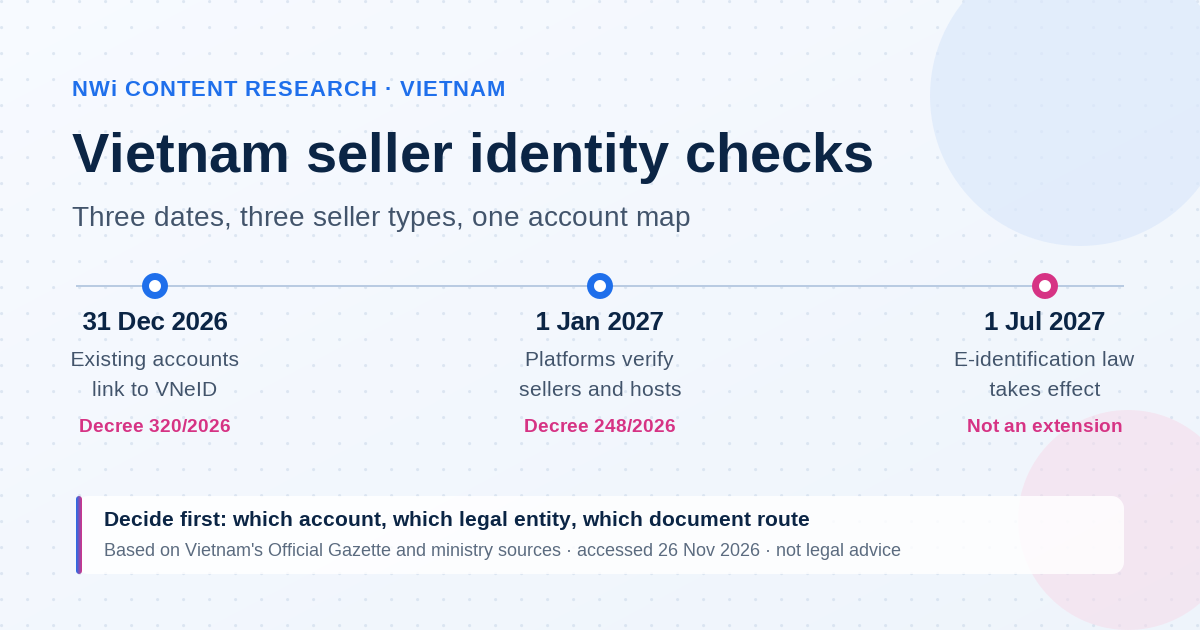
Vietnam's e-commerce seller identity verification rules are not one deadline but three. Article 52(2) of Decree 248/2026/ND-CP requires e-commerce platform operators to electronically authenticate sellers and livestreamers from 1 January 2027. Decree 320/2026/ND-CP requires e-commerce seller, livestream and affiliate accounts opened before 28 September 2026 to link to and authenticate with VNeID, Vietnam's national electronic identity account, by 31 December 2026. The Law on Electronic Identification and Authentication, passed on 20 November 2026, takes effect on 1 July 2027 and requires transaction accounts in high-risk sectors to be linked to a verified electronic identity. As of 26 November 2026, 35 calendar days remain until 31 December. This article answers three questions: which account must be verified, which documents are needed, and when a seller should stop rather than improvise.
1. The decision: separate the three dates before touching any account
Mixing the three dates produces two wrong conclusions: that every seller must personally obtain VNeID by 1 January 2027, or that the Law on Electronic Identification and Authentication starts only on 1 July 2027, so 31 December 2026 can be ignored. Neither is correct. Decree 248/2026 places the verification duty on the platform operator. Decree 320/2026 places the linking deadline on accounts opened before 28 September 2026. The law is a higher-level framework with a later effective date.
Start with the dates.
| Date | Instrument | Who is responsible | What happens | What it means for a seller |
|---|---|---|---|---|
| 28 Sep 2026 | Decree 320/2026 takes effect | Account holder and platform | Accounts opened before this date become 'existing accounts' | Confirm the account opening date; do not mix accounts opened after 28 September with existing accounts |
| 31 Dec 2026 | Article 20(3), Decree 320/2026 | Account holder; platform provides the linking entry point | Existing e-commerce seller, livestream and affiliate accounts must link to and authenticate with VNeID (bank accounts: 30 June 2027) | The tightest deadline; with 31 December as the last day and a 10-day buffer, this article uses 21 December as the internal deadline |
| 1 Jan 2027 | Article 52(2), Decree 248/2026 | E-commerce platform operator | Platforms must electronically authenticate sellers and livestreamers | The platform-side start date; sellers should have documents ready before it to avoid a January scramble |
| 1 Jul 2027 | Law on Electronic Identification and Authentication | High-risk transaction platforms and accounts | The law takes effect; high-risk transaction accounts must link to a verified electronic identity, with the implementation roadmap set by the government; verification results are retained for at least five years | A higher-level framework, not an extension of the e-commerce decree |
Article 52(1) of Decree 248/2026 says the decree takes effect on 1 July 2026, but Article 52(2) moves the platform verification duty to 1 January 2027. Decree 320/2026 takes effect on 28 September 2026 and puts the existing-account linking deadline on 31 December 2026. Two instruments, two responsible parties, two dates; they do not replace each other.
As of 26 November 2026, 35 calendar days remain until 31 December. If 10 days are reserved for platform review, remediation and resubmission, the internal deadline is Monday 21 December. The Vietnamese text says 'chậm nhất trước ngày 31/12/2026', literally 'no later than before 31 December'; treating 31 December itself as buffer is risky.
2. The mechanism: the platform verifies identity, not product quality
Article 18(1) of Decree 248/2026 sets out the fields the platform must check. For a domestic individual: full name, date of birth and personal identification number. For a domestic organization: organization name, head office address, organization identification number, and the legal representative's full name, date of birth and personal identification number. For a foreign individual: name, passport number, country or territory shown in the passport or equivalent document, with the document valid for at least six months. For a foreign organization: organization name, head office address, country or territory shown in the enterprise registration certificate or equivalent document, and the legal representative's name and passport number, with the passport or equivalent valid for at least six months.
| Seller type | Fields the platform checks | Document points | What cannot be assumed |
|---|---|---|---|
| Domestic individual | Full name, date of birth, personal identification number | Identity document / personal ID number; the platform may require face verification | The personal ID number must match the shop registrant and the payout-account name |
| Domestic organization | Organization name, head office, organization ID number; legal representative's name, date of birth and personal ID number | Business registration; legal representative's identity information; authorization documents if applicable | The text does not say how a platform should handle a legal representative who is not a Vietnamese citizen and has no Vietnamese personal ID number |
| Foreign individual | Name, passport number, country or territory; passport valid for at least 6 months | Passport or equivalent; the platform may ask for a visa or residence document | The six-month validity runs from the approval date, not the entry date |
| Foreign organization | Organization name, head office, country or territory; legal representative's name and passport number; validity of at least 6 months | Enterprise registration or equivalent; legal representative's passport; authorization / translation if the platform asks | Article 18 does not set translation, notarization or legalization requirements; do not add or omit them on assumption |
Article 12 also requires a platform that offers livestream selling to publish operating rules covering, at minimum, the subjects, procedures and instructions for livestreamers to complete electronic identification and authentication, and the conditions and procedures for opening seller and livestream accounts. The MOIT explainer of 4 July 2026 adds that an intermediary platform must verify a seller's identity before allowing the seller to trade; individuals selling by livestream, including KOLs, KOCs, influencers or hired promoters, must verify before broadcasting; and social media platforms with e-commerce functions must verify sellers and distinguish ordinary social interaction from commercial activity.
But 'identity verified' is not 'product verified'. A verified seller can still sell counterfeit or unsourced goods, run misleading advertising or breach tax duties. Product inspection, advertising enforcement, tax registration and customs declaration are separate obligations. Treating 'verified' as a quality badge misleads consumers and gives sellers a false sense of risk control.
Public reports of the National Assembly resolution of 21 November 2026 also place identity verification inside tax administration: 491 of 492 present deputies voted in favour, and the resolution requires platforms to verify sellers and livestreamers from 1 January 2027 under Decree 248/2026, while strengthening data connectivity, taxpayer identification, risk criteria and big-data analysis of e-commerce, with tax-ID data cleanup to be completed by the end of the first quarter of 2028. The distinction matters: identity verification is the identity layer, tax-ID cleanup is the tax-data layer. The resolution reports read for this article do not mention an automatic tax reassessment or a uniform back-tax formula; that absence is not proof that no other provision exists.
3. The evidence boundary: the text proves dates and duties, not platform flows
This article can check the decree text, the Official Gazette, the ministry explainer, public reports of the National Assembly resolution and official media. They prove that platforms have a verification duty from 1 January 2027; that the VNeID linking deadline for existing accounts is 31 December 2026; that the verification fields differ for domestic individuals/organizations and foreign individuals/organizations; that a foreign individual's or organization's passport or equivalent must be valid for at least six months; that the Law on Electronic Identification and Authentication takes effect on 1 July 2027 and verification results must be retained for at least five years; and that the resolution passed 491/492 while the law passed 473/478.
They do not prove which face-recognition vendor a platform uses, which translation or notarization it accepts, what alternative route applies when a foreign legal representative has no VNeID, whether unverified accounts will be suspended on 1 January 2027, the size of any penalty, or whether a grace period exists. Those depend on platform rules and later implementing documents. This article does not answer for the platform and does not turn 'may' into 'will'.
A typical gap is the 'local entity plus foreign legal representative' structure. Article 18(1)(a) lists the legal representative's name, date of birth and personal identification number among the fields for a domestic organization. If the legal representative is a foreign citizen without a Vietnamese personal ID number, the text does not say whether the platform should switch to a passport or require a local authorized representative. For a cross-border seller this is not a detail: it decides whether the account goes through the domestic-organization route or the foreign-organization route, and whether the contracting entity or authorization documents need to change.
Another wording detail is 'chậm nhất trước ngày 31/12/2026'. The Vietnamese text means 'no later than before 31 December', not '31 December itself is still available'. This article takes the conservative reading: 30 December is the last full day, and the internal deadline is 21 December. If a platform confirms in writing that submissions are still accepted on 31 December, the deadline can move later; do not assume it in the other direction.
Translation also creates drift. The Vietnamese text uses 'xác thực điện tử danh tính'; official English translations use both 'authentication' and 'verification' in different passages. This article uses 'verification' for readability, but the responsible party, dates and document fields are governed by the Vietnamese text.
4. Worked scenarios: three sellers, three checklists
The numbers below are illustrative assumptions, not client data or platform measurements. Calculation basis: accounts × minutes per account = total hours; failed accounts are rounded up; the internal deadline is 21 December, the 25th day of the 35 calendar days from 26 November to 31 December, leaving 10 days for platform review.
Scenario A: domestic individual seller with 2 shop accounts and 1 livestreamer
Assumptions: a domestic individual seller in Vietnam; 2 shop accounts, one on each of 2 platforms; 1 livestreamer with one host account on each platform, so 2 host accounts; all 4 accounts were opened before 28 September 2026; checking the name, personal ID number, payout account and link status takes 30 minutes per account; one account fails the first check and needs 30 minutes of rework. These are illustrative assumptions.
Total accounts = 2 shops + 2 host accounts = 4. First-pass work = 4 × 30 = 120 minutes = 2 hours. Rework for one account adds 30 minutes. Total = 2.5 hours. With 31 December as the last day and a 10-day buffer, the internal deadline is 21 December. If 'before 31 December' is read as ending on 30 December, the internal deadline remains 21 December, but the buffer shrinks to 9 days.
Decision: handle the 2 shop accounts first, then the host accounts. If the shop registrant, personal ID number and payout-account name do not match, stop the linking, fix the record and resubmit. Test one host account before a live session and confirm whether the platform requires the host to complete face verification in person.
Scenario B: foreign company seller with a Vietnamese local entity and a foreign legal representative
Assumptions: a foreign parent contracts through a Vietnamese local entity, and the platform treats the local entity as the seller; the local entity's legal representative is a foreign national with no Vietnamese personal ID number and no VNeID account; 3 shop accounts sit on 2 platforms, with 2 KOC hosts; collating the enterprise registration, legal representative's passport, authorization documents and platform inquiry takes 45 minutes per account; one account fails the first check and needs 45 minutes of rework; every passport is valid for at least 6 months. These are illustrative assumptions.
Total accounts = 3 shops + 2 host accounts = 5. First-pass work = 5 × 45 = 225 minutes = 3.75 hours. Rework for one account adds 45 minutes. Total = 4.5 hours. The bigger uncertainty is the contracting entity: if the platform verifies the local entity as a domestic organization, the legal representative's personal ID number field may not be fillable; if the platform verifies the foreign parent as a foreign organization, the passport and enterprise-registration route applies. The two document packs are not interchangeable.
Decision: ask the platform in writing which entity is the seller and what alternative documents it accepts when the foreign legal representative has no VNeID. Prepare both document packs, but do not change the contracting entity just to avoid a field. Until the platform answers in writing, do not treat the local entity as an automatic safe harbour.
Scenario C: multi-platform operations team with 12 shop accounts and 4 host accounts
Assumptions: the team manages 3 platforms, 12 shop accounts and 4 host accounts, for 16 accounts in total; a status check takes 15 minutes per account; 20% of accounts fail the first check, so 16 × 20% = 3.2, rounded up to 4 accounts; each failed account needs 30 minutes of rework; 2 operations staff can work in parallel; the internal deadline remains 21 December. These are illustrative assumptions.
Status-check work = 16 × 15 = 240 minutes = 4 hours. Rework = 4 × 30 = 120 minutes = 2 hours. Total = 6 hours; with 2 people in parallel, about 3 hours each. Spread over 10 working days, the team needs to handle only 1.6 accounts per day; the real bottleneck is platform review and rework, not form-filling.
Decision: run two waves. Start with the 4 shops and 2 host accounts that contribute the most revenue, then handle the rest. Do not upload every document in one batch. Record the submission time, platform ticket number and review result for each account, and resubmit failed accounts within 48 hours.
Across all three scenarios, counting accounts is easy; the hard part is deciding who the legal seller is and which document route the platform accepts. Put those two questions in writing before estimating hours.
5. Countercases and alternative explanations
Countercase 1: a verified seller is not a verified product. Identity verification can reduce anonymous accounts and improve traceability, but it does not prove product origin, quality, brand authorization or tax compliance. Treating 'verified' as a quality badge misleads consumers.
Countercase 2: do not treat 'a foreign seller only needs a passport' as an exemption from VNeID. Article 18(1)(b) of Decree 248/2026 does set a document route for foreign individuals and organizations through a passport, enterprise registration or equivalent legal documents. But Decree 320/2026 requires e-commerce seller, livestream and affiliate accounts to link to and authenticate with an electronic identity account, and the text does not explicitly exempt foreign sellers without VNeID. Whether a platform accepts a passport plus a local authorized representative, or requires the account holder to obtain an electronic identity account first, must be confirmed in writing.
Countercase 3: 1 January 2027 does not necessarily mean every unverified account is suspended that day. The decree sets the duty and the date, but it does not say platforms must bulk-suspend accounts on that day, and it does not set a penalty amount; a platform may have a remediation, grace or exception process. Prepare for the tightest date without using 'your shop closes tomorrow' to scare sellers or clients.
Countercase 4: the law's 1 July 2027 effective date is not an extension of the e-commerce decree. The platform verification duty in Article 52(2) of Decree 248/2026 starts on 1 January 2027; the Law on Electronic Identification and Authentication takes effect on 1 July 2027 as a higher-level framework. Using 1 July to postpone the 31 December linking is a misreading.
Countercase 5: tax-data connectivity does not equal an automatic tax bill. The National Assembly resolution calls for data sharing, full taxpayer identification, risk criteria and AI analysis of e-commerce big data, with tax-ID cleanup by the end of the first quarter of 2028; it does not say every verified seller will be reassessed. Identity verification is part of the tax-administration infrastructure, not the tax bill itself.
Countercase 6: a local entity is not an automatic shield. If the platform treats the local entity as the seller, the domestic-organization fields may require the legal representative's personal ID number; when a foreign legal representative does not have that number, the text does not say whether a passport or an authorized representative is accepted. Ask first, then decide whether to change the entity structure.
6. Action list and stop conditions
Step 1: build an account inventory. Record platform, account type (seller / livestream / affiliate), login email, legal entity, opening date, current KYC status, document type already linked, payout-account name, tax ID and owner. Do not register only by shop name; the shop name and the contracting entity are often different.
Step 2: bucket by date. Accounts opened before 28 September 2026 are 'existing accounts' and should complete the VNeID link before 31 December. Accounts opened after 28 September follow the platform's new-account process. Every seller and host account needs to be ready for platform verification from 1 January 2027.
Step 3: prepare documents by entity. Domestic individual: full name, date of birth, personal ID number. Domestic organization: organization name, head office, organization ID number, legal representative's name/date of birth/personal ID number. Foreign individual: passport number, country or territory, passport valid for at least 6 months. Foreign organization: enterprise registration, head office, country or territory, legal representative's name/passport number, passport valid for at least 6 months. List any extra translation, notarization or authorization the platform requests separately; do not mix it with the statutory fields.
Step 4: reconcile identities. The seller name, tax ID, payout-account name, legal representative and platform account holder must line up. If they do not, fix the registration or add authorization first; do not click 'link' first. A common verification failure is a name or number mismatch, not a missing document; check the match before assuming a document is missing.
Step 5: ask the platform five questions in writing. First, which legal entity does the platform treat as the seller? Second, can a foreign seller verify with a passport or enterprise registration, or is VNeID mandatory? Third, what alternative documents does the platform accept when a foreign legal representative has no VNeID? Fourth, what translation, notarization or legalization does it require? Fifth, what happens to an account that is not verified on 1 January 2027, and is there a remediation or grace process? Keep the answers, ticket numbers and dates.
Step 6: test one shop and one host account before scaling. Keep the submission screenshot, platform receipt and verification result. If the host must complete face verification in person, schedule it in advance; do not leave it until ten minutes before a live session.
Step 7: set the calendar. 21 December is the internal deadline recommended here; 28 December is the final status review; 31 December is for confirmation, not first submission. Platform operators should also finish onboarding, exception handling and seller notices before 1 January 2027; the five-year retention rule comes from the law effective 1 July 2027, so the system design should account for it early.
Stop conditions: if the platform cannot confirm the foreign-seller flow or the contracting entity, stop restructuring the entity; if the foreign legal representative has no VNeID and the platform cannot confirm an alternative, pause new investment and seek local legal advice; if the tax ID, payout account and seller identity cannot be reconciled, fix them before linking; if a host or creator refuses identity-data processing, do not upload their documents, use a contracted entity or replace the host; if the account relies on a nominee or a local entity that cannot pass verification, stop expansion and do not try to work around it; if the platform asks for an 'expedite fee' to a personal account or for documents through an unofficial link, stop and verify through the official app or a ticket.
Fields to watch: platform, account ID, account type, legal entity, opening date, KYC status, document type and expiry, VNeID link status, tax ID, payout-account name, platform ticket number, last verification date, next action and owner. Put them in one table and update it weekly; review immediately when a platform notice, legal-representative change, passport expiry, tax-ID change, shop transfer or platform merger occurs.
7. Limitations and unknowns
This article did not log in to any seller backend, read any seller's KYC page or capture any platform onboarding screen. It provides a decree-level account checklist and conditional analysis, not a platform-specific operating manual.
It has no penalty schedule, no platform grace policy, no official answer on the foreign legal representative's VNeID alternative and no uniform rule on translation or notarization. Those unknowns directly affect the hours needed and whether an account can finish on time.
It does not estimate the number of affected sellers, GMV or suspension rates; no such data was used, and the illustrative hours are not an industry average. The 491/492 and 473/478 figures are vote shares, not compliance rates.
Dates and articles reflect the official texts read on 26 November 2026; later implementing documents, platform rules or legal amendments may change the details. This is not legal, tax or platform-operations advice; confirm with the platform and a local professional before acting.
8. Methodology and disclosure
Data basis: Article 18 (verification fields for domestic individuals/organizations and foreign individuals/organizations), Article 12 (livestream rules) and Article 52(2) (platform verification from 1 January 2027) of Decree 248/2026/ND-CP, Official Gazette No. 407/2026; Article 19 and Article 20(3) of Decree 320/2026/ND-CP (existing accounts must link to VNeID by 31 December 2026), Official Gazette No. 479/2026; the MOIT explainer of 4 July 2026; Government News on the Law on Electronic Identification and Authentication of 20 November 2026; the Vietnam News Agency National Assembly press release of 20 November 2026 (473/478); VTV and Thanh Nien reports of 21 November 2026 on the National Assembly resolution (491/492). Calculation basis: date differences use calendar days; accounts = shop accounts + host accounts; hours = accounts × minutes per account ÷ 60; failed accounts are rounded up; internal deadline = 21 December (35 days from 26 November to 31 December, with 10 days reserved). All hours, account counts, failure rates and document-preparation times are illustrative assumptions, not client data or platform measurements.
This article was prepared with automated research assistance from the public sources listed at the end. It was not reviewed by a human. It does not invent client data, expert review or ranking results. It is not legal, tax or platform-operations advice.
The contribution is not a restatement of the 1 January 2027 verification date. It separates the 31 December 2026 VNeID linking deadline, the 1 January 2027 platform-verification deadline and the 1 July 2027 law effective date, recalculates accounts and hours for domestic-individual, foreign-company and platform-operator scenarios, and identifies the 'local entity plus foreign legal representative' gap and the stop conditions that follow.
If you need to put Vietnam platform, category, brand/store and price-band data in one view, NWi CrossborderGo supports market and competitor research. The Cross-border Agent can turn regulatory changes, platform rules and review insights into a research brief; review insights are limited to selected brands, the product-innovation advisor focuses on beauty, and the creator advisor currently covers Vietnam, Indonesia and Malaysia. NWi Operations helps organise product and operations lists. To map your own account structure, request a walkthrough at /demo/. Coverage, historical ranges and fields depend on the contract and account authorization; NWi Operations market values are third-party estimates; none of the products provides legal advice or guarantees a verification outcome.
9. Sources
- 1. Government of Vietnam, Decree 248/2026/ND-CP, issued 30 June 2026, effective 1 July 2026; Articles 18, 12 and 52(2); Official Gazette No. 407/2026, 18 July 2026. Accessed 26 November 2026. View the Official Gazette
- 2. Government of Vietnam, Decree 320/2026/ND-CP, issued 13 August 2026, effective 28 September 2026; Articles 19 and 20(3); Official Gazette No. 479/2026, 25 August 2026. Accessed 26 November 2026. View the Official Gazette
- 3. Ministry of Industry and Trade (Vietnam), 'Ministry of Industry and Trade disseminates the Law on E-commerce and Government Decree No. 248/2026/ND-CP', 4 July 2026; confirms that platforms must verify seller identity before allowing trade and that livestream sellers must verify before broadcasting. Read the article
- 4. Government News (Vietnam), 'Social media accounts must undergo identity verification', 20 November 2026; confirms the Law on Electronic Identification and Authentication was passed on 20 November, takes effect on 1 July 2027, and requires verification results to be retained for at least five years. Read the article
- 5. Vietnam News Agency (VietnamPlus), 'Thông cáo báo chí số 26, Kỳ họp thứ Hai, Quốc hội khóa XVI', 20 November 2026; records that the Law on Electronic Identification and Authentication passed with 473 of 478 votes. Read the release
- 6. VTV, 'Yêu cầu xác thực danh tính người livestream bán hàng từ 1/1/2027', 21 November 2026; records the National Assembly resolution passing 491/492 and the platform verification requirement from 1 January 2027. Read the article
- 7. Thanh Niên, 'Quốc hội "chốt" hạn làm sạch mã số thuế trong quý 1/2028', 21 November 2026; records the 491/492 vote, the reference to Decree 248/2026 and the tax-ID cleanup deadline in the first quarter of 2028. Read the article
- Note: items 1 and 2 are primary official texts; items 3, 4 and 5 are official government, ministry and news-agency explanations; items 6 and 7 are media reports of the same National Assembly session, used to check the 491/492 vote and the meeting date, not as two independent confirmations. No competitor data vendor's text, estimates, charts, screenshots, methods or API/MCP output was used.