
If you ship direct to Thai consumers by express or international post, the cabinet decision of 10 November 2026 is not a simple “Thailand is adding 30%”. The real question is which of your SKUs move from a reduced effective duty rate to the HS ceiling (capped at 30%), how much the 7% VAT on CIF plus duty adds to the cash cost per unit, and whether you should reprice, absorb, move to local stock/wholesale, or exit. Separate three layers first: Thailand ended the THB 1,500 duty exemption on 1 January 2026, so low-value parcels were already inside the duty net, with 7% VAT applied under the import VAT rules; the 10 November 2026 decision resets direct e-commerce parcels to the HS ceiling, capped at 30%; and as of 26 November 2026 no gazetted finance ministry notification had been found, so “1 January 2027” is a media expectation, not the legal effective date. The table and three scenarios below turn “30%” into a recalculable unit cost.
1. The decision: not “30%”, but each SKU’s distance to its HS ceiling
The real question is not whether Thailand is adding a tax on e-commerce, but which SKUs move from a reduced effective duty rate to the HS ceiling (capped at 30%) after the finance ministry notification is gazetted, how much the 7% VAT on CIF plus duty adds to the cash cost per unit, and whether to reprice, absorb, move to local stock/wholesale, or exit.
“30%” is a ceiling, not a flat rate. Thai Customs applies the tariff schedule by HS code: if the statutory ceiling for a code is 30%, the rate is 30%; if the ceiling is below 30%, the lower ceiling applies; if a category is already taxed at 30%, the rate does not change. In its 21 November 2026 fact-check, the Anti-Fake News Center quoted Customs as saying that this is not a flat 30% increase on all online goods, but a tariff-based charge on express and international post, capped at 30%. A blanket 30% price increase would therefore hit SKUs that were never touched; a blanket “average 10%” estimate would miss the 0%-to-30% categories.
Collect eight fields for every SKU: HS code, current effective duty rate, HS ceiling, CIF (goods + international freight + insurance), importer of record (IOR), Thai VAT registration and credit status, platform/carrier collection terms, and price and variable costs. Without all eight, the unit cost is a guess. The distinction that matters most is between the current effective rate and the HS ceiling: many parcels now benefit from a reduced rate under a Ministry of Finance notification; the measure returns direct e-commerce parcels to the ceiling. That is where “0% becomes 30%” comes from.
| Field | Why it matters | Where to verify |
|---|---|---|
| HS code | Sets the statutory ceiling and whether the measure covers the product | Broker / Thai customs tariff; final gazetted notification |
| Current effective rate | Determines the size of the step-up, not just the 30% headline | Latest import duty bill / broker |
| HS ceiling | If below 30%, the lower ceiling applies; do not assume 30% | Thai customs tariff / notification annex |
| CIF | Base for duty and VAT | Goods, freight and insurance; customs valuation rules if no insurance |
| IOR / importer | Determines who pays duty, declares and credits VAT | Contract, carrier, broker |
| Thai VAT registration | Determines whether 7% is a cost or a creditable input | Thai tax adviser / Revenue Department |
| Platform collection terms | Determines who collects VAT at checkout and whether it is in the price | Seller centre / contract |
| Price and variable costs | Determines pricing room and contribution floor | Own store data; do not substitute competitor estimates |
2. Mechanism: a duty ceiling plus 7% VAT, layered
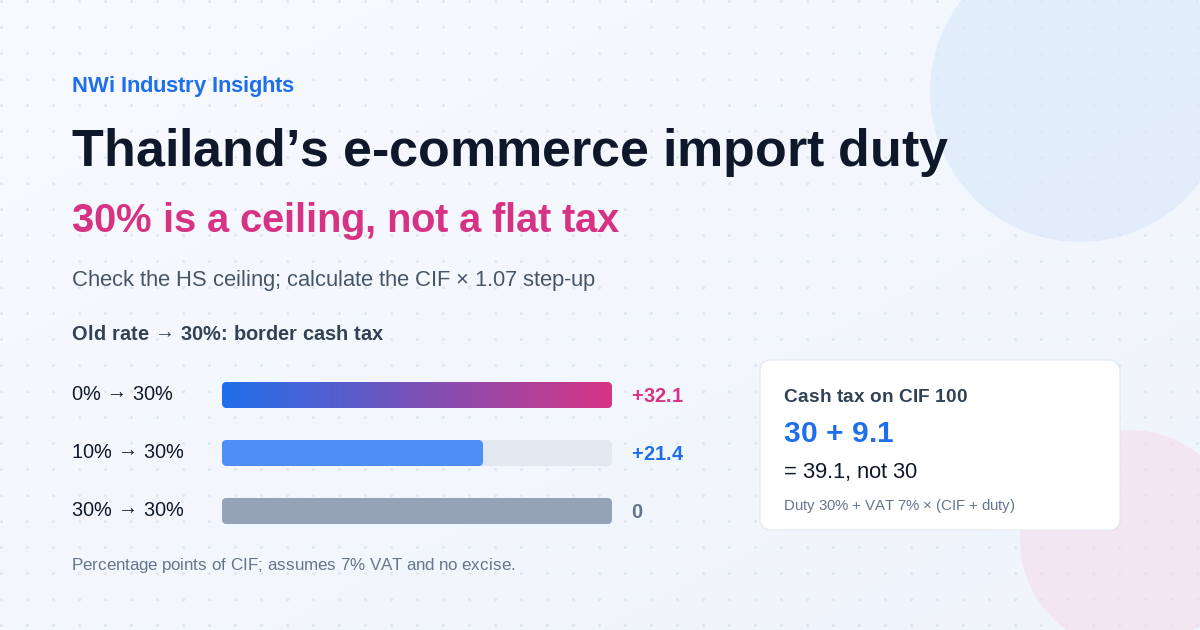
The mechanism has two layers: duty is levied at the HS code’s statutory ceiling, capped at 30%; VAT is 7% of CIF plus duty, so a 30% duty produces a border cash tax of 39.1% of CIF, not 30%.
On 10 November 2026, Thailand's cabinet approved the Ministry of Finance proposal: goods ordered through foreign e-commerce platforms and entering Thailand by express or international post are charged import duty under the customs tariff, at a rate not exceeding 30%. The Customs Department's press release of the same day confirms the four points: cabinet approval, tariff-based assessment, a 30% cap, and the express/international-post channels. The 30% is a ceiling on duty, not a ceiling on duty plus VAT, and not a single rate for every product.
Before 1 January 2026, Thailand exempted imported parcels valued at no more than THB 1,500 from duty; from that date, the exemption was removed and low-value parcels entered the duty net from the first baht, with 7% VAT applied under the import VAT rules. The 2027 change is therefore not “Thailand's first tax on low-value parcels”; it is “direct e-commerce parcels return to the HS ceiling, capped at 30%”. Do not mix the layers: treating the tax already incurred in 2026 as a zero baseline overstates the 2027 increment; treating 2027 as the first tax misses the cost that already exists.
The VAT base is not CIF alone: it is CIF plus duty, plus excise (if any) and other statutory taxes and fees. The Revenue Department's English page states that the VAT base for imported goods is the C.I.F. price plus import duty plus excise tax (if any) plus other taxes and fees, at a general rate of 7%. The Suvarnabhumi Airport Cargo Clearance Customs Office gives the same formula: import duty = CIF × duty rate; VAT = (CIF + import duty) × 7%; total taxes and duties = duty + VAT. At a 30% duty, the border cash tax is therefore 30% + 7% × 1.30 = 39.1% of CIF, not 30%.
The table translates “duty rate” into “border cash tax” and shows the increment when an old rate moves to 30%. It is the calculation base for every scenario below.
| Old duty rate | Old cash tax (% of CIF) | New cash tax at 30% duty | Incremental cash tax (pp of CIF) | Note |
|---|---|---|---|---|
| 0% | 7.0% | 39.1% | +32.1 pp | Largest shock: from VAT-only to duty + VAT |
| 5% | 12.35% | 39.1% | +26.75 pp | Common 5% band |
| 10% | 17.7% | 39.1% | +21.4 pp | 10% band |
| 20% | 28.4% | 39.1% | +10.7 pp | 20% band |
| 25% | 33.75% | 39.1% | +5.35 pp | A 25% ceiling does not reach 30% |
| 30% | 39.1% | 39.1% | 0 | Goods already at the 30% ceiling do not change |
Read the last two rows carefully: if the HS ceiling is 25%, the new rate is 25%, the cash tax is 33.75%, not 39.1%; if the category is already at 30%, the rate does not change. The “30%” only applies to categories whose ceiling is at least 30% and whose current rate is below 30%. Match the table to your HS list before you conclude which SKUs are hit.
3. Evidence boundary: keep “approved”, “gazetted” and “in force” apart
As of 26 November 2026, public searches found no gazetted finance ministry notification; what is confirmed is the cabinet approval and the formula that the measure takes effect 15 days after Gazette publication, so 1 January 2027 is not the legal effective date.
The first line is cabinet approval. On 10 November 2026, the cabinet approved the Ministry of Finance proposal; the Customs Department press release confirms the approval, the express/international-post channels and the 30% cap. Approval is not the same as entry into force, and it is not the same as a published tariff schedule.
The second line is the Ministry of Finance notification and Royal Gazette publication. The government readout and the Anti-Fake News Center both state that the measure takes effect 15 days after publication in the Royal Gazette. As of 26 November 2026, public searches found no gazetted ministry notification; “1 January 2027” is therefore an expectation reported by Customs and the media, not the legal effective date. The notification could be earlier or later; until it is gazetted, any exact date should be labelled as an expectation.
The third line is scope. The government readout names express and international post; Deloitte Thailand's 20 November 2026 analysis adds goods released from e-commerce duty-free zones (eWTP) as a third channel. The gazetted channel list will control. Product rates follow the same logic: the categories cited at the briefing are not the notification annex; the annex and the Thai customs tariff are the basis for each line.
On 21 November 2026, the Anti-Fake News Center classified “the government will add a flat 30% to all online goods from January 2027” as misleading, for three reasons: 30% is a duty ceiling, not a flat rate; it applies only to express and international post, not all online goods; and the trigger is 15 days after Gazette publication, not a fixed 1 January. That correction matters because it removes both the “flat 30%” and the “1 January” misreads.
One more boundary: this article has no seller-backend data, platform checkout implementation details, actual duty bills or item-by-item Thai customs rulings. All unit costs, prices, variable costs and volumes are clearly labelled assumptions, not NWi measurements, platform data or customs statistics.
4. Counter-cases: what the “30%” does not hit
The counter-case is that clothing and other goods already taxed at the 30% ceiling do not change; goods with an HS ceiling below 30% pay that lower ceiling; and normal wholesale imports and FTA-qualified goods may keep existing preferences if they are not direct platform-to-consumer parcels, subject to the gazetted text.
Counter-case one: categories already at the 30% ceiling. If clothing, footwear or another category is already taxed at 30%, the rate does not change; its cash tax remains 39.1%, but there is no “low rate to 30%” increment. Accruing a new 30% on these SKUs overstates the cost.
Counter-case two: categories with an HS ceiling below 30%. Some HS codes have a statutory ceiling below 30%; the measure can only charge that lower ceiling. “Up to 30%” at the briefing does not mean every category reaches 30%. Check the annex and the HS code, not the product name.
Counter-case three: normal wholesale imports and FTA-qualified goods. One alternative explanation to verify is that normal/wholesale imports and goods declared under FTA rules may fall outside the core “platform direct-to-consumer” scope and keep existing reductions; that would open a possible “bulk import + local fulfilment” route. But the conditions, FTA origin rules, local warehouse costs and the final VAT step must be modelled separately; “may keep FTA” is not “zero duty”. The gazetted text and a broker's opinion control.
Counter-case four: a delayed or narrowed notification. If the notification is gazetted later in 2027, or the final text covers only some channels, direct parcels in early 2027 may still pay the current rates. Repricing the whole catalogue in advance would pass on a cost that has not occurred and damage conversion. Keep two price tables and switch only when the gazetted text arrives.
Counter-case five: treating a platform commission as an import duty. A commission is a platform service fee, a duty is a customs charge. Their bases, bearers and effective dates differ and they do not offset each other. This article covers only import duty and import VAT.
5. Scenario A: a 0%→30% fashion accessory with CIF THB 300
Scenario A: a 0%→30% fashion accessory with CIF THB 300
Assumptions: CIF THB 300 (goods, international freight and insurance), current effective duty 0%, HS ceiling 30%, 7% VAT, retail price THB 690, variable platform/payment/last-mile/returns costs THB 180, contribution floor 15%; excludes advertising, fixed costs and income tax.
Result: old tax THB 21; new duty THB 90, VAT THB 27.3, total THB 117.3; the increase is THB 96.3 per unit. On a cash basis, contribution falls from THB 189 to THB 92.7, and the contribution margin falls from 27.4% to 13.4%, below the 15% floor.
Decision: if the price ceiling allows, raise the price to THB 703 (+1.8%) to restore the 15% floor, then test THB 720–747; if the market only accepts THB 690, or the volume loss at a higher price cuts total contribution below the old level, stop direct parcel and compare local stock/wholesale or exit.
The key is not “30%” but the 0%→30% jump: duty rises from zero to THB 90, VAT rises from THB 7 to THB 27.3, and the two together add THB 96.3, or 32.1% of CIF. Looking only at “30%” understates the 6.3-point VAT add-on; looking only at VAT misses the THB 90 duty.
If you are a Thai VAT-registered importer, the 7% import VAT can usually be credited as input tax (provided it is used for taxable business and the documents comply). The economic cost is then mainly the THB 90 duty, not the THB 117.3 cash tax. On that basis, the contribution at THB 690 is THB 120 (17.4%), already above the 15% floor; to hold a 20% margin, the price is about THB 712.5 (+3.3%), not THB 746.6. The difference between the two books is whether VAT is a cash-flow item or a final cost.
6. Scenario B: a 10%→25% small appliance with CIF THB 800
Scenario B: a 10%→25% small appliance with CIF THB 800
Assumptions: CIF THB 800, current effective duty 10%, HS ceiling 25%, 7% VAT, retail price THB 1,990, variable costs THB 500, contribution floor 15%; excludes advertising, fixed costs and income tax.
Result: old tax THB 141.6; new duty THB 200, VAT THB 70, total THB 270; the increase is THB 128.4 per unit. Contribution falls from THB 548.4 to THB 420, and the contribution margin falls from 27.6% to 21.1%, still above 20%.
Decision: you can leave the price unchanged and absorb THB 128.4; to hold the old contribution, raise the price to THB 2,118.4 (+6.5%). At 5,000 units a month, the extra tax is THB 642,000, so compare the volume loss from a price increase with the cash-flow cost of absorbing it.
This scenario deliberately uses a ceiling below 30%: a flat 30% estimate would overstate duty by THB 40 (30% × 800 − 25% × 800 = 40) and misclassify a SKU that still has room as a loss-maker. “30% cap” is not the same thing for every HS code; check the ceiling first, then calculate the jump.
If VAT is creditable, the economic cost rises by only THB 120 (200 − 80), and the contribution margin is about 24.6%; to hold a 20% margin, the price is about THB 1,875, below the current THB 1,990. The SKU still has room for a VAT-registered importer. If you are not VAT-registered and the platform collects and passes on VAT, demand elasticity, not your P&L, is the main risk.
7. Scenario C: a 10%→30% low-ticket accessory with CIF THB 60
Scenario C: a 10%→30% low-ticket accessory with CIF THB 60
Assumptions: CIF THB 60, current effective duty 10%, HS ceiling 30%, 7% VAT, retail price THB 199, variable costs THB 90, contribution floor 15%; excludes advertising, fixed costs and income tax.
Result: old tax THB 10.62; new duty THB 18, VAT THB 5.46, total THB 23.46; the increase is THB 12.84 per unit. Contribution falls from THB 38.38 to THB 25.54, and the contribution margin falls from 19.3% to 12.8%.
Decision: raise the price to THB 204 (+2.6%) to restore the 15% floor, or THB 217 (+9.0%) to restore 20%; the absolute increase is only THB 12.84, so prefer absorbing, bundling or multi-packs rather than exiting just because the percentage looks high.
This is the low-ticket trap: in percentage terms, THB 12.84 is 21.4% of CIF and looks alarming; in absolute terms, it is 6.5% of the THB 199 price. If the platform has a strong THB 199 anchor, jumping to THB 217 may cost conversion; but THB 204 adds only THB 5 and is usually more feasible than changing packaging, logistics or exiting. Calculate the absolute amount before using price.
If VAT is creditable, the economic cost rises by only THB 12, and the contribution margin is about 15.6%, already slightly above the 15% floor; to hold 20%, the price is about THB 210 (+5.5%). The conclusion for a low-ticket SKU is especially sensitive to VAT status: the same SKU can be absorbed by a VAT-registered importer but may require a price increase or exit for a non-registered direct seller.
8. Recalculable: a SKU-level stop-loss table
The recalculable formula is: incremental cash tax = 1.07 × CIF × (new rate − old rate); at CIF THB 300, an old rate of 0% and a new rate of 30%, the increase is THB 96.3, lifting border cash tax from THB 21 to THB 117.3.
Compress the scenarios into a set of formulas that work for any SKU:
- CIF = goods + international freight + insurance.
- New duty = CIF × min(HS ceiling, 30%).
- VAT = (CIF + new duty) × 7% (assuming no excise or other statutory fees).
- Border cash tax = new duty + VAT.
- Economic cost for a VAT-registered importer = new duty + non-creditable VAT; if all 7% is creditable, only the new duty.
- Contribution = price − CIF − other variable costs − non-creditable tax.
- Contribution margin = contribution ÷ price.
- Minimum price for a contribution floor m = (CIF + other variable costs + non-creditable tax) ÷ (1 − m).
- Incremental cash tax = 1.07 × CIF × (new rate − old rate).
- Price increase needed to hold the old contribution = incremental tax (or incremental economic cost) ÷ old price.
Apply the formulas to the three scenarios and you get a “cash basis vs VAT-registered basis” table. The same 30% duty requires very different price increases depending on your status; confirm the status before you talk about price.
| Scenario | Cash-basis extra tax | Cash 15% floor price | Cash 20% margin price | VAT-registered extra economic cost | VAT-registered 20% price |
|---|---|---|---|---|---|
| A: 0%→30%, CIF 300 | THB 96.3 | THB 702.7 | THB 746.6 | THB 90 | THB 712.5 |
| B: 10%→25%, CIF 800 | THB 128.4 | Current THB 1,990 already above 15% | THB 1,962.5 | THB 120 | THB 1,875 |
| C: 10%→30%, CIF 60 | THB 12.84 | THB 204.1 | THB 216.8 | THB 12 | THB 210 |
The stop rules can be specific. First, if the minimum price needed to hold a 15% contribution margin is above the category's acceptable price ceiling, stop direct parcel and compare local stock/wholesale or exit. Second, if the volume loss at the higher price cuts total contribution below the pre-increase level, demand elasticity has eaten the tax gap; go back to absorbing or change route. Third, if the final gazetted rate is lower than assumed, recalculate; do not carry the 30% conclusion. Fourth, if the notification is delayed, keep two price tables and do not reprice the whole catalogue. Fifth, after the first duty bill, replace assumptions with actual amounts; SKUs below the contribution floor for two consecutive months go on the exit list.
9. Action list: before the Gazette, after the Gazette, after the first duty bill
Build a SKU-level table first: HS code, current effective duty rate, HS ceiling, CIF, importer of record, Thai VAT registration status, platform collection terms, price, variable costs and contribution floor; prepare before the Gazette, but do not reprice the whole catalogue.
Before the Gazette (now): build the SKU-level table; do not change prices first. Rank the top 20% of SKUs by contribution, then verify HS code, current rate, HS ceiling, CIF, IOR, VAT status and platform collection terms; ask a broker for a written opinion that checks the notification annex line by line; for high-volume, low-margin SKUs, get quotes for local warehousing, wholesale import and FTA routes in advance.
After the Gazette (15 days before entry into force): replace the assumed rates with the annex rates and rerun the three tables; choose one of four actions per SKU (reprice, absorb, change route, exit); test prices on a small traffic slice or a few SKUs and watch conversion and returns; update platform prices, shipping templates and promotions; if the platform collects VAT, confirm whether the checkout shows a tax-inclusive or added-on price to avoid “same list price, higher checkout price” complaints.
After the first duty bill (first month in force): reconcile actual duty, VAT, brokerage fees and FX losses line by line; if the actual tax is higher than modelled, check HS classification, valuation and whether a non-direct channel was used by mistake; if lower, do not treat the difference as permanent profit; observe for three months; SKUs below the contribution floor for two consecutive months go on the exit or local-stock migration list.
Write the stop conditions down: stop direct parcel when the minimum price needed to hold a 15% contribution margin is above the category's price ceiling, when the total contribution after a price increase is below the pre-increase level, or when cash flow cannot cover the import VAT float (for non-registered sellers). Do not delay with “prices will rise later”. Conversely, if the HS ceiling is below 30%, VAT is creditable, or the local-stock/wholesale route has a lower all-in cost, do not decide on a flat 30% assumption.
- NWi CrossborderGo: review site, category and price-band data as inputs to the SKU cost table.
- The Cross-border Agent's expert research: test consumer, competitor and channel assumptions for Thailand first.
- Book a demo: build a landed-cost model around your SKU mix.
- Lazada, Shopee and TikTok Shop: Thailand platform data-analysis landing pages.
10. Limitations and unknowns
This article has no gazetted tariff schedule, seller-backend data, platform checkout implementation details or actual duty bills; HS classification, customs valuation, VAT credit eligibility, FTA/wholesale treatment and the 90/10 domestic/imported split all need item-by-item verification. The percentage formulas assume ad valorem duty; where an HS code uses a specific or mixed rate, the 30% cap and the VAT base may work differently and must be checked against the notification and a broker's advice. It also has no gazetted Ministry of Finance notification or item-by-item tariff schedule; platform collection arrangements, the possibility of delay or narrowing, and the final rates remain subject to the Royal Gazette notification, the Thai customs tariff and a licensed broker/tax adviser's opinion. The CIF, price, variable cost, volume and contribution-floor figures are assumptions, not customs statistics, platform data or NWi measurements. This article is not legal, tax, customs or platform-operations advice.
11. Methodology and disclosure
Data basis: Thailand's cabinet approved the Ministry of Finance proposal on 10 November 2026; the Thai Customs Department press release of the same day confirms duty on goods ordered through foreign e-commerce platforms and imported by express or international post, charged under the customs tariff and capped at 30%; the Anti-Fake News Center fact-check of 21 November 2026 records Customs' clarification that 30% is a ceiling, not a flat increase, that it applies only to express and international post, and that the measure takes effect 15 days after Royal Gazette publication; the Revenue Department states that the import VAT base is CIF plus import duty, excise (if any) and other statutory taxes and fees, at a general rate of 7%, with import VAT treated as input tax; the Suvarnabhumi Airport Cargo Clearance Customs Office gives duty = CIF × rate, VAT = (CIF + duty) × 7%, and total = duty + VAT; the Government Public Relations Department note of 10 November 2025 records that from 1 January 2026 the THB 1,500 exemption ended and duty and VAT apply from the first baht; Deloitte Thailand's 20 November 2026 analysis adds the three channels (express, e-commerce duty-free zones/eWTP and international post), the HS ceiling mechanism, product examples and the 15-day post-Gazette effective date. Calculation basis: border cash tax = duty + 7% × (CIF + duty); economic cost for a Thai VAT-registered importer = duty + non-creditable VAT; contribution = price − CIF − other variable costs − non-creditable tax; minimum price for a contribution floor m = (CIF + other variable costs + non-creditable tax) ÷ (1 − m); incremental cash tax = 1.07 × CIF × (new rate − old rate). All CIF, price, variable cost, volume and contribution-floor figures are clearly labelled assumptions, not customs statistics, platform data or NWi measurements.
This article was prepared with automated research assistance and is based on the public sources listed at the end; it was not manually reviewed. It does not invent customer data, expert review, customs outcomes or ranking results. It is not legal, tax, customs or platform-operations advice.
12. Sources
- 1. Thai Customs Department, press release, 10 November 2026, “Director-General joins the press conference on the government's adjustment of online trade rules” (primary: cabinet approval, express/international post, tariff-based assessment, 30% cap): read the original, accessed 26 November 2026.
- 2. Anti-Fake News Center Thailand (Ministry of Digital Economy and Society), 21 November 2026, “Government orders 30% tax on online goods from January 2027…” (primary: 30% is a ceiling, not a flat increase; express/international post only; effective 15 days after Gazette publication): read the original, accessed 26 November 2026.
- 3. The Revenue Department, Thailand, “Value Added Tax” (primary: import VAT base = CIF + duty + excise + other taxes and fees; general rate 7%; import VAT as input tax): read the original, accessed 26 November 2026.
- 4. Suvarnabhumi Airport Cargo Clearance Customs Office, “Tax calculation” (primary: duty = CIF × rate; VAT = (CIF + duty) × 7%; total = duty + VAT): read the original, accessed 26 November 2026.
- 5. Government Public Relations Department, Thailand, 10 November 2025, “Thailand to Apply Import Tax on All Online Goods from Jan '26” (primary: from 1 January 2026 the THB 1,500 exemption ended and duty/VAT apply from the first baht): read the original, accessed 26 November 2026.
- 6. Deloitte Thailand / tax@hand, 20 November 2026, “Direct-to-consumer e-commerce imports to be disqualified from special duty rates” (secondary: three channels including eWTP, HS ceiling mechanism, product examples, 15 days after Gazette; the core mechanism is cross-checked against sources 1 and 2): read the original, accessed 26 November 2026.
- Note: sources 1–5 are Thai government, Customs and Revenue Department primary pages; source 6 is a professional analysis used only to supplement the eWTP channel and product examples, not to support the core mechanism on its own. This article does not use any competitor data vendor's text, estimates, charts, screenshots, methods or API/MCP output; every scenario figure is labelled as an assumption in the body.
13. Original analytical contribution
The contribution is to separate “30%” into three layers: the 2026 removal of the THB 1,500 exemption, the 2027 return of direct e-commerce parcels to the HS ceiling, and the VAT-on-duty cascade; the old-rate-to-30% table and the two VAT books then produce SKU-level thresholds for repricing, absorbing, moving to local stock/wholesale, or exiting.
For the reader, the useful takeaway is not the number 30% but three actions: check the HS ceiling, calculate the CIF × 1.07 tax step-up, and work back from the contribution floor to a minimum price. Put those three steps into a SKU table; when the Gazette arrives, you only replace the rates, not start from zero.