
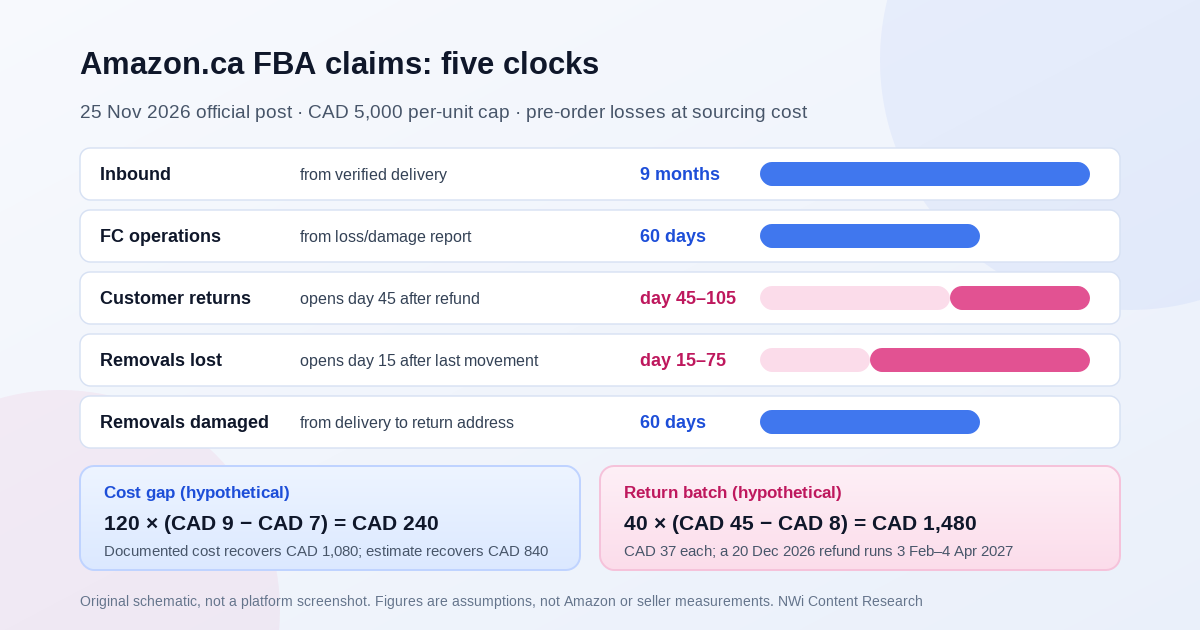
If you sell through FBA on Amazon.ca, the lost, damaged and returned units of Q4 are not an administrative task for a quiet week. They are a set of cash-flow windows, each with its own countdown. On 25 November 2026, the Amazon.ca Seller Forums published a peak-season reminder that lists five claim clocks, the CAD 5,000 per-unit cap and the sourcing-cost basis. The post is not a new fee change; it pulls deadlines that normally sit on separate help pages into one place. It also leaves three questions unanswered for an individual seller: which claim is still inside its window, should you fix sourcing cost before filing, and what should you do with a SKU above CAD 5,000? This article turns the five clocks into a calendar, works through three hypothetical scenarios and sets out stop conditions.
1. The decision: five clocks, not one 60-day rule
For an Amazon.ca FBA seller, the real question is which loss is still inside its own claim window, whether to fix sourcing cost before filing, and whether a SKU above CAD 5,000 needs insurance. Treating 60 days as a universal rule produces two opposite errors: filing a customer-return claim before the 45-day floor, or leaving a removal claim in the queue after its 75-day ceiling.
The official post puts five routes on one page: inbound shipments, fulfilment-centre operations, customer returns, removals lost in transit and removals damaged in transit. Each clock starts from a different event, so the day counts cannot be transferred from one route to another. What you need is not a general rule but a calendar sorted by claim route and event date.
Why now? Q4 raises inbound, return and removal volumes, and loss records pile up towards year-end. The claim windows do not extend for peak season. The post appeared on 25 November, leaving about five weeks to review sourcing costs, clear old claims and decide on insurance for high-value SKUs.
2. Mechanism: five clocks, two payout bases, one cap
The five clocks start from different events: inbound shipments run nine months from verified delivery; fulfilment-centre operations run 60 days from the date the loss or damage is reported; customer returns open on day 45 and close on day 105 after the refund or replacement; removals lost in transit open 15 days after the last confirmed movement and close 75 days after the shipment is created; removals damaged in transit run 60 days from delivery to the return address.
| Route | Clock starts | Opens | Closes | Typical evidence |
|---|---|---|---|---|
| Inbound shipment | Verified delivery date | When eligible for investigation | 9 months | Shipment ID, packing list, delivery proof, invoices |
| FC operations | Loss/damage reported | Same day | 60 days | Inventory Ledger, defect ID, cost documents |
| Customer return | Refund or replacement | Day 45 | Day 105 | Order ID, refund date, returns report, reimbursements report |
| Removal lost | Last confirmed movement / creation | Day 15 | Day 75 from creation | Removal order ID, tracking, delivery proof, LPN, photos |
| Removal damaged | Delivery to return address | Same day | 60 days | Delivery proof, photos, removal order |
There are two payout bases. Items lost or damaged before a customer order (inbound, FC operations, removals) are paid at sourcing cost. Customer returns are paid at the refund or replacement amount minus applicable fees. Sourcing cost is what you paid to source or make the unit; it excludes shipping, handling and customs duties. It is neither your landed cost nor your selling price.
The cap is CAD 5,000 per unit. For units above that amount, Amazon recommends third-party insurance. The uninsured excess is retained risk; a claim does not automatically cover it.
If sourcing cost is blank, Amazon uses an estimate based on comparable products. The estimate can be higher or lower than your actual cost, and the gap is magnified for high-margin or high-ticket SKUs. You can review and submit costs on the Manage Your Sourcing Cost page in the Inventory Defect and Reimbursement portal, but the figure needs invoices and payment records that support it.
One mechanism is easy to miss: Amazon now reimburses some fulfilment-centre losses automatically. Check the Reimbursements report first to see whether a unit has already been paid. A duplicate claim does not speed up processing. The policy PDF also warns that premature, insufficiently researched or high-volume requests can lead to delayed support, monitoring or account action.
3. Evidence boundary: forum post, policy PDF, login wall
The five clocks come from the 25 November 2026 Amazon.ca Seller Forums post. The public Canada policy PDF (19 December 2024) confirms the CAD 5,000 per-unit cap and the pre-order cost basis, but it does not contain the five clocks, and the full policy page still requires a login. This article is therefore a method piece, not a legal guide.
The forum post is complete as a seller-facing reminder, but it is not a legal text. Its timestamp is relative ("19 hours ago"), so the absolute publication date is inferred from 06:00 CST on 26 November 2026. The public Canada policy PDF is a 2024-12-19 template that uses the older "manufacturing cost" wording; the 2026 post uses "sourcing cost" and points to Manage Your Sourcing Cost. The two describe the same cost basis, but the 2024 wording cannot be treated as the current text line by line.
The full FBA inventory reimbursement policy page and the cost-management page both require a login. This article did not read their body text, so the five clocks have not been checked line by line against the policy page. Before filing, log in to your own Seller Central and check the version shown for your marketplace.
The post also gives no approval rate, average payout, processing time or seller median. This article does not invent those numbers. Every unit count, cost, refund, fee and date below is an explicitly labelled assumption, not Amazon data or a seller measurement.
4. Counter-case: claims that can fail or should not be filed
The counter-case is that a claim filed inside its window can still be rejected for missing documents, duplicate filing, an account that is not in normal status, or a loss caused by the seller's own removal, commingling or disposal. Check the Reimbursements report first so you do not file again for a unit that has already been paid.
Do not file, or fix the condition first, when the item was not registered in FBA at the time of loss; the item did not meet FBA product restrictions or inventory requirements; the items and quantities did not match the shipping plan; the shipment was cancelled or deleted; the item was pending disposal or was disposed of at your request; the item was defective or damaged by the customer; or the account was not in normal status during filing, review and appeal.
Customer returns have a timing counter-case: a claim filed before day 45 is premature and may be rejected, while a claim filed after day 105 is late and loses the window. File by refund date in batches after the 45-day floor, rather than starting the reconciliation on day 105.
Removals have a common sequencing error: waiting for inbound reconciliation before filing. The nine-month inbound clock and the 75-day removal clock are not the same clock; waiting for inbound can let the removal window close. File a lost removal separately after day 15 instead of bundling it with the inbound claim.
The high-value counter-case is a unit that costs CAD 8,000: the CAD 5,000 cap leaves CAD 3,000 uninsured and unreserved. A claim covers only part of the loss. Insurance is worth considering when the annual premium is below the expected loss, calculated as the probability of loss multiplied by the uninsured amount; the probability is an assumption, not platform data.
5. Scenario A: 120 units lost inbound, documented cost CAD 9 vs estimate CAD 7
Scenario A: 120 units lost inbound, documented cost CAD 9 vs estimate CAD 7 (hypothetical).
Assumptions: 120 units lost at the inbound stage; documented sourcing cost CAD 9 per unit; Amazon estimate CAD 7 per unit; verified delivery on 15 March 2026; the claim is filed inside the nine-month window; no exclusions and no duplicate payment.
Result: documented recovery is 120 × 9 = CAD 1,080; estimate recovery is 120 × 7 = CAD 840; the gap is CAD 240, or 22.2% of the documented recovery; the nine-month deadline runs from 15 March 2026 to 15 December 2026.
Decision: fix sourcing cost before filing. If invoices and payment records cannot support CAD 9, accept the estimate or skip the cost-based claim; do not substitute a landed cost that includes freight and duty.
The point of this scenario is not the size of 120 units but the CAD 240 that comes from one cost field. If every active ASIN is missing cost, the gap multiplies by unit count; if only one SKU is affected, the cost work is still reusable.
6. Scenario B: a 40-return batch, refund CAD 45, applicable fees CAD 8
Scenario B: a 40-return batch, refund CAD 45 and applicable fees CAD 8 (hypothetical).
Assumptions: 40 returns; refund CAD 45 each; applicable fees CAD 8; refund date 20 December 2026; the claim is filed inside the day 45–105 window; no duplicate payment and no grading dispute.
Result: claimable per return is 45 − 8 = CAD 37; the batch totals 40 × 37 = CAD 1,480; the earliest day-45 date is 3 February 2027 and the latest day-105 date is 4 April 2027.
Decision: batch by refund date and file soon after the day-45 floor, not at the day-105 ceiling. If the return is still in transit or the grading is disputed, preserve the evidence and do not file early.
The payout basis for a return is not sourcing cost; it is the refund or replacement minus applicable fees. You cannot estimate a return claim from your purchase cost. The 40-return, CAD 37 net figure is the reproducible starting point for this route; the actual amount comes from the refund record and the fee detail.
7. Scenario C: 30 removal units lost in transit, cost CAD 12
Scenario C: 30 removal units lost in transit, cost CAD 12 (hypothetical).
Assumptions: 30 removal units lost in transit; sourcing cost CAD 12 per unit; removal order created 1 October 2026; last confirmed movement 20 October 2026; no insurance and no duplicate payment.
Result: recoverable at cost is 30 × 12 = CAD 360; the window opens 15 days after the last movement on 4 November 2026 and closes 75 days after creation on 15 December 2026.
Decision: file immediately after the day-15 floor; do not wait for inbound reconciliation. Keep the removal order ID, tracking number, delivery proof, LPN and photos of the packaging.
Conditional analysis for a high-value SKU: a unit that costs CAD 8,000 exceeds the CAD 5,000 cap, leaving CAD 3,000 uninsured and retained. If the annual premium is below the expected loss (probability of loss × CAD 3,000), insurance is cheaper; otherwise retain the risk and hold a reserve. The probability is an assumption, not platform data.
8. Recalculable: one formula table and one calendar
The formula is: documented recovery = units × sourcing cost; estimate recovery = units × Amazon estimate; gap = units × (documented cost − estimate). At 120 units and CAD 9 versus CAD 7, the gap is CAD 240, or 22.2% of the documented recovery of CAD 1,080.
| Metric | Formula | Example |
|---|---|---|
| Documented recovery | N × C_doc | 120 × 9 = CAD 1,080 |
| Estimate recovery | N × C_est | 120 × 7 = CAD 840 |
| Cost gap | N × (C_doc − C_est) | 120 × 2 = CAD 240 |
| Return net | R × (refund − fees) | 40 × 37 = CAD 1,480 |
| Cap exposure | N × max(0, C_doc − 5,000) | 1 × (8,000 − 5,000) = CAD 3,000 |
| Nine-month deadline | EDATE(verified delivery, 9) | 15 Mar 2026 → 15 Dec 2026 |
| Day-count deadline | Event date + days | 20 Dec 2026 + 45 = 3 Feb 2027 |
The calendar puts the three scenarios on one timeline: inbound expires on 15 December 2026; the return batch opens on 3 February 2027 and closes on 4 April 2027; the lost removal opens on 4 November 2026 and closes on 15 December 2026. The dates differ, so a single month-end or quarter-end process will not work.
Keep the units consistent: nine months is a calendar-month calculation, not 270 days; 45, 105, 60, 75 and 15 are calendar days. Use the event date shown in Seller Central. If you only remember the month, work back from the report date and preserve the evidence rather than guessing a precise date.
9. Action list and stop conditions
Export the Reimbursements report, the Inventory Ledger and the return/removal detail first. Sort each loss into one of the five routes, then sort by the earliest deadline. Fix sourcing cost and invoices for every active ASIN; do not substitute a landed cost that includes freight, handling and duty.
- Export the Reimbursements report and mark each item as paid, in progress or eligible, to avoid duplicate claims.
- Assign every loss to one of the five routes and record its start event and deadline.
- Sort inbound claims by verified delivery date and work the earliest deadline first.
- Sort FC-operation claims by report date and file inside 60 days; do not wait for inbound reconciliation.
- Batch return claims by refund date, file after the day-45 floor and finish before day 105.
- File lost removals after the day-15 floor and damaged removals within 60 days of delivery.
- Fix sourcing cost, invoices and payment records for every active ASIN; assess insurance separately for high-value SKUs.
- Put the deadlines in a shared calendar with an owner and review new Eligible for claim items weekly.
The stop conditions are equally specific. If the policy page cannot be read and the official post is the only source, use the article as a method piece, not a legal guide. If sourcing cost cannot be supported by invoices and payment records, do not file a cost-based claim; accept the estimate or skip. If a claim is outside its window, do not file; record the loss. If the loss came from your own removal, commingling or disposal, do not claim. If a SKU is above CAD 5,000 and uninsured, treat the excess as unhedged risk. If the account is not in normal status, fix the account before filing.
If you disagree with the amount, the official post gives three routes: dispute the reimbursement amount through Get help and resources or Seller Assistant; customer-return reimbursement disputes have 60 days from the date the reimbursement was issued; a resolved decision can be filed again from the Resolved tab; and a customer-return grading dispute can be raised within 60 days of delivery. Keep the refund record, fee detail and grading evidence before disputing, and do not resubmit without new information.
- NWi CrossborderGo: review Amazon.ca sites, categories and price bands as inputs for claim value and SKU priority.
- NWi Operations: put returns, inventory and profit fields back into one operating table to decide which SKUs deserve cost work and which should exit.
- Request a demo: model FBA loss and claim cash flow against your own SKU structure.
- NWi Cross-border Agent: use expert research when platform rules, category and market assumptions need to be examined together.
10. Limitations and unknowns
This article has no seller-backend data, actual claim outcomes, approval rates or average payouts. The five clocks rest on one readable official post; the policy page requires a login, and the post uses a relative timestamp. Check every date in your own Seller Central before filing.
The article also does not check the current Canada policy page line by line, does not verify exceptions by account type, marketplace or product restriction, and does not cover separate rules for new FBA inbound, AWD, MCF or other fulfilment channels. It does not include exchange rates, capital cost, tax treatment or insurance terms. All unit counts, costs, refunds, fees, dates and loss probabilities are assumptions, not Amazon data, seller measurements or client cases. This is not legal, financial, tax or marketplace advice.
11. Method and disclosure
Data basis: the five clocks, the CAD 5,000 per-unit cap and the sourcing-cost basis come from the Amazon.ca Seller Forums post of 25 November 2026. The public Canada FBA reimbursement policy PDF (19 December 2024) is used to check the CAD 5,000 cap and the pre-order cost basis, but it does not contain the five clocks. The full policy page and the cost-management page require a login and were not used as readable evidence. Calculation basis: documented recovery = units × sourcing cost; estimate recovery = units × Amazon estimate; gap = units × (documented cost − estimate); return net = returns × (refund − applicable fees); nine months is calculated in calendar months, while 45/105/60/75/15 are calendar days. All unit counts, costs, refunds, fees and dates are explicitly labelled assumptions, not Amazon or seller measurements.
This article was prepared with automated research assistance from the public sources listed at the end. It was not reviewed by a human editor, and it does not invent client data, expert review, claim outcomes or ranking results. It is not legal, financial or marketplace advice.
12. Sources
- 1. Amazon.ca Seller Forums, 25 November 2026, "FBA Reimbursement Claims: Prepare Your Business for Peak Season" (primary: five clocks, CAD 5,000 cap, sourcing-cost basis, estimate fallback, dispute routes): Read the post, accessed 26 November 2026.
- 2. Amazon, 19 December 2024, "FBA inventory reimbursement policy" (Canada policy PDF; primary: CAD 5,000 per-unit cap, pre-order losses at cost, cost excludes freight/handling/duty, estimate used when cost is blank): Read the PDF, accessed 26 November 2026.
- 3. Amazon.ca Seller Forums, 28 February 2025, "New effective date for FBA inventory reimbursement policy" (primary: the cost-basis policy takes effect on 31 March 2025, and sellers can review and submit costs before it applies): Read the post, accessed 26 November 2026.
- 4. Amazon Seller Central Help, G200213130, "FBA inventory reimbursement policy" (full policy page; login required on this check, body not read, not used as readable evidence): View the page, accessed 26 November 2026.
- 5. Amazon Seller Central, "Manage Your Sourcing Cost" (cost-management page; login required on this check, no account-level data read, not used as readable evidence): View the page, accessed 26 November 2026.
- Note: sources 1–3 are primary; sources 4–5 are login-walled pages used only to describe the evidence boundary. No competitor data vendor's text, estimates, charts, screenshots, methods or API/MCP output was used; every scenario figure is labelled as an assumption in the body.
13. Original analytical contribution
The contribution is to split "60 days" into five claim clocks with different start events, and to put the sourcing-cost-versus-estimate gap, the return net and the CAD 5,000 cap into one recalculable framework rather than repeating an official reminder.
For the reader, the three most useful actions are: assign every loss to one of the five routes, calculate the deadline from its start event, and use the gap between documented cost and estimate to decide whether to fix cost before filing. Put those three steps in one table, and the Q4 backlog will not be left until year-end.