
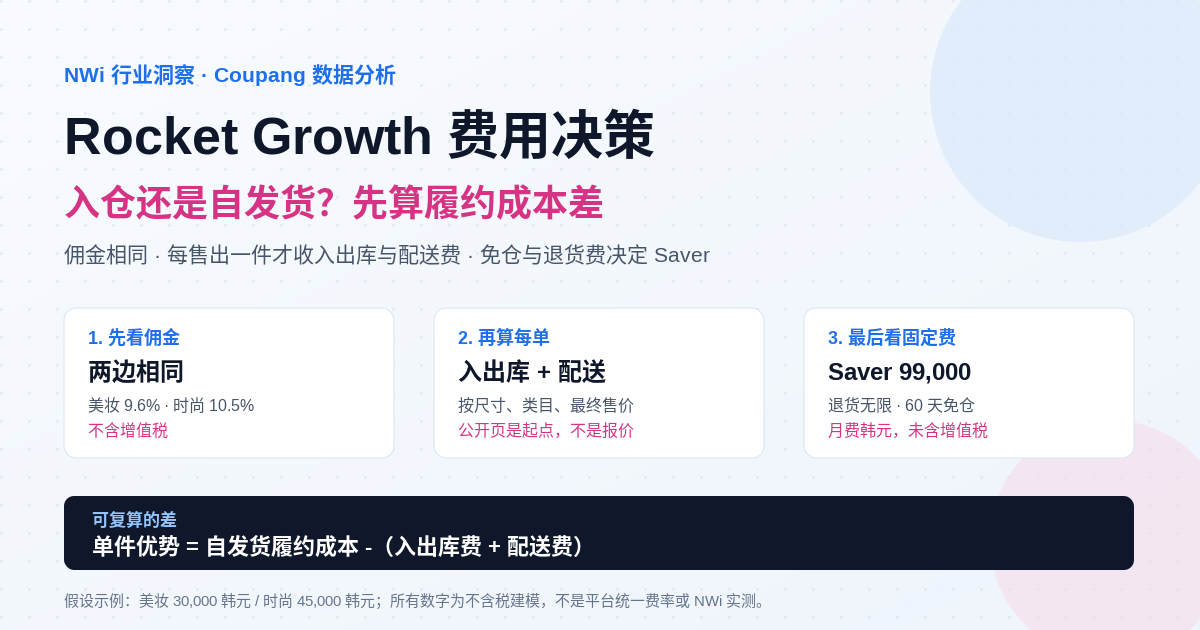
For cross-border sellers of beauty or fashion on Coupang Korea, Rocket Growth is not automatically the faster or more profitable default. The sales commission is the same as seller-fulfilled (self-ship); what changes is the per-order handling and delivery fee, the free-storage window, the monthly return-fee allowance and the KRW 99,000 Saver subscription. This article uses two hypothetical SKUs to build a reproducible per-unit contribution, first-inbound quantity and exit line.
1. The decision: move inventory in, or stay seller-fulfilled?
Coupang data analysis here is not a bestseller list; it turns the official fee schedule into a per-unit contribution. For one SKU, compare staying seller-fulfilled, moving to Rocket Growth, or adding Saver, and ask which account leaves more money per unit.
The real question is not whether Rocket Growth is good, but whether this SKU, at this price and size in Korea, earns a higher per-unit contribution after inbound, how large the first inbound should be, and when to exit.
There are three questions: first, whether the inbound contribution is higher than seller-fulfilled; second, how much to send first so the batch sells within the free-storage window without stocking out; third, at what return volume and inventory speed the KRW 99,000 Saver actually pays back.
A general "inbound is easier" answer cannot replace these three calculations. Category commission, size band, final price, return rate and inventory turnover all change the result; the next section separates the mechanics.
2. Mechanism: the commission is unchanged; logistics and free windows change
Coupang's official fee page states that Rocket Growth uses the same sales commission as seller-fulfilled; its January 2025 official deck further states that handling and delivery are charged only on sold products. Inbound is therefore not a fixed upfront fee; it replaces the per-order courier, packaging and outbound labour with a platform handling fee plus a delivery fee based on size, category and final price.
Rocket Growth charges the same sales commission as seller-fulfilled; what changes is the per-order handling and delivery fee charged only on sold units, the free-storage window and the 20 free returns a month, so the contribution difference equals seller-fulfilled logistics cost minus the handling-plus-delivery fee.
The free-storage window is the second variable. The main page gives 30 days per inbound, and 45 days for clothing, shoes and accessories; Saver extends every product to 60 days. Free storage is not free inventory; it is an upper bound for the first inbound, because stock left after the window starts to incur storage fees.
Return fees are the third variable. The main page gives 20 free return pickups, 20 free return restocks and 20 free outbound units a month, as a promotion that can change with notice; Saver makes return pickup and restock unlimited and free. For high-return categories, this can matter more than the per-order logistics gap.
Saver costs KRW 99,000 a month. The official page lists unlimited free return pickup/restock, 60 days of free storage for all products, and free fast settlement up to KRW 5 million a month. It is not a requirement for inbound; it is a fixed-fee option whose value depends on return volume and inventory turnover.
3. Evidence boundary: why "from KRW 1,125" is not a quote
Coupang's main Rocket Growth page and its separate fee page quote different small-item delivery starting points, KRW 1,250 and KRW 1,550; the public pages also do not list a per-SKU storage rate or a per-return fee, so this article treats them as a range and assumptions, not a quote.
The public pages give "from" prices, not a quote for your SKU. The final fee depends on category, size type and final consumer price; the main page says the price is the final consumer price after seller discounts such as instant discounts and downloadable coupons. The only executable number comes from entering the SKU in WING.
The fee basis must also be consistent. The fashion page explicitly says the 10.5% commission is VAT-exclusive, and Coupang's January 2025 official deck says payments are made after fees and the take rate are deducted, VAT excluded; the beauty page only says 9.6% and does not spell out VAT, so this article models everything VAT-exclusive and defers to the WING statement. If your storefront price includes VAT, divide by 1.1 before using the formulas.
The public pages do not give a per-return fee or a per-unit storage rate. This article assumes KRW 2,000 per return and KRW 300 per unit per 30 days, then solves for break-even. If your actual rates differ, the conclusion must change. These are not platform-wide rates or NWi measurements.
There is another boundary: every fee fact comes from Coupang's official pages and official material, a single publisher, and no second independent institution has replicated the schedule. This article does not use competitor data providers to "cross-check" it; instead it states the conflict and gaps in the official pages and handles them with a reproducible model.
Claims such as "1.8x growth" or "Saver sellers grew sales 15%/13%" are platform marketing, not causal experiments; this article does not treat them as evidence that inbound creates incremental sales.
4. The math: three accounts and the Saver break-even
The reproducible formulas are: seller-fulfilled contribution = price - commission - courier/packaging labour - COGS; inbound contribution = price - commission - handling - delivery - COGS; the difference is the fulfilment-cost gap and is independent of price and commission.
Define P as the VAT-exclusive price, r as the commission rate, L as seller-fulfilled courier, packaging and labour, H as handling, D as delivery and C as COGS. Seller-fulfilled contribution M_SF = P - rP - L - C; inbound contribution M_RG = P - rP - H - D - C; the per-unit advantage is delta = L - (H + D). Because rP and C are identical on both sides, they do not change the inbound-versus-seller-fulfilled choice; they only change whether the SKU is worth selling at all.
Saver is a fixed monthly fee, so the monthly break-even is B = (max(R - 20, 0) x F) + S, where R is monthly returns, F is the per-return handling fee and S is storage outside the free window. Saver pays back when B exceeds KRW 99,000; equivalently, the per-return break-even is F* = (99,000 - S) / max(R - 20, 0), and the monthly return break-even is R* = 20 + (99,000 - S) / F.
Size the first inbound from the free-storage window: Q = daily sales x free-storage days. Use 30 days for beauty, 45 for clothing, shoes and accessories, and 60 with Saver. For a new SKU without history, start with a conservative 14-day forecast and replenish within 30 days at the actual sell-through rate. Do not treat 60 days of free storage as a 60-day sales forecast; it is only the storage-fee boundary.
| Account | Charged per order | Fixed or monthly | When to choose |
|---|---|---|---|
| Seller-fulfilled | Commission; courier, packaging, labour | No platform monthly fee | Handling plus delivery is higher than seller-fulfilled logistics, or volume is too small |
| Rocket Growth | Commission; handling; delivery | 30 days free storage (45 for clothing, shoes, accessories); 20 free returns a month | The per-order gap is positive and the first inbound can sell within the free window |
| Rocket Growth + Saver | Same; KRW 99,000 monthly Saver fee | Unlimited return fees; 60 days free storage for all items | Monthly return fees above 20 units plus paid storage exceed KRW 99,000 |
The table splits "inbound" into three accounts: seller-fulfilled, plain Rocket Growth, and Rocket Growth plus Saver. Calculate the per-unit gap between the first two, then use monthly returns and storage to decide whether the third is worth adding.
5. Scenario A: low-return beauty, inbound adds KRW 760,000 a month (hypothetical)
Scenario A: low-return beauty serum, KRW 30,000 net price, 600 units a month (hypothetical)
Assumptions: KRW 30,000 net price (VAT excluded), KRW 8,000 COGS, 9.6% commission, small-item handling KRW 650 plus delivery KRW 1,550; seller-fulfilled courier KRW 3,000 plus packaging and labour KRW 500; 600 units a month, 5% return rate, KRW 2,000 return handling per unit, 20 free returns a month; all 600 units sell within the 30-day free-storage window; advertising, FX and tax excluded.
Result: commission KRW 2,880; inbound contribution KRW 16,920 versus KRW 15,620 for seller-fulfilled, a KRW 1,300 per-unit advantage; 600 units add KRW 780,000 a month; 10 of 30 returns exceed the free allowance, costing KRW 20,000, so the net gain is KRW 760,000; the KRW 99,000 Saver fee would save only that KRW 20,000 and does not pay back.
Decision: use Rocket Growth without Saver; set the first inbound at 30 days times 20 units a day, or 600 units, and start a new SKU with 300 units for a 15-day test; revisit Saver only if monthly returns exceed about 70 units.
The key is not that beauty is a good category; it is that the per-order fulfilment gap for a small item is large. Seller-fulfilled costs KRW 3,500 versus KRW 2,200 inbound, a KRW 1,300 advantage per unit. Only 10 of 30 returns exceed the 20-unit allowance, so KRW 20,000 of return cost cannot consume the KRW 780,000 monthly advantage. Saver would save only KRW 20,000 against a KRW 99,000 fee, so it does not pay back.
Sensitivity: using the main page's KRW 1,250 delivery fee, inbound contribution becomes KRW 17,220, the per-unit advantage KRW 1,600 and the monthly advantage KRW 960,000; the conclusion is still inbound without Saver. The real dividing line is the WING quote, not the public starting price.
6. Scenario B: high-return fashion, Saver turns a near-tie into a positive contribution (hypothetical)
Scenario B: high-return fashion item, KRW 45,000 net price, 300 units a month (hypothetical)
Assumptions: KRW 45,000 net price (VAT excluded), KRW 15,000 COGS, 10.5% commission, medium-item handling KRW 1,250 plus delivery KRW 2,100; seller-fulfilled courier KRW 3,000 plus packaging and labour KRW 800; 300 units a month, 25% return rate, KRW 2,000 return handling per unit, 20 free returns a month; first inbound 600 units sold over 60 days, 45 days free storage, then KRW 300 per unit per 30 days for 15 days; advertising, FX and tax excluded.
Result: commission KRW 4,725; inbound contribution KRW 21,925 versus KRW 21,475 for seller-fulfilled, only KRW 450 per unit; 300 units add KRW 135,000 a month; 55 of 75 returns exceed the free allowance, costing KRW 110,000, and 75 units on average sit in paid storage for 15 days, costing KRW 11,250, so the net gain is KRW 13,750; Saver costs KRW 99,000 and saves KRW 121,250, adding KRW 22,250, so Rocket Growth plus Saver beats seller-fulfilled by KRW 36,000.
Decision: use Rocket Growth plus Saver for this SKU; inbound 600 units for the 60-day free window, but not beyond your cash position and demand forecast; if the per-return cost is below about KRW 1,596 or monthly returns are below about 64, Saver does not pay back and the SKU should return to plain Rocket Growth or seller-fulfilled.
The key is that the per-order advantage is only KRW 450: medium-item handling KRW 1,250 plus delivery KRW 2,100 is KRW 3,350, only KRW 450 below the KRW 3,800 seller-fulfilled cost. Of 75 returns, 55 exceed the allowance, and KRW 110,000 of return cost plus KRW 11,250 of storage cuts the KRW 135,000 monthly advantage to KRW 13,750. Saver spends KRW 99,000 to remove KRW 121,250, lifting the net advantage to KRW 36,000.
Sensitivity: if the per-return cost is KRW 1,500 instead of KRW 2,000, 55 excess returns plus KRW 11,250 of storage total KRW 93,750, below KRW 99,000, so Saver loses KRW 5,250. If monthly returns are only 60 (40 excess), at KRW 2,000 the total is KRW 80,000 plus KRW 11,250, also below KRW 99,000. Recalculate the break-even with your own return and storage rates.
7. Counterexamples and stop conditions: which SKUs should not move in
The counterexample is a large or heavy item: when handling plus delivery exceeds the courier, packaging and labour cost of seller-fulfilled, Rocket Growth costs more per order; a high-return, slow-moving fashion item can also consume a thin per-order advantage.
Put a large item into the formula: assume a large-2 SKU with handling KRW 1,375 and delivery KRW 4,100 on the fee page, or KRW 5,475 total; seller-fulfilled courier, packaging and labour is KRW 3,500, so the per-unit advantage is negative KRW 1,975. Unless inbound can be shown to create incremental sales, this SKU should not give up seller-fulfilled for "inbound".
The low-price counterexample is not a smaller per-unit advantage (that is set only by the fulfilment-cost gap); it is a contribution too thin to absorb fixed fees. If inbound contribution is only KRW 3,000 and you sell 100 units a month, the KRW 99,000 Saver fee needs KRW 99,000 divided by the per-return fee in excess returns or equivalent storage to break even; the smaller the volume, the harder the fixed fee is to spread.
Stop conditions can be fixed in advance: first, exit if inbound net contribution is below seller-fulfilled for two consecutive months; second, recalculate Saver if the actual return rate is 5 percentage points above the assumption; third, cut the first inbound or move to Saver if paid storage exceeds 20% of inbound contribution; fourth, do not move if the WING handling-plus-delivery quote is above seller-fulfilled fulfilment cost.
8. Action list: from the WING quote to the 30-day review
First obtain a WING estimate for the target SKU by size, category and final price; then use the last 90 days of returns to calculate the monthly cost above 20 free returns and the storage cost outside the free window; set the first inbound at no more than free-storage days times daily sales, and review after 30 days.
- 1. Enter the target SKU's category, size and final price in WING and export the handling/delivery estimate; record the date and page, and never substitute the public "from" price.
- 2. Pull the last 90 days of orders and returns; calculate average monthly units, return rate, returns above 20 units, per-return handling cost and average inventory outside the free window.
- 3. Calculate M_SF, M_RG and delta in the three-account sheet; if delta is zero or negative, stay seller-fulfilled rather than switching for "faster inbound".
- 4. Calculate the monthly Saver saving with B = (R - 20) x F + S; buy Saver only when B exceeds KRW 99,000, otherwise start with plain Rocket Growth.
- 5. Set the first inbound at Q = daily sales x free-storage days; for a new SKU, use a conservative 14-day forecast, stay below Q, and replenish after 30 days at the actual sell-through rate.
- 6. Review after 30 days: compare actual return rate, storage fee, stockout days and per-unit contribution with the assumptions; exit or change the account when a stop condition triggers.
For execution, use the Coupang data analysis platform to review category, price band and product structure in Korea, then use NWi CrossborderGo to put brand, store and product data into one research workflow. For selection, profit and replenishment in an operations tool, see NWi Operations; to connect platform reports to a research workflow, see MCP data access; for expert research and review insight, see the Cross-border Agent; for a SKU-specific fee and entry assessment, go to inquiry and demo.
9. Limitations, method and disclosure
Data basis: commission, handling, delivery, free-storage windows and return-fee allowances come from Coupang Marketplace's Rocket Growth main page, fee page, beauty category page, fashion category page and Saver page, accessed on 26 November 2026; the "charged only on sold products" and "VAT excluded" mechanics come from Coupang's January 2025 official deck; commission is calculated on the VAT-exclusive final selling price, and handling and delivery are treated as charged only on sold units, as the official material states; 30-day free storage, 45 days for clothing, shoes and accessories, 60 days with Saver, 20 free returns a month and the KRW 99,000 Saver fee are current promotional or rate terms and may change. Calculation: seller-fulfilled contribution = price - commission - courier/packaging labour - COGS; inbound contribution = price - commission - handling - delivery - COGS; Saver break-even = monthly return fees above 20 units + storage outside the free window > KRW 99,000. All prices, COGS, return rates, return-handling fees and storage rates are labelled assumptions, not Coupang's universal rates or NWi measurements.
This article was prepared with automated research assistance and analysed from the public sources listed at the end; it was not manually reviewed. It does not invent customer data, expert review, sales lift, ranking results or platform endorsement. It is not legal, tax, platform-operations or investment advice.
This article has no seller WING quote, actual per-return fee, storage rate or sales data; the prices, COGS, return rates, return fees and storage fees in the two SKUs are labelled assumptions, not Coupang's universal rates or NWi measurements.
The unknowns most likely to change the conclusion are the WING quote for the specific SKU, subcategory commission, final-price discounts, actual return rate, per-return handling fee, storage rate outside the free window and first-batch sell-through. If any of them changes, recalculate with the same formulas rather than reusing the numbers in this article.
Rates and promotions can also change: 30/45/60-day free storage, 20 free returns a month and the KRW 99,000 Saver fee are the terms shown on the official pages on 26 November 2026, and the pages say changes are announced in advance; check WING and the latest notice before acting. This article is not legal, tax or platform-operations advice.
10. Sources
- 1. Coupang Marketplace, "Coupang Rocket Growth" (primary: same commission, handling/delivery starting points, 30/45-day free storage, 20 free returns a month, Saver 60-day storage): read the original
- 2. Coupang Marketplace, "Rocket Growth fees" (primary: small KRW 650 + 1,550, medium KRW 1,250 + 2,100, the page does not spell out VAT, free storage and return allowances): read the original
- 3. Coupang Marketplace, "Beauty category" (primary: 9.6% beauty commission, small KRW 650 + 1,550, medium KRW 1,250 + 2,100): read the original
- 4. Coupang Marketplace, "Fashion category" (primary: 10.5% fashion commission, VAT-exclusive, medium KRW 1,250 + 2,100, 45-day apparel storage): read the original
- 5. Coupang Marketplace, "Rocket Growth Saver" (primary: KRW 99,000 monthly fee, unlimited return pickup/restock, 60-day storage, fast settlement): read the original
- 6. Coupang Marketplace, "Introduction to Coupang Rocket Growth (2025.01)" (primary: handling and delivery charged only on sold products, payment after fees and take rate, VAT excluded; used only for billing mechanics, not current rates): read the original
11. Original analytical contribution
The contribution is to reduce "inbound or seller-fulfilled" to a fulfilment-cost gap and to give the break-even condition for the KRW 99,000 Saver fee: whether monthly return fees above 20 units plus storage outside the free window exceed KRW 99,000.
The second contribution is turning "the commission is the same" from a commonplace into a calculation: commission and COGS are identical in both accounts and cancel, so the decision depends on seller-fulfilled logistics cost minus handling plus delivery. That gap is KRW 1,300 per unit for small beauty and only KRW 450 for medium fashion; the size band explains more than the category story.
The third contribution is turning Saver from "should I buy the membership" into a monthly inequality: do return fees above 20 units plus storage outside the free window exceed KRW 99,000? The beauty scenario has only KRW 20,000 and does not buy; the fashion scenario has KRW 121,250 and does; when the per-return cost falls to KRW 1,500, fashion flips back to no Saver.
The fourth contribution is keeping the delivery-fee difference between official pages as a range instead of pretending there is one number. The public page is the starting point; the WING quote is the executable cost. The conservative calculation and sensitivity analysis make that distinction visible in the decision.