
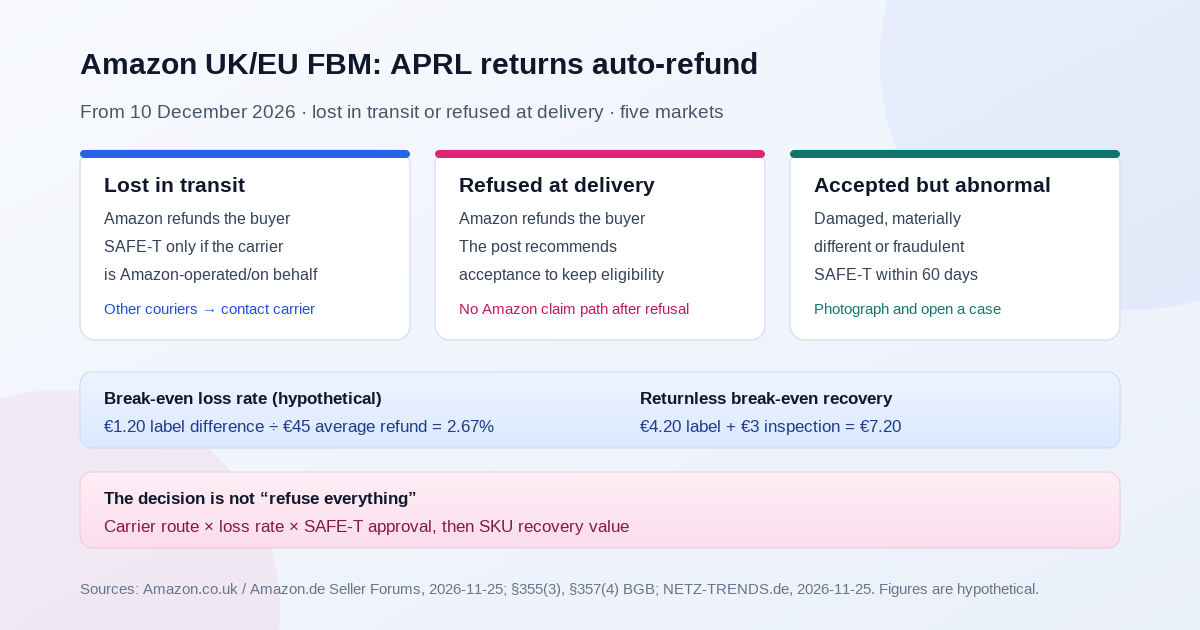
If you sell through FBM in the UK, Germany, France, Italy or Spain and use Amazon Pre-paid Return Labels (APRL) for returns, 10 December 2026 adds a new default: when a return parcel is lost in transit, or refused at delivery, Amazon refunds the customer first. The seller's real decisions are three: whether the return travels with a carrier operated by or on behalf of Amazon, whether to accept it at the warehouse, and which SKUs should move to returnless resolution. This article combines the official announcement, the German statutory withdrawal risk and two hypothetical scenarios into a reproducible carrier-route and SKU-tiering method.
1. The decision: refusal turns from a defensive move into a certain refund plus a lost reimbursement route
For an FBM seller in the UK, Germany, France, Italy or Spain, the real decision after 10 December is the carrier route, the recovery value per unit and whether the SKU should go returnless. Refusing a suspicious return used to be a defensive move: the parcel does not enter the warehouse, so at least there is no inspection or resale cost. From 10 December, the cost structure changes. The announcement says that when a seller refuses an APRL return, Amazon automatically refunds the customer; it also recommends accepting delivery because acceptance keeps the seller eligible for reimbursement. Refusal is therefore no longer just 'send the parcel back': it is 'book a certain refund and give up the route to an Amazon claim'.
But 'accept everything' is not the answer either. After acceptance, if the parcel is damaged, materially different or fraudulent, the seller still has to file a SAFE-T claim within 60 days; a claim is an application, not an automatic payout. The announcement gives no approval rate, reimbursement amount or handling time. For a low-value SKU, the label and inspection cost can exceed the recoverable value; for a high-value SKU, acceptance plus a claim has a higher expected value.
Why now? The announcement was published on 25 November, a little over two weeks before the 10 December start. Sellers need to list the carriers on their FBM returns, identify which routes are operated by or on behalf of Amazon, change the default from 'refuse suspicious parcels' to 'accept–inspect–claim', and set returnless rules for low-recovery SKUs. Waiting until after 10 December means the first automatic refunds have already happened and retrospective repair costs more.
2. Mechanism: three return states, three evidence chains
The post separates APRL returns into three states — lost in transit, refused at delivery and accepted but abnormal — and each state has a different refund trigger and claim path, so collapsing them into 'lost means reimbursed' will misprice the decision. The table below separates the refund, the claim route and the key action for each state.
| State | Trigger | Automatic Amazon refund? | Can the seller claim from Amazon? | Key action |
|---|---|---|---|---|
| Lost in transit | APRL return lost during transport | Yes | SAFE-T only if the carrier is a delivery partner operated by or on behalf of Amazon; other couriers are outside Amazon reimbursement | Confirm the carrier; keep tracking and dispatch evidence; file a damage/materially different/fraud claim within 60 days where applicable |
| Refused at delivery | Seller refuses the APRL return | Yes | The post recommends acceptance to keep reimbursement eligibility; it gives no claim path after refusal | Refuse only when safety, contamination or fraud evidence justifies it, and record the reason |
| Accepted but abnormal | Parcel accepted, but damaged, materially different or fraudulent | Not triggered automatically (the return was accepted) | SAFE-T claim within 60 days | Open, photograph and document; keep the label and correspondence |
The carrier is the key to a lost return. The post says that if the return was sent by a delivery partner operated by or on behalf of Amazon, the seller can file a SAFE-T claim for reimbursement; if it was sent by any other courier, the seller can contact the courier directly, because those returns are not eligible for reimbursement from Amazon. The post does not explain how to identify a delivery partner operated by or on behalf of Amazon, and it does not publish a carrier list. Sellers cannot guess from the label design; they need to confirm in the return settings, the carrier contract or the Seller Central return report.
Eligibility is the key to a refusal. The post recommends accepting delivery because acceptance 'keeps you eligible for reimbursement'. Conversely, it gives no route to an Amazon claim after refusal. Refusal can still be right: the parcel may be visibly damaged, contaminated, leaking dangerous goods, or you may have strong evidence of fraud, and receiving it may cost more than the refund. But in that case you accept a certain refund and no Amazon claim; you should not assume SAFE-T remains available after refusal.
Time and evidence are the keys to an accepted but abnormal return. The post says that if a return arrives damaged, materially different or fraudulent, the seller can file a SAFE-T claim within 60 days. The 60 days are the window stated in the post; the start date, required documents and approval standard are not set out. Sellers need opening photos, the label, the tracking number, buyer correspondence and the return reason in one case file, or the 60-day window may close before the evidence is complete.
The other mechanism is returnless resolution. The post says sellers can set returnless resolutions by specific criteria or by individual SKU, so the customer is refunded and keeps the product. This option does not use an APRL return, so it does not trigger the 'lost in transit/refused at delivery' automatic refund scenarios; the refund itself still happens and the product is not recovered. It suits SKUs with low recovery value, high return cost or highly predictable return reasons.
Operationally, the post says sellers 'don't need to take any action' and automatic refunds start on 10 December. Refund transactions can be viewed in Seller-fulfilled return reports, generated once or scheduled. That is a platform operating note, not financial advice: without a reconciliation process, automatic refunds will mix with SAFE-T claims, carrier claims and unrecoverable losses, and the month-end view will be one refund total.
3. Evidence boundary: one readable official post, one German edition, two login walls
The readable primary source is the Amazon.co.uk Seller Forums post published on 25 November 2026. Amazon.de Seller Forums carries a German edition of the same announcement; it matches the English text on the five markets, FBM scope, 10 December date, carrier condition and 60-day window, but it is a translation of the same announcement, not an independent source. Both posts use a relative timestamp ('17 hours ago'); the absolute date is cross-checked against NETZ-TRENDS.de's report at 19:36 CET on 25 November 2026 and the search index.
The only readable primary text is the Amazon.co.uk Seller Forums post of 25 November 2026; the two help pages require sign-in, and the post publishes no loss rate, carrier mix or SAFE-T approval rate. The linked pages — Reimbursements for seller-fulfilled orders with Amazon pre-paid return labels (G202175000) and Returnless Resolution (G202174940) — redirected to sign-in when accessed on 26 November 2026, so their body text was not read. The announcement is therefore the only readable official text on the mechanics; any carrier list, 60-day start rule, SAFE-T document list or exception on the help pages was not checked line by line. Readers should sign in to their own Seller Central and check the version shown for their account.
The post gives no loss rate, carrier mix, average refund, SAFE-T approval rate, reimbursement amount or handling time. It does not define which carriers count as 'operated by or on behalf of Amazon', does not compare the five countries' local laws, and does not say whether FBA returns are covered. This article does not fill those unknowns with numbers; every parcel count, amount, loss rate and approval rate in the scenarios is an explicitly labelled assumption.
The German law section uses two readable primary legal texts: §355(3) BGB provides that, on an effective consumer withdrawal, the trader bears the risk of returning the goods; §357(4) BGB provides that, in a consumer-goods sale, the trader may refuse the refund until the goods are returned or the consumer proves dispatch, unless the trader offered to collect the goods. NETZ-TRENDS.de cited both provisions in its 25 November 2026 report and noted that Amazon's announcement gives no fixed interval between loss and refund. This article applies German law to Germany only; it did not check the corresponding rules in France, Italy, Spain or the UK, so the German conclusion is not extended to the other four markets.
One seller reply under the German post raises concern that a buyer could scan the label at a Packstation without handing over the goods, and says SAFE-T claims are 'not upheld 90% of the time'. That is one public seller comment, not approval-rate data and not platform statistics. This article uses it only as a process-risk reminder: if the return was never actually dispatched, the seller needs to show that a label scan is not proof that the goods were sent. The comment is not presented as the real SAFE-T approval rate.
4. Counter-case: refuse everything, accept everything or switch every carrier can all cost more
Refusing everything, accepting everything and switching every return to a cheaper carrier can all cost more; refusal is rational only when safety, contamination, dangerous goods or fraud evidence justifies it, and acceptance still needs the evidence file within 60 days. Start with refusal: if the parcel is visibly damaged, contaminated or leaking dangerous goods, or you have evidence that the buyer returned an empty box or stones, receiving it means inspection, disposal and resale costs, and possibly a safety liability. Refusing, accepting the certain refund and giving up the Amazon claim may then be cheaper. The key is to include the lost claim, not just the refund.
The counter-case to accepting everything: if returns are frequently unsellable, materially different or fraudulent, a SAFE-T claim after acceptance may be rejected for insufficient evidence, and the post does not promise payment. The 'accept–inspect–claim' process can then cost more than returnless. For a low-value SKU, a €4.20 label plus €3 inspection may already exceed the recoverable value; returnless can be cheaper.
The counter-case to switching every return to a cheaper carrier: a third-party carrier may be cheaper than APRL, but a lost return on that route is outside Amazon reimbursement. Whether the label saving covers the added refund exposure depends on the loss rate and the label difference, not on the carrier's unit price alone. Scenario A below calculates a break-even loss rate; if the actual loss rate is below it, the cheaper carrier can still be better.
The German-law counter-case: German law allows the trader to withhold the refund until the goods are received or the buyer proves dispatch, but Amazon's automatic refund may trigger as soon as the parcel is treated as lost. How the two interact depends on the seller's platform contract, account state and evidence; this article does not make a legal determination. Sellers should not read 'Amazon auto-refunds' as 'German law requires me to refund at this moment', nor 'German law allows withholding' as 'the platform will not auto-refund'.
Another counter-case is changing the carrier without changing the process. If the returns team still defaults to refusal, or does not photograph and open a case after receiving a return, the 60-day claim window can expire even after the carrier and label are changed. The policy change alters the refund trigger; recovering money depends on the evidence chain.
5. Scenario A: 2,000 APRL returns, 1.5% lost, Amazon-partner carrier vs third-party carrier (hypothetical)
Scenario A: 2,000 APRL returns, 1.5% lost, Amazon-partner carrier vs third-party carrier (hypothetical)
Assumptions: 2,000 APRL returns in a quarter; 1.5% lost in transit (30 parcels); average refund €45; COGS €18 per unit; Amazon-partner APRL label €4.20 per return, borne by the seller; third-party label €3.00 per return; SAFE-T is assumed to approve 100% of the refund for Amazon-partner lost returns; carrier recovery on the third-party route is assumed to be zero; labour, FX, tax and fraud are excluded.
Result: lost parcels = 2,000 × 1.5% = 30; refund exposure = 30 × €45 = €1,350; COGS loss = 30 × €18 = €540; Amazon-partner labels = 2,000 × €4.20 = €8,400; third-party labels = 2,000 × €3.00 = €6,000. The Amazon-partner route costs €8,400 + €540 = €8,940 after the refund is fully reimbursed; the third-party route costs €6,000 + €540 + €1,350 = €7,890. Under these assumptions the third-party route is €1,050 cheaper.
Decision: do not choose the more expensive Amazon-partner label just to preserve SAFE-T eligibility. With 2,000 returns, a 1.5% loss rate, a €45 average refund and a €4.20 versus €3.00 label difference, the break-even loss rate is 2.67%; below it the cheaper carrier wins, above it the Amazon-partner route wins. This threshold applies only to these assumptions; recalculate with your own label prices and order value.
Sensitivity: when the SAFE-T approval rate is below 100%, the Amazon-partner advantage narrows. At 100% approval the net cost is €8,940; at 50% it is €8,400 + €540 + €1,350 × 50% = €9,615; at 0% it is €8,400 + €540 + €1,350 = €10,290. Against the third-party route's €7,890, the third-party advantage is €1,050, €1,725 and €2,400 respectively. The post publishes no approval rate, so this sensitivity is not a forecast; it shows that the value of SAFE-T eligibility depends on how much reimbursement you actually obtain.
Conditional analysis: if the third-party carrier also pays for lost parcels (for example under a carrier contract with insurance), reducing the carrier recovery from zero to the actual value lowers the third-party net cost and raises the break-even loss rate. If the third-party label is only €0.50 cheaper rather than €1.20, the label difference is €1,000 and the break-even loss rate is €1,000 ÷ €90,000 = 1.11%; at a 1.5% actual loss rate the Amazon-partner route then wins. The conclusion is sensitive to both the label difference and the loss rate; do not compare unit prices alone.
6. Scenario B: an €18 item, accept and resell vs returnless (hypothetical)
Scenario B: an €18 item, accept and resell vs returnless (hypothetical)
Assumptions: selling price €18; COGS €6; APRL label €4.20; inspection and restocking labour €3; expected resale recovery €8; refund €18; no fraud or return abuse; both options refund €18.
Result: accept and resell = €18 refund + €4.20 label + €3 inspection − €8 recovery = €17.20 net cost; returnless = €18 net cost; accepting is €0.80 cheaper. The break-even recovery is €4.20 + €3 = €7.20, so accepting is cheaper above €7.20 and returnless is cheaper below it. If the item is unsellable (recovery €0), accept costs €18 + €4.20 + €3 = €25.20 versus €18 returnless, so returnless is €7.20 cheaper.
Decision: use €7.20 as this SKU's break-even recovery; set returnless first for SKUs expected to recover less than €7.20 and keep accept–inspect–resell above it. Do not set returnless by price alone; add category, return reason and customer-history conditions to limit abuse. €7.20 is not a platform threshold; it comes from your own label, labour and recovery values.
Conditional analysis: if inspection labour falls from €3 to €1, the break-even recovery falls to €5.20 and more SKUs are worth accepting; if the label rises to €5.50, the threshold rises to €8.50 and more SKUs should go returnless. If recovery is only €4, accept costs €18 + €4.20 + €3 − €4 = €21.20 versus €18 returnless, so returnless is €3.20 cheaper. The calculation can be copied into your SKU table as long as the four inputs are replaced with local numbers.
7. Germany: beyond the platform auto-refund, a statutory withdrawal risk
Germany is the only one of the five markets where this article checks local law separately. §355(3) BGB provides that, on an effective consumer withdrawal, the trader bears the risk of returning the goods; §357(4) BGB provides that, in a consumer-goods sale, the trader may refuse the refund until the goods are returned or the consumer proves dispatch, unless the trader offered to collect the goods. NETZ-TRENDS.de cited both provisions in its 25 November 2026 report and noted that Amazon's announcement gives no fixed interval between loss and refund.
This means that, in Germany, the return-transport risk already sits with the seller; Amazon's automatic refund changes the trigger point and operating routine, not the existence of a new statutory risk. But the timing can still differ: German law allows withholding until receipt or proof of dispatch, while Amazon's automatic refund may occur as soon as the parcel is treated as lost. Sellers need to read the platform contract, account state and evidence together; one rule alone is not enough.
The practical checklist for a German seller is: keep the buyer's dispatch proof and tracking record; if the buyer has no dispatch proof, check the platform process against §357(4) to see whether withholding is available; if the platform has already refunded, keep the refund record, SAFE-T application and carrier claim in one case file. This article does not decide the legal outcome of a specific case and does not extend the German rule to France, Italy, Spain or the UK.
8. Reproducible: formula table and tiering rules
The scenarios reduce to formulas that can be replaced with your own numbers. All formulas are arithmetic; they contain no unpublished approval rate or loss rate.
| Metric | Formula | Scenario example |
|---|---|---|
| Lost parcels | returns × loss rate | 2,000 × 1.5% = 30 |
| Refund exposure | lost parcels × average refund | 30 × 45 = €1,350 |
| COGS loss | lost parcels × COGS per unit | 30 × 18 = €540 |
| Amazon-partner labels | returns × APRL label fee | 2,000 × 4.20 = €8,400 |
| Third-party labels | returns × third-party label fee | 2,000 × 3.00 = €6,000 |
| Amazon-partner net cost | labels + COGS + refund exposure × (1 − approval rate) | 8,400 + 540 + 1,350 × 0 = €8,940 |
| Third-party net cost | labels + COGS + refund exposure − carrier recovery | 6,000 + 540 + 1,350 − 0 = €7,890 |
| Break-even loss rate | label difference ÷ (returns × average refund) | 2,400 ÷ 90,000 = 2.67% |
| Returnless break-even recovery | label + inspection labour | 4.20 + 3 = €7.20 |
The tiering rule fits in three sentences: first, list every FBM return by carrier route and confirm whether the carrier is a delivery partner operated by or on behalf of Amazon; second, calculate the label-plus-inspection break-even recovery for each SKU and send SKUs below it to returnless first; third, split automatic refunds each month into 'SAFE-T filed', 'carrier claim open' and 'written off', so the month-end view is not one refund total.
The table cannot decide 'accept or refuse' for you, because refusal also involves safety, contamination, fraud and brand risk; it only clears the financial part. Safety, legal and platform-compliance decisions should be signed off separately, not replaced by a spreadsheet formula.
9. Action list and stop conditions
Before 10 December, list the carrier routes, change the default from refusal to accept–inspect–claim, set returnless tiers by SKU and start a monthly reconciliation of automatic refunds. The specific actions are below.
- Export the last 12 months of FBM returns, group them by carrier and return reason, and mark the routes carried by a delivery partner operated by or on behalf of Amazon; ask the carrier or check Seller Central if unsure, and do not guess.
- Change the returns team's default from 'refuse suspicious parcels' to 'accept–open–photograph–open a case–decide on SAFE-T within 60 days'; refuse only when safety, contamination, dangerous goods or fraud evidence justifies it, and record the reason.
- Calculate the label-plus-inspection break-even recovery for each SKU, set returnless first for SKUs below it, and limit abuse with price bands, category, return reason and customer history.
- Generate the Seller-fulfilled return report each month and match every automatic refund to SAFE-T, a carrier claim or a written-off loss; do not wait until quarter end.
- Do not switch carriers on label price alone; put SAFE-T eligibility, approval uncertainty and carrier recovery terms into the same comparison.
- After 10 December, sign in to Seller Central again and check the help pages and the account display; the public post is a summary, not the full policy.
The stop conditions are equally explicit: if the help pages cannot be read and the official post is the only source, use this as a method article and not as the complete policy; if the carrier cannot be confirmed, do not assume SAFE-T is available; if a return is clearly dangerous, contaminated or fraudulent, refuse it and record why rather than accepting it to preserve eligibility; if the SKU's recovery value is below the label plus inspection cost, use returnless rather than forcing acceptance; if Amazon changes the rule or a help page conflicts with the post, stop and re-verify rather than following the old post.
One more stop condition is 'do not file claims in bulk without evidence'. The post allows a SAFE-T claim within 60 days, but it does not say that filing equals payment; if a batch of returns lacks opening photos, labels or tracking records, bulk filing can be rejected and consume processing capacity. Fix the evidence first, then file.
- NWi CrossborderGo: review FBM returns and SKU structure by marketplace, category and price band as inputs to the carrier-route and returnless tiers.
- NWi Operations: put returns, labels, inspection and recovery value into one operating table to check which SKUs are worth accepting.
- NWi Cross-border Agent: use it when platform rules, destination law and category assumptions need to be researched together; review insights are limited to selected brands.
- MCP: see how return reports and internal order tables could feed one analysis flow; actual compatibility and permissions depend on integration testing.
- Book a demo: build an APRL return profit-and-loss estimate for your carrier mix and SKU structure.
10. Limitations and unknowns
This article has one readable official announcement text; the English and German posts are the same announcement. The two help pages require sign-in and were not read. The carrier list, the 60-day start rule, the SAFE-T document list, the reimbursement amount and the handling time were therefore not checked line by line. The post publishes no loss rate, carrier mix, average refund, SAFE-T approval rate or seller-measured data; this article does not invent those numbers.
This article covers only FBM APRL returns in the five markets, not FBA or other EU countries; the German law review covers only §355(3) and §357(4) BGB and does not extend the German conclusion to the other four markets. The post does not define 'a delivery partner operated by or on behalf of Amazon', and this article does not supply a list.
The 2,000 returns, 1.5% loss rate, €45 average order value, €18 COGS, €4.20/€3.00 labels, €3 inspection, €8 recovery and 100%/50%/0% approval rates are assumptions, not Amazon data, seller measurements or client cases. This article is not legal, financial, tax or platform-operations advice; a specific case should be checked with a qualified local professional and against the Seller Central display for the account.
11. Method and disclosure
Data basis: the policy mechanics come from the Amazon.co.uk Seller Forums post of 25 November 2026 and were checked against the German edition on Amazon.de Seller Forums; the publication date is cross-checked against NETZ-TRENDS.de's report at 19:36 CET on 25 November 2026 and the search index; German law comes from the §355 and §357 BGB texts on gesetze-im-internet.de; NETZ-TRENDS.de is used for German-law context and the 'no fixed refund interval' point, not for platform-policy facts. Calculation basis: lost parcels = returns × loss rate; refund exposure = lost parcels × average refund; COGS loss = lost parcels × COGS per unit; Amazon-partner net cost = labels + COGS + refund exposure × (1 − SAFE-T approval rate); third-party net cost = labels + COGS + refund exposure − carrier recovery; break-even loss rate = label difference ÷ (returns × average refund); returnless break-even recovery = label + inspection labour. All parcel counts, amounts, loss rates, approval rates and recovery values are explicitly labelled assumptions, not Amazon or seller measurements.
This article was prepared with the assistance of an automated research workflow, based on the public sources listed at the end, and was not reviewed by a human editor; it does not invent client data, expert review, claim outcomes or ranking results. Nothing here is legal, financial or platform-operations advice.
12. Sources
- 1. Amazon.co.uk Seller Forums, 25 November 2026, 'Automated refunds for lost or rejected APRL returns starts on 10 December' (primary: five FBM markets, 10 December automatic refund, carrier condition, refusal forfeiting reimbursement, 60-day SAFE-T window, returnless resolution, Seller-fulfilled return reports): read the post, accessed 26 November 2026.
- 2. Amazon.de Seller Forums, 25 November 2026, 'Automatisierte Rückerstattungen für verlorene oder abgelehnte Rücksendungen mit vorfrankiertem Rücksendeetikett starten am 10. Dezember' (German edition of the same announcement, used to check key wording; the thread contains one unverified seller reply): read the post, accessed 26 November 2026.
- 3. NETZ-TRENDS.de, 25 November 2026 19:36 CET, 'Amazon-Rücksendung: Automatische Erstattung ab 10. Dezember' (independent German report; confirms the German start date, notes that the announcement gives no fixed refund interval, and cites §355(3) and §357(4) BGB): read the report, accessed 26 November 2026.
- 4. Bundesministerium der Justiz / Bundesamt für Justiz, 'Bürgerliches Gesetzbuch (BGB) § 355 Widerrufsrecht bei Verbraucherverträgen' (primary legal text; §355(3): the trader bears the risk of return transport): read the text, accessed 26 November 2026.
- 5. Bundesministerium der Justiz / Bundesamt für Justiz, 'Bürgerliches Gesetzbuch (BGB) § 357 Rechtsfolgen des Widerrufs von außerhalb von Geschäftsräumen geschlossenen Verträgen und Fernabsatzverträgen' (primary legal text; §357(4): refund may be withheld until receipt or proof of dispatch): read the text, accessed 26 November 2026.
- Note: items 1, 2, 4 and 5 are primary sources; item 2 is a German edition of the same announcement and is not independent cross-evidence; item 3 is an independent publication, but its platform facts come from the same announcement. The G202175000 and G202174940 help pages linked from item 1 require sign-in and were not read; they are noted only for the evidence boundary. This article uses no competitor data vendor's text, estimate, chart, screenshot, method or API/MCP output; every scenario number is labelled as an assumption in the body.
13. Original analytical contribution
The contribution is to turn 'accept or refuse' into a carrier route × loss rate × SAFE-T approval calculation, then connect SKU recovery value to the returnless break-even, instead of restating an automatic-refund announcement.
The three most useful actions for a reader are: assign every FBM return to a carrier route, calculate how much loss the label difference can absorb, and use the label-plus-inspection break-even recovery to decide which SKUs go returnless. Put those three steps into one table, and the 10 December automatic refunds will not become an unexplained total at month end.