
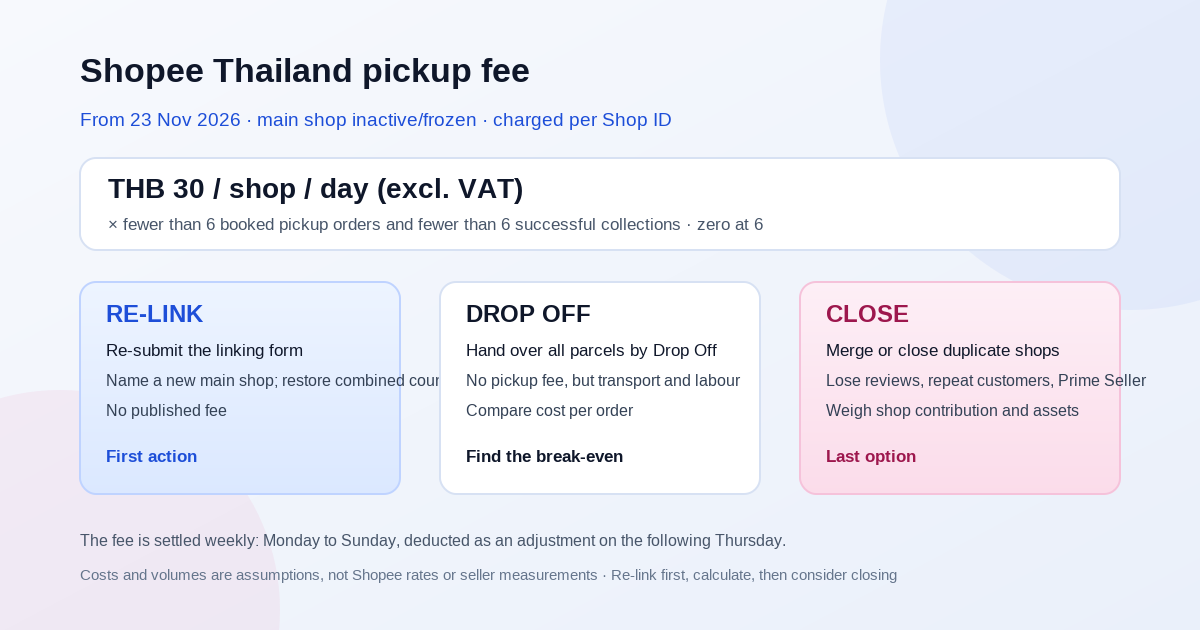
A Thai multi-shop seller wakes up to find the main shop inactive or frozen, with four other shops still running. Previously the group's orders were combined, so the group paid the pickup fee only when the combined count fell below six. Now each shop is counted separately: a shop with fewer than six pickup orders pays THB 30/day until the seller re-submits the multi-shop linking form. The real decision is not whether THB 30 is expensive. It is whether to re-link a new main shop, move the remaining shops to drop-off, or close the duplicate shops. This article puts those three options into one monthly cost table, works through three scenarios and sets stop conditions. All scenario costs, order volumes, contributions and the 30-day month are explicitly labelled assumptions; the THB 30/day rate and six-order threshold come from Shopee policy, not seller measurements.
1. This is a change in the billing unit, not a rate increase
Shopee Thailand's Seller Education Hub Pickup Fee Policy says a shop that uses domestic Standard Delivery and hands parcels over by Pick Up, with fewer than six booked pickup orders and fewer than six successfully collected orders that day, pays THB 30/day excluding VAT. Standard Delivery Bulky, seller-own fleet, Instant Delivery and Express Delivery do not count toward the six.
The change on 23 November 2026 does not raise the THB 30. It changes who is counted. A multi-shop linked group used to combine orders, so the group paid once when the combined count reached six. If the main shop is Inactive or Frozen, the system stops combining and tests each Shop ID separately: a shop with fewer than six orders pays THB 30/day until the seller re-submits the linking form.
The main shop is not the oldest or the highest-volume shop; it is the first Shop ID entered on the linking form. The official example is explicit: a seller links five shops and enters Shop A first, so the system normally counts all five together. If Shop A becomes inactive or frozen, the other four are counted separately; the seller must re-submit the form with a new first shop before the system combines them again.
Two operating details change the decision. First, since 10 July 2026 an approved multi-shop link stays in place permanently until the seller requests a cancellation or change; re-submitting is not an annual renewal but a structural change of main shop. Second, the fee is settled weekly: Monday to Sunday is one cycle, and the charge appears as an adjustment on the following Thursday, deducted from the seller balance. It is not charged per order or at month-end.
2. The mechanism: main shop, six-order threshold and THB 30/day
Three variables make the decision clear: main-shop status, a shop's daily pickup volume, and the per-order drop-off cost. When the main shop is active, the group is tested on combined orders. When the main shop is inactive or frozen, each Shop ID is tested separately. A shop with fewer than six booked pickup orders and fewer than six successful collections pays THB 30/day; if either count reaches six, the fee is zero.
The fee is a fixed daily amount per shop, not a linear charge per order. Under the per-shop basis after the main shop fails, a shop with five orders and a shop with one order both pay THB 30 that day; the difference is the per-order cost: THB 6 at five orders, THB 30 at one. That fixed-fee nature makes it heavier for thin shops and means the drop-off break-even must be calculated per order, not guessed from the headline rate.
Read the exemptions together: all items handed over by Drop Off; six or more booked pickup orders successfully delivered; a booked pickup where the carrier did not come at all that day (treated as carrier responsibility); and some areas where Shopee reserves the right to decide on an exemption. A Prime Seller shop with a no-daily-minimum pickup-fee waiver is not included in the combined calculation; if the other shops in the group do not have that waiver, the seller still has to re-submit the form and name a new main shop.
The table puts the main-shop status and per-shop volume together, so the seller can first decide whether the fee applies and then choose an action.
| Main-shop status | Counting basis | Fee (excl. VAT) | First action |
|---|---|---|---|
| Active | Group orders combined | Combined below 6/day: THB 30/day (one group) | Keep the link; reconcile the weekly bill |
| Inactive/frozen | Each Shop ID counted separately | Shop below 6/day: THB 30/shop/day | Re-link and name a new main shop first |
| Inactive/frozen | Each Shop ID counted separately | Either booked or successful count at 6/day: 0 | Keep the shop; check for a wrong charge |
| Any | All Drop Off | 0 | Compare drop-off transport and labour with THB 30/day |
3. Evidence boundary: what Shopee says and does not say
Shopee publishes the fee amount, eligible channel, six-order threshold, exemptions and multi-shop linking rules. It does not publish a seller's own order volume, shop contribution, drop-off transport cost or the value of the customer assets lost by closing a shop. The article can calculate the fee; it cannot assert that a particular shop should close. A closure decision needs a shop-level P&L, not a rate card.
The rule applies to domestic Standard Delivery Pick Up for Thai local/3PL sellers, not to every fulfilment method and not to every cross-border direct order. Applying 'per-shop charging' to cross-border direct mail, express, instant delivery or Standard Delivery Bulky produces the wrong cost. Confirm the shop type, fulfilment channel and linking status before changing anything.
The Thai official page is a JavaScript shell. The base terms were read through a search renderer; the 23 November update section was not read as direct HTML. It was cross-checked against the official Shopee University TH social post and 360KJT's full restatement on 22 November 2026. Both point to the same rule: after the main shop is inactive or frozen, the remaining shops are charged by Shop ID until the linking form is re-submitted. That chain supports the rule but is not a Shopee back-office bill sample.
This article has no seller back office, order ledger or real bill. Every order volume, drop-off cost and contribution figure is an assumption. The fee amount and effective date come from public sources; the scenario results show the calculation method only and are not platform parameters or NWi customer data.
4. Scenario A: a four-shop cluster after the main shop is frozen
Scenario A: a four-shop cluster after the main shop is frozen
Assumptions: four remaining shops, each with three domestic Standard Delivery pickup orders a day; the pickup fee is THB 30/shop/day excluding VAT; a 30-day month; drop-off transport and labour cost THB 20/order. The order volumes and drop-off cost are examples, not Shopee rates or seller measurements.
At the current split basis, the pickup fee = 4 × 30 × 30 = THB 3,600/month; moving all four shops to drop-off = 4 × 3 × 20 × 30 = THB 7,200/month. After re-linking, the group has 12 combined orders/day, above the six-order threshold, so the fee is zero, and re-linking has no published fee. Re-linking costs THB 7,200 less per month than moving everything to drop-off, and THB 3,600 less than staying split.
Decision: re-link first and name a new main shop; do not close shops or switch to drop-off until the form is rejected or a shop's contribution is below the fee.
The point is not the THB 3,600 itself. If it is a small share of the four shops' monthly contribution, closing a shop is an overreaction. Conversely, if a shop contributes only THB 1,000 a month, its share of the fee plus fixed costs may remove the case for keeping it; the test is still shop-level P&L, not the total fee.
5. Scenario B: two thin-contribution shops — what share of contribution is the fee?
Scenario B: two thin-contribution shops — what share of contribution is the fee?
Assumptions: two remaining shops, each with two orders a day; the pickup fee is THB 30/shop/day for a 30-day month; the second shop's contribution is THB 100/order in one case and THB 10/order in the other. The order volumes and contribution figures are examples.
The second shop's own fee = 30 × 30 = THB 900/month; the two-shop total fee = 2 × 30 × 30 = THB 1,800/month. At THB 100/order contribution, the second shop contributes 2 × 30 × 100 = THB 6,000/month, so its fee is 15% of its contribution. At THB 10/order, contribution is THB 600/month, so the second shop's fee exceeds it by THB 300.
Decision: keep and re-link when contribution exceeds the fee and the shop has customer-asset value; consider merging or closing only when contribution is below the fee and there is no review history, Prime Seller benefit or other asset to preserve.
The comparison is fee versus contribution, not fee versus revenue. THB 100/order is contribution (price minus product, platform commission, logistics and other variable costs), not the selling price. Using revenue as the denominator understates the fee share and distorts both the keep and close decisions. The comparison uses the second shop's own THB 900 fee, not the two-shop THB 1,800 total, because the numerator and denominator must cover the same scope.
6. Scenario C: a single shop at five orders a day — the drop-off break-even
Scenario C: a single shop at five orders a day — the drop-off break-even
Assumptions: the shop is assessed on its own (the main shop has failed or the shop is not in a multi-shop group), with five pickup orders a day; the pickup fee is THB 30/day; drop-off transport and labour cost THB 8/order; a 30-day month. The order volume and drop-off cost are examples.
Pickup fee = 30 × 30 = THB 900/month; drop-off = 5 × 8 × 30 = THB 1,200/month; drop-off costs THB 300 more. The break-even drop-off cost is 900 ÷ (5 × 30) = THB 6/order: switching to drop-off is worthwhile only below THB 6/order.
Decision: compare your actual drop-off cost per order with the THB 6 break-even. Above THB 6, keep pickup and check whether the shop reaches six orders; below THB 6, switch to drop-off.
This also shows that a single-shop seller does not necessarily need multi-shop linking. A single shop has no "main shop failure splits the group" problem; it faces a two-way choice between pickup and all drop-off. Applying a multi-shop seller's re-linking action to a single shop is another misdiagnosis.
7. Counter-cases and alternative explanations
Counter-case one: the fee may not arise at all. If each shop already has six or more pickup orders a day, uses drop-off for everything, or the carrier did not come that day, THB 30/day may not apply. Check the bill and pickup records before changing the structure.
Counter-case two: closing a shop is not free. A closure can lose listing history, reviews, Prime Seller benefits, repeat customers and campaign eligibility; those assets are often worth more than THB 30/day.
Counter-case three: drop-off can cost more. It saves THB 30/day but adds transport, packing, labour and the risk of a missed handover. At two orders a day, drop-off can easily exceed THB 15/order, which is more expensive than THB 30/day.
Counter-case four: a Prime Seller waiver does not automatically cover the group. A shop with a no-daily-minimum pickup-fee waiver is not included in the combined calculation; if the other shops lack the waiver, the group still has to re-submit the form and name a new main shop after the main shop fails. Do not assume one Prime Seller shop protects the whole group.
Counter-case five: re-submitting the form has no published fee, but it does not guarantee the new main shop will never fail. If the new main shop later becomes inactive or frozen, the system splits the group again. Put main-shop status on a monthly check rather than treating re-linking as a one-off.
Counter-case six: this is a domestic Standard Delivery Pick Up rule, not a general surcharge on every cross-border order. Cross-border direct mail, express, instant delivery and Standard Delivery Bulky have different bases. Confirm the shop type and fulfilment channel before changing prices or logistics.
8. Action list and stop conditions
Step one: log in to Seller Centre, confirm whether the main shop is active, inactive or frozen, list every Shop ID in the linked group, and check that the first Shop ID on the form is the shop you think it is. Step two: if the main shop has failed, re-submit the multi-shop linking form with a new main shop before changing logistics or closing anything. Step three: count each shop's daily pickup orders over the past 30 days and calculate the monthly fee under the current basis; a shop with either count at six or more a day should show zero. Step four: compare the monthly fee with shop contribution, drop-off cost and the customer-asset value at risk from closing. Step five: reconcile the bill weekly; Monday to Sunday is one cycle, the charge appears as an adjustment on the following Thursday, and if a shop with either count at six or more is still charged, keep the pickup records and appeal within the window.
Stop conditions: the system still does not combine after re-linking — escalate in Seller Centre or with support before closing any shop; drop-off cost exceeds the fee plus the customer-asset risk — keep pickup and re-link; shop contribution is below the fee and there is no review history, Prime Seller benefit or other asset — only then consider merging or closing; Prime Seller waiver status is unclear — confirm before changing the structure; the shop type or fulfilment channel is not domestic Standard Delivery Pick Up — confirm scope before repricing.
Fields to track: Shop ID, main-shop status, linking-form submission date, daily booked pickup orders, successful collections, bill date, fee amount, drop-off cost per order, shop contribution, customer assets (reviews/repeat purchases/Prime Seller) and appeal outcome. Put them in one monthly table so the next main-shop change can reuse the work instead of starting from guesswork.
If you want to put the Thai multi-shop structure, per-shop volume and fee back into market data, use NWi CrossborderGo for Shopee Thailand market, category, price-band and brand/store data; use NWi Operations for product and store research; and see the Shopee platform page for platform context. To model your own shop structure, request a demo. CrossborderGo coverage, historical ranges and fields depend on the contract and account authorisation; NWi Operations market figures are third-party estimates; neither provides shop-linking, logistics or platform-appeal services, and neither guarantees sales, ranking or fee outcomes.
9. Limitations and unknowns
This article has no Shopee seller back office, order ledger, bill sample or seller interview. Every order volume, cost, contribution and drop-off figure is an assumption. The THB 30/day and six-order threshold come from public policy, but an actual bill can differ by channel, area and waiver status.
The Thai official page is a JavaScript shell; the 23 November update was cross-checked through the official social post and independent media, not read as direct HTML. If the official page or Seller Centre later shows a different basis, the seller centre governs.
The article does not value the listing history, reviews, Prime Seller benefits or repeat customers lost by closing a shop; those assets require the seller's own data. It is not legal, tax, logistics or platform-operations advice.
The rules may change again; the 10 July 2026 permanent-linking rule, the Prime Seller waiver and area exemptions may have implementation details. The conclusion is a decision order — re-link, then calculate, then consider closing — not a recommendation to close a particular shop.
10. Method and disclosure
Data scope: the THB 30/day fee excluding VAT, six-order threshold, domestic Standard Delivery scope, exemptions, multi-shop linking and the 10 July 2026 permanent-linking rule come from Shopee Thailand's Seller Education Hub Pickup Fee Policy and Shopee China's Seller Education Hub explainer for the Thailand site. The 23 November 2026 update charging each Shop ID separately after the main shop is inactive or frozen comes from the official Shopee University TH social post and 360KJT's full restatement on 22 November 2026. Calculation: monthly fee = shops × THB 30 × 30 days; drop-off cost = orders × cost per order × 30 days; break-even drop-off cost = monthly fee ÷ monthly orders; contribution = price − product cost − platform commission − logistics and other variable costs. All order volumes, drop-off costs, contribution figures and the 30-day month are assumptions; VAT, FX, returns and fixed costs are excluded.
This article was prepared with the assistance of an automated research workflow, based on the public sources listed at the end, and was not manually reviewed. It does not invent customer data, expert review or ranking results. It is not legal, tax, logistics or platform-operations advice.
The article's contribution is not to repeat the THB 30/day figure but to frame it as a change in the billing unit: first check whether the main shop has failed, then compare the monthly cost of re-linking, drop-off and closing. It also separates fee-versus-contribution from fee-versus-revenue, so the wrong denominator does not drive the decision.
11. Sources
- 1. Shopee Thailand Seller Education Hub, "Pickup Fee Policy" (นโยบายค่าบริการเข้ารับสินค้า), base page 10 July 2026, updated 19 November 2026 (effective 23 November 2026); accessed 26 November 2026. read the original
- 2. Shopee China Seller Education Hub, "Pickup Fee introduction – Thailand site", 16 July 2026; accessed 26 November 2026. read the original
- 3. Shopee University TH by Ajarn Shopee, official social post, 19/23 November 2026; accessed 26 November 2026. read the original
- 4. 360KJT, "Shopee Thailand updates its Pickup Fee Policy: from 23 November, fees will be charged per shop if the main shop is inactive or frozen", 22 November 2026; accessed 26 November 2026. read the original
- Note: sources 1-3 are Shopee official pages/social; source 4 is an independent trade-media full restatement. Source 4 cites the same official page and is not used as an independent measurement. No competitor data provider's text, estimates, charts, screenshots, methods or API/MCP output was used; all hypothetical numbers are labelled as examples.