
Start with the decision, not the headline. The question is not whether Indonesia has added a 0.5% tax. It is whether your shop counts as a domestic Indonesian trader (Pedagang Dalam Negeri) under the regulation, which layer of turnover the 0.5% is applied to, and whether the cash is a timing item or a final cost. First, if you are not a domestic Indonesian trader (Pedagang Dalam Negeri), the 0.5% usually should not go straight into your cost sheet. Second, the 0.5% is charged on invoiced gross turnover, not profit, and the base is measured before sales discounts, so deeper discounts raise the effective rate. Third, for a general taxpayer the amount is a prepayment of annual income tax, not a new 0.5% cost; the real work is cash-flow planning, bill reconciliation and the exemption statement, not an automatic price increase.
1. First-month IDR 254.66bn: who said it, what it covers, what it is not
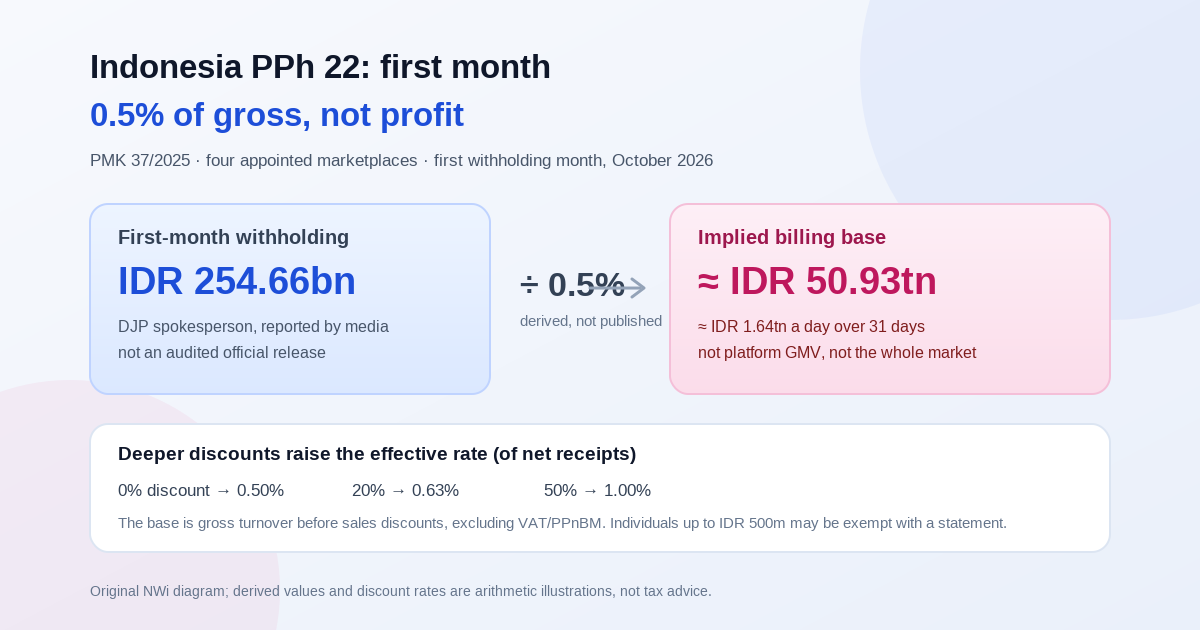
On 23 November 2026, a DJP spokesperson told reporters that the four appointed marketplaces — PT Shopee International Indonesia, PT Global Digital Niaga Tbk (Blibli), PT Tokopedia and PT Ecart Webportal Indonesia (Lazada) — reported IDR 254.66 billion of PPh 22 withheld in the first month. DDTCNews, PajakOnline and Bisnis.com reported the figure on 23-24 November; all three attributed it to the DJP spokesperson, not to an audited official release.
The timing needs to be precise. In a press release dated 2 October 2026, DJP said withholding through marketplaces began on 1 October 2026. The first full withholding month after the final 1 October start was October 2026; platforms had to remit the tax by 15 November and report it through the SPT Masa PPh Unifikasi by 20 November. The IDR 254.66 billion therefore refers to the October 2026 withholding and reporting data, not a full year and not a platform-specific disclosure.
The IDR 254.66 billion figure was disclosed by a DJP spokesperson to the media and reported separately by three tax and business outlets; it is not an audited DJP release, and there is no platform-level, seller-level or sector-level breakdown. It cannot be used to infer a platform's market share, the average seller's tax burden or a compliance rate, and it is not Indonesian e-commerce GMV. The implied base later in this article is an arithmetic result of dividing by 0.5%, and must be kept separate from 'platform GMV'.
The regulation is a separate layer of evidence. Article 8(1) of PMK 37/2025, signed on 11 June 2025, sets the rate at 0.5% of the gross turnover (Peredaran Bruto) stated in the invoice and excludes VAT (PPN) and luxury-goods sales tax (PPnBM). Article 1(10) defines gross turnover before sales discounts, cash discounts and similar deductions. In other words, the 0.5% is not based on profit, not on net settlement and not on the amount actually received after discounts.
2. Mechanism: where the 0.5% is withheld and how the cash moves
PPh 22 becomes due when the platform receives payment, and the platform withholds it at the transaction stage; the platform's invoice to the seller must show the PPh 22 amount as a separate line, and that invoice also serves as the withholding evidence. See Articles 8(2), 12(3)(f) and 12(4). The seller does not see an abstract tax bill but a line in each settlement; if that line is missing, reconciliation and crediting become harder.
For a general taxpayer, the withheld PPh 22 can be credited as a payment of current-year income tax (Article 8(3)); for a taxpayer subject to final income tax, it is part of the final tax (Article 8(4)). If the final tax due exceeds the amount withheld, the seller pays the difference; if the amount withheld exceeds the final tax due, the seller may apply for a refund of the excess under the applicable procedure (Article 8(6)-(7)). The 0.5% therefore means different things under different tax regimes: for the former it is mainly a cash-flow timing item; for the latter it is a prepayment or component of the final tax. Neither is an extra 0.5% stacked on top of the existing tax burden.
The IDR 500 million exemption for individuals is not automatic. Article 6(2) of PMK 37/2025 requires an individual seller with annual turnover of up to IDR 500 million to submit a statement; Article 6(4) requires the statement before income is received; Article 6(5) requires it to be resubmitted at the start of each tax year where turnover does not exceed IDR 4.8 billion; and Article 10(1)(a) makes 'statement submitted' a condition for not withholding. Once turnover exceeds IDR 500 million, the seller must submit a statement that turnover has exceeded the threshold by the end of the month in which it does so (Article 6(6)-(7)), and the platform starts withholding from the beginning of the following month after receiving the statement (Article 7(3)). If no information is submitted, withholding still applies (Article 8(8)).
Two details are easy to miss. First, transactions in a currency other than rupiah are converted at the prescribed exchange rate on the payment date (Article 8(9)), so the rate is not a single month-start or month-end rate; it is applied per payment. Second, the regulation applies to a 'Pedagang Dalam Negeri': a business resident or established in Indonesia, transacting through an electronic system, receiving income through an Indonesian bank or financial account, and transacting using an Indonesian IP address or Indonesian telephone code (Article 1(9) and Article 5). That definition determines whether a cross-border seller should put the 0.5% into its cost sheet at all.
3. Recomputable: the implied base behind IDR 254.66bn and the discount multiplier
If IDR 254.66 billion is the 0.5% withholding, the implied billing base is IDR 254,660,000,000 ÷ 0.005 = IDR 50,932,000,000,000, or about IDR 50.93 trillion. Spread over the 31 days of October 2026, that is about IDR 1.64 trillion a day. This is an 'implied billing base', not platform GMV: it covers only domestic sellers on the four appointed platforms, only turnover subject to withholding, and it is affected by exemptions, reporting timing and rounding. Treating it as 'Indonesia's e-commerce market did IDR 50.93 trillion in a month' would overstate the market and mislead.
The second recomputable point is discounts. Because the regulation measures gross turnover before sales discounts, the effective rate on the seller's net receipts is 0.5% ÷ (1 − discount rate). At a 0% discount it is 0.50%; at 20% it is 0.625%; at 50% it is 1.00%. If the invoice shows a list price of 100, a 20% discount and net receipts of 80, PPh 22 is still 0.5 (calculated on 100), or 0.625% of the 80 received. That is not the platform over-withholding; it is the result of the base definition. The invoice presentation still governs, so confirm the base with the platform if discounts are netted into line items.
| Discount rate | Billing base (list price 100) | PPh 22 | Share of net receipts |
|---|---|---|---|
| 0% | 100.0 | 0.500 | 0.50% |
| 10% | 100.0 | 0.500 | 0.56% |
| 20% | 100.0 | 0.500 | 0.63% |
| 30% | 100.0 | 0.500 | 0.71% |
| 50% | 100.0 | 0.500 | 1.00% |
The third recomputable point is single-shop cash flow. If a shop bills IDR 100 million a month, PPh 22 = IDR 100 million × 0.5% = IDR 500,000 a month, or IDR 6 million a year; at IDR 1 billion a month it is IDR 5 million a month, or IDR 60 million a year. For a general taxpayer, the IDR 6 million or IDR 60 million is a prepayment credited against annual income tax; for a final taxpayer, it is part of the final tax. In either case the cash leaves the account in the month, while the credit or settlement waits for the annual return. That is the cash-flow effect.
4. Scenario A: individual seller with IDR 480m annual turnover and no statement
Scenario A: individual seller with IDR 480m annual turnover and no statement
Assumptions: an individual seller with 2026 annual turnover of IDR 480 million, or IDR 40 million a month; selling on one appointed marketplace; no statement for the IDR 500 million exemption; invoiced turnover excludes VAT and luxury-goods sales tax; no returns or discounts.
Monthly withholding = IDR 40 million × 0.5% = IDR 200,000; annual = IDR 200,000 × 12 = IDR 2.4 million, or 0.5% of turnover.
Check the platform's tax/regulation section first to confirm whether the statement has been submitted and is valid for the current tax year; if not, submit it before the next settlement cycle and keep the receipt. If the platform has already withheld, reconcile the PPh 22 line and do not bury it in the platform fee; at this scale, the IDR 2.4 million cash effect is usually smaller than the volume risk of a price increase, so fix the statement before repricing.
5. Scenario B: company billing IDR 2bn a month and the break-even volume loss of a 0.5% price rise
Scenario B: company billing IDR 2bn a month and the break-even volume loss of a 0.5% price rise
Assumptions: an Indonesian company (PT), a general taxpayer, billing IDR 2 billion a month; a 12% contribution margin, or IDR 240 million a month; PPh 22 withheld at 0.5% = IDR 10 million a month; no change in returns, exchange rates or platform fees; unit variable cost unchanged after a 0.5% price rise.
Withholding as a share of monthly contribution = IDR 10 million ÷ IDR 240 million = 4.17%; annual withholding = IDR 120 million. If the 0.5% is passed into price, using a list price of 100, variable cost of 88 and contribution of 12, the new contribution is 100 × 1.005 − 88 = 12.5, and the break-even volume loss is 1 − 12 ÷ 12.5 = 4.0%.
Because PPh 22 is a creditable prepayment for a general taxpayer, the default should be to absorb it in cash flow and credit it in the annual return, not to raise price reflexively. Consider passing the 0.5% into price only when the cash constraint is tight and a small-cohort test shows a volume loss below 4%; if the test exceeds 4%, stop the increase and return to cash scheduling and payment-term management.
6. Scenario C: a cross-border seller without an Indonesian entity should confirm scope first
Scenario C: a cross-border seller without an Indonesian entity should confirm scope first
Assumptions: a Chinese company sells directly on Shopee Indonesia, settles to a bank account in China, runs operations and customer service outside Indonesia, has no Indonesian PT, and the marketplace account is registered as a cross-border seller.
Under Article 1(9) and Article 5 of PMK 37/2025, a 'Pedagang Dalam Negeri' must be resident or established in Indonesia, receive income through an Indonesian bank or financial account, and transact using an Indonesian IP address or Indonesian telephone code. A seller that is entirely offshore and settles to an offshore account usually does not meet that definition; but the platform may classify the account from registration data, the settlement account or local fulfilment arrangements, so the invoice is the final check.
Build a four-column check: entity, settlement account, IP/telephone, and platform invoice. A cross-border seller should not pre-load 0.5% into its pricing model, but should keep a scenario allowance in case the platform starts withholding. If the invoice has no PPh 22 line, do not add 0.5% to cost on your own; if it appears, confirm the withholding entity and the billing base before deciding whether to credit it, challenge it or change the entity structure.
7. Counter-cases: the 0.5% is not necessarily a cost, and the exemption is not automatic
The first counter-case is 'treating a prepayment as a cost'. For a general taxpayer, PPh 22 is a prepayment of annual income tax that can be credited at year-end; treating it directly as a 0.5% gross-margin loss and raising price can destroy more contribution than the IDR 10 million withheld. The item to manage is the timing gap while the cash is out of the account, not the rate itself.
The second counter-case is 'the exemption means I can ignore it'. The IDR 500 million exemption applies only to individual sellers, requires a statement and must be resubmitted every year; a company (PT) cannot use the individual exemption. An individual seller at IDR 490 million may still be withheld if the statement is missing; an individual who has just crossed IDR 500 million may be withheld earlier than expected if the 'exceeded' statement is not filed by the end of that month. The exemption is a process, not a default state.
The third counter-case is 'discounts do not matter'. The billing base is gross turnover before sales discounts, so a deep discount can push the effective rate from 0.50% to 0.63% or even 1.00%. A pricing team that models 'net receipts × 0.5%' will underestimate both the withholding and the cash pressure.
The fourth counter-case is 'all platforms are the same'. Only the four appointed platforms apply the withholding; platforms outside the list, or accounts not classified as domestic traders, may show no such line. Conversely, the list and classification rules can change, so today's 'none' is not tomorrow's 'none'. Do not extrapolate the four-platform first-month total to the whole market.
The fifth counter-case is 'returns are automatically reversed'. Withholding happens when the platform receives payment; if a return and refund follow, the withheld PPh 22 is not automatically reversed with the refund and must be handled through invoice correction, the annual return or a refund procedure. Sellers with high return rates should put that timing gap into cash flow instead of assuming 'a return cancels the tax'.
8. Action list and stop conditions
Confirm the entity and the invoice first, then decide whether to claim the exemption: list PPh 22 separately for each platform, schedule cash flow around the 15th/20th filing calendar, and only then consider whether a price increase should cover it. Do five things: first, confirm the entity, settlement account and IP/telephone behind each shop to determine whether it is a domestic or cross-border seller; second, export the latest monthly settlement invoice and check whether PPh 22 is a separate line, whether the base is list or discounted price, and whether VAT is included; third, individual sellers should check whether the IDR 500 million statement is filed and valid for the tax year, while companies should confirm their tax regime and crediting path; fourth, estimate annual cash tied up as 'monthly withholding × 12' and put it in the cash-flow plan, not the gross-margin sheet; fifth, only when the cash constraint is tight should you run a small price test, with the break-even volume loss written down as a stop line.
Write the stop conditions in advance: if the statement status is unclear and annual turnover is near IDR 500 million, do not assume exemption; if the invoice does not show PPh 22 separately, do not raise price before checking with the platform; if a price test loses more volume than the break-even line (4% in the example), stop the increase; if the seller changes legal form, tax regime or settlement entity, rerun the scope test; if the platform is outside the four-name list, or the entity is classified as a cross-border seller, do not pre-load 0.5% on your own but keep a scenario allowance; if returns are high, do not treat the withheld amount as the final tax burden until the refund and correction rules are confirmed.
9. Unknowns and limitations
Six unknowns are most likely to change the conclusion. First, the IDR 254.66 billion is a media statement by a DJP spokesperson, not an audited official release, and there is no platform, seller or sector breakdown. Second, the exact transaction period behind 'first month', whether it includes cross-month settlement, and whether corrections and refunds are deducted are not explained in the reports. Third, the statement format, platform acceptance time and rejection handling may differ by platform; this article relies only on the regulation and DJP's public explanation. Fourth, The crediting for general taxpayers and the settlement for final taxpayers depend on the seller's actual tax regime, annual profit and filings; this article has no seller filing data. Fifth, discounts, returns, exchange rates and platform fees change single-shop results; the scenarios are all assumptions. Sixth, the regulation and the platform list may change; this article is not tax advice.
There is also an evidence boundary: this article read the full text of PMK 37/2025 (extracted from the BPK JDIH PDF), DJP's press release and official explainer, and reports by DDTCNews, PajakOnline and Bisnis.com. It did not obtain DJP's audit workpapers, platform-level data from the four marketplaces or any seller's actual invoice. The IDR 50.93 trillion is an arithmetic value derived from 0.5%, not platform GMV; the discount table, single-shop cash flow and three scenarios are hypothetical examples, not NWi customer data or measurements.
This article does not forecast Indonesian e-commerce growth or assess any platform's compliance level. For application, filing and crediting, rely on PMK 37/2025, the latest DJP guidance, the platform invoice and your tax adviser.
10. Method and disclosure
Data scope: the PPh 22 rate, billing base, tax point, the IDR 500 million individual exemption, statement submission and resubmission, and the final-tax and crediting rules come from the full text of PMK 37/2025 (signed 11 June 2025, extracted from the BPK JDIH PDF, accessed 26 November 2026). The four appointed platforms, the 1 October 2026 start, the IDR 254.66 billion first-month figure and the 15th/20th filing calendar come from DJP's press release of 2 October 2026, DJP's official explainer of 16 November 2026, and reports by DDTCNews, PajakOnline and Bisnis.com between 23 and 24 November 2026. The IDR 254.66 billion was disclosed by a DJP spokesperson to the media and reported separately by three outlets; it is not an audited official release. The IDR 50.93 trillion is an implied billing base derived by dividing by 0.5%, not platform GMV. The IDR 480 million/IDR 40 million, IDR 480 million/IDR 200,000, IDR 2 billion/12% contribution, 0.5% price rise, 4% break-even volume loss, discount table and three scenarios are hypothetical examples, not platform parameters, NWi customer data or measurements.
The article's contribution is not to repeat the IDR 254.66 billion headline, but to break it into three checkable quantities: the implied billing base derived from 0.5%, the discount multiplier on the effective rate, and the domestic-versus-cross-border scope. It then separates 'prepayment' from 'final tax' so that a cash-flow timing item is not misread as a new cost.
This article was prepared with the assistance of an automated research workflow, based on the public sources listed at the end, and was not manually reviewed.
Put the withholding back into the operating decision: use NWi CrossborderGo to size the Indonesia market, category, price band and brand/store data, and to see which price bands and discount structures the 0.5% affects most; use NWi Operations for category, product and store research plus image and translation tools to prepare product content; when the platform invoice, returns and contribution definitions need to be aligned, see the Shopee platform page and data methodology. CrossborderGo coverage, historical ranges and fields depend on the contract and account authorisation; NWi Operations market figures are third-party estimates; neither provides tax filing or withholding services, and neither guarantees sales, ranking or tax outcomes. To model your own entity, category and invoice structure, request a demo.
11. Sources
- 1. Kementerian Keuangan RI, 'PMK 37/2025: Penunjukan Pihak Lain sebagai Pemungut Pajak Penghasilan serta Tata Cara Pemungutan, Penyetoran, dan Pelaporan Pajak Penghasilan' (primary legal text: 0.5% rate, billing base, tax point, IDR 500 million individual exemption, statement and resubmission, crediting and final-tax rules): read the original, signed 11 June 2025, accessed 26 November 2026.
- 2. DJP, 'Pemungutan PPh Pasal 22 Melalui Marketplace Mulai Dilaksanakan 1 Oktober 2026' (primary press release: four appointed platforms, 1 October 2026 start, 0.5% excluding VAT/PPnBM, IDR 500 million statement exemption, crediting and final tax): read the original, page dated 2 October 2026, accessed 26 November 2026.
- 3. DJP, 'Empat Sisi Pajak Marketplace' (primary official explainer: 0.5% of turnover, IDR 500 million individual exemption requires a statement through the platform feature): read the original, published 16 November 2026, accessed 26 November 2026.
- 4. DDTCNews, 'Shopee Cs Setor PPh Pasal 22 dari Pedagang Online Rp254,6 Miliar' (independent tax media reporting the DJP spokesperson: IDR 254.66 billion first month, four platforms, payment by the 15th and reporting by the 20th): read the original, published 23 November 2026 19:00 WIB, accessed 26 November 2026.
- 5. PajakOnline, 'PPh Marketplace Tembus Rp254,66 Miliar dalam Sebulan, DJP Perkuat Pengawasan Pedagang Online' (independent tax media: first-month total, gross rather than profit, base excludes VAT/PPnBM): read the original, published 24 November 2026 03:15 WIB, accessed 26 November 2026.
- 6. Bisnis.com, 'Pajak E-Commerce via Tokopedia, Shopee Cs Tembus Rp254,6 Miliar dalam Sebulan' (independent business media: first-month total, IDR 500 million individual treatment, 0.5% final rate for turnover above IDR 500 million up to IDR 4.8 billion, creditable for general taxpayers): read the original, published 23 November 2026 18:45 WIB, accessed 26 November 2026.
- Note: sources 1-3 are the regulation and DJP first-party materials; sources 4-6 are three independent outlets reporting the same DJP spokesperson briefing, used to cross-check the figure, not as three separate events. No competitor data provider's text, estimates, charts, screenshots or API output was used; all hypothetical numbers are labelled as examples.