
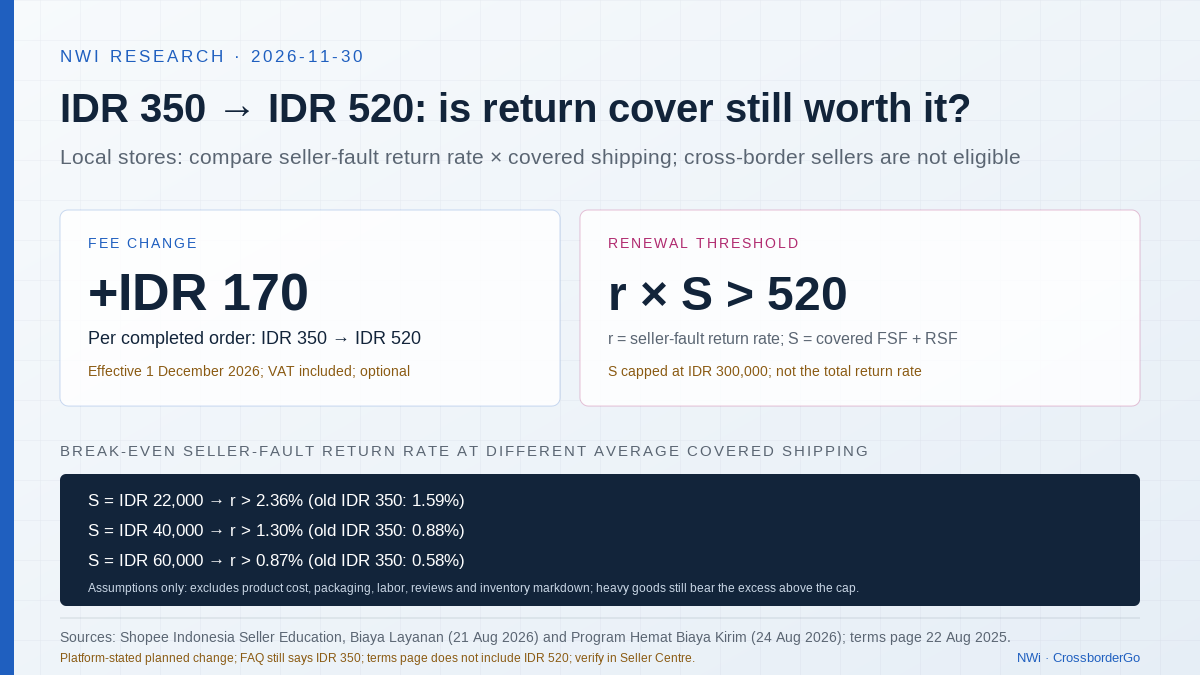
If you run a local Shopee Indonesia store and have joined Hemat Biaya Kirim, the program fee rises from IDR 350 to IDR 520 per completed order on 1 December 2026. The real decision is whether the optional return-shipping cover is still worth renewing at IDR 520, not simply whether the increase is IDR 170. This analysis separates seller-fault returns from total returns, costs two store scenarios, and explains why cross-border sellers are outside the program.
1. What changes: the program fee, not the shipping cost
Shopee Indonesia's seller-education page "Biaya Layanan Program Hemat Biaya Kirim" (21 August 2026) says sellers currently pay IDR 350, VAT included, for each order that is successfully delivered and completed. From 1 December 2026, the service fee becomes IDR 520. A second page, "Program Hemat Biaya Kirim" (24 August 2026), repeats the same change note.
Three limits matter. First, this is a program fee, not the shipping cost itself; the shipping cost is what the cover pays, not the base on which the fee is charged. Second, the unit is the order ("pesanan yang berhasil terkirim dan terselesaikan"), not the SKU, the item or the sales value. Third, both IDR 350 and IDR 520 include VAT; the page does not separate the tax.
The program is optional. Sellers can join or leave in Seller Centre or the Shopee seller app, and cover starts with orders created after registration. Leaving does not retroactively cancel the fee on orders already created; the terms also say an eligible order remains charged even if a return is later approved.
Keep this separate from the other 1 December change: Shopee Indonesia's Free Shipping XTRA (GOX) minimum ad spend rises from 3% to 4%, which is an advertising-rate condition. Hemat Biaya Kirim is a return-shipping program fee. Both can appear on the same December bill, but the decision variables differ: the first is about ad spend and fee discounts, the second about seller-fault return rate and average covered shipping.
There is also an evidence boundary: the program page's FAQ still says IDR 350, and the terms page (last updated 22 August 2025) does not contain IDR 520. Among the pages reviewed, only the fee page and the program page carry the change note. We treat it as a platform-stated planned change, not an independently confirmed market fact; sellers should verify the first December invoice and the latest fee table in Seller Centre.
| Item | Before | After | Effective / scope |
|---|---|---|---|
| Hemat Biaya Kirim service fee | IDR 350 per completed order (VAT included) | IDR 520 per completed order (VAT included) | 1 December 2026 |
| Cover | Seller-fault return FSF/RSF | Same | Shopee-supported shipping only |
| Per-order cap | IDR 300,000 (FSF + RSF combined) | Same | Per eligible order |
| Eligibility | Local sellers (not cross-border) | Same | Main account, normal store, non-digital goods |
2. Mechanism: a narrow, per-order insurance
Think of the program as insurance. The premium is IDR 520 per completed order; the claim is the forward shipping fee (FSF) and/or reverse shipping fee (RSF) on a seller-fault return, capped at IDR 300,000 per order. It is not "return and get paid", and it is not priced by return rate: every enrolled seller pays per order at the published IDR 520 rate; at that standard rate, high-risk sellers collect more and low-risk sellers subsidize them, though the terms reserve the right to vary the fee by seller.
The official table splits claims into four cases: refund only (buyer keeps the item) covers FSF; return and full refund covers FSF + RSF; return and partial refund covers RSF only; partial refund only covers no shipping. This matters because many stores see refund-only or partial-refund cases, where the covered amount is lower than assumed.
The exclusions come first: change-of-mind return shipping is borne by Shopee; damaged or non-receipt cases can be appealed, and carrier fault is not charged to the seller; sellers in Garansi Bebas Pengembalian categories registered for that program are also outside the cover. The terms list carrier cause, damage/defect, non-receipt and other reasons Shopee may determine as exclusions.
There is a 90-day limit: the return/refund request must be completed and confirmed within 90 days of order placement, or the cover does not apply. The order must use a Shopee-supported delivery service. Claims are automatic: the system adjusts FSF/RSF to the seller balance after the return/refund is completed, with no manual claim; the total appears in the income transaction record under "Penghasilan Saya".
The practical meaning: the program protects only the seller-fault slice of returns. It does not protect product cost, packaging, labor, bad reviews, wasted ads or inventory markdown. Those belong in a full return-cost calculation, but they are not program claims.
3. The break-even: r × S > 520
Let N be completed orders per month, r the seller-fault return rate (covered returns ÷ completed orders), and S the average FSF + RSF per covered return (capped at IDR 300,000). Monthly fee = N × 520; expected cover = N × r × min(S, 300,000). Stay if r × min(S, 300,000) > 520. Equivalently, the break-even return rate is r* = 520 ÷ min(S, 300,000), and the break-even covered shipping cost is S* = 520 ÷ r.
r is not the store's total return rate. If total returns are 8%, half are change-of-mind, 20% are damage/non-receipt and only 30% are seller-fault, then r = 8% × 30% = 2.4%, not 8%. Using the total rate overstates the cover and pushes stores into the program that should not join.
| Average covered shipping S | Break-even seller-fault return rate (IDR 520) | Break-even seller-fault return rate (IDR 350) | Typical case |
|---|---|---|---|
| IDR 22,000 | 2.36% | 1.59% | Light, small, near-island |
| IDR 40,000 | 1.30% | 0.88% | Medium weight, inter-island |
| IDR 60,000 | 0.87% | 0.58% | Larger, long distance |
| IDR 100,000 | 0.52% | 0.35% | Heavy, high freight |
| IDR 300,000 (cap) | 0.17% | 0.12% | Above cap, use IDR 300,000 |
Two things follow. First, the more expensive the shipping, the lower the seller-fault return rate needed; heavy-goods sellers benefit more easily. Second, the move from IDR 350 to IDR 520 lifts the threshold across the board: at S = IDR 40,000, break-even rises from 0.88% to 1.30%, pushing a store that was just breaking even into a loss.
But the IDR 170 increase is not the decision unit. An enrolled seller already pays IDR 350; the choice now is "continue at IDR 520" versus "leave and self-insure". IDR 170 is the change, not the whole new cost. Treating IDR 170 as the decision threshold understates both the cost of staying and the cost of self-insuring.
The original contribution here is to treat the change as an insurance renewal, not a price increase of about 49%: separate seller-fault returns from total returns, derive the r × S > 520 renewal threshold, and show that IDR 170 is a change amount, not the decision unit.
4. Two scenarios: same program, different answers
Scenario A: 8,000 orders a month, 1.0% seller-fault return rate, IDR 30,000 average covered shipping. Assumptions: 8,000 completed orders a month, a 1.0% seller-fault return rate, IDR 30,000 average FSF + RSF per covered return, all returns are return-and-full-refund, the IDR 300,000 cap is not reached, and the fee is charged per completed order. Calculation: monthly fee = 8,000 × 520 = IDR 4,160,000; expected cover = 8,000 × 1.0% × 30,000 = IDR 2,400,000; net = 2,400,000 − 4,160,000 = −IDR 1,760,000. Result: at IDR 520, staying costs IDR 1,760,000 more than self-insuring; at the old IDR 350, the fee is IDR 2,800,000 and the net is −IDR 400,000. Decision: if r and S do not improve, leave before 1 December; fix the seller-fault causes (wrong item, missing item, description mismatch) and use the saved premium to reduce return cost; re-evaluate if S rises above IDR 52,000 or r rises above 1.73%.
Scenario B: 1,500 orders a month, 4.0% seller-fault return rate, IDR 60,000 average covered shipping. Assumptions: 1,500 completed orders a month, a 4.0% seller-fault return rate, IDR 60,000 average FSF + RSF per covered return, all returns are return-and-full-refund, the cap is not reached, and the fee is charged per completed order. Calculation: monthly fee = 1,500 × 520 = IDR 780,000; expected cover = 1,500 × 4.0% × 60,000 = IDR 3,600,000; net = 3,600,000 − 780,000 = +IDR 2,820,000. Result: even at the new fee, staying costs IDR 2,820,000 less than self-insuring; at the old IDR 350, the net is +IDR 3,075,000, so the increase takes only IDR 255,000. Decision: stay; watch cap hits, the partial-refund share and claim timing, rather than only the IDR 170 increase.
Scenario C: a cross-border seller, or a local store whose returns are mostly change-of-mind/damage/non-receipt. Assumptions: the seller is cross-border and therefore not an eligible seller under the terms; or the store is local but 80% of returns are change-of-mind, damage or non-receipt, the seller-fault return rate is only 0.2%, and average covered shipping is IDR 25,000. Calculation: a cross-border seller has zero covered protection and should not budget the IDR 520; the local store's expected cover per order is 0.2% × 25,000 = IDR 50, far below IDR 520; monthly fee = 2,000 × 520 = IDR 1,040,000, expected cover = 2,000 × 0.2% × 25,000 = IDR 100,000, net = −IDR 940,000. Result: the cross-border seller is not eligible; the local store is very likely worse off even if it joins. Decision: the cross-border seller should not join and should check whether its local entity or partner is enrolled and whether the fee is passed through; the local store should leave unless the seller-fault return rate rises above 2.08% or S rises above IDR 260,000.
The common thread: the answer is driven by r and S, not by the size of the fee increase. A is low r, low S: leave. B is high r, high S: stay. C is an eligibility or coverage mismatch: do not join.
5. Counter-cases and evidence boundaries
Counter-case 1: high total return rate, low seller-fault rate. Assume total returns are 10%, of which 70% are change-of-mind, 20% damage/non-receipt and only 10% seller-fault; then r = 1%. At S = IDR 40,000, the break-even r* is 1.30%, and 1% is below it. A 10% total return rate looks like a strong case for cover, but the covered slice is too small to pay for IDR 520.
Counter-case 2: high-value, heavy goods with S above IDR 300,000. The cap limits each claim to IDR 300,000; if actual FSF + RSF is IDR 400,000, the seller still bears IDR 100,000. The program is not full insurance; heavy-goods sellers must add the excess to their self-insured cost.
Counter-case 3: a high share of refund-only or partial-refund cases. Refund-only covers FSF; partial refund covers no shipping. If a store uses refund-only or partial refunds heavily, the actual covered amount is lower than an S built on return-and-full-refund.
Counter-case 4: the 90-day window and the logistics condition. A return not completed within 90 days is not covered; an order not shipped with a Shopee-supported service is not covered. Cross-border sellers, digital-goods sellers, sub-accounts and stores under restriction are also outside eligibility.
Evidence boundary: The official pages give the fee, cap, four claim cases and exclusions, but not the distribution of return reasons, average FSF/RSF, seller-fault return rate or claim timing; the program page's FAQ still says IDR 350, the terms page does not contain IDR 520, and its last update is 22 August 2025. Public data cannot confirm whether the "average seller" benefits; only a conditional formula and scenarios are possible.
Another boundary: the pages differ slightly on whether the fee applies to a completed order or to every eligible order. The program page says "delivered and completed"; the terms say an eligible order remains charged even if a return is approved. This analysis uses completed orders N; if returned orders are also charged, actual fees are slightly higher, A and C lose more and B gains slightly less, but the direction does not change.
6. Action list: data to pull before and after 1 December
First: completed orders and Hemat Biaya Kirim deductions for the last 90 days. Pull them from the income transaction record in "Penghasilan Saya"; confirm the fee line, per-order amount and month. Do not estimate from an order export.
Second: seller-fault returns. Split by reason: change of mind, damage/defect, non-receipt, carrier cause, description mismatch/wrong item/missing item, other. Count only the covered seller-fault reasons in r; treat damage/non-receipt as appeal-dependent and do not put all returns in the numerator.
Third: FSF and RSF per covered return. Take the actual adjustment from the order detail and income record, capped at IDR 300,000; do not use a carrier list price or a guess.
Fourth: the gap between total return rate and seller-fault return rate. Put total returns, covered returns, refund-only share and partial-refund share in one table; if total returns are high but the covered rate is low, do not join.
Fifth: the other fees on the same December bill. The GOX minimum ad spend rises from 3% to 4%, which may change the ad budget; put the IDR 520 Hemat Biaya Kirim fee and the GOX incremental ad spend in one monthly cost table so you do not optimize one line and miss the other.
Action order: Calculate r × min(S, 300,000) against 520; if there is more than a 10% margin, stay; if it is below 520, leave; if it is within ±10%, stay one month and check the first December invoice. Leave before 1 December if that is the decision, but remember that orders already created remain charged and covered under the terms.
Stop conditions: the December invoice does not show IDR 520; Seller Centre eligibility or terms differ from the public page; actual claims are below 70% of expectation for two consecutive months; the seller-fault return rate is below break-even for two consecutive months; cap hits rise enough to exceed the self-insured budget. If any of these occurs, pause the renewal and recalculate from the invoice.
Fields to watch: completed orders, program fee, covered returns, FSF/RSF adjustments, cap hits, refund-only and partial-refund shares, claim days, return-reason mix and December net contribution.
If you need to size Shopee Indonesia categories, price bands and brand/store concentration before judging return exposure, see Shopee data analysis. To put category data, store returns, shipping and contribution into one analysis, see cross-border e-commerce data analytics, or request a demo.
7. Limitations and next step
Limitation 1: We have no Seller Centre access and no seller-level return, shipping or fee data; N, r and S are assumptions, not platform averages or NWi measurements.
Limitation 2: the official pages do not publish average FSF/RSF, return-reason mix or claim timing; islands, weight, carriers and categories differ widely, so sellers must replace the assumptions with their own invoices.
Limitation 3: Among the pages reviewed, IDR 520 appears only in the change note on the fee page and program page; the terms page is not updated and the FAQ still says IDR 350. If the platform adjusts or delays the change before December, recalculate from the latest page.
Limitation 4: this is an operating-cost analysis, not legal, tax, platform-operation or financial advice; eligibility, rates, claims and deductions are governed by Shopee Seller Centre and the latest terms.
Next step: complete the five data pulls before 1 December; check the first December invoice; recalculate with the same formula in January 2027. If Seller Centre and the public page conflict, Seller Centre governs.
Data basis: this article uses Shopee Indonesia Seller Education's program page (24 August 2026), fee page (21 August 2026) and the Help Center terms page (last updated 22 August 2025). The fee page states that the IDR 350 fee, VAT included, becomes IDR 520 per completed order from 1 December 2026; the program page states the seller-fault FSF/RSF cover, the IDR 300,000 per-order cap, automatic claims, the 90-day window, Shopee-supported shipping, main-account/normal-store/non-digital/non-cross-border conditions; the terms page states the eligible-order fee, four claim cases, exclusions and cap. N, r, S, monthly fees, claims and net amounts are assumptions, recalculated line by line with the formula in the text; they are not platform averages, seller measurements or return forecasts.
This article was prepared with automated research assistance from the Shopee Indonesia seller-education pages and Help Center terms listed at the end. It was not manually reviewed; it does not invent customer data, expert review, actual return rates, shipping costs, claim amounts or ranking results. It is not legal, tax, platform-operation or financial advice; fees, eligibility, cover, claims and deductions are governed by the latest fee table, program terms and actual invoice in Shopee Seller Centre.
8. Sources and search notes
- seller.shopee.co.id/edu/article/279... — Shopee Indonesia Seller Education, "Biaya Layanan Program Hemat Biaya Kirim", 21 August 2026; states the IDR 350 to IDR 520 change and the 1 December 2026 effective date.
- seller.shopee.co.id/edu/article/206... — Shopee Indonesia Seller Education, "Program Hemat Biaya Kirim", 24 August 2026; states the cover, eligibility, claim process and the same change note.
- help.shopee.co.id/portal/4/articl... — Shopee Indonesia Help Center, "Syarat dan Ketentuan Layanan: Program Hemat Biaya Kirim", last updated 22 August 2025; states eligible orders, four claim cases, exclusions, 90-day window and IDR 300,000 cap.