
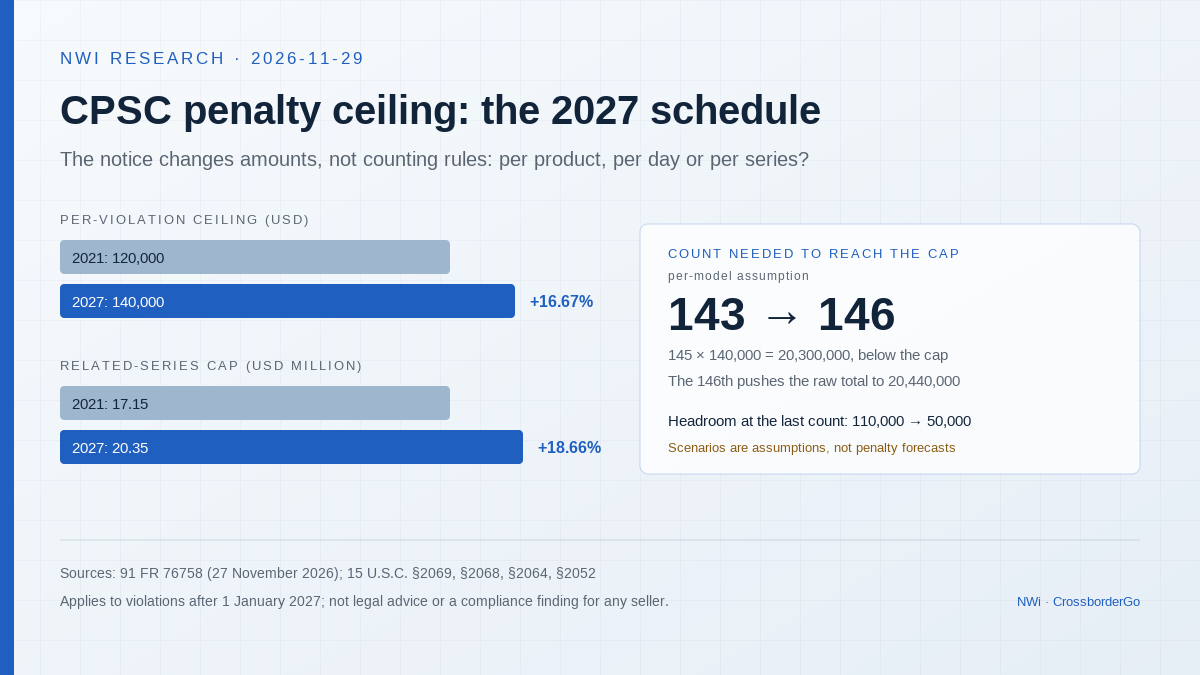
If you sell consumer products in the US, violations occurring after 1 January 2027 face a higher CPSC civil penalty ceiling: USD 140,000 per violation, up from USD 120,000, and USD 20,350,000 for any related series, up from USD 17,150,000. The real decision is whether to multiply the new ceiling by the number of models, by the days of non-compliance, or neither — treating it as a statutory tail while putting resources into the knowledge date, the reporting duty, and recall cost.
This is not a story about fines rising again. The notice changes the amounts, not the counting rules, and the counting rules decide what you multiply. Multiplying USD 140,000 by every SKU produces a large number with no legal definition behind it; ignoring the ceiling misses the per-day records duty.
The article is for three groups: brands and private-label sellers preparing to expand their US catalogue in 2027; distributors and retailers selling consumer products on Amazon, Walmart, TikTok Shop, or their own sites; and teams that have already received a CPSC records or information request. Sellers outside the US, or products outside the CPSA, FHSA and FFA, are outside the core scope.
1. What the notice changes, and what it does not
On 27 November 2026 the US Consumer Product Safety Commission published 91 FR 76758 (FR Doc. 2026-24153) in the Federal Register, setting the inflation-adjusted civil penalty ceiling at USD 140,000 per violation and USD 20,350,000 for any related series. The previous schedule, published on 1 December 2021, set USD 120,000 and USD 17,150,000. The document was filed on 25 November and the Commission voted 3-0 to approve publication.
The amounts apply to violations that occur after 1 January 2027. Violations occurring on or before 1 January 2027 stay on the old schedule; the new amounts apply to violations that occur after 1 January 2027. The notice does not say how a continuing violation that straddles the date should be split between the two schedules, which is one of the limitations below.
The notice also shows the calculation: the cost-of-living adjustment produced USD 142,466 per violation and USD 20,360,701 per series before rounding. Under the statutory rounding rules, the USD 100,000–200,000 band rounds to the nearest USD 10,000 and amounts above USD 200,000 round to the nearest USD 25,000, giving USD 140,000 and USD 20,350,000.
This is not an enforcement policy shift. The CPSIA requires the CPSC to publish a penalty schedule no later than 1 December 2011 and on 1 December of each fifth calendar year after that; 2021 was one cycle, 2026 is the next, and 2031 will follow. Writing it up as “the CPSC has started imposing heavy fines” is a misattribution.
2. The mechanism: four steps decide what you multiply
The first step is knowledge. §2069(a)(1) applies to a person who “knowingly violates” §2068, and §2069(d) defines “knowingly” as actual knowledge or the presumed knowledge of a reasonable person who acts in the circumstances, including knowledge obtainable with due care. It is not limited to deliberate violations; “we did not know” holds only if the seller can show due care.
The second step is which provision was violated. §2069(a)(1) counts violations of §2068(a)(1), (2) and (4) to (11) separately for each consumer product involved; only §2068(a)(3) — records, inspections, reports, or information — counts each day of a continuing violation. The reporting duty in §2064(b) corresponds to §2068(a)(4), so it follows the per-product path, not the per-day path.
The third step is the counting unit. The text says “each consumer product involved” but does not define whether that means per model, per SKU, per variant, or per unit. The gap is not semantics: per model and per unit can differ by a large multiple. The scenarios below state “per model” as an explicit assumption, not as a statutory conclusion.
The fourth step is the series cap. §2069(a)(1) limits the civil penalty for “any related series of violations”, and the notice updates the cap to USD 20,350,000. The statute does not define “related series”. Whether different models in one line form one series, or different channels and batches form separate series, depends on the facts.
One branch is easy to miss. §2069(a)(2) disapplies the per-product sentence in §2069(a)(1) for violations of §2068(a)(1) or (2) by a person who is not the manufacturer, private labeler, or distributor of the products and who had neither actual knowledge nor notice from the Commission. The carve-out does not cover a §2068(a)(4) failure to report, and §2064(b) explicitly covers manufacturers, distributors, and retailers. In other words, the reseller carve-out is narrower than it looks.
§2052(a)(8) defines a “distributor” as a person to whom a consumer product is delivered or sold for purposes of distribution in commerce, and expressly excludes a manufacturer or retailer of the product. Whether a marketplace seller is a retailer or a distributor depends on to whom and how it sells; this article cannot make that legal call, but the answer decides whether the carve-out can apply. If the second sentence is disapplied, both per-product counting and the series cap fall away, leaving the first sentence’s per-violation ceiling; how “each violation” is then counted is another open question on the reseller path.
3. The evidence boundary: statute versus assumption
What can enter a decision is the text of the notice and the statutes: the old and new amounts, the effective date, the rounding, the vote, per-product counting, per-day counting, the series cap, the knowledge test, the compromise power, and the penalty factors.
- The notice confirms that violations after 1 January 2027 use USD 140,000 and USD 20,350,000; the 2021 values were USD 120,000 and USD 17,150,000; the unrounded values were 142,466 and 20,360,701; the Commission voted 3-0.
- §2069(a)(1) confirms that §2068(a)(1), (2) and (4) to (11) are counted per consumer product involved, subject to the series cap; only §2068(a)(3) is counted per day.
- §2069(d) confirms that “knowingly” includes actual knowledge and knowledge obtainable with due care.
- §2069(b) and (c) confirm that the penalty factors include the size of the business and the economic impact on small businesses, and that the Commission may compromise a penalty.
- §2064(b) confirms that manufacturers, distributors, and retailers must inform the Commission immediately after obtaining information that reasonably supports the conclusion; the word is “immediately”, not 24 hours.
- §2069(a)(2) confirms that the reseller carve-out covers only §2068(a)(1) and (2), not a §2068(a)(4) reporting failure.
What cannot enter a decision is what the notice does not give: the counting unit for “each consumer product involved”, the boundary of a “related series”, the distribution of actual CPSC settlements, how a continuing violation is split across the two schedules, and whether a particular seller knew. These are open questions; “per unit × USD 140,000” or “per model × USD 140,000” cannot be presented as the statutory answer.
4. Counter-cases: a higher ceiling is not a proportional risk increase
The first counter-case is knowledge. A seller that maps the applicable standard, tests, certifies and tracks the product before launch, and assesses its reporting duty as soon as it obtains information, faces a different path from a seller that relied on a supplier’s verbal assurance. The ceiling applies to both, but the route to a penalty is not the same.
The second counter-case is compromise and business size. §2069(c) allows the Commission to compromise a penalty, and §2069(b) requires it to consider the size of the business and how to mitigate undue adverse economic impacts on small businesses. The ceiling is a statutory maximum, not an average award and not an automatic fine.
The third counter-case is the reseller carve-out. If a marketplace seller is not a manufacturer, private labeler, or distributor and had neither actual knowledge nor CPSC notice, the per-product sentence for §2068(a)(1)/(2) may not apply; but if it failed its §2064(b) reporting duty, §2068(a)(4) still counts per product, and the carve-out does not cover it.
The fourth counter-case is the five-year cycle. This is a routine CPI adjustment, not a change in enforcement intensity. Writing it up as “the CPSC is enforcing harder” misleads the budget and the order of actions.
5. Recalculating: what to multiply by USD 140,000
Start with the two increases: 140,000 ÷ 120,000 − 1 = 16.67%; 20,350,000 ÷ 17,150,000 − 1 = 18.66%. The cap rose faster than the per-violation amount, so the number of violations needed to reach the cap does not move in proportion.
On the 2027 schedule, 145 violations total 145 × USD 140,000 = USD 20,300,000, below the USD 20,350,000 cap; the 146th pushes the raw total to USD 20,440,000, so the cap binds at the 146th, which adds only USD 50,000 (USD 20,350,000 − USD 20,300,000), and counts from the 147th onward add nothing to the statutory maximum.
On the 2021 schedule, 142 × USD 120,000 = USD 17,040,000, below the USD 17,150,000 cap; the 143rd pushes the raw total to USD 17,160,000, so the cap binds at the 143rd, which adds USD 110,000. The count at which the cap binds rose from 143 to 146, but the headroom at the last count fell from USD 110,000 to USD 50,000.
This is the first contribution: the headline says “the ceiling rose 16.7%”, but the more useful decision number is “the count needed to reach the cap rose from 143 to 146, and the headroom at the last count fell from USD 110,000 to USD 50,000”. For a seller with fewer than 146 involved models and no per-day violations, the series cap never binds and USD 140,000 only affects the single-violation narrative; for a seller above 146 models, the marginal model adds nothing to the statutory maximum, and recall, refund, and stop-sale revenue decide the loss.
Scenario A: a 12-model children’s toy line, with one model found non-compliant after launch
Assumptions: all 12 models in the same series are treated as involved; counting is per model; there is no §2068(a)(3) records or inspection violation; the seller assesses and reports immediately after obtaining information; the actual penalty is undetermined.
Result: 12 × USD 140,000 = USD 1,680,000, or 8.26% of the USD 20,350,000 cap; the cap does not bind. Even if all 12 models were counted at the ceiling, the statutory penalty would be less than one-tenth of the cap.
Decision: this seller should not spend the budget on the “the ceiling rose again” narrative; put resources into pre-launch standard applicability, test reports, certificates, tracking labels, and the reporting date. The penalty ceiling is not the main risk for this line; recall and stop-sale are.
Scenario B: a 180-variant home line treated as one related series
Assumptions: all 180 variants in the same series are treated as involved; counting is per model or variant; there is no per-day §2068(a)(3) violation; the actual penalty is undetermined.
Result: 180 × USD 140,000 = USD 25,200,000, above the USD 20,350,000 cap; the cap binds at the 146th count, and variants 147 to 180 add nothing to the statutory maximum; the raw total is USD 4,850,000 above the cap, but the statutory ceiling remains USD 20,350,000.
Decision: rank SKUs by recall cost, stop-sale revenue, and refunds, not by the penalty ceiling; also fix the records and inspection obligations that can trigger per-day counting, because that path is not limited by the per-product unit.
The per-day path can be calculated separately: a §2068(a)(3) records or inspection violation lasting 30 days gives 30 × USD 140,000 = USD 4,200,000, or 20.64% of the cap; 60 days gives USD 8,400,000 (41.28%); 90 days gives USD 12,600,000 (61.92%); 146 days reaches the cap. For a seller with only 12 models but a long-running records problem, the per-day statutory exposure can exceed the per-model path.
| Path | Counting unit | Example | Statutory ceiling calculation | Share of USD 20.35m cap |
|---|---|---|---|---|
| Scenario A | Per model | 12 models | 12 × 140,000 = 1,680,000 | 8.26% |
| Scenario B | Per model or variant | 180 variants | min(180 × 140,000, 20,350,000) = 20,350,000 | 100% |
| Per day | Days of violation | 30 days | 30 × 140,000 = 4,200,000 | 20.64% |
| Per day | Days of violation | 90 days | 90 × 140,000 = 12,600,000 | 61.92% |
If the counting unit were “per unit” rather than “per model”, one model selling 1,000 units would produce 1,000 × USD 140,000 = USD 140,000,000, far above the cap; per model, it takes 146 models to reach the cap. The two readings count different objects — units versus models — and both can reach the cap; the real difference is how many objects you must document and how you describe the scope, not the penalty amount itself. The statute does not define the unit, so this table is a conditional analysis, not a forecast; its purpose is to make the internal ledger state which unit is being used, not to tell buyers that every unit will be fined USD 140,000.
A sensitivity check: if the actual penalty is 10%, 25% or 50% of the ceiling, Scenario A gives USD 168,000, USD 420,000 and USD 840,000; Scenario B, because it is capped, gives USD 2,035,000, USD 5,087,500 and USD 10,175,000. These ratios are not CPSC settlement data; they only show the distance between the ceiling and the actual amount.
6. Actions and stop conditions before 2027
First, build a compliance ledger that links each model or SKU to the applicable standard, test report, certificate, tracking label, sales channel, information-obtained date, and reporting decision. The ledger is not for an inspection; it lets you describe the scope by model rather than by unit and show when information was obtained, assessed and reported.
Second, classify your role: manufacturer, private labeler, distributor, or retailer. The §2069(a)(2) carve-out covers only §2068(a)(1) and (2), not the §2068(a)(4) reporting duty; the §2052(a)(8) definition of distributor excludes manufacturers and retailers. Different roles follow different paths, and “we are a marketplace seller” is not a classification.
Third, build two exposure models: per product and per day. The per-product model multiplies the number of models by USD 140,000 and caps the result at USD 20,350,000; the per-day model multiplies the days of violation by USD 140,000 and applies the same cap. Both are models of the statutory ceiling, not forecasts of the actual penalty, which also depends on the §2069(b) factors and on compromise.
Fourth, do not use the ceiling as the budget base. Build scenario budgets from recall cost, stop-sale revenue, refunds and replacements, testing and legal fees; use the ceiling as a tail boundary, not the center of the annual compliance budget. For a seller below 146 involved models and with no per-day violations, the series cap does not bind; the ceiling is a single-violation narrative, and the main cost returns to recall and stop-sale. Above 146 models the marginal model adds nothing to the ceiling, and recall economics become the ranking tool.
Fifth, put the reporting date into the control system. The trigger in §2064(b) is information that reasonably supports the conclusion, not a CPSC request and not a recall announcement. The statute says “immediately”; the operational deadline, format and channel should follow current CPSC guidance and legal advice.
Sixth, track records and inspection duties separately. §2068(a)(3) is the only per-day entry point; a continuing failure to provide records, allow inspections or make reports turns the per-product path into a per-day path. For a team already facing a CPSC information request, fix that line before arguing about the amount.
Stop conditions: no applicable-standard assessment, test report or certificate before launch; the product is already identified as involved; the counting unit or series boundary cannot be explained; recall and stop-sale costs cannot be separated from the penalty; the lawyer recommends reporting while the team wants to wait. If any of these holds, stop the sale or report first; do not hedge with “the probability is low”.
7. Limitations and unknowns
The notice gives amounts, rounding, the effective date and the vote, but it does not define the counting unit for “each consumer product involved”, define “related series”, give a distribution of CPSC settlements, or decide whether a particular seller knew.
- The counting rules cited here come from CPSA §2069; the notice also adjusts the FHSA and FFA ceilings, but this article does not analyze those two counting provisions and they need separate checking.
- §2064(b) says “immediately”; this article does not turn 24 hours into a statutory requirement, and current CPSC guidance and the operational deadline need separate verification.
- The notice does not say how a continuing violation is split between the 2021 and 2027 schedules, and this article does not supply an answer.
- Per unit, per model, per SKU, and per variant are all possible counting readings; the scenarios state “per model” as an explicit assumption, not a statutory conclusion.
- This article does not read CPSC settlement statistics and gives no average penalty, settlement ratio, or enforcement probability.
- There are no customer data, seller back-end data, platform takedown data, or actual recall costs here; every scenario number is an assumption.
- This article does not measure Chinese or English search demand; it is an event-driven decision analysis and claims no verified keyword opportunity.
8. What this means for product selection and data decisions
The product-selection lesson is not “add the penalty ceiling to every category”. It is: before adding a model, ask whether the model can produce compliance evidence, whether the CPSC would see it as one product or part of a series, and how large its recall and stop-sale cost would be. Children’s products, electricals, toys, and flammable fabrics, which more often trigger mandatory standards, deserve this step first; lower-risk categories still need a ledger, but need not multiply USD 140,000 into every SKU price.
The data lesson is about definitions: the penalty ceiling is a statutory boundary, not sales, not profit and not platform data. NWi CrossborderGo can show US category, brand, store, product, sales, units, ASP and price bands to estimate the revenue exposure of a line or a set of models; it does not read CPSC records, determine compliance, calculate penalties or provide recall lists. Separating revenue exposure from the statutory ceiling lets a team rank with market data without turning an assumption into a conclusion.
Within activated modules, NWi CrossborderGo provides category, brand, store, and product data for Amazon US and other sites, including sales, units, ASP, brand share, and price bands; public-market data are updated monthly, and the available sites, history and fields depend on the contract. It supports a “what revenue is exposed if this line stops for 30, 60 or 90 days” scenario; it does not support a forecast of “how much the CPSC will fine”.
To see US category, brand and price-band data, start with Amazon data analysis; to put several marketplaces into one set of definitions, see NWi CrossborderGo; to check whether your platform mix, sites and fields can be connected, describe them in a demo request. Product capabilities, site coverage and fields depend on the modules activated and the contract.
9. Method and disclosure
Data basis: on 29 November 2026 this article reopened the US Federal Register notice 91 FR 76758 (FR Doc. 2026-24153), published on 27 November 2026, checking the publication and filing dates, the old and new amounts, the unrounded values, the rounding rules, the applicability date and the 3-0 vote. On the same day it reopened the 2024 edition of the US Code on GOVINFO: 15 U.S.C. §2069 (civil penalties), §2068 (prohibited acts), §2064 (substantial product hazards and reporting) and §2052 (definitions), checking the knowledge test, per-product counting, per-day counting, the series cap, the compromise power, the penalty factors, the reporting duty and the definition of distributor. Calculations: the per-violation increase is 140,000 ÷ 120,000 − 1 = 16.67%; the series-cap increase is 20,350,000 ÷ 17,150,000 − 1 = 18.66%; 142,466 rounded to the nearest USD 10,000 in the USD 100,000–200,000 band gives USD 140,000; 20,360,701 rounded to the nearest USD 25,000 above USD 200,000 gives USD 20,350,000; on the 2027 schedule, 145 × 140,000 = 20,300,000 and 146 × 140,000 = 20,440,000, so the cap binds at the 146th count and that count adds only USD 50,000; on the 2021 schedule, 142 × 120,000 = 17,040,000 and 143 × 120,000 = 17,160,000, so the cap binds at the 143rd count and that count adds USD 110,000; Scenario A is 12 × 140,000 = 1,680,000, or 8.26% of 20,350,000; Scenario B is 180 × 140,000 = 25,200,000, USD 4,850,000 above the cap, with the cap binding at the 146th count and variants 147–180 adding nothing to the statutory maximum; the per-day path is 30 × 140,000 = 4,200,000 (20.64%), 60 × 140,000 = 8,400,000 (41.28%), 90 × 140,000 = 12,600,000 (61.92%) and 146 × 140,000 = 20,440,000 at the cap; the sensitivity check at 10%, 25% and 50% of the ceiling gives 168,000, 420,000 and 840,000 in Scenario A and 2,035,000, 5,087,500 and 10,175,000 in Scenario B. The 12 and 180 models or variants, the 30/60/90/146 days and the 10%/25%/50% penalty ratios in the scenarios are labeled assumptions, not measurements by the CPSC, any seller or NWi; the article gives no specific recall cost, stop-sale revenue or refund figures, does not read CPSC settlement statistics and gives no average penalty or enforcement probability. Product boundary: within activated modules, NWi CrossborderGo provides category, brand, store, and product data for Amazon US and other sites, including sales, units, ASP, brand share, and price bands; public-market data are updated monthly, and available sites, history and fields depend on the contract; it does not read CPSC records, determine compliance, calculate penalties or provide recall lists.
This article was prepared with automated research assistance from the public sources listed at the end and has not been reviewed by a human. It does not invent customer data, expert review, actual penalties, settlement amounts, recall execution or ranking effects. It is not legal, compliance, product-safety, tax or accounting advice; whether a product violates a rule, whether a seller knew, how violations are counted, whether products form one related series, and whether a report or recall is required should be based on the latest Federal Register schedule, the US Code, current CPSC guidance, a lawyer and the competent authority. Public-source analysis is not a market-wide test report.
Sources
- U.S. Consumer Product Safety Commission, 27 November 2026, Civil Penalties; Notice of Adjusted Maximum Amounts: 91 FR 76758, FR Doc. 2026-24153; USD 140,000 per violation and USD 20,350,000 per related series; unrounded values 142,466 and 20,360,701; applies to violations after 1 January 2027; 3-0 vote; accessed 29 November 2026.
- United States Code, 2024 edition, 15 U.S.C. §2069 — Civil penalties: per-product counting, per-day counting, series cap, knowledge test, penalty factors and compromise power; the statutory base amounts remain USD 100,000 and USD 15,000,000, and the current amounts come from the Federal Register schedule; accessed 29 November 2026.
- United States Code, 2024 edition, 15 U.S.C. §2068 — Prohibited acts: §2068(a)(3) records, inspection and reporting duties; §2068(a)(4) failure to furnish information required by §2064(b); accessed 29 November 2026.
- United States Code, 2024 edition, 15 U.S.C. §2064 — Substantial product hazards: manufacturers, distributors, and retailers must inform the Commission immediately after obtaining information that reasonably supports the conclusion; accessed 29 November 2026.
- United States Code, 2024 edition, 15 U.S.C. §2052 — Definitions: the definition of distributor excludes manufacturers and retailers; accessed 29 November 2026.
10. Conclusion
Three sentences. First, CPSC civil penalty violations occurring after 1 January 2027 face a ceiling of USD 140,000 per violation and USD 20,350,000 per related series, and the notice changes the amounts, not the counting rules. Second, do not multiply USD 140,000 by the SKU count: check knowledge, which provision was violated, whether the path is per product or per day, and whether the series cap applies; per model, the cap binds at 146, and per day, at 146 days. Third, treat the ceiling as a statutory tail and put the budget and the ranking into recall, stop-sale, refunds, and reporting controls; a model without compliance evidence should be stopped before the amount is discussed.
The contribution is to translate “the ceiling rose 16.7%” into “the number of violations needed to reach the cap rose from 143 to 146, and the headroom at the last count fell from USD 110,000 to USD 50,000”, to separate the per-product and per-day paths, and to flag that the reseller carve-out does not cover the §2064(b) reporting duty and that “knowingly” includes presumed knowledge under due care.