
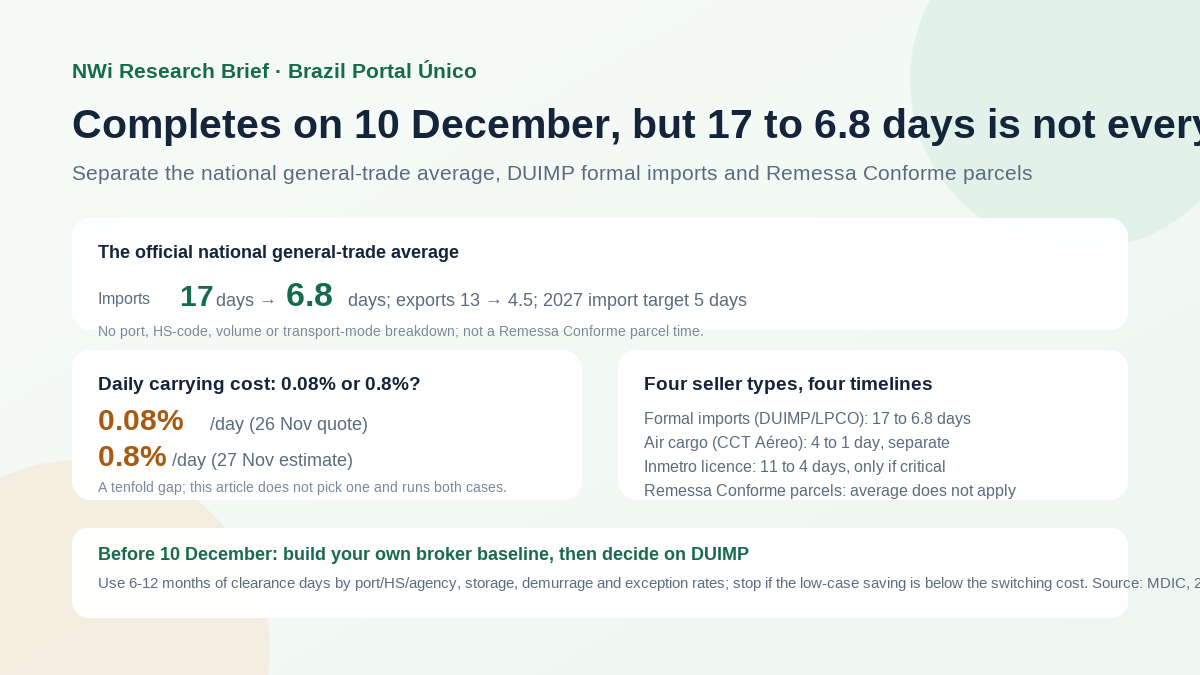
If you import formally into Brazil, or move stock into a Brazilian warehouse through a local importer or 3PL, the decision on 10 December 2026 is not whether Portal Único exists. It is whether this shipment's DUIMP, LPCO and agency approvals are ready, and whether you should use the official 17-to-6.8-day average to change price, replenishment or broker. If you only sell Remessa Conforme parcels, that national general-trade average is not your clearance time; using it to cut prices gives away a saving that does not exist.
The real decision is whether, before Brazil's Portal Único completes its import migration on 10 December 2026, a formal importer should switch to DUIMP, change customs broker, or first calculate the saving from its own clearance data before moving.
The article's increment is to separate the national general-trade average from Remessa Conforme parcels, turn the tenfold 0.08% versus 0.8% conflict into a range stress test, and set out three different action lines for formal imports, air cargo and Inmetro licences.
1. What was announced on 26-27 November: a 10 December completion, and more than one number
MDIC's 26 November article says the Portal Único platform implementation will complete on 10 December. At the 27 November delivery event at CNI in São Paulo, MDIC and Receita Federal added a set of savings that have already occurred or are in progress. Those two pages and the 26 November event notice are the entire primary record used here.
| Item | Official number | Scope / boundary |
|---|---|---|
| Platform implementation | 10 December 2026 | 26 Nov article; 27 Nov article calls the programme complete; a second ceremony is on 1 December in Brasília |
| Import average | 17 to 6.8 days | National general-trade average; 2027 expectation is 5 days |
| Export average | 13 to 4.5 days | National general-trade average |
| Agencies involved | 18 | 27 Nov article |
| Export documents / fields | -70% / -60% | Export operations, not imports |
| Flex licences | 72% of 2026 licences | One licence can cover several imports if agency conditions are met |
| Air cargo CCT release | 4 to 1 day (-80%) | CCT Aéreo stage, not total clearance |
| Inmetro licence | 11 to 4 days (-65%) | Average approval time |
| Anvisa fee-to-review wait | About 48 hours to 0 | Wait between fee payment and review start, not total release |
| Cost coefficient | 0.08%/day or 0.8%/day | Two MDIC pages on the same event, a tenfold gap |
| Cost of one extra day | BRL 28.7bn/year | Estimated on the 2025 trade flow and 0.8%/day |
The number most often misread is the 17-to-6.8-day import average. It is MDIC's national general-trade average, not a promise for a specific port, HS code or seller; the pages give no port, HS, volume or transport-mode breakdown.
The word "completion" is also easy to misread. The 26 November article says the platform implementation completes on 10 December; the 26 November event notice says the migration of import processes completes; the 27 November article refers to a new implementation phase from December 2026. The three statements point to the same programme, but this article did not find a per-company official schedule saying which importer must use DUIMP on 10 December; that is one of the limitations below.
Keep three dates separate: 27 November was the São Paulo delivery event, 1 December is the Brasília ceremony, and 10 December is MDIC's platform implementation completion date, not a single compliance deadline for every importer. Merging them into one "10 December cliff" overstates the urgency and understates the transition uncertainty.
The three MDIC pages come from one publisher, not three independent organisations; they prove what the government said on 26-27 November, not that every port already reaches 6.8 days.
2. Mechanism: which part of the clock is cut, and how it becomes money
Portal Único puts the import declaration, LPCO, agency approvals and tax payment into one digital interface, so data entered once can be reused by several agencies.
MDIC's 27 November article gives three concrete mechanisms. First, export operations require 70% fewer documents and 60% fewer fields; information such as company name, exporter and importer address, goods description, weight, packaging and NCM code used to be entered up to 18 times across different systems, and can now be shared. Second, flex licences allow one licence to cover several import operations and accounted for 72% of licences issued in 2026. Third, automation in agency review and risk management cut waiting time at agencies such as Anvisa and Inmetro.
For a seller, the time saving lands in four cost lines: port or in-transit storage, demurrage/detention, financing cost, and lost sales from stock-outs. The first three can be estimated as cargo value x daily cost coefficient x days; the fourth needs your own sales and replenishment data and cannot be replaced by a national average.
But a time saving is not automatically a cash saving. If the cargo already sits within free time, if the forwarder's all-in rate covers storage, or if your replenishment cycle is set by production scheduling, a few clearance days may only lengthen the buffer rather than add profit.
3. Evidence boundary: 0.08% and 0.8% cannot both be true
The 26 November article quotes Tatiana Prazeres: "Each day a cargo remains parked represents a cost equivalent to 0.08% of the cargo's value." The 27 November article says in the same economic-impact passage that each additional day of waiting costs about BRL 28.7 billion a year, based on Brazil's 2025 trade flow and an estimated cost of 0.8% of goods value per day.
0.08% and 0.8% differ by a factor of ten. Using the same BRL 28.7 billion/year figure: at 0.8%/day, the implied 2025 trade flow is 28.7 / 0.008 = BRL 3.5875 trillion; at 0.08%/day, the implied flow is 28.7 / 0.0008 = BRL 35.875 trillion, ten times larger. This article does not decide which is a typo and does not choose one for the government; every scenario reports both cases.
This is not nit-picking. For a FOB USD 50,000 shipment, 10.2 days saved is USD 408 at 0.08% and USD 4,080 at 0.8%; for a USD 100,000 air shipment, 3 days saved is USD 240 at the low case and USD 2,400 at the high case. Choose the wrong coefficient and the replenishment or pricing conclusion can reverse.
Other boundaries: the three MDIC pages have one publisher; no Receita Federal page for the same event was found; the 17-to-6.8-day figure has no port/HS/volume split; the five-day target is a 2027 expectation, not a measured result; 10 December is the platform completion date, not every seller's compliance deadline; Remessa Conforme parcels are outside the general-trade average.
4. Counter-cases: who should not change price because of this
Counter-case one: a seller that only uses Remessa Conforme parcels. The 17-to-6.8-day figure is a national general-trade average, not a parcel clearance time; cutting the price per order by that figure gives away a saving that does not exist.
Counter-case two: a seller whose free time and all-in forwarder rate already cover most of the waiting. A few clearance days may reduce financing cost but not the storage or demurrage invoice; if the financing cost is below 0.08%/day, the low-case saving is small.
Counter-case three: a seller whose licence is not on the critical path. Inmetro approval falling from 11 to 4 days is a seven-day saving only when the licence is holding the shipment; if the licence is obtained before replenishment, those seven days do not enter clearance time.
Counter-case four: a seller that treats the average as its own port. The average may be pulled down by a few large ports and low-risk HS codes; if your port or category is already above 10 days, 6.8 days is not your baseline. Start with your broker's data.
Alternative explanation: the fall in clearance time may also come from inspection rates, cargo mix or a change in statistical method, not only from Portal Único; MDIC provides no control group, so this article treats the official number as an official post-event average, not as proof of causation.
5. Reproducible analysis: four scenarios, two coefficients
All cargo values, shipment counts, days and coefficients below are clearly labelled assumptions, not MDIC, NWi or seller measurements; the currency is USD and the figures exclude freight, insurance, duties, IPI/ICMS, broker fees, returns and lost sales.
Scenario A: formal import, FOB USD 50,000, 12 shipments a year, 10.2 days saved
Assume the import average falls from 17 to 6.8 days, saving 10.2 days; each shipment is FOB USD 50,000; 12 shipments a year; the combined financing, storage and demurrage cost is either 0.08%/day or 0.8%/day.
At 0.08%: 50,000 x 0.0008 x 10.2 = USD 408 per shipment, or USD 4,896 a year; at 0.8%: 50,000 x 0.008 x 10.2 = USD 4,080 per shipment, or USD 48,960 a year.
For a FOB USD 50,000 shipment, 12 shipments a year and 10.2 days saved, the 0.08%/day case is USD 408 per shipment and USD 4,896 a year, while the 0.8%/day case is USD 4,080 per shipment and USD 48,960 a year: a tenfold difference.
Use your own 6-12 months of storage, demurrage and financing cost to choose the low or high case; do not promise a price cut based on the USD 48,960 high case.
Scenario B: parcel seller, USD 30 average order, 5,000 orders a month
Assume a Remessa Conforme parcel seller with a USD 30 average order and 5,000 orders a month, wrongly applying the 10.2-day general-trade average to every order.
At 0.08%: 30 x 0.0008 x 10.2 = USD 0.2448 per order, or USD 1,224 a month; at 0.8%: 30 x 0.008 x 10.2 = USD 2.448 per order, or USD 12,240 a month.
Neither number belongs in parcel pricing because the general-trade average does not apply; keep using your own carrier and clearance data and treat Portal Único only as background information that formal imports may become faster.
Scenario C: air cargo, USD 100,000, CCT release cut from 4 to 1 day
Assume air cargo worth USD 100,000; CCT Aéreo release falls from 4 to 1 day, saving 3 days; only the CCT stage is counted, not the 17-to-6.8-day general average.
At 0.08%: 100,000 x 0.0008 x 3 = USD 240; at 0.8%: 100,000 x 0.008 x 3 = USD 2,400.
For perishables, electronics, medicines or high value-to-weight cargo, the three days may be worth more than the financing cost; for ordinary low-value air cargo, do not switch modes for these three days alone.
Scenario D: Inmetro licence, USD 20,000, 11 to 4 days
Assume Inmetro licence approval falls from 11 to 4 days, saving 7 days; the licence is on the critical path; the shipment is worth USD 20,000; only licence waiting is counted, not total clearance.
At 0.08%: 20,000 x 0.0008 x 7 = USD 112; at 0.8%: 20,000 x 0.008 x 7 = USD 1,120.
If the licence is not on the critical path, do not count the seven days; if it is, use the range and record the seven days separately from port and transport time.
6. Action and stop conditions: what to do before 10 December
First, confirm the entity and the process: are you the importer, or do you import through a local importer or 3PL; is your broker already using DUIMP/LPCO; are there system permissions that need to be re-authorised around 10 December.
Second, build your own baseline: ask the broker for 6-12 months of clearance days by port, HS code and agency (Anvisa, Inmetro, Ibama, MAPA and others), plus storage, demurrage and exception reasons. Without that baseline, 6.8 days is only a national average.
Ask the customs broker for 6-12 months of clearance days by port, HS code and agency, plus storage and demurrage costs, run the 0.08%-0.8% range, and only then decide whether to switch to DUIMP or change the replenishment rhythm before 10 December.
Third, calculate a range, not a point: put both 0.08% and 0.8% into the budget and check whether the low-case saving covers the switching cost (broker process changes, system integration, training, test shipments), and whether the high case justifies locking capacity earlier.
Fourth, set an observation window: 30 days after 10 December, look at DUIMP usage and declaration errors; 60 days, look at clearance days by port/HS; 90 days, look at storage/demurrage and stock-out rates. If your own clearance days have not fallen after 60 days, or exception rates rise after the switch, stop expanding the switch.
Stop conditions: the low-case saving is below the switching cost; your port/HS baseline is already below 6.8 days; the licence is not on the critical path; or you only sell parcels and the 17-to-6.8-day average does not apply. If any of these is true, do not change price or broker because of this news.
7. Unknowns and limitations
This article did not find an independent Receita Federal page for the same event, nor clearance data split by port, HS code, volume or transport mode; the three MDIC pages are one publisher and are not independent cross-validation.
The 0.08% versus 0.8% conflict has no official explanation; this article handles it as a range and does not decide which is a typo. The BRL 28.7 billion/year figure is an official estimate, not a company invoice, and cannot be added directly to a seller's P&L.
10 December is the platform implementation completion date; whether a specific importer must use DUIMP, whether there is a transition period and whether permissions must be re-authorised were not found in a per-company official schedule. The current Siscomex/Receita Federal rules and the broker's advice govern.
CNI's USD 108 billion GDP and USD 93.6 billion trade-flow figures are macro projections to 2040, not a 2026 seller benefit; this article uses them only as background and does not put them into the scenarios.
All three MDIC pages have one publisher, there is no Receita Federal page for the same event and no port/HS/volume breakdown; the five-day target is a 2027 expectation, not a measured result.
This article did not interview importers, brokers or platforms and did not use NWi customer data; all scenarios are assumptions and must not be treated as measured returns.
8. What this means for data work
If you are making a Brazil market-entry or replenishment decision, split "clearance time" into four fields: DUIMP/DI declaration type, port or airport, HS code and agency, and actual release days; add three cost fields: storage, demurrage/detention and financing. Only then can you tell whether 6.8 days is your baseline.
Portal Único's completion does not change one fact: marketplace data (category, brand, price band, sales) and customs data are two layers. NWi CrossborderGo's selectable coverage includes Shopee Brazil and Mercado Libre Brazil, with monthly category, brand, store, product and price-band research; it does not read DUIMP, LPCO, broker records, storage/demurrage invoices or importer settlements, and cannot verify a seller's clearance days.
In other words: use marketplace data to answer "what to sell, to whom, at what price band"; use broker or importer data to answer "how many days will this shipment take and what does a day cost". Do not mix the two.
If you want to put Brazil category, brand and price-band research into one workflow, see NWi CrossborderGo's global overview, industry, brand and store, and product research modules; to see a demo for your own sites and data scope, book a demo. Available sites, history and fields depend on account authorisation and the contract.
9. Method and disclosure
Data basis: this article reopened and read three MDIC pages on 28 November 2026: "Governo Federal conclui implantação do Portal Único de Comércio Exterior em dezembro" (published 26 November 2026, updated 27 November 2026), "Portal Único moderniza e prepara o Brasil para novo recorde na corrente de comércio" (published 27 November 2026, updated 27 November 2026) and the 26 November seminar notice. The completion date, 17-to-6.8-day import average, 13-to-4.5-day export average, 18 agencies, 70%/60% document and field reductions, 72% flex licences, 4-to-1-day CCT Aéreo release, 11-to-4-day Inmetro approval, 48-hour Anvisa wait and the BRL 28.7 billion/year estimate all come from those pages. Calculation: Scenario A uses 50,000 x 0.0008 x 10.2 = 408 and 50,000 x 0.008 x 10.2 = 4,080, multiplied by 12; Scenario B uses 30 x 0.0008 x 10.2 = 0.2448 and 30 x 0.008 x 10.2 = 2.448, multiplied by 5,000; Scenario C uses 100,000 x 0.0008 x 3 = 240 and 100,000 x 0.008 x 3 = 2,400; Scenario D uses 20,000 x 0.0008 x 7 = 112 and 20,000 x 0.008 x 7 = 1,120. The implied trade-flow check is 28.7 / 0.008 = 3.5875 trillion and 28.7 / 0.0008 = 35.875 trillion. All cargo values, shipment counts, days, coefficients, storage costs and order volumes are labelled assumptions, not MDIC, NWi or seller measurements. Product basis: NWi CrossborderGo's selectable coverage includes Shopee Brazil and Mercado Libre Brazil for monthly category, brand, store, product and price-band research; commercial availability depends on the contract. It does not provide DUIMP, LPCO, broker, storage/demurrage or importer settlement data, and this article's calculations do not rely on NWi product data.
This article was prepared with the assistance of an automated research workflow, based on the public sources listed at the end, and was not reviewed by a human editor. It does not invent customer data, expert review, sales uplift, ranking results or platform endorsement. It is not legal, tax, financial or operational advice; questions about importer obligations, DUIMP transition, agency approval, fees or penalties should be checked against the current Siscomex/Receita Federal rules, the broker's advice and the relevant official pages.
The article's increment is to separate the national general-trade average from Remessa Conforme parcels, turn the tenfold 0.08% versus 0.8% conflict into a range stress test, and set out three different action lines for formal imports, air cargo and Inmetro licences.
To put Brazil category, brand, store and price-band research into one workflow, see NWi CrossborderGo’s global overview, industry, brand and store, and product research modules; to see a demo for your own sites and data scope, book a demo. For expert research on a specific category, see the cross-border AI agent; to connect marketplace data to your own analysis workflow, see MCP data access. Available sites, history and fields depend on account authorisation and the contract; these products do not read DUIMP, LPCO, broker records or importer settlements.
Sources: the pages below were reopened and read on 28 November 2026; dates, numbers and quotations follow the page text at that time. All three pages come from MDIC as one publisher and are not independent cross-validation.
- MDIC, "Portal Único moderniza e prepara o Brasil para novo recorde na corrente de comércio", afirma Tatiana Prazeres, published 27 November 2026 and updated the same day: 18 agencies, Anvisa 48-hour wait, export documents -70% / fields -60%, flex licences 72%, CCT Aéreo 4 to 1 day, Inmetro 11 to 4 days and the 0.8%/day estimate: read the original
- MDIC, "Governo Federal conclui implantação do Portal Único de Comércio Exterior em dezembro", published 26 November 2026 and updated 27 November 2026: 10 December completion, imports 17 to 6.8 days, exports 13 to 4.5 days, 2027 five-day expectation and the 0.08%/day quote: read the original
- MDIC, "MDIC realiza seminário que marca a entrega do Portal Único de Comércio Exterior", published 26 November 2026: completion of the import-process migration and the DUIMP/LPCO agenda: read the original