
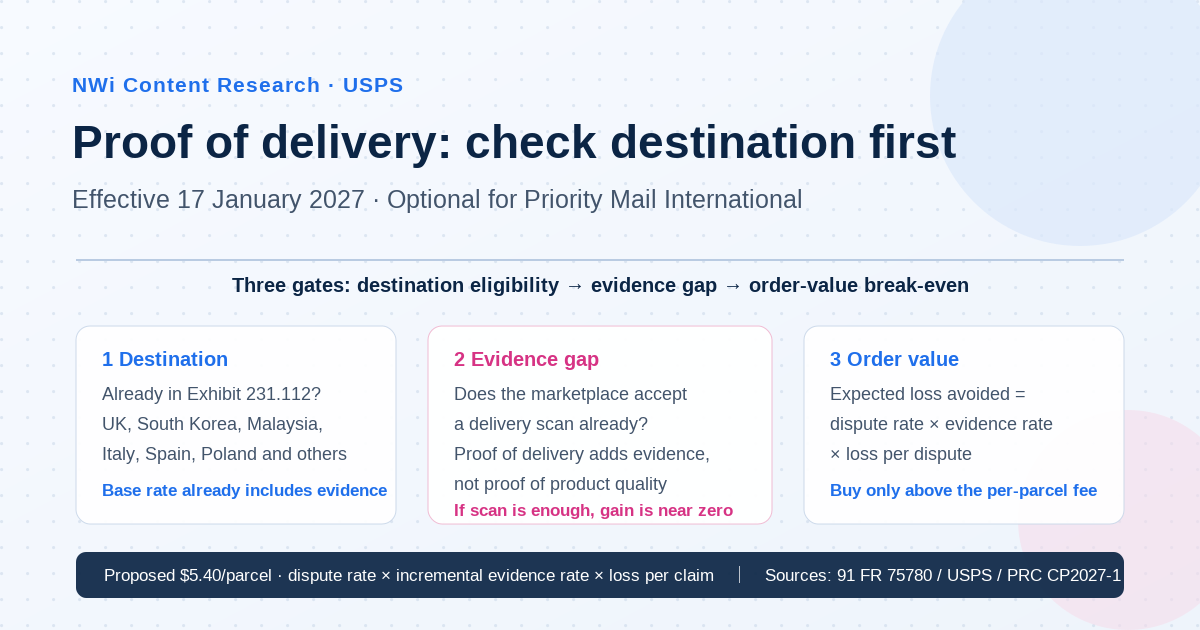
Cross-border sellers using USPS Priority Mail International should not add International Proof of Delivery to every parcel after 17 January 2027. First check whether the destination already includes evidence of delivery in the PMI base rate, then compare the fee with the expected loss avoided per parcel; only buy where the expected loss avoided exceeds the fee. USPS published the final rule on 24 November 2026, effective 17 January 2027; the fee is additional to postage and still subject to Postal Regulatory Commission price approval.
The real question is not whether proof of delivery is useful, but whether the expected loss avoided on this mix of destinations, order values and disputes exceeds the per-parcel fee.
Start by separating three concepts. First, every Priority Mail International parcel already receives a delivery scan; it shows that the parcel reached the destination postal network and was scanned on delivery, not that the addressee signed for it. Second, the new service supplies additional evidence of delivery, which may take the form of a signature, identity-card data, a recipient authorisation for out-of-home delivery, an electronic or written record of delivery without the recipient present, or another form of proof recognised by destination law. Third, the service is only needed where the destination postal operator does not include evidence of delivery in its base service; the destinations in Exhibit 231.112 already include evidence of delivery in the PMI base rate.
1. What the service changes: from a delivery scan to usable proof
The new service does not replace the delivery scan that every PMI parcel receives; where the destination does not include evidence of delivery in its base service, it buys a signature, identity data or recipient authorisation as additional evidence.
The rule defines the evidence broadly: a signature is only one form, and identity-card data, advance authorisation or a record of delivery without the recipient present may also qualify. A refused delivery, a wrong address, a parcel left at the door or a neighbour accepting it can all leave different evidence; sellers should not read “bought proof of delivery” as “obtained the addressee’s signature”.
Another easily missed limit is timing. The rule says International Proof of Delivery can be obtained only at the time of mailing: at a Post Office retail counter, through Click-N-Ship, through USPS APIs, or through USPS-produced Global Shipping Software. It cannot be added after the parcel is mailed; if it was not bought at mailing, the seller is left with the inquiry or claim process.
| Item | Every Priority Mail International parcel | With International Proof of Delivery |
|---|---|---|
| Delivery scan | Yes | Yes |
| Signature / identity / authorisation evidence | Depends on the destination | Additional evidence where the destination does not include it |
| Purchase timing | Automatic at mailing | Bought at mailing; cannot be added later |
| Fee | Included in base postage | Additional; this article uses a proposed $5.40 |
| Inquiry window | 7 days to 6 months after mailing | 7 days to 6 months after mailing |
2. Check the destination first: parcels covered by Exhibit 231.112 do not need it
Exhibit 231.112 is titled “Proof of Delivery Included With PMI Base Rate”. Its examples include the United Kingdom, South Korea, Malaysia, Italy, Spain and Poland. For those destinations, evidence of delivery is already included in the PMI base rate; the seller does not need to buy it again. For other destinations, the rule says the mailer may buy International Proof of Delivery at the time of mailing, but availability still depends on the Individual Country Listings.
This article does not assert that a specific country “lacks” the service, because the rule points to the Individual Country Listings and this round did not read every country listing. In practice, group orders by destination, check Exhibit 231.112 and the latest USPS country list, and isolate the lanes that actually need the purchase.
This is also the first counter-case: if the destination is already in Exhibit 231.112, or the marketplace already accepts a delivery scan as proof, the purchase does not change the dispute outcome and only adds cost per parcel.
3. Fee and timing: $5.40 is proposed, not final
In its 12 November 2026 news release, USPS announced international price changes effective 17 January 2027 and a new optional Outbound Proof of Delivery service; international products rise by an average of 7.9%. The final rule says the International Proof of Delivery fee is in the Notice 123 price list, must be paid in addition to postage, and the service takes effect subject to PRC approval of the price in CP2027-1.
The PRC established Docket No. CP2027-1 in Order No. 9804 on 19 November 2026, with comments due 4 December 2026 and the price changes scheduled for 17 January 2027. Until the final price list is published, any specific fee is proposed, not final. Intelligent Audit’s analysis of 18 November 2026 reports a proposed $5.40 fee for Priority Mail International proof of delivery; this article treats that figure as a planning assumption, not the final rate.
If the final fee is $8.00 instead of $5.40, the break-even order value rises materially at the same dispute and incremental evidence rates. The sensitivity table below shows the change.
The rule and effective date are primary, but the fee sits in a Notice 123 price list that still needs approval; the $5.40 figure is an independent analysis of the proposed price, not the final rate.
4. The break-even formula: fee per parcel versus expected loss avoided
Write the decision as a formula: expected loss avoided per parcel = dispute rate × incremental evidence rate × expected loss per dispute. Net benefit = expected loss avoided per parcel − fee per parcel. Buy only when net benefit is positive.
The replicable formula is: expected loss avoided per parcel = dispute rate × incremental evidence rate × expected loss per dispute; buy only when that exceeds the per-parcel fee.
Conversely, break-even order value = fee per parcel ÷ (dispute rate × incremental evidence rate); break-even dispute rate = fee per parcel ÷ (incremental evidence rate × expected loss per dispute). Both formulas can be recalculated from the seller’s own last 12 months of data.
The “incremental evidence rate” is not the marketplace claim-approval rate; it is the share of disputes that move from lost to won because of the added evidence. If the marketplace already accepts a delivery scan, the incremental evidence rate may be close to zero; if it requires a signature or identity evidence, the rate may approach the claim-approval rate. Only the seller’s own dispute history can estimate this parameter; it cannot be read directly from the USPS rule.
The expected loss per dispute is not necessarily the order value. If the seller recovers part of the goods after a refund, or the reshipment cost is lower than the original order, use the net loss (goods + shipping + handling − recoveries), not GMV. For replicability, the scenarios below use order value as the expected loss per dispute and label that assumption in each case.
5. Three scenarios: low value, high value and a high-dispute destination
All three scenarios are hypothetical examples, not USPS data, marketplace data or seller measurements. Replace the parcel counts, order values, dispute rates, incremental evidence rates and fees with your own numbers.
Scenario A: low-value parcels, 1% dispute rate and 50% incremental evidence rate (hypothetical)
Assume 1,000 PMI parcels, a $45 average order value, a 1.0% dispute rate (10 disputes), a 50% incremental evidence rate (5 disputes move from lost to won), and a $5.40 fee per parcel, with no administrative cost.
Calculation: expected loss avoided per parcel = 1.0% × 50% × $45 = $0.225; net = $0.225 − $5.40 = −$5.175 per parcel; 1,000 parcels produce a net loss of $5,175. Break-even order value = $5.40 ÷ (1.0% × 50%) = $1,080; at a $45 order value, the break-even dispute rate = $5.40 ÷ (50% × $45) = 24%.
Result: at a $45 order value and a 1% dispute rate, the proposed $5.40 fee is far above the expected loss avoided, and 1,000 parcels produce a net loss of $5,175.
Decision: do not buy proof of delivery for low-value parcels; unless the destination dispute rate approaches 24%, or the marketplace explicitly requires signature evidence, spend the budget on reducing loss and fixing addresses.
Scenario B: high-value parcels, 1.5% dispute rate and 60% incremental evidence rate (hypothetical)
Assume 1,000 PMI parcels, a $650 average order value, a 1.5% dispute rate (15 disputes), a 60% incremental evidence rate (9 disputes move from lost to won), and a $5.40 fee per parcel, with no administrative cost.
Calculation: expected loss avoided per parcel = 1.5% × 60% × $650 = $5.85; net = $5.85 − $5.40 = $0.45 per parcel; 1,000 parcels produce a net gain of $450. Break-even order value = $5.40 ÷ (1.5% × 60%) = $600; if the fee rises to $8.00, the break-even order value rises to $888.89.
Result: at a $650 order value and a 1.5% dispute rate, the proposed $5.40 fee is slightly below the expected loss avoided, producing a net gain of $450 across 1,000 parcels, but the margin is thin.
Decision: buy only for high-value lanes whose destination is not in Exhibit 231.112 and whose marketplace accepts signature evidence; pilot first and recalculate if the fee rises above $5.85.
Scenario C: high-dispute destination, 4% dispute rate and 70% incremental evidence rate (hypothetical)
Assume 1,000 PMI parcels, a $180 average order value, a 4.0% dispute rate (40 disputes), a 70% incremental evidence rate (28 disputes move from lost to won), and a $5.40 fee per parcel, with no administrative cost.
Calculation: expected loss avoided per parcel = 4.0% × 70% × $180 = $5.04; net = $5.04 − $5.40 = −$0.36 per parcel; 1,000 parcels produce a net loss of $360. Break-even order value = $5.40 ÷ (4.0% × 70%) = $192.86; at a $180 order value, the break-even dispute rate = $5.40 ÷ (70% × $180) = 4.29%.
Result: even at a 4% dispute rate, a $180 order value remains below the $192.86 break-even line, and 1,000 parcels produce a net loss of $360.
Decision: a high dispute rate does not automatically justify the purchase; first raise the order value above $192.86 or cut the dispute rate below 4.29%, then reconsider.
Taken together, the decision is not driven by “high order value” or “high dispute rate” alone, but by their product. A $45 parcel needs a dispute rate of about 24% to break even; a $180 parcel is still just short at a 4% dispute rate; a $650 parcel only clears the line at a 1.5% dispute rate.
| Scenario | Parcels | Order value | Dispute rate | Evidence rate | Expected loss avoided | Net per parcel | Total net | Break-even order value |
|---|---|---|---|---|---|---|---|---|
| A | 1,000 | $45 | 1.0% | 50% | $0.225 | −$5.175 | −$5,175 | $1,080 |
| B | 1,000 | $650 | 1.5% | 60% | $5.85 | +$0.45 | +$450 | $600 |
| C | 1,000 | $180 | 4.0% | 70% | $5.04 | −$0.36 | −$360 | $192.86 |
If the incremental evidence rate is fixed at 60%, the break-even order value at different dispute rates is shown below. If the fee rises from $5.40 to $8.00, the break-even order value at a 1.5% dispute rate rises from $600 to $888.89; that is why the final Notice 123 fee must be confirmed rather than treating the proposed figure as final.
| Dispute rate | Break-even order value at $5.40 | Break-even order value at $8.00 |
|---|---|---|
| 1.0% | $900 | $1,333.33 |
| 1.5% | $600 | $888.89 |
| 2.0% | $450 | $666.67 |
| 3.0% | $300 | $444.44 |
| 4.0% | $225 | $333.33 |
6. Counter-cases: when proof of delivery does not change the outcome
The counter-case is a seller whose marketplace already accepts a delivery scan, or whose disputes are mainly product-quality claims: extra proof of delivery does not change those outcomes and only adds cost per parcel.
- The destination is already in Exhibit 231.112: the base rate includes evidence of delivery, and buying it again adds no evidence.
- The marketplace accepts a delivery scan: if the platform or card network already treats the scan as proof of delivery, the incremental evidence rate is near zero.
- The dispute is about product quality, description or damage: proof of delivery proves delivery, not that the goods were correct.
- The parcel was lost before delivery: there is no delivery to prove, and proof of delivery does not solve a lost parcel.
- The buyer refused delivery or the address was wrong: the evidence may be a return or refusal record, not a signature.
- Another carrier already includes signature service at a lower cost: adding the USPS service may be more expensive than switching carriers.
- The marketplace claim window is shorter than the USPS inquiry window: the six-month USPS limit is not the marketplace deadline, and proof of delivery cannot rescue a claim filed after the marketplace deadline.
- The destination is unavailable or not listed in the Individual Country Listings: do not assume the service can be bought.
7. Action list and stop conditions
Export 12 months of PMI orders and dispute outcomes by destination and order value, exclude destinations whose base rate already includes evidence of delivery, and pilot only the remaining high-value lanes.
- 1. Export 12 months of PMI orders and group them by destination, order value and dispute outcome; label each dispute as non-receipt, chargeback, damage or product quality.
- 2. Check Exhibit 231.112 and the Individual Country Listings, exclude destinations whose base rate already includes evidence of delivery, and isolate the lanes where the service can be bought.
- 3. Check the final Notice 123 fee; before it is published, run the numbers at $5.40 and at a higher fee.
- 4. Use the formulas to calculate expected loss avoided per parcel, net benefit and break-even order value; run low, medium and high incremental evidence rates rather than one optimistic value.
- 5. Pick one high-value, higher-dispute, eligible lane for a 2–4 week pilot and keep a control group that does not buy the service.
- 6. Buy the service at mailing, keep the proof-of-delivery reference and evidence, and file the marketplace claim within its own window rather than waiting for the USPS six-month limit.
- 7. Stop conditions: the fee exceeds the expected loss avoided; the destination already includes evidence; the marketplace does not accept the evidence; disputes are mainly product quality; the parcel was lost before delivery; the fee increase pushes the break-even order value above the actual order value; the pilot and control groups show no observable difference.
- 8. Recalculate quarterly because fees, destination lists, marketplace rules and the seller’s own dispute rate change.
If you want to put destinations, order values, disputes and categories back into market research, use NWi CrossborderGo to view platform, category and brand data (platform and field availability depend on your subscription); operations teams can use NWi Operations to bring selection and operating data back into a SKU calculation; for expert research that combines destination markets, categories and competition, see the Cross-border Agent; to connect your own order, refund and logistics data to a research workflow, see MCP data access (the actual integration scope is confirmed during onboarding); for a proof-of-delivery calculation for your own SKUs and destinations, see demo and consultation. These tools do not replace the USPS Notice 123, the Individual Country Listings or marketplace claim rules, and do not guarantee a dispute outcome.
8. Evidence boundary and limitations
This article has no seller-specific dispute rate, incremental evidence rate or marketplace acceptance data; the order counts, order values and rates in the three scenarios are labelled assumptions, not measurements.
- The rule and effective date are primary; the fee is proposed and the final amount must be read from Notice 123.
- The $5.40 figure comes from Intelligent Audit’s analysis of the proposed price filing, not from the final USPS price; this article did not read the PRC price table page by page.
- There is no seller-specific dispute rate, incremental evidence rate or marketplace acceptance data; every scenario number is an assumption.
- The Individual Country Listings were not read country by country; the article does not assert that a specific country lacks the service.
- No purchase or claim was submitted in a live account; the article does not claim a tested result.
- The rule covers Priority Mail International only; it does not apply to other USPS international products.
- The UPU inbound proof-of-delivery obligation starts on 1 January 2027, while the USPS outbound service starts on 17 January 2027; the scope and dates differ.
- Proof of delivery is not insurance and does not guarantee marketplace or card-network acceptance; loss, damage and product disputes still need separate handling.
9. Original analytical contribution
The contribution is to turn international proof of delivery into three gates—destination eligibility, evidence gap and order-value break-even—and to show how a higher fee moves the threshold, rather than repeating 'buy it for high-value orders'.
The second contribution is to separate the delivery scan from proof of delivery: every PMI parcel has a scan, but a scan is not a signature; the new service only adds value where the destination does not include evidence and the marketplace requires more than a scan.
The third contribution is to bring fee uncertainty into the decision: running the break-even order value at both $5.40 and $8.00 avoids treating a proposed price as final.
The fourth contribution is to put destination eligibility before the formula: exclude destinations in Exhibit 231.112 that already include evidence of delivery before discussing order value and dispute rate; otherwise a duplicate purchase is counted as a benefit.
10. Conclusion
In one sentence: do not add International Proof of Delivery to every PMI parcel. Use Exhibit 231.112 and the Individual Country Listings to exclude destinations that already include evidence, then compare “dispute rate × incremental evidence rate × expected loss per dispute” with the per-parcel fee; buy at mailing only on lanes with high order value, an eligible destination, marketplace acceptance and a positive net benefit.
11. Sources
- 1. Federal Register, “International Proof of Delivery Service” (91 FR 75780, 24 November 2026; primary: service scope, evidence forms, purchase timing, inquiry window and effective date): Read the source
- 2. USPS Newsroom, “U.S. Postal Service Recommends Shipping Price Adjustments for 2027” (12 November 2026; primary: new optional Outbound Proof of Delivery, 7.9% average international increase, effective 17 January 2027): Read the source
- 3. Postal Regulatory Commission, “Order No. 9804, Docket No. CP2027-1” (91 FR 74611, 19 November 2026; primary: price proceeding, comments due 4 December 2026, changes scheduled for 17 January 2027): Read the source
- 4. Intelligent Audit, “USPS GRI 2027: The Familiar 5.9% Plus Permanent Fuel Surcharges and Net New Fees” (18 November 2026; independent analysis: reported proposed $5.40 PMI proof-of-delivery fee and PMI retail/commercial rate changes): Read the source
- 5. USPS Postal Explorer, “January 2027 Price Change” (revised 12 November 2026; primary: the January 2027 price files are marked Proposed, effective 17 January 2027): Read the source
12. Methodology and disclosure
Data basis: the service scope, eligible destinations, evidence forms, purchase timing and inquiry window of International Proof of Delivery come from the USPS final rule published in the Federal Register on 24 November 2026 (91 FR 75780) and the USPS news release of 12 November 2026; the fee remains subject to the CP2027-1 price proceeding, where PRC Order No. 9804 of 19 November 2026 established the docket, set comments due on 4 December 2026 and scheduled the changes for 17 January 2027. Intelligent Audit's independent analysis of 18 November 2026 reports a proposed fee of $5.40 per parcel; this article treats that figure as a planning assumption, with the final rate to be confirmed in USPS Notice 123. Calculation basis: expected loss avoided per parcel = dispute rate × incremental evidence rate × expected loss per dispute; net benefit = expected loss avoided per parcel − fee per parcel; break-even order value = fee per parcel ÷ (dispute rate × incremental evidence rate); break-even dispute rate = fee per parcel ÷ (incremental evidence rate × expected loss per dispute). The incremental evidence rate is the share of disputes that move from lost to won because of the added evidence, not the marketplace claim-approval rate; the scenarios use order value as the expected loss per dispute and do not deduct recoveries. All order counts, order values, dispute rates, incremental evidence rates and fees are labelled assumptions, not USPS, marketplace or NWi measurements.
This article was prepared with automated research assistance and analysed from the public sources listed at the end; it was not manually reviewed. It does not invent customer data, expert review, sales lift, ranking results or platform endorsement. It is not legal, tax, platform-operations or investment advice.