
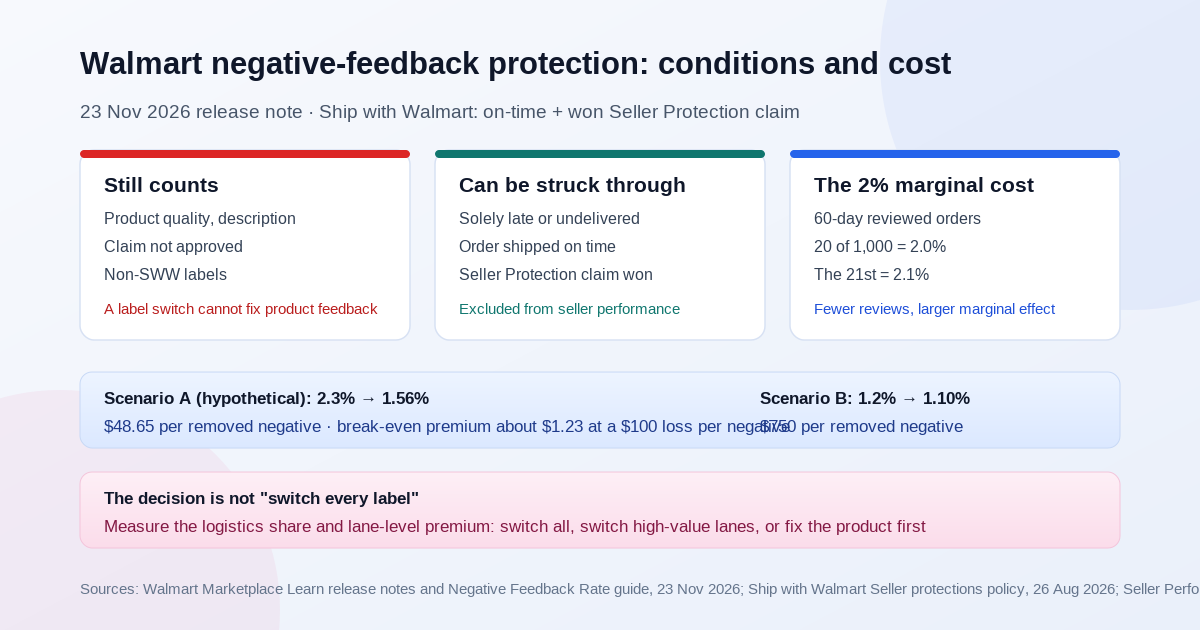
The real question is not whether the protection is good, but whether, for this order mix, this label premium and this feedback structure, the expected cost of switching to Ship with Walmart is lower than the value of the negatives it removes. Walmart's 23 November 2026 seller release note sets a narrow rule: for eligible Ship with Walmart orders shipped on time, where the seller has won a Ship with Walmart Seller Protection claim, negative feedback related solely to late or undelivered shipments is struck through and excluded from seller performance. Product-quality feedback, inaccurate descriptions, claims that are not approved and ineligible orders still count toward the 2% negative-feedback rate.
Separate three layers. The first is display: the guide says eligible Ship with Walmart orders shipped on time will show a strikethrough on Walmart.com for feedback related solely to late or undelivered shipments. The second is measurement: the same passage says the feedback will not count toward Seller Performance metrics. The third is the claim condition: the 23 November release note requires that the seller has won a Ship with Walmart Seller Protection claim. Together, the protection covers feedback already judged to be within the protection scope, not every negative review on a late order.
The mechanism is not deleting a review: eligible late or undelivered feedback gets a strikethrough and is excluded from seller performance, so the protection changes the numerator of the 2% rate but does not change product-quality feedback.
1. What changed: not "late means no negative", but "eligible and claim won"
Walmart's wording is worth reading literally. The release note says "shipped on time where the seller has won a Ship With Walmart Seller Protection claim"; the guide says "eligible Ship with Walmart orders shipped on time". Neither promises that a late review disappears automatically because a seller uses a Ship with Walmart label. The order must be eligible, the shipment must be on time, and the claim must be approved before a strikethrough is possible. The protections policy also says Walmart handles the carrier claim directly and no action is required from the seller for an eligible lost-package refund; the release note, however, ties the strikethrough to the claim outcome, so verify the status instead of assuming every late order is automatically approved.
| Condition | What the official text says | What it means for you |
|---|---|---|
| Order channel | A Ship with Walmart label is required; Bring Your Own Account (BYOA) and non-SWW labels are outside the protection | Your own FedEx/UPS account or a third-party label cannot rely on this protection |
| Ship time | Ship on or before the Ship By date | A late handoff itself creates unprotected late feedback |
| Account status | Account in good standing, seamless returns configured, no active dispute with the buyer | Do not assume approval while a dispute or returns setup is unresolved |
| Claim status | The release note requires a won Seller Protection claim | Not every late order is automatically struck through |
| Feedback content | Solely late or undelivered shipments | Product quality, description accuracy and transit damage still count |
| Refund cap | Up to $100 per qualifying order; cross-border includes duties and covers lost in transit only; the amount above $100 may be charged back to you | High-value orders still carry a gap |
The practical meaning is that the protection is not a single label-switch action. It is a combination of label, on-time shipment, eligibility and claim approval. The last item is the easiest to miss: if the claim is not approved, the strikethrough does not appear and the numerator of the 2% rate does not fall.
2. How the 2% rate works: one negative costs most at the threshold
Walmart's Negative Feedback Rate guide defines the rate as the share of Marketplace orders that received a one- or two-star rating in the last 60 days and says it applies to orders that received customer reviews, including WFS orders. For WFS orders, the rate includes only seller-related ratings such as item quality or missing components; delivery and fulfilment feedback is generally excluded. Sellers must keep the rate at or below 2%. The Seller Performance Standards guide says failure to act may result in suppression, suspension or termination.
The threshold math is simple. If a seller has only 1,000 reviewed orders in 60 days, 20 negatives are exactly 2.0%; the 21st is 2.1%. The same one negative adds only 0.01 percentage point across 10,000 reviewed orders. The smaller the reviewed-order base, the larger the marginal cost of one negative, which is why the reviewed-order denominator comes before the label decision.
The guide also says Walmart may unpublish an item when poor ratings, negative reviews or recurring feedback indicate concerns with product quality, item accuracy, authenticity, safety, shipping condition or the overall customer experience. Item evaluation is independent of the seller-level rate, so 2% is not the only risk line and product-quality negatives cannot be priced only through the rate.
3. Three scenarios: label premium, negatives removed and cost per removal
All three scenarios are hypothetical examples, not Walmart data or seller measurements. Replace the order counts, negative rates, approval rates and label premiums with your own data. The denominator is reviewed orders, matching the guide's "orders that received customer reviews" scope.
Scenario A: 2.3% negative rate, 40% logistics-related (hypothetical)
Assumptions: 10,000 reviewed orders in 60 days; 230 one- or two-star ratings (2.3%); 40% (92) relate solely to late or undelivered shipments; 80% of claims are approved, removing 74; 60% of orders are eligible for Ship with Walmart; the label premium is $0.60 per eligible order; no other costs.
Calculation: 92 logistics negatives × 80% = 73.6, rounded to 74 removed; 230 − 74 = 156 negatives; 156 ÷ 10,000 = 1.56%. 6,000 eligible orders × $0.60 = $3,600; $3,600 ÷ 74 = $48.65. At a $100 expected loss per negative, the break-even premium is 0.92% × 80% × $100 ÷ 60% = $1.23.
Result: negatives fall from 230 to 156 and the rate falls from 2.3% to 1.56%; the premium on 6,000 eligible orders totals $3,600, or $48.65 per removed negative.
Decision: if one negative is expected to cost more than $48.65 and the label premium stays below about $1.23, switch the eligible high-late-risk lanes; otherwise keep the cheaper carrier and fix fulfilment first.
Scenario B: 1.2% negative rate, 10% logistics-related (hypothetical)
Assumptions: 10,000 reviewed orders in 60 days; 120 one- or two-star ratings (1.2%); 10% (12) relate solely to late or undelivered shipments; 80% of claims are approved, removing 9.6; 60% of orders are eligible; the label premium is $1.20 per eligible order; no other costs.
Calculation: 12 logistics negatives × 80% = 9.6 removed; 120 − 9.6 = 110.4 negatives; 110.4 ÷ 10,000 = 1.104%, about 1.10%. 6,000 eligible orders × $1.20 = $7,200; $7,200 ÷ 9.6 = $750.
Result: negatives fall to about 110.4 and the rate to about 1.10%; the premium on 6,000 eligible orders totals $7,200, or $750 per removed negative.
Decision: when the rate is already below 2%, spending $750 per removed negative is usually not worth it; keep the cheaper carrier and revisit only if the expected loss from one negative is clearly above $750.
Scenario C: 2.5% negative rate, 80% product-quality complaints (hypothetical)
Assumptions: 10,000 reviewed orders in 60 days; 250 one- or two-star ratings (2.5%); only 20% (50) relate to late or undelivered shipments; 80% of claims are approved, removing 40; 60% of orders are eligible; the label premium is $0.60 per eligible order; product-quality negatives do not change.
Calculation: 50 logistics negatives × 80% = 40 removed; 250 − 40 = 210 negatives; 210 ÷ 10,000 = 2.1%. 6,000 eligible orders × $0.60 = $3,600; $3,600 ÷ 40 = $90.
Result: negatives fall from 250 to 210 and the rate from 2.5% to 2.1%, still above 2%; the premium totals $3,600, or $90 per removed negative.
Decision: do not expect a label switch to bring the rate below 2%; fix product quality, description accuracy and packaging first, and use the protection only for the small logistics slice on eligible high-value lanes.
| Scenario | Negative rate | Logistics share | Claim approval | Removed | New rate | Cost per removal |
|---|---|---|---|---|---|---|
| A | 2.3% | 40% (92) | 80% | 74 | 1.56% | $48.65 |
| B | 1.2% | 10% (12) | 80% | 9.6 | 1.10% | $750 |
| C | 2.5% | 20% (50) | 80% | 40 | 2.1% | $90 |
The reproducible formula is: cost per removed negative = label premium × eligible-order share ÷ (late-or-undelivered negative rate × claim approval rate); the protection pays only when that cost is below the expected loss from one negative.
In reverse, break-even label premium = late-or-undelivered negative rate × claim approval rate × expected loss per negative ÷ eligible-order share. In Scenario A, at a $100 expected loss per negative, the break-even premium is 0.92% × 80% × $100 ÷ 60% = $1.23; at a $50 loss it falls to $0.61.
The formula also explains why a cheaper Ship with Walmart quote changes the conclusion: if its label price is below your current carrier, the premium is negative and the protection is a side benefit. Eligibility, on-time shipment and claim approval still need to be checked; a cheaper label is not evidence that every negative will be struck through.
4. Counterexamples: who cannot label-switch below 2%
The counterexample is a seller whose negatives are mainly product quality or inaccurate descriptions: even if every order moves to Ship with Walmart, those negatives still count toward 2%, and the label premium only adds cost.
- Product quality or inaccurate descriptions dominate: the guide lists product defects, authenticity concerns and inaccurate descriptions as common reasons; fix the product and listing first, because a label switch only addresses the logistics slice.
- The claim is not approved or is still open: the release note requires a won claim; an unapproved claim cannot be counted as a removed negative.
- The order is ineligible: late shipment, account not in good standing, seamless returns not configured, an active dispute with the buyer, a BYOA label, incorrect packaging or labelling, or prohibited/restricted items.
- Cross-border limits: the $100 cap includes duties and covers lost in transit only; loss after delivery or transit damage is not covered.
- A strikethrough is not a deletion: the guide describes display and performance exclusion, not removal of the customer review; do not treat it as repairing the product rating.
- Item unpublish is independent: Walmart may unpublish for quality, accuracy, authenticity, safety, shipping condition or overall experience even when the seller-level rate is met.
- Already below 2% with a low logistics share: the premium may buy little marginal benefit; quality and packaging spend is likely better.
- A slower or more expensive SWW lane: on-time shipment is not on-time delivery, and a slower lane can create more late feedback and make the protection harder to earn.
5. Action list: check four fields before switching
First export the last 60 days of seller reviews and classify them into late/undelivered, product quality, inaccurate description and other; then check each order's Ship with Walmart eligibility and claim status; finally pilot only the high-value lanes that the formula clears.
- 1. Export the last 60 days of seller reviews and count late/undelivered, product quality, inaccurate description and other; calculate the logistics share. Do not substitute the star rating for the reason.
- 2. Verify eligibility: Ship By attainment, account status, seamless returns configuration, open disputes and label source. Confirm the order actually uses a Ship with Walmart label.
- 3. Verify the claim: check the protection or claim status for the affected orders in Seller Center; do not count an unapproved claim as a removed negative.
- 4. Get lane-level quotes: price Ship with Walmart for your top routes, weight bands and delivery speeds, and compare each lane with your current carrier. Do not use an average discount as a lane quote.
- 5. Compute three numbers: cost per removed negative, break-even label premium, and where you sit among Scenarios A/B/C. If the logistics share is below 10%, fix the product first.
- 6. Pilot one eligible, high-late-risk, higher-value lane for 2–4 weeks; monitor the negative-feedback rate, On-time delivery, claim status and label cost.
- 7. Stop conditions: cost per removed negative above the expected loss from one negative; logistics share below 10%; persistently low claim approval; a higher label premium; an unresolved product or description issue; or a rate already comfortably below 2%.
If you want to put the feedback mix back into product, price-band and brand structure, use NWi CrossborderGo to put products, price bands and brands into one market-research workflow (platform and field availability depend on your subscription); to connect your own order, review and logistics data to a research workflow, see MCP data access; for a SKU- and lane-specific label and fulfilment calculation, see demo and consultation. These tools do not replace the Seller Center feedback-reason classification and do not guarantee a lower negative-feedback rate.
6. Evidence boundary and limitations
All four readable documents are Walmart publications; they can establish the policy text and conditions, but they cannot establish label rates, claim approval rates or a seller's actual feedback mix.
- The release note and the guide are both Walmart publications, not independent cross-evidence; this article does not present them as two independent confirmations.
- No public label rate, claim approval rate or seller-level feedback data is available; every scenario number is an assumption.
- No claim was filed and no strikethrough was observed in a live Seller Center account; this article does not claim a live test.
- The guide says "eligible" without listing every condition; the release note gives three conditions, while the protections policy adds account, returns and dispute requirements. Check the current Seller Center page before acting.
- The 2% consequence in the Seller Performance Standards is "may result in suppression, suspension or termination", not a fixed penalty; do not describe it as automatic account closure.
- The protection is a discretionary Walmart benefit, not insurance; it is not guaranteed and may be modified or withdrawn.
- The cross-border $100 cap includes duties and covers lost in transit only; do not extend it to every international lane.
- The strikethrough affects the seller-performance treatment; the guide does not say the product rating is restored, and this article does not infer that it is.
This article has no seller label quote, claim approval rate or actual feedback mix; the order counts, negative rates, approval rates and label premiums in the three scenarios are labelled assumptions, not Walmart data or NWi measurements.
7. Original contribution
The contribution is to turn the protection announcement into a reproducible cost per removed negative and a break-even label premium, so a seller can decide whether to switch labels, switch only some lanes, or fix the product first.
The second contribution is to break "automatic protection" into three gates: order eligibility, on-time shipment and claim approval. Many sellers read "uses Ship with Walmart" as "the negative will be struck through", but the release note's claim condition makes that assumption unsafe.
The third contribution is to put the marginal cost of 2% on the denominator: the fewer reviewed orders, the larger the effect of one negative. Smaller sellers should calculate the denominator before switching labels.
The fourth contribution is to separate product-quality negatives from logistics negatives: if 80% of negatives are product-related, a label switch can address at most the remaining 20% and cannot by itself move 2.5% below 2%. Scenario C is built for that case.
8. Conclusion
One sentence: do not switch the whole catalogue. Use the last 60 days of reviews to calculate the logistics share and the cost per removed negative; switch eligible, on-time, claim-won orders only when the cost is below the expected loss from one negative, and only on high-late-risk lanes. Otherwise fix the product, packaging and ship time first.
9. Sources
- 1. Walmart Marketplace Learn, "Release notes" (23 November 2026 entry; primary: conditions, strikethrough and performance exclusion for Ship with Walmart negative-feedback protection): Read the source
- 2. Walmart Marketplace Learn, "Performance dashboard: Negative Feedback Rate" (last updated 23 November 2026; primary: 60-day scope, 2% standard, WFS exclusion and item unpublish): Read the source
- 3. Walmart Marketplace Learn, "Ship with Walmart: Seller protections policy" (last updated 26 August 2026; primary: Ship By, account status, seamless returns, disputes, $100 cap and exclusions): Read the source
- 4. Walmart Marketplace Learn, "Seller Performance Standards: Overview" (last updated 28 July 2026; primary: 2% negative-feedback standard, possible consequences and WFS exception): Read the source
10. Methodology and disclosure
Data basis: the publication date, conditions, exclusions and 2% definition of the Ship with Walmart negative-feedback protection come from Walmart Marketplace Learn's release notes dated 23 November 2026, the Negative Feedback Rate guide last updated 23 November 2026, the Ship with Walmart Seller protections policy last updated 26 August 2026, and the Seller Performance Standards guide last updated 28 July 2026, all accessed on 26 November 2026. The rate is read as the guide describes it: the share of Marketplace orders that received a one- or two-star rating in the last 60 days, applied to orders that received customer reviews. The protection covers feedback related solely to late or undelivered shipments where the order shipped on time and the Seller Protection claim was won. Calculation basis: cost per removed negative = label premium × eligible-order share ÷ (late-or-undelivered negative rate × claim approval rate); break-even label premium = late-or-undelivered negative rate × claim approval rate × expected loss per negative ÷ eligible-order share. All order counts, negative rates, approval rates, label premiums and negative-loss values are labelled assumptions, not Walmart rates or NWi measurements.
This article was prepared with automated research assistance and analysed from the public sources listed at the end; it was not manually reviewed. It does not invent customer data, expert review, sales lift, ranking results or platform endorsement. It is not legal, tax, platform-operations or investment advice.