
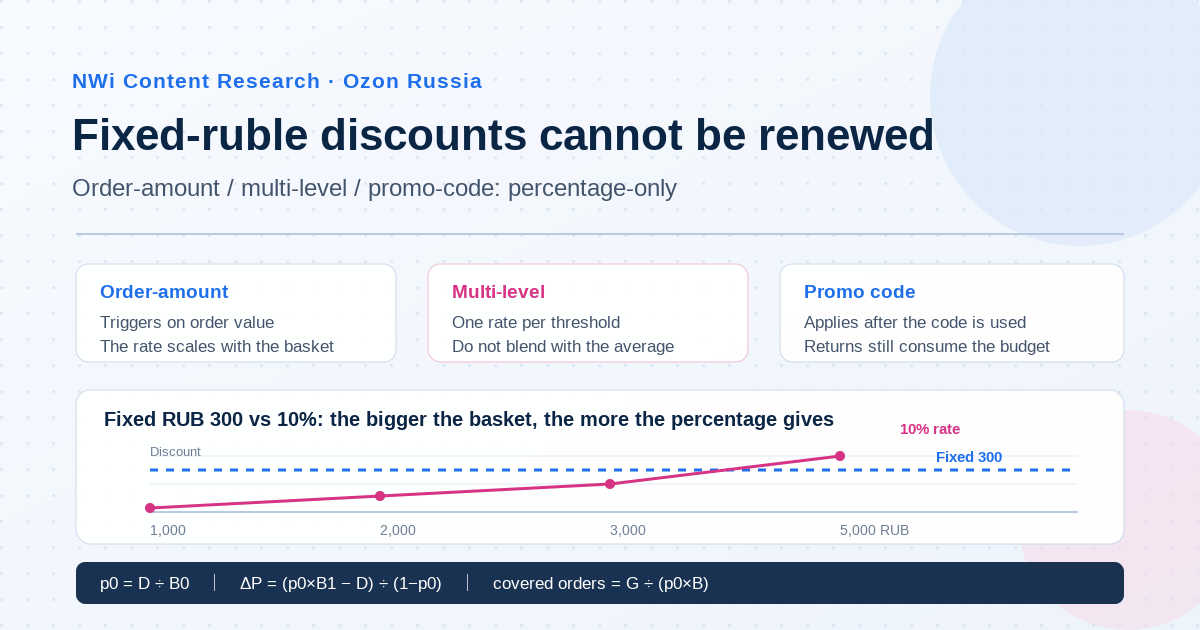
If you run order-amount, multi-level order-amount or promo-code campaigns on Ozon Russia with a fixed-ruble discount, you can no longer create a fixed amount or renew one. The real question is not whether to switch to a percentage, but which percentage replaces the old amount: one that keeps the offer attractive at the median basket without letting high-ticket and multi-unit baskets eat contribution. The answer is usually not one store-wide percentage. Set the rate from the basket distribution: protect the offer at the median, protect margin at the 90th percentile, and size the promo budget from the worst-case basket, not the average.
1. Decision problem: the percentage shifts who pays when the basket grows
A fixed-ruble discount is an absolute amount: when the basket grows from RUB 2,000 to RUB 3,000, the discount stays at RUB 300. A percentage discount is a ratio: the same 10% is RUB 200 on a RUB 2,000 basket and RUB 300 on a RUB 3,000 basket. The rule does not say the discount must become more expensive; it changes who pays for the extra discount when the basket grows.
So the decision is not whether to switch to a percentage, but which of three concrete choices to make: convert the old fixed amount at the median basket, cut the percentage so it holds at the 90th-percentile basket, or let the campaign expire. High-ticket single-unit, low-ticket multi-unit and promo-code structures need different answers.
For a seller with a fixed-ruble campaign that has not reached its end date, the urgent step is not to create a new campaign but to split the existing campaign by mechanic, SKU, end date and budget, then calculate the equivalent percentage for each basket tier.
2. Mechanism: all three mechanics are percentage-only, but they calculate on different bases
The change affects three seller-built mechanics: order-amount discount, multi-level order-amount discount and promo-code discount. Ozon's seller-education page states that from 16 November 2026 new campaigns can only use a percentage discount; existing fixed-ruble campaigns run to their end date under the old terms but cannot be renewed with a fixed amount.
The three mechanics share one change — the discount can no longer be fixed as a ruble amount — but they do not share the same calculation base: order-amount discounts trigger on the order value, multi-level discounts trigger on thresholds, and promo-code discounts apply to the order value after the code is used.
The budget mechanism needs separate treatment. The official page says the campaign stops when the budget is used up or exceeded; if a promo-code discount exceeds the remaining budget, the budget is overspent rather than the purchase being blocked at the budget line. If a promo-code order is returned, the discount amount is still deducted from the budget. In other words, the budget is a planning number, not a guarantee that spending will stop at that amount; the overrun depends on the last order that triggers it, and the seller account is the final reference.
There is one date difference to disclose: the official seller-education page says 16 November 2026; some Russian industry reports between 19 and 24 November say 19 November. Both dates precede this article and the rule is already in force; the article does not treat either day as an execution deadline, and the seller account is the reference for the actual options.
3. Evidence boundary: one official rule, one independent full text, one date difference
The article can check, point by point, Ozon's seller-education description of the three mechanics, the percentage-only rule, the no-renewal rule, the budget treatment and the return-budget rule; the direct page enters a redirect loop, so the body was read through the search index and was not re-read word for word from the direct page before publication.
The materials establish that the rule exists; they do not establish that a particular seller will earn less or more after switching to a percentage, because basket distribution, promo budget, return rate and conversion elasticity are not public.
The independent full text is SberBusiness Live's report of 24 November 2026: it confirms that the three mechanics are percentage-only, that existing campaigns run to their end date and that a fixed amount cannot be renewed; it does not provide seller-level promo performance, basket distribution or conversion data. Marketplacers' report of 19 November 2026 says 'from 19 November'; that is one source of the date difference retained here.
This is also why the article does not say 'Ozon raised prices' or 'Ozon cut discounts'. The rule changes how a discount is set; the same rate produces different absolute amounts on different baskets, and the direction depends on the seller's old fixed amount, basket distribution and subsequent pricing.
4. Reproducible maths: convert the fixed ruble amount, then check contribution
Let D be the old fixed discount in rubles and B0 the reference basket in rubles; the equivalent percentage is p0 = D ÷ B0. On the same basket, p0 × B0 = D, so the discount is unchanged. When the basket becomes B1, the percentage discount is p0 × B1, which is p0 × (B1 − B0) more than the old fixed amount.
Contribution can be written as: old contribution = B1 × m − D; new contribution = B1 × m − p0 × B1; difference = D − p0 × B1 = −p0 × (B1 − B0), where m is the contribution rate before discount. That difference is the extra discount the seller bears when the basket grows.
To hold contribution with a price increase, assuming the increase applies to the same basket and the percentage discount is calculated on the increased amount, the required increase is ΔP = [p0 × B1 − D] ÷ (1 − p0). As a share of the basket, that is ΔP ÷ B1. The formula assumes other costs, commission, logistics and returns are unchanged; in practice they belong in the SKU calculation.
Converting the fixed amount at the reference basket leaves the discount on that same basket unchanged; the incremental cost comes from rounding the percentage up to a marketing-friendly number, or from the basket growing.
The budget uses the same arithmetic. Let G be the budget, p the discount rate and B the average basket; the number of orders the budget can cover is about G ÷ (p × B). A 50% basket increase does not cut covered orders by 10%; it cuts them to about two-thirds. If the platform completes the last order after the budget line, the overrun depends on that order's discount, so the budget cannot be treated as a hard cap.
| Basket | Equivalent percentage of RUB 300 | Discount if the rate is 10% |
|---|---|---|
| RUB 1,000 | 30.0% | RUB 100 |
| RUB 2,000 | 15.0% | RUB 200 |
| RUB 3,000 | 10.0% | RUB 300 |
| RUB 5,000 | 6.0% | RUB 500 |
The table shows that the same fixed amount corresponds to very different percentages at different baskets; conversely, the same percentage corresponds to very different absolute discounts. The seller has to choose which basket's equivalent rate becomes the main rate, not look for one store-wide number.
5. Three scenarios: high-ticket, low-ticket multi-unit and a soft budget cap
All three scenarios are assumptions, not Ozon data, seller measurements or NWi client data. Every price, order count, contribution rate and budget can be replaced with your own.
Scenario A: RUB 15,000 high-ticket SKU, old fixed RUB 1,000, new rate 10% (assumption)
Assumptions: selling price RUB 15,000; old fixed discount RUB 1,000, equivalent to 6.67%; the seller sets the new discount at 10%; 500 orders a month; contribution before discount 20%, or RUB 3,000 per order; no returns, commission changes or budget overrun.
Calculation: old discount RUB 1,000; new discount 10% × 15,000 = RUB 1,500; RUB 500 more per order; RUB 250,000 more a month at 500 orders. The extra discount equals 500 ÷ 3,000 = 16.7% of contribution before discount. To hold contribution with a price increase under the 10% rate, ΔP = 500 ÷ (1 − 0.10) = RUB 555.56, or 3.70%.
Result: raising the equivalent 6.67% rate to 10% gives up RUB 500 per order and RUB 250,000 a month; holding contribution requires a price increase of about 3.70%, and because the 10% discount also applies to the higher price, this is larger than the 3.33 percentage-point gap between 6.67% and 10%.
Decision: if 10% is only a marketing round number, go back to 6.67% or 7%; if 10% is meant to buy traffic, first confirm that the contribution from incremental orders covers RUB 500 per order, otherwise do not apply 10% store-wide.
Scenario B: RUB 1,000 low-ticket SKU, old fixed RUB 300, basket grows to RUB 2,000 (assumption)
Assumptions: unit price RUB 1,000; old fixed discount RUB 300, equivalent to 30% of one unit; the buyer takes two units, so the basket is RUB 2,000; the new campaign keeps 30%; 1,000 orders a month; contribution before discount on the RUB 2,000 basket is 25%, or RUB 500; no returns or budget overrun.
Calculation: the old fixed discount is still RUB 300, or 15% of the RUB 2,000 basket; the new discount is 30% × 2,000 = RUB 600; RUB 300 more per order; RUB 300,000 more a month at 1,000 orders. The extra discount equals 300 ÷ 500 = 60% of the assumed contribution on the RUB 2,000 basket. To hold contribution with a price increase under the 30% rate, ΔP = 300 ÷ (1 − 0.30) = RUB 428.57, or 21.4% of the basket.
Result: the same 30% is RUB 300 on one unit and RUB 600 on a two-unit basket; RUB 300 more per order and RUB 300,000 more a month, equal to 60% of the assumed contribution.
Decision: for low-ticket multi-unit SKUs, set the cap from the 90th-percentile basket, for example 300 ÷ 2,000 = 15%, or exclude multi-unit bundles from the campaign; do not apply the single-unit equivalent rate directly to a multi-unit basket.
Scenario C: RUB 100,000 budget, 10% discount, basket rises from RUB 2,000 to RUB 3,000 (assumption)
Assumptions: promo budget RUB 100,000; discount rate 10%; average basket RUB 2,000; 500 orders a month; the basket later rises to RUB 3,000; the platform may complete the last order after the budget is exhausted, with the overrun equal to that order's discount; no returns.
Calculation: at a RUB 2,000 basket the discount is RUB 200 per order, and 100,000 ÷ 200 = 500 orders exhaust the budget exactly; at a RUB 3,000 basket the discount is RUB 300 per order, and 100,000 ÷ 300 = 333.33, so only 333 orders are fully covered, using RUB 99,900 and leaving RUB 100; if 500 orders still run, total discount is 500 × 300 = RUB 150,000, or RUB 50,000 over budget.
Result: a 50% basket increase cuts fully covered orders from 500 to 333; the same 500 orders produce RUB 150,000 of discount and a RUB 50,000 overrun, not a 10% overrun.
Decision: size the budget from the 90th-percentile basket, not the average; monitor burn daily, and if the account allows overrun, treat the budget as a planning number rather than a hard cap and cut the rate or the SKU list before the overrun.
Taken together: the high-ticket risk comes from rounding the equivalent rate up to a marketing number; the low-ticket multi-unit risk comes from the basket doubling; the budget risk comes from sizing on the average basket instead of the worst case. The common fix is to calculate the equivalent percentage at the 90th-percentile basket first, then decide whether to convert, cut or exit.
| Scenario | Basket | Old fixed discount | New rate | Extra per order | Extra per month | Share of contribution | Price increase to hold contribution |
|---|---|---|---|---|---|---|---|
| A high-ticket | RUB 15,000 | RUB 1,000 (6.67%) | 10% | RUB 500 | RUB 250,000 | 16.7% | RUB 555.56 (3.70%) |
| B low-ticket multi-unit | RUB 2,000 | RUB 300 (15%) | 30% | RUB 300 | RUB 300,000 | 60% | RUB 428.57 (21.4%) |
| Budget scenario | Discount per order | Orders fully covered | Total discount at 500 orders | Overrun |
|---|---|---|---|---|
| RUB 2,000 basket | RUB 200 | 500 | RUB 100,000 | RUB 0 |
| RUB 3,000 basket | RUB 300 | 333 (fully covered) | RUB 150,000 | RUB 50,000 |
6. Counter-cases and alternative explanations: not every SKU should convert
If the old fixed discount was already a small share of the basket and contribution is high enough, converting at the equivalent percentage leaves the discount on the same basket unchanged; the seller does not need to reprice or exit.
Counter-case two: for a high-ticket, low-elasticity SKU, exiting the campaign may be better than converting. A percentage discount amplifies the absolute amount on a high-ticket item; if traffic is insensitive to the discount, the discount saved may be worth more than the orders lost.
Counter-case three: a multi-level discount cannot be replaced by one blended rate. Each threshold has its own percentage and trigger; a single rate calculated from the average basket may make the top tier too deep or too shallow.
Counter-case four: the budget may not provide a backstop. The official page says the budget can be overspent and that returns still consume it; if the seller treats the budget as a hard cap, actual cash spending may be higher than planned.
Counter-case five: recreating a fixed amount through another mechanic is unreliable. Promo codes, coupons and other tools have their own rules; do not recreate a 'fixed ruble' campaign through a different entry point before confirming the options in the account.
Counter-case six: the platform may adjust the rules again. Keep the campaign list, the percentage equivalent at each threshold and the budget-consumption record; do not hard-code one conversion as a long-term policy.
7. Action list and stop conditions
Export every active campaign, split it by mechanic, discount type, end date, budget, SKU and threshold, then calculate the equivalent percentage at the median and 90th-percentile basket for every fixed-ruble campaign.
- 1. Export every active campaign: mechanic, discount type, end date, budget, SKU and threshold; mark which are fixed-ruble and which already use a percentage.
- 2. Use the last 90 days of orders to calculate the median basket B50 and the 90th-percentile basket B90; for multi-level campaigns, do this per threshold, not from the store-wide average.
- 3. For each fixed-ruble campaign, calculate p50 = D ÷ B50 and p90 = D ÷ B90; the wider the gap, the less suitable a single store-wide percentage is.
- 4. Decide: p50 protects the perceived offer, p90 protects margin; if p90 is below the minimum acceptable discount, let the campaign expire or narrow the SKU list.
- 5. Size the budget from p90 and B90: budget ÷ (p90 × B90) gives the covered orders; monitor burn daily instead of discovering the overrun at month-end.
- 6. Test one mechanic and one SKU group for 1–2 weeks, keeping an unchanged control group; compare contribution per order and order count, not the discount headline.
- 7. Stop conditions: contribution per order falls below the internal floor for two consecutive reviews; the discount exceeds the planned share of contribution; covered orders fall below plan after the basket grows; the platform rejects the equivalent rate or adds conditions; the test group shows no order lift while contribution falls.
- 8. Recalculate every two weeks: basket distribution, return rate, budget consumption and platform rules can all change; do not hard-code this conversion.
For market and brand research, NWi CrossborderGo lists Ozon Russia with sales, units, ASP and brand-share metrics (platform, site, fields and history subject to contract activation). Operations teams can use NWi Operations to put promotion, fulfilment and contribution margin back into the SKU. To run the conversion on your own SKU and basket distribution, use the demo request. These tools do not replace Ozon's seller back office, campaign settings, budget or settlement data, and do not guarantee promo results.
8. Limitations and unknowns
This article does not have seller-level basket distribution, promo conversion, return rate or budget-consumption data from Ozon; the prices, order counts, contribution rates and budgets in the three scenarios are assumptions, not Ozon, seller or NWi measurements.
- Ozon's seller-education page enters a redirect loop on direct access; the body was read through the search index and was not re-read word for word from the direct page before publication.
- The official page says 16 November 2026, while some independent reports say 19 November 2026; the date difference is unresolved, but the rule is in force.
- The budget-overrun and return-budget descriptions come from the official page; the account and mechanic should be checked in the seller back office.
- The three mechanics calculate on different bases; the generic formula cannot replace each mechanic's back-office rules.
- Commission, logistics, storage, returns, tax and exchange rates are excluded; actual contribution needs the seller's own cost table.
- Ozon is listed as the Russian site in NWi's public coverage, updated monthly and subject to contract; this article's calculations do not depend on NWi data and do not mean NWi provides Ozon back-office or real-time settlement access.
- The platform may publish later clarifications or category exceptions; check the seller-education page and the account before execution.
- No A/B test or live campaign change was run; the article cannot claim that conversion improves sales, profit or ranking.
9. Original analytical increment
The increment is to split a fixed amount into two equivalent rates — the median basket and the 90th-percentile basket — and to give three reproducible formulas for the extra discount as the basket grows, the price increase needed to hold contribution, and the number of orders the budget can cover.
A second increment is the distinction that converting at the reference basket leaves that basket's discount unchanged; the cost increase comes from rounding the percentage up to a marketing number or from the basket growing, not from the rule itself. That distinction prevents a blanket price increase across all SKUs.
A third increment treats the budget as a soft cap: a 50% basket increase cuts covered orders to about two-thirds, and 500 orders move the total discount from RUB 100,000 to RUB 150,000. That is closer to the seller's cash-flow problem than 'the rate went from X to Y'.
10. Conclusion
In one sentence: export the fixed-ruble campaigns, use the median basket to calculate the equivalent rate that preserves the offer and the 90th-percentile basket to calculate the cap that protects margin; convert at the equivalent rate where it holds, and where it cannot cover the worst-case basket, cut the rate, split the SKU or let the campaign expire. Do not use one store-wide percentage, and do not treat the budget as a hard cap.
11. Sources
- 1. Ozon Seller Education, 'Seller promotions: discounts and coupons' (official seller-education page; three mechanics, percentage-only rule, no renewal with a fixed amount, budget and return-budget treatment; page undated, rule effective 16 November 2026; accessed 26 November 2026): read the original
- 2. SberBusiness Live, 'Ozon sellers can set discounts in three mechanics only as percentages' (24 November 2026; independent full text: three mechanics percentage-only, existing campaigns to their end date, fixed amount cannot be renewed): read the original
- 3. Marketplacers, 'Ozon moves three seller promotions to percentage discounts' (19 November 2026; independent industry report: says 'from 19 November', used to record the date difference): read the original
12. Method and disclosure
Data basis: the three affected mechanics, the percentage-only requirement, the no-renewal rule for fixed-ruble campaigns, the promo-budget treatment and the return-budget rule come from Ozon's seller-education page on seller promotions, discounts and coupons, which states that the change applies from 16 November 2026. The direct page enters a redirect loop; the body was read through the search index during the 09:15 radar run and the core rule was re-checked against SberBusiness Live's full text of 24 November 2026. The date is reported as 19 November 2026 by some Russian industry outlets, including Marketplacers on 19 November 2026; both dates precede this article, and the article does not treat either as an execution deadline. Calculation basis: equivalent percentage p0 = D ÷ B0; discount at a different basket = p0 × B1; extra discount = p0 × (B1 − B0); price increase needed to hold contribution = [p0 × B1 − D] ÷ (1 − p0); fully covered orders = budget ÷ (p0 × B). All prices, order counts, contribution rates and budgets in the scenarios are labelled assumptions, not Ozon, seller or NWi measurements. NWi's public coverage lists the Russian site, updated monthly and subject to contract; this article's calculations do not depend on NWi data and do not represent access to Ozon's seller back office or real-time settlement.
This article was prepared with automated research assistance and analysed from the public sources listed at the end; it was not manually reviewed. It does not invent customer data, expert review, sales lift, ranking results or platform endorsement. It is not legal, tax, platform-operations or investment advice.