
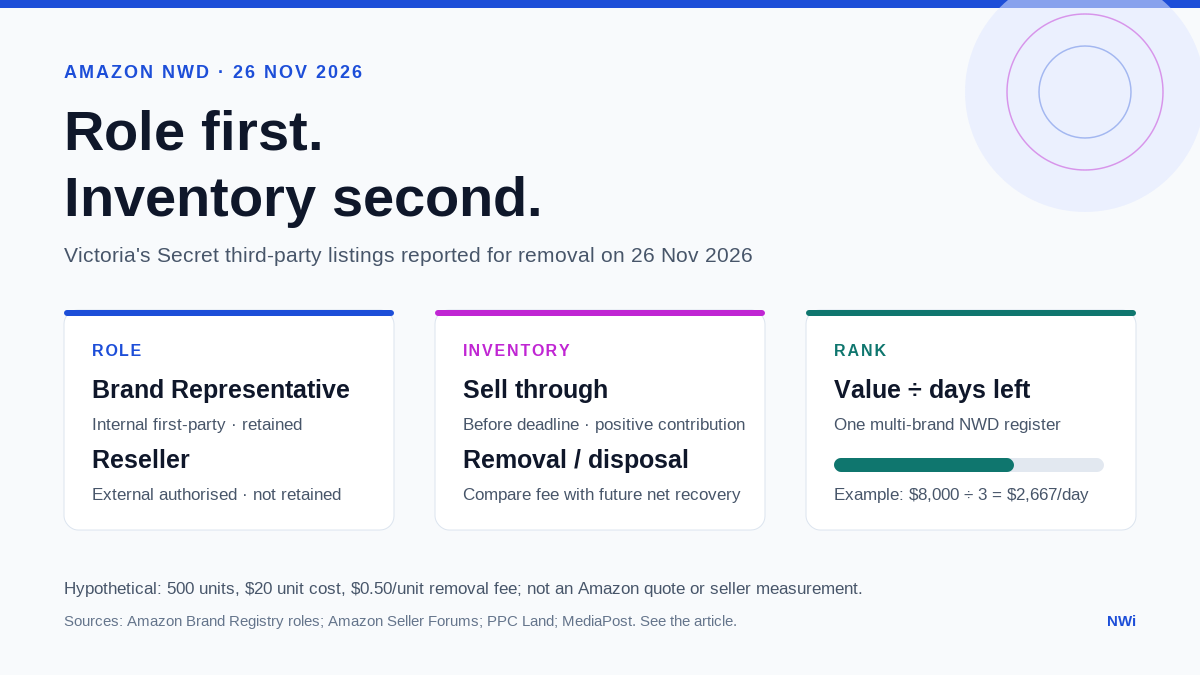
For a seller reselling Victoria's Secret on Amazon.com without the Brand Representative role, 26 November 2026 is not an ordinary brand-authorization email; it is a deadline for inventory and cash. PPC Land and MediaPost reported that an Amazon Services notice tells third-party sellers their Victoria's Secret listings will be removed on 26 November and that only Brand Representative accounts can keep selling. The notice is signed by Amazon Services and was made public on LinkedIn by ASGTG founder Ephraim Rosenberg; the notice itself was not opened directly in this run. The real decision is threefold: whether the role can become active before the removal, whether to sell through or file a removal order now, and whether other brands carry the same exposure. This article does not treat the media reports as an Amazon confirmation and does not turn an NWD removal into an account-health suspension; it separates the verifiable rule, the notice template and the hypothetical scenarios, and gives a reconciliation sheet that can be used today.
Separate the emotion from the action. For most resellers, the immediate consequence of an NWD removal is a delisted offer and an FBA inventory without a sales channel, not a suspended account; according to the notice quoted by PPC Land, these removals do not affect the Account Health Rating. The real problem is inventory and cash, not a reason to liquidate everything in a panic or open the same case repeatedly.
1. Separate three things: the brand notice, the NWD rule and the account consequence
First, the brand notice is account-level: it applies only to the seller, brand and marketplace that received it, so the Victoria's Secret date cannot be applied to every brand. Second, NWD is a general Amazon brand-distribution rule: an NWD brand sells only direct to consumers and does not supply wholesalers or resellers, and only the brand can create or update listings. Third, the account consequence and the inventory consequence are different: according to the notice quoted by PPC Land, an NWD removal does not affect the Account Health Rating; that does not mean there is no other risk, only that this type of removal is not counted in account health. What the seller actually has to manage is inventory, cash and role.
Mixing the three produces two common errors. One is to see 'Account Health is not affected' and do nothing, leaving FBA inventory to be removed or disposed of. The other is to see 'listings removed' and assume the account will be suspended, then liquidate in a hurry or open duplicate cases. Neither is right. First confirm whether the notice is in your own Seller Central, then confirm the role, then handle the inventory.
| What to confirm | Question it answers | What it does not prove |
|---|---|---|
| Brand notice | Which brand, marketplace, date and SKUs | That another brand or marketplace has the same removal date |
| General NWD rule | Why only the brand can create or update listings | That every NWD notice follows the same timetable |
| Account Health | Whether this removal counts against account health | That inventory, cash or advertising has no loss |
| Brand Registry role | Whether the exact selling account can keep selling | That an authorized distributor or Administrator is automatically a Brand Representative |
2. Mechanism: Brand Representative is not another name for Reseller
Amazon's guide 'What are Brand Registry roles?' divides selling roles into two: Brand Representative is for internal, first-party sellers directly employed by the brand; Reseller is for external, third-party sellers authorized by the brand to sell on Amazon. A selling account can hold only one of the two selling roles. Amazon's public description does not treat them as interchangeable.
That is the crux of the Victoria's Secret notice. The notice quoted by PPC Land keeps only the 'Brand Representative role for Victoria's Secret'; it does not mention Reseller. In a public Amazon Seller Forums thread from October 2026, a seller-shared Selling Partner Support reply is more direct: holding the Authorized Reseller role is not sufficient to bypass the NWD restriction, only Brand Representative is exempt, and a role assignment can take up to 48 hours to reflect. That reply is a seller's account of a support response, not Amazon's published policy, but it is consistent with the Brand Registry role definitions and is a reasonable operational assumption.
So 'I am an authorized distributor', 'I have a brand authorization letter' and 'I am the Brand Registry Administrator' do not equal 'my selling account has the Brand Representative role'. Check three fields: the brand, the marketplace and the exact selling account. Do not rely on the login email or the Brand Registry home page alone.
| Identity or role | Selling status under the notice | What to do now |
|---|---|---|
| Brand Representative (that brand, marketplace and selling account) | Explicitly retained by the notice | Confirm the role is active under Brand Benefit Eligibility; keep a screenshot |
| Reseller / Authorized Reseller | Not retained; the support reply says it is insufficient | Do not assume you can keep selling; contact the Brand Administrator or prepare removal or clearance |
| Administrator / Rights Owner (protection roles only) | A protection role is not a selling role | Check whether a selling role exists; if not, treat the account as a Reseller |
| No role or not enrolled | Outside the retained group | Stop replenishment; handle inventory; do not send new FBA stock |
3. Timeline: 48-hour role activation inside a three-day public window
PPC Land published the report on 23 November 2026, and the notice sets the removal date as 26 November; the notice itself does not show a send date. That leaves three calendar days from the public report to the removal. If a seller requested Brand Representative on 24 November, the 48-hour activation window would run into 26 November with almost no buffer. Amazon has not published the exact time the removal job runs, and the notice gives a date, not an hour.
This does not mean every seller had only three days. The notice may have been sent to some accounts earlier, and the general 15-day notice window may apply to other brands; but the Victoria's Secret notice's send date is not public, so a seller cannot assume it has 15 days. Operate on 'complete the role check and the inventory decision today', not on 'there are two weeks left'.
The time zone also needs to be explicit: 26 November is the US date for Amazon.com; for sellers in Asia, Beijing time enters that date on the afternoon of 26 November, and the exact execution time is not disclosed. Do not schedule a removal order around a vague 'tonight' or 'tomorrow morning'.
Scenario B: Brand Representative requested on 24 November, removal on 26 November (hypothetical).
Assume the seller is an internal first-party account, the Brand Administrator assigns the Brand Representative role on 24 November 2026, Amazon support says the role can take up to 48 hours to reflect, the removal date is 26 November, and the notice's send date is not public.
Calculation: 24 November + 48 hours = 26 November; the public report on 23 November left three calendar days to the 26 November removal; the 48-hour activation consumes two of them and leaves one day of buffer; if the removal job runs on 26 November, the role may not yet be active.
Result: a last-day role request is not a reliable cure; the role may become active only after the removal starts, and the listings can still be removed.
Decision: confirm today whether the role is active; if it is not, file the removal order and contact both the Brand Administrator and Seller Support in parallel instead of waiting for the assignment.
4. Inventory: sell-through, removal order or disposal — identify the sunk cost first
The most easily missed part of the notice is the FBA inventory. The October 2026 notice template on Amazon Seller Forums says the seller can 'sell your remaining inventory' and 'create a removal order for unsold inventory' before the deadline, and warns that 'Any FBA inventory without a removal order filed before [date] will be disposed of at your cost'. But the Victoria's Secret notice quoted by PPC Land lists only 'sell your remaining inventory' and 'delete your Victoria's Secret SKUs without any inventory'; it does not mention removal orders and does not say FBA inventory will be disposed of. That gap is the biggest operational unknown in this event: do not assume a removal-order window, and do not assume disposal either; rely on the notice in your own account and the removal page in Seller Central.
Second, product cost is sunk. At 500 units and a $20 unit cost, the book inventory cost is $10,000; if half sells before the deadline, 250 units remain and the book cost is $5,000. That $5,000 does not disappear through removal or disposal; it has already been incurred. The decision is about the forward cash flow: a removal order at an assumed $0.50 per unit costs $125 for 250 units; disposal has an assumed zero recovery; if the seller keeps discounting, the unit contribution is the discounted price minus product cost, platform fee and fulfillment fee. Treating the '$5,000 disposal loss' as avoidable overstates the value of the removal order; the real comparison is the removal fee plus future net resale recovery versus the discount contribution available now.
Scenario A: 500 units, $20 cost, 50% sold before the deadline (hypothetical).
Assume 500 FBA units, $20 unit cost, 250 units sold before the deadline and 250 units left; a removal-order fee of $0.50 per unit; zero recovery from disposal; if the residual is discounted, a $28 price and $3 contribution per unit; storage, disposal fees and capital cost excluded.
Calculation: remaining book cost = 250 × $20 = $5,000; removal-order cost = 250 × $0.50 = $125; if all 250 units sell at $28, discount contribution = 250 × $3 = $750; if only 125 units sell, contribution = $375 and the other 125 units cost $62.50 to remove, for a net recovery of $312.50 before the sunk product cost.
Result: a $125 removal order preserves 250 units, but whether it is worth it depends on future net resale recovery; selling all 250 at a discount yields $750 of contribution, although the deadline may not allow it. Zero recovery from disposal does not mean the $5,000 book loss can be avoided by the removal order.
Decision: file the removal order if future net resale recovery exceeds the removal fee and handling cost; prefer the discount if it can clear the units before the deadline at a positive unit contribution; do not clear stock at a negative contribution merely to avoid disposal.
One more variable is often missed: a removal order is neither free nor unlimited. It has a per-unit handling fee, a carrier charge and a lead time; high-value, small-volume SKUs are better candidates for removal, while low-value, bulky SKUs may be better cleared or disposed of locally. The $0.50 per unit is only a reproducible assumption; the actual quote must be checked in Seller Central's removal page by size, weight and destination.
| Disposition path | Cost paid now | What comes back | When it fits |
|---|---|---|---|
| Sell through before the deadline | Discount, advertising, handling | Discounted contribution | Listing still live, positive unit contribution, can clear before the deadline |
| Removal order | Per-unit removal fee + carrier charge | Physical inventory and a future resale option | Future net recovery exceeds the removal fee; the notice or Seller Central allows a removal order |
| Disposal | Disposal fee, if any | Almost no recovery | Low value, bulky, future net recovery below the removal fee |
| Delete empty SKUs | Staff time | Listing cleanup, no inventory handling | No FBA inventory, or the inventory is handled separately |
5. Multi-brand exposure: put 20 brands into one risk table
Victoria's Secret is not the only NWD brand. In October 2026, sellers on Amazon Seller Forums reported receiving similar notices, and some brand owners also received notices in error; Amazon support told at least one seller that the notice had been sent in error. This does not mean the Victoria's Secret notice is also an error, and it does not mean every recipient is an unauthorized reseller. It means one thing: NWD notices repeat, and a seller needs a cross-brand table rather than reacting to each email separately.
Assume a seller carries 20 brands, 3 of which are NWD or under a notice: inventory values of $8,000, $3,000 and $1,000, with 3, 15 and 15 days to removal. Total exposure is $12,000, and the largest brand is 66.7% of it. Ranking by 'inventory value ÷ days remaining' gives $2,667, $200 and $67 per day; the largest brand is both the biggest amount and the tightest deadline, so it should be handled first.
Scenario C: 20 brands, 3 NWD, $12,000 total exposure (hypothetical).
Assume 20 active brands, 3 of them NWD or under a removal notice; FBA inventory values of $8,000, $3,000 and $1,000; 3, 15 and 15 days to removal; one operations owner; removal and discount quotes not yet obtained.
Calculation: total exposure = $8,000 + $3,000 + $1,000 = $12,000; the largest brand is $8,000 ÷ $12,000 = 66.7%; risk rank = inventory value ÷ days remaining = $2,667, $200 and $67 per day; handling only the largest brand covers 66.7% of the exposure.
Result: exposure is concentrated in one brand, and both value ranking and value-per-day ranking point to the same brand; the other two can wait, but they cannot drop off the monitor.
Decision: file the removal order or clear stock first for the $8,000 brand with the 3-day window; create five fields for all three brands (role, notice date, removal date, inventory value, owner); stop replenishment for every NWD brand.
The table is not a forecast of the next brand; it turns 'I received an email' into 'a ranked exposure'. Add one row for every new NWD brand, review it weekly, and do not wait until the deadline to count inventory.
6. Counter-cases and alternative explanations: when no action is needed
- You hold the active Brand Representative role for that brand, marketplace and selling account: the notice explicitly keeps you, so you do not need a removal order for that brand; verify the role and keep the record.
- You have no Victoria's Secret inventory: no removal order is needed; stop replenishment and advertising and monitor.
- You hold only a Reseller or Authorized Reseller role: do not assume you can keep selling; the support reply says Reseller is insufficient, so treat the account as not retained.
- The notice is an error: some brand owners received erroneous notices in October 2026; if you are confident the role is correct, open a case and preserve the evidence instead of emptying the inventory because of one email.
- The removal order costs more than the inventory's future net recovery: compare disposal, clearance and removal; do not file a removal order blindly.
- The notice applies only to Amazon.com in the US: do not apply it to other marketplaces or other brands; the notice does not say whether other marketplaces have a similar restriction.
- Account Health is not affected: this type of removal does not count against the Account Health Rating; the real risk is inventory and cash, not suspension.
- The removal may be delayed or reversed: do not destroy valuable inventory because of one media report; rely on the notice in your own account.
7. Action list and stop conditions
Split the actions into today, this week and every month. Today, take a snapshot of the role and the inventory; this week, handle the most urgent brand; every month, recheck the NWD status of every brand.
- Today: find the notice in Seller Central's Manage Products, Account Health and Brand Registry; record the brand, marketplace, notice date, removal date, ASINs and FBA units on hand.
- Today: check the exact selling account's role under Brand Registry > Manage selling roles / Brand Benefit Eligibility; save a screenshot; do not rely on the login email alone.
- Today: if the role is missing and you are part of the brand, ask the Brand Administrator to assign Brand Representative immediately; allow up to 48 hours for activation and do not assume it is active the same day.
- Today: if the role cannot become active before the removal, open Seller Central's removal-order page and get a quote by size, weight and destination; file a removal order for inventory that cannot be sold at a positive contribution before the deadline.
- Today: stop replenishment for the affected brand and pause related advertising; do not send new FBA stock; do not clear stock at a negative contribution.
- This week: build an NWD register for every active brand: brand, role, inventory value, notice date, removal date and owner; rank by 'inventory value ÷ days remaining'.
- This week: keep screenshots, case IDs, removal-order numbers and tracking numbers for delisted offers; if the notice is an error, submit the evidence through Seller Support.
- Every month: recheck roles, inventory and platform rules; when a new notice arrives, update the table before deciding on an action.
The stop conditions should be equally specific. If the role is active, there is no inventory, the removal order costs more than future net recovery, the notice is not in your account, the notice is an error or the brand genuinely sells through resellers, the removal date has passed, or the platform rule cannot be read, stop the current action and verify before continuing.
- The role is active: no removal action is needed for that brand; confirm and stop.
- There is no inventory: stop replenishment and advertising; do not file a removal order.
- The removal order costs more than future net recovery: compare disposal and clearance; do not file.
- The notice is not in your own account: do not act on a screenshot; confirm with Seller Support first.
- The notice is an error or the brand genuinely sells through resellers: submit evidence and wait for review; do not empty the inventory automatically.
- The removal date has passed: escalate to Seller Support and stop further shipments; do not promise a restoration date in public.
- The platform rule cannot be read: publish the method only; do not give a definitive legal conclusion.
8. Evidence boundary and unknowns
The evidence has three layers. The first is Amazon's public role definition: Brand Representative is internal first-party, Reseller is external authorized third-party; this is primary and can be quoted directly. The second is the public Amazon Seller Forums thread: it contains the October 2026 NWD notice template, the removal-order and disposal warning, and a seller-shared support reply (48-hour activation, Reseller insufficient); this is platform-hosted user content, not Amazon policy text, and is only an operational lead. The third is media: PPC Land quoted the Victoria's Secret notice in full on 23 November 2026, and MediaPost reported the removal date and the authorized-seller scope on 24 November; both rely on the same notice published on LinkedIn, so they are not two independent confirmations.
The Victoria's Secret notice itself was not opened directly in this run; the Amazon NWD help page returned only a login shell; MediaPost returned HTTP 403 and its full text was read through a search index. Therefore, the article writes 'Victoria's Secret removal on 26 November' as 'reported by PPC Land and MediaPost', not as an Amazon confirmation; and writes 'does not affect Account Health' as a quotation from the notice, not as a platform-wide promise for every NWD removal.
- The notice's send date is not public, so the actual notice period for each seller cannot be determined.
- The number of affected sellers and listings, the inventory value, the disposal cost and the advertising impact are not public.
- The notice names only Brand Representative; it does not say whether a Reseller account can be retained through another path.
- The notice does not say whether removal orders apply to this Victoria's Secret inventory; rely on the notice in your own account.
- The $0.50 per-unit removal fee, $20 cost, $28 discounted price and $3 contribution are assumptions, not Amazon quotes or seller measurements.
- The article does not cover the specific terms of other marketplaces, other brands or other NWD notices.
- The article is not legal, tax or platform-operations advice.
9. Original analytical contribution
The first increment is to separate the brand notice from the NWD rule: the notice is account-level, the rule is platform-level; applying the Victoria's Secret date to every brand creates unnecessary clearance.
The second increment is to put the role before the inventory: Brand Representative and Reseller are not interchangeable labels; a 48-hour activation means a last-day request is usually too late, so verify the role before deciding whether to file a removal order.
The third increment is the gap between the October template and the Victoria's Secret notice: the October template includes removal orders and a disposal warning, while the Victoria's Secret notice lists only sell-through and deletion; that gap cannot be filled with an assumption and must be resolved from the notice in your own account.
The fourth increment is to treat product cost as sunk and compare 'removal fee + future net recovery' with 'discount contribution now', rather than using a '$5,000 disposal loss' to frighten yourself; that is how to avoid making a worse cash decision to dodge a book loss.
The fifth increment is cross-brand risk ranking: use 'inventory value ÷ days remaining' to put multiple NWD notices into one table, instead of handling only the loudest email.
10. Conclusion
In one sentence: the Victoria's Secret NWD removal is an inventory and role deadline, not an account-health suspension. Confirm your own notice and role first, then decide whether to sell through, remove or dispose; if you do not have Brand Representative, do not assume Reseller is enough; if you have no inventory, do not file a removal order; if you have several NWD brands, rank them by 'inventory value ÷ days remaining'. The media reports provide the event, Amazon's role definition and the notice template provide the mechanism, and the actual decision must be recalculated with your own inventory, costs and quotes.
If you want to put brand, store and product data back into this decision, use [NWi CrossborderGo](/product/) to review marketplace, category and brand/store/product data (the platforms, sites and fields depend on your account); the operations team can use [NWi Operations](/products/zhiying/) to put inventory, cost and discounts back into an SKU model; if brand authorization, market entry and competition need to be examined together, see [NWi Cross-border Agent](/page/agent.html); if your own orders, inventory and role data need to enter the research workflow, see [MCP data access](/mcp/) (the integration scope depends on the actual connection); and to model NWD exposure against your own brands and inventory, go to [Request a demo](/demo/). These tools do not replace the notice in Seller Central, the Brand Registry role or the removal-order quote.
11. Sources
- 1. Amazon, 'What are Brand Registry roles?' (23 April 2025; primary: Brand Representative and Reseller definitions, one selling role per account): Read the guide
- 2. Amazon Seller Forums, 'Brand owner blocked from selling own brand' (12 October 2026; platform-hosted public thread: October 2026 NWD notice template, removal-order and disposal wording, seller-shared 48-hour activation and Reseller-insufficient support reply): Read the thread
- 3. PPC Land, 'Amazon blocks third-party Victoria's Secret sellers from November 26' (23 November 2026; independent media, full text read directly: quotation of the Victoria's Secret notice, removal date, Brand Representative-only scope, no removal orders and no FBA inventory statement): Read the article
- 4. MediaPost, 'Amazon To Pull Unauthorized Victoria's Secret Listings On Thanksgiving' (24 November 2026; independent media, direct page returned HTTP 403 and the full text was read through a search index: removal date, authorized sellers continue, advertising impact): Read the article
- 5. Amazon Seller Central Help, 'Resolve No Wholesale Distribution (NWD) errors 5465 and 6045' (the help page referenced by the notice; this round returned only a login shell and was not used as a source of facts, only to identify the page): View the page
12. Method and disclosure
Data basis: the Victoria's Secret removal date, the Brand Representative-only scope, the absence of removal orders in the notice and the silence on FBA inventory come from PPC Land's full quotation of the Amazon Services notice on 23 November 2026. MediaPost's 24 November 2026 report is used to check the removal date and the authorized-seller scope; its direct page returned HTTP 403 and the full text was read through a search index. The Brand Representative and Reseller definitions come from Amazon's Sell on Amazon guide 'What are Brand Registry roles?' dated 23 April 2025. The October NWD notice template, the removal-order and disposal wording, the 48-hour role activation and the statement that a Reseller role is insufficient come from a public Amazon Seller Forums thread dated 12 October 2026; the thread contains a seller-posted notice and a seller-shared support reply, not Amazon policy text. The Amazon NWD help page returned only a login shell this round and was not used as a source of facts. Calculation basis: inventory exposure = units on hand × unit cost; removal-order cost = units × per-unit removal fee; discount contribution = discounted price − product cost − platform fee − fulfillment fee; risk rank = inventory value ÷ days remaining. All unit counts, costs, fees, discounts and days are explicitly labeled assumptions, not Amazon, seller or NWi measurements.
This article was prepared with automated research assistance from the public sources listed at the end. It was not reviewed by a human editor, and it does not invent client data, expert review, sales lifts, ranking results or platform endorsements. It is not legal, tax, platform-operations or investment advice.