
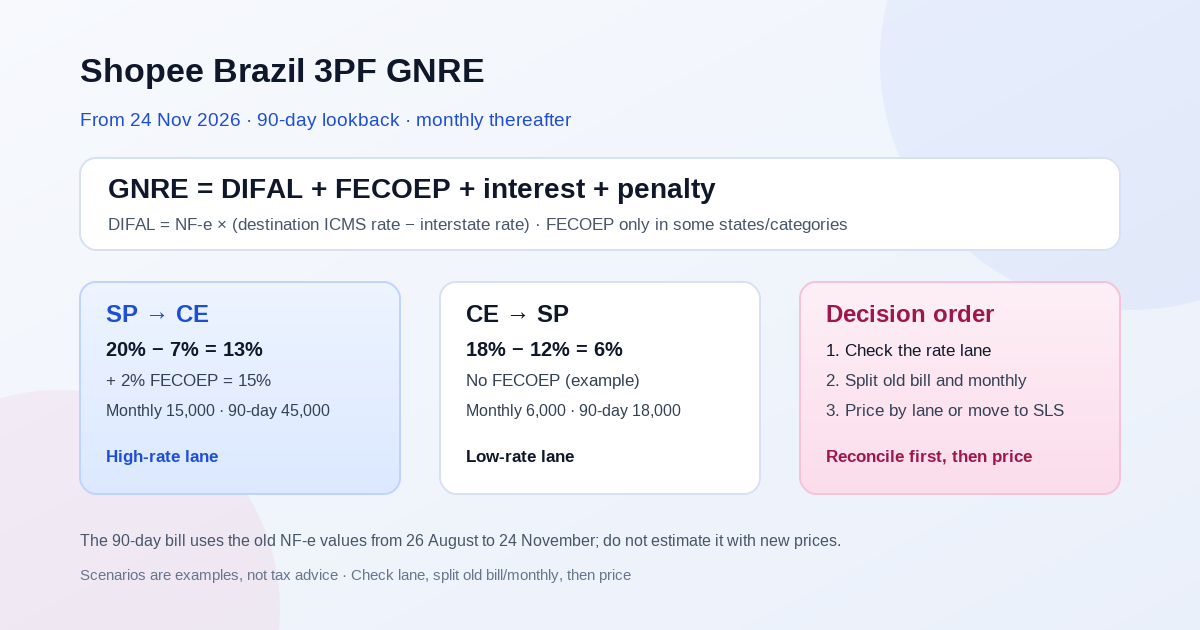
A Shopee Brazil seller using a local third-party warehouse (3PF) opens the late-November statement and finds a GNRE charge deducted as a manual adjustment. It covers cross-state orders completed from 26 August to 24 November 2026; after that, the charge returns in the last week of each month. The decision is not whether the tax is high. It is whether to reconcile the rate lane on the bill, separate the retroactive cash hit from the ongoing monthly cost, and then choose which SKUs to absorb, reprice by lane, or move to cross-border direct mail (SLS) or a same-state warehouse — and when a 10-working-day objection is the right move. This article works through three scenarios: São Paulo to the Northeast, the Northeast to São Paulo, and a mixed-lane seller. All invoice values, contributions, rate assumptions and months are explicitly labelled examples; the effective date, 90-day lookback, formula and 10-working-day window come from Shopee's public notice. This is not tax, legal or financial advice.
1. This is not a new tax: Shopee is recovering GNRE it advanced
Shopee's notice of 17 November 2026, 'Collection of GNRE amounts from third-party-warehouse sellers on Shopee Brazil', explains that when goods are sold across Brazilian states, the difference between state ICMS rates is DIFAL, settled through a GNRE payment to the destination state. To keep orders fulfilled, Shopee had advanced the amount for Brazil 3PF sellers. From 24 November 2026 local time, the platform recovers it through 'Platform Payments > Bills > Manual Adjustment'.
Collection has two stages. Historical orders: completed orders within the 90 days before 24 November 2026, i.e. 26 August to 24 November 2026, are expected to be collected in one manual adjustment at the end of November. Future orders: orders completed from 24 November 2026 are collected monthly in the last week of each month. The 'end of November' and 'last week of each month' are platform settlement windows, not the tax payment due date; do not conflate them.
The formula is: GNRE = DIFAL + FECOEP (where the destination state applies it) + interest (if overdue) + penalty (if overdue). DIFAL = NF-e invoice amount × (destination state ICMS rate − interstate rate); FECOEP = invoice amount × FECOEP rate; interest = (DIFAL + FECOEP) × (SELIC rate / 365) × overdue days; penalty = (DIFAL + FECOEP) × penalty rate. The notice's common ranges are: destination ICMS 17%–20%, FECOEP 0%–2%, penalty 10%–75%. DIFAL is normally due when the NF-e is issued, and the state finance department usually gives a 24-hour payment window.
Scope matters: only Brazil sellers shipping from a local third-party warehouse (3PF) are affected; cross-border direct mail (SLS) sellers are not affected by this adjustment; same-state shipments do not require GNRE; whether a sale is interstate is determined by the Brazilian tax authority. The notice also says there is no refund if the destination rate is lower, because the interstate rate is always lower than the state internal rate. Objections to a specific bill must be raised with Shopee customer service or the account manager within 10 working days of receiving the adjustment notice.
2. First, identify the interstate rate lane
The key variable is not the invoice value but the origin-to-destination interstate rate lane. Senate Resolution 22/1989 sets the general interstate ICMS rate at 12%. Operations from the South/Southeast (São Paulo, Rio de Janeiro, Minas Gerais, Paraná, Santa Catarina, Rio Grande do Sul, excluding Espírito Santo) to the North, Northeast, Center-West or Espírito Santo use 7%. The reverse, from the North/Northeast/Center-West or Espírito Santo to any state, uses 12%. So São Paulo to Ceará is 7%, Ceará to São Paulo is 12%, and São Paulo to Rio de Janeiro is 12%.
The notice's rate paragraph and its own example do not agree. The paragraph says '12% when the origin state is in the South/Southeast, or 7% when it is in the North/Northeast/Center', but the example uses Minas Gerais (MG, Southeast) to Ceará (CE, Northeast) at 7%, with Ceará's internal rate at 20%, DIFAL at 20% − 7% = 13%, and an NF-e of BRL 219.33 producing BRL 28.51 of DIFAL. The example matches the Senate resolution; the parenthetical order is reversed. Use the lane rate printed on your NF-e; if the bill applies the wrong lane, keep the invoice and the statement and object within 10 working days.
One rule the notice does not expand can change the result: Senate Resolution 13/2012 applies a 4% interstate rate to qualifying imported goods (for example, goods not subjected to industrialization, or goods with more than 40% import content, subject to the FCI/CCI and exception list). If the 3PF stock falls into that category, DIFAL is 'destination rate − 4%', not '− 7%/12%', and the result is higher. The notice lists only 12%/7%, so the scenarios here assume the goods do not qualify for the 4% rule; if yours do, recalculate with 4%.
| Lane | Interstate rate | Example: DIFAL at a 20% destination | When it applies |
|---|---|---|---|
| South/Southeast → North/Northeast/Center-West/ES | 7% | 20% − 7% = 13% | São Paulo→Ceará, Minas Gerais→Ceará, etc. |
| North/Northeast/Center-West/ES → any state | 12% | 20% − 12% = 8% | Ceará→São Paulo, etc. |
| South/Southeast (excl. ES) ↔ South/Southeast (excl. ES) | 12% | 20% − 12% = 8% | São Paulo→Rio de Janeiro, etc. |
| Imported goods (Resolution 13/2012) | 4% | 20% − 4% = 16% | Subject to FCI/CCI and the exception list |
| Same state | Not applicable | 0 | No GNRE |
3. Evidence boundary: what the notice says and does not say
This is a platform billing notice, not tax law, and not a tax determination for a particular seller. It gives the effective date, 90-day lookback, two-stage collection, formula, 3PF/SLS scope, same-state exclusion, no-refund rule and 10-working-day objection window. It does not give the seller's order mix, actual state rates, FECOEP category list, Simples Nacional/ICMS-ST/tax-credit treatment, or a sample bill. This article can estimate 'what the public formula implies'; it cannot determine 'what the tax authority will finally assess' for a particular seller.
The only readable primary source for the event itself is the Shopee China Seller Education Hub notice. 360KJT's English full-text summary of 20 November 2026 cites the same notice and helps check the dates and formula, but it is not an independent second measurement. Senate Resolutions 22/1989 and 13/2012 are independent primary law for the rate method and support the 7%/12%/4% lane test, but they do not prove which lane Shopee applied to a particular seller's bill. Together they support the mechanism analysis; they are not two independent confirmations of the same deduction.
Shopee Brazil's seller help page 'Cobrança de DIFAL', dated 23 February 2026, is explicit: the seller is legally responsible for DIFAL; Shopee does not automatically collect DIFAL on platform sales; an adjustment is passed back through the wallet only when goods are retained or inspected at a state fiscal barrier, when the state requires DIFAL payment to release transport, or when Shopee pays the tax to avoid blocking or delay in delivery. The new notice can be read as the third case at scale: the platform advanced the amount and is now recovering it for 3PF sellers. Reading it as 'Shopee now automatically collects DIFAL on every order' overstates it; reading it as 'this money needs no attention' misses it.
The same help page also addresses Simples Nacional: it states that Liminar 5464 (ADI 5464) excluded DIFAL under that tax regime, and that a Simples Nacional taxpayer who sees a DIFAL wallet deduction should ask the state finance department (SEFAZ) to reverse the charge. The new notice does not carve out Simples Nacional, which makes this a stop condition to confirm before paying, not a detail to assume away.
The notice's formula is also simplified. It does not cover ICMS-ST, tax credits, state-specific bases (single base, double base or tax-inside-base), the FECOEP category list, the SELIC reference date for overdue interest, or how a 3PL contract allocates the tax. A Brazilian tax accountant or adviser should confirm all of these against the seller's actual invoices. The stance here is 'reconcile, then price, then decide whether to move SKUs', not 'apply one national average rate'.
4. Scenario A: São Paulo to the Northeast, a 15% lane with FECOEP
Scenario A: São Paulo to Ceará with 2% FECOEP
Assumptions: monthly cross-state NF-e value BRL 100,000, all shipped from São Paulo (Southeast) to end consumers in Ceará (Northeast); Ceará's internal ICMS rate 20% (the notice's example); interstate rate 7% (South/Southeast to Northeast); the product is in a Ceará FECOEP-covered category and FECOEP is 2%; the 90-day lookback is three months of the same mix; contribution margin 10%, or BRL 10,000 per month. These values, category, contribution and three-month assumption are examples, not seller measurements or a tax ruling.
DIFAL rate = 20% − 7% = 13%; GNRE rate = 13% + 2% = 15%; monthly GNRE = 100,000 × 15% = BRL 15,000; 90-day bill = 15,000 × 3 = BRL 45,000. The old bill equals 4.5 months of contribution (45,000 / 10,000 = 450%); the ongoing monthly cost equals 1.5 months of contribution (15,000 / 10,000 = 150%). If FECOEP does not apply, monthly GNRE is BRL 13,000 and the 90-day bill is BRL 39,000, or 3.9 months of contribution.
To pass the ongoing GNRE fully into price, a 15% increase is not enough: GNRE is calculated on the higher NF-e value, so the increase is taxed too. Let the price increase be x; set P × x = P × (1 + x) × 15%, which gives x = 15% / 85% = 17.65%. A simple 15% increase covers only part of it; a 17.65% tax-inclusive gross-up makes the new price's GNRE exactly equal to the added revenue. This assumes no demand loss and no other taxes; if demand is elastic, 17.65% may not be viable.
Decision: treat the BRL 45,000 old bill as a one-off cash event and reserve cash or a temporary surcharge for it; test the ongoing cost at a 17.65% tax-inclusive increase, not 15%. If 17.65% would significantly reduce conversion, move the lowest-contribution SKUs to SLS or a same-state warehouse rather than raising every SKU. Do not estimate the old bill with the new prices; it corresponds to the old NF-e values from 26 August to 24 November.
5. Scenario B: the Northeast to São Paulo, a 6% lane
Scenario B: Ceará to São Paulo without FECOEP
Assumptions: monthly cross-state NF-e value also BRL 100,000, all shipped from Ceará (Northeast) to São Paulo (Southeast); destination São Paulo internal ICMS rate 18% (an illustrative assumption; the notice gives only the 17%–20% range); interstate rate 12% (North/Northeast/Center-West to any state); FECOEP does not apply in this scenario; three months for the 90-day lookback; contribution margin 20%, or BRL 20,000 per month. These rates, values, contribution and three-month assumption are examples.
DIFAL rate = 18% − 12% = 6%; monthly GNRE = 100,000 × 6% = BRL 6,000; 90-day bill = BRL 18,000. The old bill equals 0.9 months of contribution (18,000 / 20,000 = 90%); the ongoing monthly cost equals 30% of monthly contribution (6,000 / 20,000 = 30%). The tax-inclusive gross-up is 6% / 94% = 6.38%.
Decision: on the same BRL 100,000 monthly value, this lane's old bill is only 40% of Scenario A's (18,000 / 45,000), and the ongoing cost is only 40% (6,000 / 15,000). Split orders by lane before repricing; do not apply Scenario A's 17.65% here, and do not blend the two lanes into a national average. If 6.38% does not hurt conversion, use the 6.38% tax-inclusive increase; if it does, keep this lane and focus resources on the high-rate lane's SKUs.
6. Scenario C: mixed lanes — why a single price increase is not enough
Scenario C: 60% São Paulo→Northeast (15%) + 40% São Paulo→Southeast (6%)
Assumptions: monthly cross-state NF-e value BRL 100,000; 60% shipped from São Paulo to the Northeast (Scenario A's 15% lane with 2% FECOEP); 40% shipped from São Paulo to another Southeast state (destination 18%, interstate 12%, no FECOEP, DIFAL 6%); contribution margin 12%, or BRL 12,000 per month; three months for the 90-day lookback; no demand change or other taxes. These structure, rates and contribution are examples.
Weighted GNRE rate = 60% × 15% + 40% × 6% = 9% + 2.4% = 11.4%; monthly GNRE = 100,000 × 11.4% = BRL 11,400; 90-day bill = BRL 34,200. A uniform 10% increase adds BRL 10,000 of revenue; the new GNRE would be 110,000 × 11.4% = BRL 12,540. The added revenue covers the added GNRE (BRL 1,140) with room to spare, but it does not pass through the entire GNRE. To pass the entire GNRE through tax-inclusively, the uniform increase would be 11.4% / 88.6% = 12.87%; but that uniform line overprices the 6% lane and underprices the 15% lane. Lane-specific gross-ups — 17.65% on the 15% lane and 6.38% on the 6% lane — align each lane's GNRE with its added revenue.
Decision: use the weighted rate to estimate the total bill, then price by lane. A uniform 10% is not 'wrong': it covers the incremental cost but does not fully pass the tax through. A uniform 12.87% covers the total but overprices the low-rate lane. If demand elasticity differs by lane, lane-level pricing is more robust; if operations can only apply one increase, at least know which lane is subsidising which, and decide at SKU level whether to move to SLS.
7. Counter-cases and alternative explanations
Counter-case 1: same-state orders do not generate GNRE. If your interstate share is low, the old bill may be far below the 100% interstate value used here; split same-state from interstate before pricing.
Counter-case 2: SLS is not a free substitute. SLS is outside this GNRE adjustment, but cross-border direct mail has different delivery time, freight, returns and conversion from 3PF. Moving a low-margin SKU to SLS may save GNRE while losing the 3PF delivery experience. Compare full landed cost and conversion, not one tax line.
Counter-case 3: Simples Nacional may not apply. The help page states that Liminar 5464 (ADI 5464) excluded DIFAL under that regime and advises a charged Simples Nacional taxpayer to ask SEFAZ to reverse the charge; the new notice does not carve it out. If you are on Simples Nacional, check the bill and the regime within the 10 working days; do not assume 'the platform charged it, so it is correct'.
Counter-case 4: the 3PL contract may already allocate the tax. GNRE being recovered from the seller does not mean the 3PL contract has no separate tax clause; read the contract before deciding whether to pursue the 3PL, reprice or absorb.
Counter-case 5: a lower destination rate does not produce a refund. The notice says DIFAL cannot be negative; if a lane's internal rate is close to the interstate rate, DIFAL is small, but it does not become a refund. Do not build cash flow on 'overpayment will be returned'.
Counter-case 6: the historical bill and the future monthly cost are two different amounts. The old bill reflects the old prices from 26 August to 24 November; the future cost reflects the new prices. Estimating the old bill with three months of new prices will over- or understate it, depending on when you reprice.
Counter-case 7: the notice's 12%/7% parenthetical contradicts its own example. If your bill applies the lane backwards, DIFAL may be wrong; keep the NF-e, statement and lane screenshot, and object within 10 working days rather than repricing the whole catalogue on a wrong bill.
Counter-case 8: the 4% imported-goods rule can make the result higher. If the SKU qualifies under Resolution 13/2012, DIFAL = destination rate − 4%, not − 7%/12%; confirm the FCI/CCI and the exception list before applying these scenarios.
8. Action list, stop conditions and fields to watch
Step 1: pull the 3PF completed orders and NF-e from 26 August to 24 November 2026, group by origin state → destination state, and separate same-state from interstate; same-state orders do not generate GNRE, so keep them out of the denominator. Step 2: for each lane, copy the destination internal rate and interstate rate from the NF-e, and add the applicable FECOEP; do not use a national average. Step 3: recalculate DIFAL and GNRE line by line with the notice formula and reconcile against the manual adjustment; if the bill's lane differs from the NF-e, keep the evidence and object within 10 working days. Step 4: separate the old bill from the future monthly cost; recalculate the old bill with historical NF-e values and the future cost with current prices and expected volume. Step 5: compare absorb, tax-inclusive increase, SLS and same-state warehouse for each lane and SKU; the increase formula is x = r / (1 − r), where r is the lane's GNRE rate. Step 6: check the new bill in the last week of each month for lane rate, FECOEP and amount, and enter the result in the monthly cash-flow table.
Stop conditions: the bill's lane rate differs from the NF-e/Senate rule — object first, do not reprice; Simples Nacional status conflicts with the DIFAL charge — confirm with the accountant/SEFAZ, do not pay by default; the SKU may qualify for the 4% import rule but the bill uses 7%/12% — confirm the FCI/CCI; the 3PL contract allocates the tax to another party — read the contract before deciding who bears it; a lane's tax-inclusive increase exceeds its contribution and demand elasticity is unknown — test on a small set or move to SLS, do not raise everything; the old bill would consume the cash reserve — arrange cash/financing/instalments rather than relying on future receipts; the destination state/category rate is unknown — check the state finance department or accountant, do not use a national average.
Fields to watch: order ID/NF-e number, NF-e value, origin state, destination state, destination internal ICMS rate, interstate rate, FECOEP rate/applicability, same-state/interstate flag, 3PF/SLS fulfilment, manual adjustment date and amount, 10-working-day objection deadline, SKU contribution margin, lane demand elasticity, 3PL contract tax clause, Simples Nacional status, FCI/CCI import content. Put these in one lane table so next month's bill can be reconciled directly.
To put the Brazil lane structure, category price bands and store performance back into market data, use NWi CrossborderGo for Shopee Brazil market, category, price-band and brand/store data; use NWi Operations to organise products and stores; see the Shopee platform page for platform context. To model your own order structure, request a demo via /demo/. CrossborderGo coverage, historical ranges and fields depend on the contract and account authorisation; NWi Operations market figures are third-party estimates; neither provides tax filing, 3PL, platform appeals or GNRE payment services, and neither guarantees sales, rankings or fee outcomes.
9. Limitations and unknowns
This article has no Shopee seller back office, NF-e sample, manual adjustment statement or seller interviews; all invoice values, contributions, rate assumptions and the three-month lookback are examples. The effective date, 90-day range, formula, 3PF/SLS scope, same-state exclusion, no-refund rule and 10-working-day window come from the public notice, but the actual amount depends on the seller's bill and the Brazilian tax authority's determination.
The notice's 12%/7% parenthetical conflicts with its example; this article follows the example and Senate Resolution 22/1989's lane rule, but without Shopee's calculation log it cannot confirm the exact base the platform uses for every state and category.
This article does not cover ICMS-ST, tax credits, state-specific bases, the FECOEP category list, the SELIC reference date, penalty rates or the 3PL contract's tax allocation; all can change the result. It also does not assess SLS delivery time, conversion and returns, so it cannot claim that moving to SLS is always cheaper.
This is not tax, legal or financial advice. Brazil's tax system is complex and changing; sellers should consult a Brazilian tax accountant/adviser before paying, repricing or moving inventory, and rely on the NF-e, the state finance department and the platform statement.
10. Method and disclosure
Data basis: the GNRE effective date (24 November 2026, Brazil local time), 90-day lookback (26 August–24 November 2026), two-stage collection (one end-November adjustment, then the last week of each month), formula (GNRE = DIFAL + FECOEP + interest + penalty; DIFAL = NF-e value × (destination state ICMS rate − interstate rate)), 3PF/SLS scope, same-state exclusion, no-refund rule and 10-working-day objection window come from Shopee China Seller Education Hub's notice of 17 November 2026; the 7%/12% interstate rates come from Senate Resolution 22/1989, and the 4% imported-goods rule from Resolution 13/2012; Shopee Brazil's help page is used for DIFAL responsibility, advance-payment adjustments and the Simples Nacional statement. Calculation basis: DIFAL rate = destination rate − interstate rate; GNRE rate = DIFAL rate + FECOEP rate; monthly GNRE = monthly NF-e value × GNRE rate; 90-day bill = monthly GNRE × 3; tax-inclusive gross-up x = r/(1−r). All invoice values, contributions, rate assumptions and the three-month lookback are examples; ICMS-ST, tax credits, FX, returns, demand elasticity and other taxes are excluded.
This article was prepared with automated research assistance from the public sources listed at the end; it was not reviewed by a human expert. It does not invent customer data, expert review or ranking results. It is not tax, legal or financial advice; the determination and amount depend on the Brazilian tax authority, the state finance department and the platform statement.
The contribution is not a restatement of 'the platform will collect GNRE'. It separates three things: check the interstate lane first, separate the 90-day old bill from the ongoing monthly cost, and use the tax-inclusive gross-up x=r/(1−r) to compare absorbing, lane-level repricing and SLS. It also flags that the notice's 12%/7% parenthetical contradicts its own example, that the 4% imported-goods rule is not expanded, that Simples Nacional's ADI 5464 can be a stop condition, and that the 10-working-day objection window belongs in the action list.
11. Sources
- 1. Shopee China Seller Education Hub, 'Collection of GNRE amounts from third-party-warehouse sellers on Shopee Brazil', 17 November 2026; accessed 26 November 2026. Read the notice
- 2. Shopee Brazil Seller Education Hub, 'Cobrança de DIFAL (Diferencial de Alíquota do ICMS)', page dated 23 February 2026; accessed 26 November 2026. Read the page
- 3. Senate of Brazil, Resolution No. 22 of 1989, 'Estabelece alíquotas do ICMS nas operações interestaduais', 19 May 1989; accessed 26 November 2026. Read the resolution
- 4. Senate of Brazil, Resolution No. 13 of 2012, 'Estabelece alíquotas do ICMS nas operações interestaduais com bens e mercadorias importados do exterior', 25 April 2012; accessed 26 November 2026. Read the resolution
- 5. 360KJT, 'Shopee Brazil will start collecting advanced GNRE amounts from third-party-warehouse sellers on 24 November; cross-border direct mail is not affected', 20 November 2026; accessed 26 November 2026. Read the article
- Note: sources 1 and 2 are official Shopee pages from the same publisher and are not independent cross-checks; sources 3 and 4 are the original Senate resolutions; source 5 is an independent trade-media full-text summary citing the same official notice and is not an independent measurement. No banned competitor data provider's text, estimates, charts, screenshots, methods or API/MCP output was used; all assumed numbers are labelled as examples in the text.