
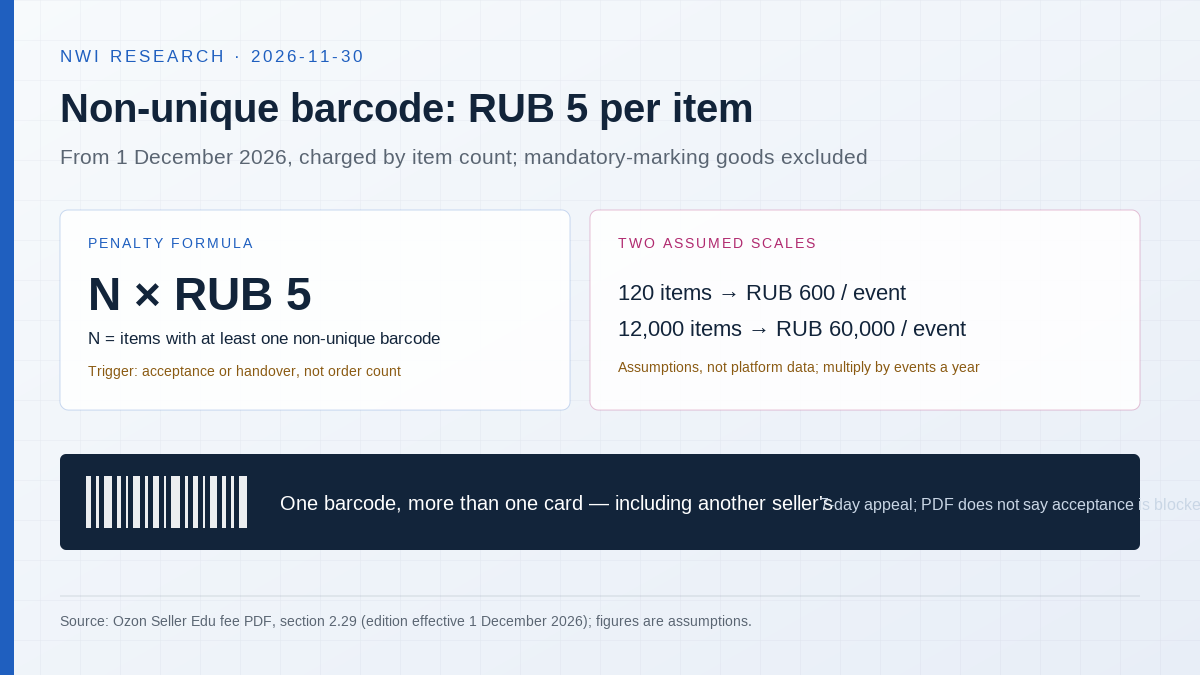
If you sell variants, multipacks or recycled barcodes on Ozon Russia, from 1 December 2026 Ozon will charge RUB 5 per item when a barcode on a product card is linked to more than one card, including another seller's card, at acceptance of a supply or handover of a shipment. The fine is small; the real decision is whether to audit every barcode now, fix only confirmed collisions, or accept the fine and appeal within seven days. This analysis separates the trigger, the cross-seller collision, the exception and the appeal window, and costs the audit-versus-fine trade-off in two scale scenarios and one exception case.
1. What the rule says: per item, not per order
Section 2.29 of Ozon Seller Edu's fee PDF, "Актуальные комиссии и тарифы для продавцов" (edition effective 1 December 2026, with additions through 30 October 2026), says that from 1 December 2026 a penalty applies if, at acceptance of a supply or handover of a shipment, an item in the seller's account has a barcode linked to several product cards on Ozon, including cards of other sellers.
The formula is the number of items with at least one non-unique barcode × RUB 5. Three limits matter: the unit is an item, not an order, a card or a SKU; the trigger is acceptance or handover, not listing review; and a barcode linked to more than one card triggers the rule even if one of those cards belongs to another seller.
The rule has two escape valves: goods subject to mandatory marking are excluded, and the seller can appeal within seven days of the violation notice by submitting evidence that the barcode is unique. The PDF does not list the evidence required for an appeal, and it does not say whether acceptance will be blocked. This article treats only the fine and the appeal window as confirmed; "may be blocked" is not written into the rule.
One detail is easy to miss: the PDF does not distinguish an Ozon back-office barcode, a manufacturer's GTIN and a logistics-label barcode. It says only that a barcode is linked to several cards. If Ozon compares back-office barcodes, the seller needs to check card bindings; if it compares manufacturer GTINs, multipacks, variants and different packaging are more likely to collide. Both possibilities are treated as open questions here.
2. How a barcode becomes non-unique
Four routes are common. First, copied cards: a barcode travels with a card copied from another seller or an old store. Second, historical reuse: a barcode is reassigned after cards are merged, closed or migrated. Third, variants and multipacks: child cards under one parent, or a single unit and a two-pack, may share one barcode. Fourth, other sellers: your barcode appears on another seller's card, or another seller's barcode appears on yours; the PDF explicitly includes "cards of other sellers".
The cross-seller route is the most underestimated. You do not control how another seller builds a card, and you may not see their barcode mapping; yet the fine is calculated on your item count. The PDF does not say whether the seller back office shows cross-seller collisions, or whether Ozon notifies before charging. What you can do is export your barcode list, group by barcode, clear internal duplicates first, and keep evidence for unexplained duplicates so you can appeal within seven days of a notice.
The mandatory-marking exception also needs a separate check. The PDF excludes goods subject to mandatory marking; it does not exclude every product with a manufacturer barcode. If the product falls within Russia's mandatory-marking scope, verify its marking status; do not apply the exception to an ordinary barcode.
3. Who should check now: four high-risk catalogues
First, variant-heavy catalogues. If one parent card has a dozen child cards, each child is a separate product card and they share a barcode, a single acceptance can cover a large amount of stock at RUB 5 per item.
Second, multipacks. If a single unit, a two-pack and a bundle share a barcode and are split into several cards, the collision risk is high. Conversely, if Ozon treats a multipack as a different sales unit on the same card, the PDF does not explain whether the fine applies.
Third, stores that have migrated or copied cards. Recycled historical barcodes are the most common hidden duplicate, and they often surface only at the first acceptance.
Fourth, high-frequency, high-volume suppliers. The fine is linear: 100 items = RUB 500, 1,000 = RUB 5,000, 10,000 = RUB 50,000. RUB 5 per item looks small until it is multiplied by the items in one acceptance.
Low risk is not zero risk: a store with one card, one SKU and one unique barcode can still be caught because another seller uses the same barcode. Run a full export once, then decide whether ongoing monitoring is worth it.
4. The math: when RUB 5 per item justifies an audit
Let N be the number of penalised items in one acceptance or handover, E the number of acceptance or handover events in a year in which the duplicate still exists, and the annual fine N × 5 × E. Audit cost = audit hours × hourly cost; re-labelling cost = new labels, packaging, labour and line-stop risk. A full audit before 1 December pays only if the avoided fine is greater than the audit plus re-labelling cost.
Scenario A: 120 items, 12 events a year, 3-hour audit. Assume the same duplicate barcode appears on all 120 items at every acceptance, 12 events a year, a 3-hour audit at RUB 1,500 an hour, and no re-labelling cost. Fine = 120 × 5 = RUB 600 per event; annual = 600 × 12 = RUB 7,200; audit = 3 × 1,500 = RUB 4,500; net saving = 7,200 − 4,500 = RUB 2,700. Confirm that the duplicate is real; if it is and the fix can be done in-house, the audit pays; if the audit finds no duplicate, RUB 4,500 is a one-off check, not a fine.
Scenario B: 12,000 items, 12 events a year, 20-hour audit. Assume the same duplicate barcode appears on all 12,000 items at every acceptance, 12 events a year, a 20-hour audit at RUB 1,500 an hour, and RUB 30,000 for re-labelling. Fine = 12,000 × 5 = RUB 60,000 per event; annual = 60,000 × 12 = RUB 720,000; audit + re-labelling = 20 × 1,500 + 30,000 = RUB 60,000; net saving = 720,000 − 60,000 = RUB 660,000. Fix the barcode with the highest item count first; if only one can be fixed, fix that one.
Scenario C: 5,000 mandatory-marking items, duplicate barcode, exception applies. Assume all 5,000 items are subject to mandatory marking and the exception applies literally. Fine = RUB 0; but if the same card also contains unmarked units, the PDF does not say whether the count is split by item. Check the marking status SKU by SKU; do not treat the mandatory-marking exception as a card-wide waiver; unmarked items still count at RUB 5 each.
The 12 events a year in the table are the Scenario A/B assumption, not Ozon or NWi data. The table shows that RUB 5 per item is not the decision unit; N × E is. For a small catalogue the fine may be below the audit cost; for a large catalogue it quickly exceeds the re-labelling cost. The original contribution here is the break-even test that puts the fine and the audit/re-labelling cost in the same equation, instead of stopping at RUB 5.
| Items per acceptance N | Fine per event (N × RUB 5) | 12 events a year (RUB) | What it means |
|---|---|---|---|
| 100 | 500 | 6,000 | Small catalogue; confirm the duplicate first |
| 1,000 | 5,000 | 60,000 | Mid-size; worth sampling |
| 10,000 | 50,000 | 600,000 | Large catalogue; re-barcode first |
| 100,000 | 500,000 | 6,000,000 | High-frequency bulk; fix before acceptance |
5. Audit and appeal: how to use the seven-day window
Step one: export product card, SKU, barcode, item count and marking status. The minimum fields are barcode, card ID, SKU, items per acceptance, mandatory-marking status, first seen and last seen.
Step two: group by barcode. Any barcode on more than one card is "to confirm"; then split it into four buckets: duplicates between your own cards, duplicates with another seller, variant/multipack duplicates, and archived-card duplicates. The bucket decides whether you can fix it yourself: your own duplicates can be merged or re-barcoded; cross-seller duplicates usually can only be appealed; variants and multipacks require the platform rule first; archived cards should be delisted or unbound first.
Step three: fix confirmed duplicates before the next acceptance. A barcode change changes the logistics label, so test on a small batch rather than re-labelling the whole warehouse; if the change would make FBS/FBO inbound labels inconsistent, confirm with the warehouse before acting.
Step four: appeal within seven days of the notice. The PDF asks for evidence that the barcode is unique but does not list the documents; useful material includes a manufacturer GTIN certificate, front and back packaging photos, card history and barcode allocation records. Do not fabricate evidence, and do not treat an appeal as guaranteed; seven days is a hard window, and a missed window leaves the notified amount in place.
Step five: set a monthly check. New cards, merged cards and new variants can create new duplicates; putting the barcode-to-card check into the new-item process is cheaper than firefighting after every acceptance.
6. The countercase: when paying the fine is cheaper
Countercase one: A SKU that is accepted only 20 times a year, once, at RUB 5 per item, faces a RUB 100 fine; if the audit takes three hours and re-labelling is required, the fix can cost more than RUB 100.
Countercase two: a cross-seller duplicate you cannot change. If the barcode is the manufacturer's GTIN, changing it can break packaging and customs documents; you can only appeal or switch the SKU. The PDF does not promise a successful appeal, and it does not say Ozon will notify first; preparing evidence inside the seven-day window is the only controllable action.
Countercase three: the operational risk of re-labelling is higher than the fine. FBS/FBO inbound labels, return addresses and warehouse systems are tied to the barcode; a warehouse-wide change can cause mis-shipments, missed shipments and inventory mismatches. Cost the line-stop and mis-shipment risk before deciding.
Countercase four: the mandatory-marking exception. If the product is within the mandatory-marking scope, the PDF says it is excluded; but mandatory marking is a product attribute, not a store attribute. Do not treat the whole card as exempt; check each SKU, because unmarked items may still be counted.
One more evidence boundary: the PDF describes a fine, not an acceptance block. If your acceptance is refused, do not use this article's fine rule as the reason; that is a separate operational issue to confirm with Ozon.
7. Action plan and stop conditions
Before 1 December: export the full barcode list; rank by item count and check the top 20% of SKUs; fix confirmed duplicates; build an evidence pack for cross-seller collisions; add the barcode-to-card check to the new-item process.
After 1 December: watch the first acceptance or handover notice; recompute the notified amount against your own N × 5; if the amount does not match, appeal within seven days; if two consecutive notices point to the same cross-seller barcode you cannot change, consider re-barcoding or delisting the SKU.
Stop conditions: if the annual fine is below the audit plus re-labelling cost and has not interrupted acceptance or shipping, accept the fine and monitor only high-volume SKUs; if the fine is above the cost, or the same duplicate keeps appearing, stop accepting it and move to re-barcoding, appeal or delisting. Do not ignore the item count because RUB 5 looks small, and do not re-label the whole warehouse because acceptance "may" be blocked.
Next step: use NWi CrossborderGo's Ozon Russia data (sales, units, ASP and brand share, monthly, by contract) to decide which SKUs and categories deserve the first audit; use NWi Operations to connect the barcode check with new-item and inventory workflows. NWi CrossborderGo does not provide barcode-level inventory, acceptance results or penalty notices; this article did not access the Ozon back office.
8. Sources and method
Data basis: section 2.29 of Ozon Seller Edu's fee PDF, "Актуальные комиссии и тарифы для продавцов" (edition effective 1 December 2026, with additions through 30 October 2026). The PDF was downloaded on 30 November 2026 and its text was extracted with pdftotext. The Russian sentence and the English translation were checked side by side; the RUB 5 per item, the mandatory-marking exception and the seven-day appeal window come from that section. The Ozon Seller Edu HTML entry point returned a 307 redirect in this environment, so the PDF is the authoritative text. The N, E, audit hours, hourly cost and re-labelling cost in the scenarios are assumptions, not measurements by Ozon, NWi or any seller; every multiplication is shown. NWi CrossborderGo's Ozon coverage is Russia, monthly, with sales, units, ASP and brand share, enabled by contract; it does not provide barcode-level inventory, acceptance results, penalty notices or appeal outcomes. This article did not access Ozon Seller Centre, a seller back office, or any penalty notice.
Disclosure: this article was prepared with automated research assistance from the public Ozon fee PDF listed below and was not manually reviewed; it does not invent customer data, expert review, penalty notices, appeal outcomes or ranking effects. It is not legal, tax, platform-operations or financial advice; the applicable rule, exceptions, appeal evidence and charges should be confirmed against Ozon Seller Centre's latest fee file, notices and actual invoices.
- cdn1.ozonusercontent.com/s3/kms-files-pr... — Ozon Seller Edu, "Актуальные комиссии и тарифы для продавцов", edition effective 1 December 2026 (additions through 30 October 2026), section 2.29; read 30 November 2026.
- seller-edu.ozon.ru/libra/commissio... — Ozon Seller Edu fee-page entry point; returned a 307 redirect in this environment, so the PDF was used for the text.